Ahu Akivi
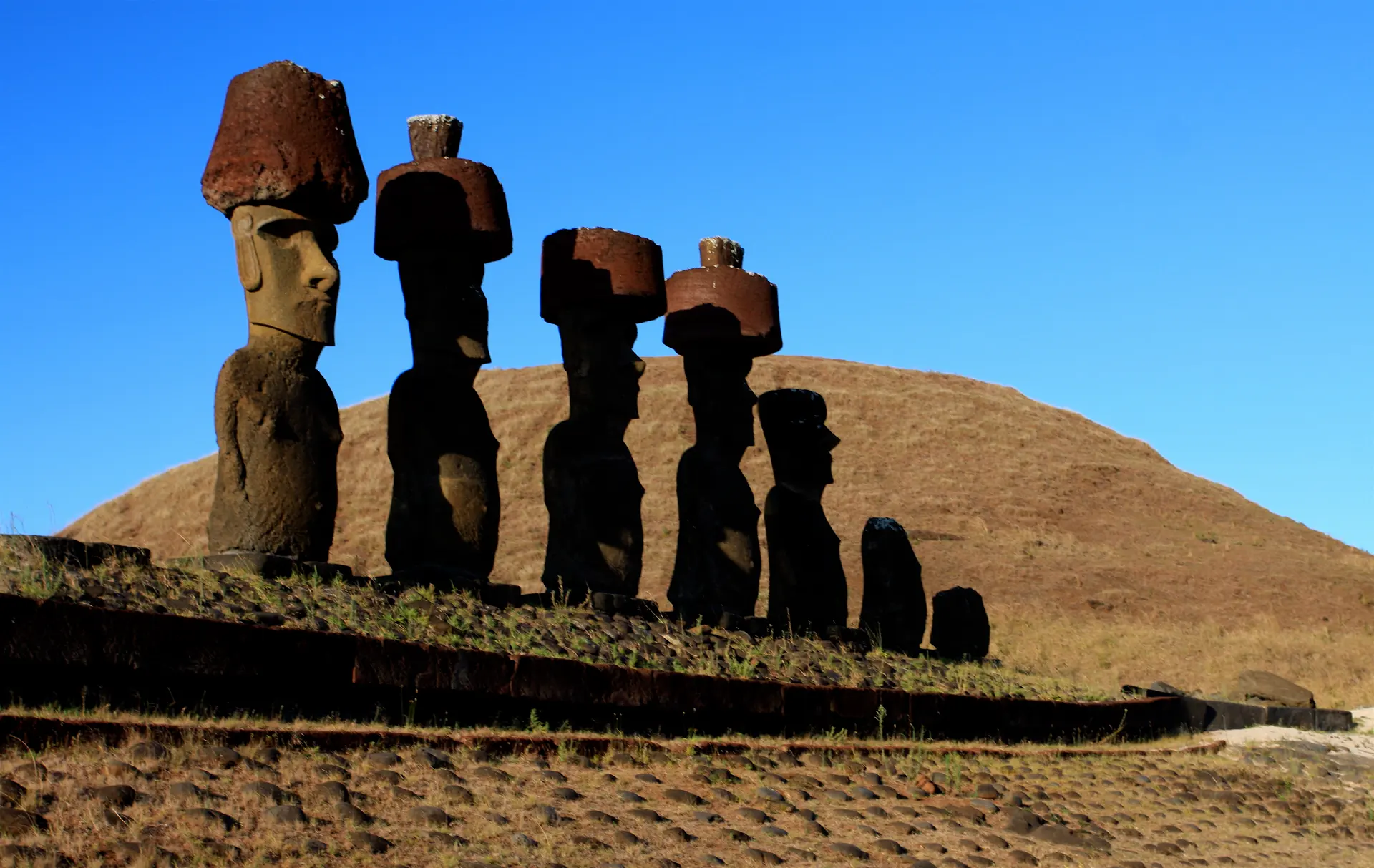
Seven identical moai, inland, facing the sea toward home
Understand sacred places, explore living traditions, and learn how to engage respectfully with Pilgrim Map.
Access has not been verified. Check current local guidance before planning a visit.
Hanga Roa interior, Rapa Nui, Valparaíso Region, Valparaíso, Chile
Read the sources
Visit essentials
A quick read before you go
- Duration
- Typically visited for 20-40 minutes as part of a half-day or full-day guided tour of the…
- Access
- Located about 10 km north of Hanga Roa, roughly 15-20 minutes by car.
Overview
Ahu Akivi is unusual on Rapa Nui: an inland ahu on grassland below Maunga Terevaka, with seven moai facing the sea rather than the community they watch over. Rapa Nui oral tradition identifies the identical figures—uniform in height and without status-marking pukao—as the seven explorers Hotu Matu'a sent ahead after his priest Haumaka dreamed of their future island home.
In 1960-61, American archaeologist William Mulloy and Chilean archaeologist Gonzalo Figueroa García-Huidobro worked with twenty-five Rapa Nui laborers on the island's first complete ahu restoration, a milestone for later conservation. Construction remains unresolved, approximately mid-1400s to early 1600s. Tourism materials also describe the moai as an ancient observatory aligned precisely with the equinox sunset; the perspectives below examine why the evidence is more modest and more interesting.
Why this place is sacred
The seven moai at Ahu Akivi carry a story more specific than most ahu on the island offer: not generic ancestors, but named participants in the founding voyage itself. According to Rapa Nui oral tradition, Haumaka, adviser to the first king Hotu Matu'a, experienced a dream-vision in which his spirit crossed the ocean and saw the island that would become Rapa Nui.
Hotu Matu'a sent seven young men ahead to confirm the island and prepare for the main settling party's arrival. The moai here, uniform and unadorned with the pukao seen on higher-status figures elsewhere, are popularly identified with those seven scouts, looking out — according to tradition — toward the sea they crossed, or toward the homeland, sometimes named Hiva, they left behind.
Some sources note this 'legend remembered in stone' reading sits awkwardly against the platform's construction chronology, a tension this content does not attempt to resolve. Layered onto the origin story is a second, more technical thread: the platform's axis runs close to the equinoctial line, and Ahu Akivi is the most-discussed example within a wider body of research, chiefly William Liller's 1989 survey, proposing that roughly twenty Rapa Nui ahu show orientations clustering near solstice or equinox solar positions.
That research is real and peer-reviewed, not an invention of tour marketing — but it was substantial enough to prompt a formal 2004 reassessment by Edwards and Belmonte, a title that alone signals the field did not treat Liller's original claims as beyond question.
The honest position held here is that Ahu Akivi's builders probably oriented the platform with some intentional relationship to the equinox sun, plausible for calendrical reasons — but the popular image of a laser-precise 'ancient observatory' overstates what the accessible literature actually supports.
The platform was built as an ancestral ceremonial ahu, its seven identical moai raised to embody, according to Rapa Nui tradition, the seven explorers sent ahead of Hotu Matu'a's colonizing voyage; the platform's axis appears to carry an additional, still-debated relationship to the equinox sun.
The seven moai fell during the same general period of internal upheaval that toppled ceremonial platforms across the island. Ahu Akivi's restoration in 1960-61, led by William Mulloy and Gonzalo Figueroa García-Huidobro, was the first complete re-erection of any ahu on Rapa Nui, a technical and symbolic milestone that shaped how later restorations, including at Tahai and Ahu Nau Nau, were approached.
The site now falls under the conservation stewardship of Ma'u Henua, the indigenous community managing Rapa Nui National Park since 2017-18.
Experience and orientation
The drive inland to Ahu Akivi trades the wind and salt of the coast for open grassland and the long slope of Maunga Terevaka rising behind it — a different register entirely from the busier southern and coastal circuit. Arriving, the first thing to register is the uniformity: seven moai, identical in height, none crowned with a pukao, standing in a single even row.
Where other Rapa Nui platforms draw attention through variation — one statue more weathered than its neighbor, one taller, one missing its head — Ahu Akivi's power comes from repetition. Walk the row slowly and let that sameness register; it is the visual argument for reading these seven as a single unit, a delegation rather than a gathering of separate ancestors.
Stand behind the platform and look past the moai toward the sea in the distance — a genuinely unusual sightline on an island where most moai have their backs to the ocean. Whether or not you hold the equinox-alignment claim loosely (and the research below suggests you should), the plain fact of moai facing seaward from an inland platform is itself worth pausing over: something about this arrangement was deliberate, even if its full intention is not fully recoverable now.
Visitors consistently describe the site as calmer and less trafficked than the coastal circuit, and that relative solitude suits the seven-explorers story well — a small party, sent ahead, still watching.
Ahu Akivi lies about 10 kilometers north of Hanga Roa, roughly 15-20 minutes by car, reached by paved or graded road through the island's pastoral interior. A short, flat walk from the parking area brings visitors to the platform itself.
Context and lineage
According to Rapa Nui oral tradition, Hotu Matu'a's priest and adviser Haumaka experienced a dream-vision in which his spirit crossed the ocean and saw the island that would become Rapa Nui. Hotu Matu'a subsequently sent seven young explorers ahead of the main colonizing voyage to confirm the island and prepare for the arrival of the king and his people.
The seven uniform moai at Ahu Akivi, lacking the pukao markers of status seen on many other moai, are popularly identified with these seven scouts, looking toward the sea they crossed or the homeland tradition sometimes names as Hiva. Some sources note this reading is difficult to reconcile precisely with the platform's construction chronology, a tension not resolved in available research.
Ahu Akivi belongs to the island-wide ahu-moai ancestral tradition, distinguished within it by its inland siting and sea-facing orientation; its 1960-61 restoration established the technical template for later work at other Rapa Nui platforms.
Haumaka
Priest and adviser to Hotu Matu'a
According to tradition, Haumaka's dream-vision of a distant island prompted Hotu Matu'a to send seven scouts ahead of the main settling voyage, the explorers popularly identified with Ahu Akivi's seven moai.
William Mulloy
American archaeologist, co-restorer
Co-led the 1960-61 restoration of Ahu Akivi with Gonzalo Figueroa García-Huidobro, the first complete re-erection of a fallen ahu anywhere on Rapa Nui, working with a team of twenty-five Rapa Nui laborers.
Gonzalo Figueroa García-Huidobro
Chilean archaeologist, co-restorer
Co-led the 1960-61 restoration of Ahu Akivi alongside William Mulloy, contributing to the island's first complete ahu restoration project.
William Liller
Archaeoastronomer
Conducted a 1989 survey proposing that roughly twenty Rapa Nui ahu, including Akivi, show orientations clustering near solstice or equinox solar positions, a finding later revisited by Edwards and Belmonte in a 2004 reassessment.
Traditions and practice
Specific historical ceremonial practices once conducted at Ahu Akivi are not well documented in available sources; broader Rapa Nui ahu practice included ancestor commemoration and, in some cases, burial. No source describes a distinct ritual calendar tied to the site's equinox orientation beyond the hypothesized agricultural-timing function proposed in archaeoastronomical literature.
No evidence of regular contemporary ceremonial or devotional practice at this specific site has been found; it functions today as a protected archaeological and heritage site within Rapa Nui National Park.
Walk the full row of moai at eye level before stepping back for the wider view — the uniformity that makes this platform distinctive is easiest to feel up close, where the identical carving of each figure becomes apparent.
If visiting near the equinox, treat the sunset alignment as a pleasant possibility rather than a guaranteed spectacle, and spend the time instead noticing the platform's genuinely unusual sea-facing orientation, which holds regardless of the exact solar geometry on a given evening. Consider a visit timed for quiet hours rather than the peak sunset crowd, since the inland pastoral setting rewards the kind of stillness that heavier tour traffic can crowd out.
Rapa Nui ancestral/moai veneration
HistoricalMoai across Rapa Nui, including the seven at Ahu Akivi, are traditionally understood as representations of important ancestors or, in this specific case, of legendary explorer-founders, believed to embody mana protecting or watching over the community and land.
Historically, ahu served as ceremonial and burial platforms where communities honored ancestors; the specific rituals once conducted at Ahu Akivi are not well documented, and no evidence of a continuous unbroken practice into the present has been found.
Legend of the seven explorers of Hotu Matu'a
HistoricalOral tradition holds that Hotu Matu'a's priest Haumaka had a dream-vision of Rapa Nui and that seven scouts were sent ahead of the main settling voyage; the seven identical, uncrowned moai at Ahu Akivi are popularly identified with these explorers.
Told as founding-migration oral history; not associated with an ongoing ritual observance at the site itself in the sources reviewed.
Solar and calendrical orientation research (archaeoastronomy)
ActiveA body of archaeoastronomical research argues that Ahu Akivi is part of a wider pattern of roughly twenty Rapa Nui ahu with orientations clustering near solstice or equinox solar azimuths, potentially reflecting a functional interest in marking agricultural seasons; Ahu Akivi is the most-discussed example of this pattern.
Ongoing academic study and reassessment, including the 2004 revisiting of Liller's original claims by Edwards and Belmonte, represents an active scholarly tradition distinct from any ancient ritual practice.
Perspectives and open questions
Ahu Akivi is read through the seven-explorers origin narrative, a real but contested body of archaeoastronomical research on its solar orientation, and a popularized 'ancient observatory' framing that overstates what the scholarly literature actually establishes — three related but distinct claims worth holding separately.
Scholarly perspective
Mainstream archaeology credits the seven Ahu Akivi moai to Rapa Nui builders working sometime in the 15th to 17th centuries, exact dating disputed, restored to standing position in 1960-61 by William Mulloy and Gonzalo Figueroa in the first complete platform restoration on the island.
On the astronomical question specifically: a real body of archaeoastronomical scholarship exists, most notably William Liller's 1989 survey proposing that roughly twenty Rapa Nui ahu, including Akivi, show orientations clustering near solstice or equinox solar azimuths — a legitimate, studied research question rather than a pure invention of tourism marketing.
However, Liller's claims were explicitly revisited in a formal 2004 reassessment by Edwards and Belmonte, signaling that subsequent specialists considered the precision and interpretive weight of the original claims worth re-examining; the reassessment's specific numeric conclusions could not be verified in this research due to source access limits.
Separately, a NASA public-science page states plainly that Rapa Nui oral history 'does not indicate a deep interest in astronomical knowledge' and notes the near-tautological point that, from an inland platform, most sightlines point toward the ocean somewhere.
The balanced picture: Ahu Akivi's axis probably carries some intentional relationship to the equinox sun, plausible for agricultural or calendrical reasons, but the popular description of it as a functioning 'astronomical observatory' with laser precision is a simplification not fully supported by the accessible literature, which treats the phenomenon as studied and debated rather than a settled, instrument-grade finding.
Living and traditional perspectives
Rapa Nui oral tradition identifies the seven moai with the seven explorers sent by Hotu Matu'a following Haumaka's dream-vision, positioned to look toward the sea — read by tradition as facing the direction of arrival or homeland rather than as an astronomical device.
Ma'u Henua, the indigenous community managing Rapa Nui National Park since 2017-18, publishes this legend along with a brief mention of the equinox alignment on its official visitor page, but no extended Ma'u Henua statement specifically articulating the site's deeper contemporary spiritual or cultural meaning to the Rapanui community was found beyond this short recap embedded in visitor-facing material — a gap consistent with the pattern found across other Rapa Nui sites, and one this content discloses rather than fills with invented perspective.
Alternative interpretations
Popular travel and new-age-adjacent sources frequently describe Ahu Akivi as an 'ancient celestial observatory' with 'astronomically precise' alignment, sometimes extending the claim to lunar alignment as well as solar equinox alignment, and framing the ancient Rapanui as possessing advanced astronomical knowledge.
These claims are not clearly traceable to a specific peer-reviewed measurement in the sources located during this research and should be treated as popularized amplification of a more modest and contested scholarly orientation finding, distinct from and less reliable than the archaeoastronomical research discussed in perspectives.scholarly.
Open questions
Open questions include the precise construction date and sequence of the platform versus the erection of the seven moai; whether the orientation toward the equinox sunset was a deliberate design goal of the original builders or a byproduct of siting the ahu perpendicular to the coastline or village axis; what functional, agricultural, or calendrical use was actually made of the alignment, given the absence of corroborating oral-historical or written record explicitly describing such use; and the specific degree of angular precision measured by Liller and subsequently reassessed by Edwards and Belmonte, which could not be directly verified in this research due to source access limitations.
Plan your visit
Access and arrival
Located about 10 km north of Hanga Roa, roughly 15-20 minutes by car. Requires a Rapa Nui National Park entrance ticket and, per current Ma'u Henua rules, accompaniment by an accredited guide or authorized Rapa Nui host; reachable by rental car, organized tour, or bicycle on paved or graded roads.
No specific accommodation information was located for this site in available sources; visitors typically stay in Hanga Roa and reach Ahu Akivi by rental car, bicycle, or organized tour.
Respectful visit
No specific dress code is documented beyond general practical outdoor wear suited to sun and wind exposure; no religious dress requirement has been found.
Photography is generally permitted for personal use; no site-specific restriction has been found beyond general park rules against climbing on or touching structures to get photos.
No documented tradition of leaving offerings at Ahu Akivi has been found in available sources.
Do not touch, climb on, or lean against the ahu platform or the moai. Do not remove or collect stones or any archaeological material. Stay on marked trails and paths; do not enter environmental recovery or restricted zones. Violations can result in fines or jail time under Chilean Law 17,288 on National Monuments. Entry requires a valid park ticket, and current policy requires accompaniment by an accredited guide or authorized Rapa Nui host for many park sites.
Hold the 'ancient observatory' framing loosely — described further in perspectives.scholarly below, the astronomical alignment claim is a real but only approximately precise and actively debated research finding, not a settled instrument-grade fact, and NASA's own public-education material explicitly declines to call the site an observatory.
Location
Map loads as you approach this section.
Pilgrim reflections
A portrait of encounter, not a score
Pilgrims describe what they felt, how present they could become, and whether the place would shape a journey. There are no stars and no ranking of traditions.
No reviewed reflections yet
The first pilgrims can help describe the character of being here.
Share a reflection
Available after an account-backed “Been there.” Every reflection is reviewed before publication.
Nearby sacred places
Explore other sacred places in the region. Proximity does not establish access or travel time; check each place’s guidance.

Easter Island
Easter Island, Valparaíso, Chile
6.3 km away

Tahai Ceremonial Complex
Hanga Roa, Rapa Nui, Valparaíso Region, Valparaíso, Chile
7.3 km away

Vinapu Ceremonial Complex
Hanga Roa, Rapa Nui, Valparaíso Region, Valparaíso, Chile
9.5 km away
Ahu Nau Nau
Anakena, Rapa Nui, Valparaíso Region, Valparaíso, Chile
9.8 km away
References
Sources consulted for this page. Source categories describe the publication, not a guarantee that every claim is verified. Traditional accounts and outside interpretations may differ.
- 01William Mulloy — In Memoriam — Easter Island FoundationacademicBiographical source on Mulloy, the US archaeologist (with Univ. of Wyoming) who directed the 1960 Ahu Akivi restoration; useful for verifying his institutional background and the scope of his broader Rapa Nui restoration work (1955-1978).
- 02The Megalithic Astronomy of Easter Island: Orientations of Ahu and Moai — William LilleracademicPrimary academic archaeoastronomy source proposing that roughly 20 ahu on Rapa Nui, including Ahu Akivi, show intentional solar orientation. Full text was paywalled; findings cited here via secondary summaries only — could not directly verify claimed precision in degrees.
- 03Megalithic Astronomy of Easter Island: A Reassessment — Edmundo R. Edwards and Juan Antonio Belmonteacademic2004 Journal for the History of Astronomy paper explicitly revisiting/reassessing Liller's earlier (1989/1993) astronomical claims about Rapa Nui ahu orientations, including Ahu Akivi. Full text inaccessible (PDF/paywall); the existence and title of a formal 'reassessment' is itself evidence that Liller's original claims were not treated by the field as beyond dispute.
- 04Rapa Nui National Park — UNESCO World Heritage Centre — UNESCOofficialConfirms Rapa Nui National Park's 1995 inscription as a UNESCO World Heritage Site under cultural criteria (i), (iii), (v); Ahu Akivi is one of the sites within the inscribed park.
- 05Visit Āhu Akivi — Ma'u Henua / Rapa Nui National ParkofficialOfficial park page (managed by the indigenous Ma'u Henua community since 2017). Direct fetch failed (DNS/404 in this session) but content was corroborated via search snippet: gives brief factual/legend framing (seven explorers sent by Hotu Matu'a, equinox alignment noted for agricultural timing) plus visitor logistics. This is the closest thing to a Ma'u Henua statement found, but it is short, generic tourist-facing copy rather than an extended cultural/spiritual interpretive statement — see sensitivity notes.
- 06Ahu Akivi — Wikipedia — Wikipedia contributorsacademicGeneral overview; cites Kirch (1986), Peregrine & Ember (2001), Flenley & Bahn (2003) but does not itself provide methodological detail on the equinox-alignment measurements or acknowledge scholarly debate about precision.
- 07Ancient Observatories — Easter Island (Sun-Earth Day archive) — NASA Goddard Space Flight CenterofficialUS government science-outreach page. Notably declines to label Ahu Akivi an 'observatory,' notes Rapa Nui oral history does not indicate deep astronomical interest, and observes that from an interior location nearly all sightlines point toward the ocean — a useful counterweight to popularized claims, though itself a popular-outreach page rather than peer-reviewed.
- 08AHU AKIVI - The seven explorers — Imagina Rapa NuiSource contextLocal Rapa Nui-based tourism/culture site; recounts the seven-explorers legend in detail and explicitly flags the debate over whether the 'legend remembered in stone' interpretation can be literally true given construction-phase dating, and separately raises the question of whether the moai truly 'look at the sea' versus an interior equinoctial axis.
- 09Ahu Akivi: Easter Island's Seven Moai Facing the Sea — moeVarua Rapa NuiSource contextLocal tourism/culture publisher; repeats the 'astronomically precise' / 'celestial observatory' framing without citing primary measurements — representative of the popularized narrative this research was asked to scrutinize.
- 10The Impact of Archaeoastronomy in Rapa Nui — moeVarua Rapa NuiSource contextDiscusses Rapa Nui archaeoastronomy more broadly, describing Ahu Akivi as 'the most studied astronomical alignment on Rapa Nui' and citing the ~20-ahu solar-orientation pattern; secondary-source level, not primary data.
- 11Ahu Akivi - the only moai statues facing ocean — Easter Island Travel (Beyond the Moai)Source contextEstablished Easter Island tourism operator/blog; corroborates restoration dates, legend, and visitor logistics. Restates the observatory/equinox claim without primary sourcing.
- 12Ahu Akivi — GoChileSource contextChilean tour operator content; used only for corroborating basic visitor/access facts, not for evaluative claims.
Share a photo
Help visitors recognize Ahu Akivi. Every submission is reviewed before publication.