Ahu Tongariki
Fifteen ancestors, toppled twice, standing again by sunrise
Understand sacred places, explore living traditions, and learn how to engage respectfully with Pilgrim Map.
Access has not been verified. Check current local guidance before planning a visit.
Hanga Nui, Rapa Nui, Valparaíso Region, Valparaíso, Chile
Read the sources
Visit essentials
A quick read before you go
- Duration
- Most visits, including a sunrise stop, run roughly 45 minutes to just over an hour at the ahu…
- Access
- Located in the bay of Hanga Nui on the southeastern coast of Rapa Nui, about 18 km from Hanga…
Overview
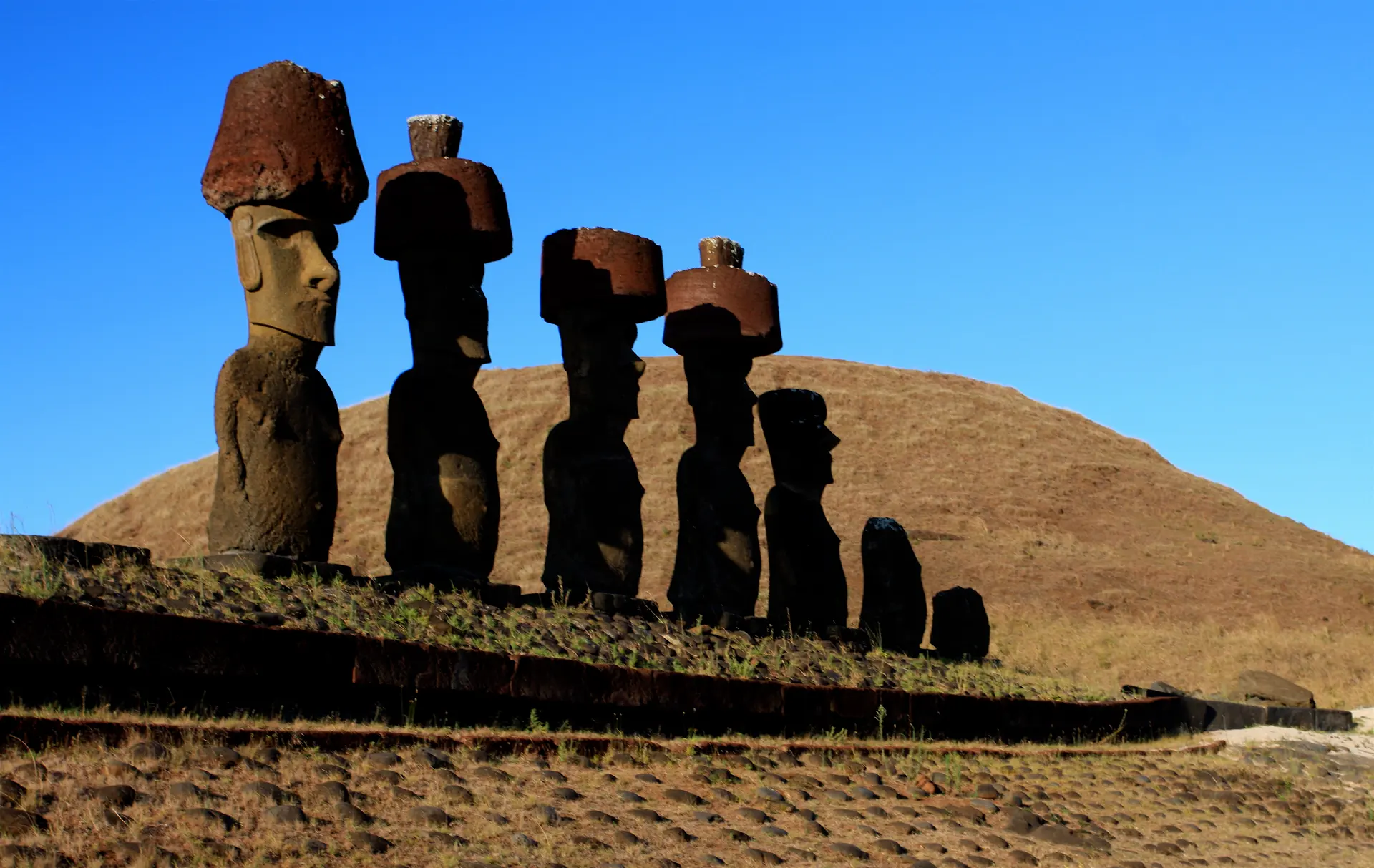
Ahu Tongariki is Rapa Nui's largest ceremonial platform and its most photographed, particularly at sunrise, when the fifteen standing moai silhouette against the sky over Hanga Nui bay. That scale is not the whole story. Across more than seven hundred years and multiple construction phases, the platform grew, was rebuilt, and at its historical peak may have held as many as thirty moai — versus the fifteen visible today, all belonging to the final major building phase.
The statues were toppled during a period of internal Rapanui conflict that predated European contact; the 1960 magnitude-9.5 earthquake off Chile then sent a tsunami that swept the fallen stones roughly 500 meters inland.
What stands today is the result of a 1992-1996 restoration led by Chilean archaeologists Claudio Cristino and Patricia Vargas Casanova, conducted under a Chile-Japan agreement using a crane donated by the manufacturer Tadano — an international collaboration that UNESCO's own assessment treats as staying within accepted conservation limits, even as the island's broader, ongoing negotiation over who controls Rapanui heritage remains a separate, live question.
Why this place is sacred
What made this platform sacred was function, not scenery: Ahu Tongariki served as the religious, social, and political capital of the Hotu-iti confederation, the eastern grouping of Rapa Nui clans, and its moai were understood as active vessels of ancestral power rather than monuments to the dead.
Tradition holds that fitting a moai with coral-and-obsidian eyes activated its capacity to radiate mana over its lineage's land and people — a ceremonial 'waking' of the ancestor figure rather than a purely decorative finishing touch. The statues face inland, backs to the ocean, a directional logic that reads as protective rather than contemplative: they watch over the community, not the horizon.
No specific founding narrative for Ahu Tongariki itself, as distinct from general moai and ahu cosmology, was identified in available sources — a real gap, and one this file names rather than fills with invented specificity.
Ahu Tongariki functioned as a ceremonial, political, and funerary center for the Hotu-iti confederation, hosting gatherings, funerary rites, clan assemblies, initiations, and harvest ceremonies. Its moai, understood as the living faces of deified ancestors, were fitted with coral-and-obsidian eyes as part of a ceremonial activation believed to channel mana toward the living community.
The site is believed to be among the earliest ahu built on Rapa Nui, with first occupation of the surrounding area dated to roughly 900 CE, expanded and rebuilt across more than seven hundred years, with older, rougher-style moai reused as structural infill in later phases. The moai were deliberately toppled during a period of internal conflict predating European contact, part of an island-wide collapse of the ahu-moai religious complex. The 1960 tsunami further scattered the already-fallen stones.
A 1992-1996 restoration, led by Cristino and Vargas Casanova under a Chile-Japan agreement, re-erected the fifteen moai visible today using a Tadano-donated crane; UNESCO's assessment treats this intervention as remaining within permissible anastylosis limits.
Experience and orientation
Arriving before dawn means joining a crowd that has grown considerably in recent years, timing shifting seasonally from roughly 6:30 a.m. in the austral summer to about 7:30 a.m. in winter — arriving thirty to forty-five minutes early is commonly recommended just to secure a clear sightline.
What the wait rewards is the fifteen moai resolving from silhouette into full visibility as the sky lightens behind them, a hundred meters of platform holding statues up to eighty-six tonnes, the heaviest ever re-erected on the island.
The site's dramatic clifftop setting at Hanga Nui, facing directly into the Pacific the moai's backs are turned against, gives the scale an added charge: this is not a sheltered inland shrine but a monument built to face down the ocean on the community's behalf. Knowing the history — toppled in conflict, buried by tsunami, restored by international effort — changes what the stillness communicates; visitors consistently report the encounter as sobering rather than simply impressive.
The ahu sits at Hanga Nui bay on the island's southeastern coast, its roughly hundred-meter platform holding the fifteen standing moai from the final construction phase. Most visits, including a sunrise stop, run forty-five minutes to just over an hour, often combined with a same-day visit to the nearby Rano Raraku quarry where the statues were carved.
Context and lineage
Rapanui tradition holds the moai to be the aringa ora, the living faces of ancestor-gods; giving a moai coral-and-obsidian eyes was believed to activate its capacity to radiate protective mana over its lineage's land and people. No origin narrative specific to Ahu Tongariki, as distinct from general moai and ahu cosmology, was identified in available sources.
The ahu was built and rebuilt across generations by the Hotu-iti confederation, the eastern grouping of Rapa Nui clans. Its modern custodianship runs through the Chilean state (via CONAF) until 2017, and since then through Ma'u Henua, the Indigenous Rapanui community organization that assumed full park administration following a 2015 community consultation in which 86.6 percent supported the transition.
Claudio Cristino
Lead restoring archaeologist
Led the 1992-1996 restoration of Ahu Tongariki alongside Patricia Vargas Casanova, working with the Chilean government, the University of Chile, and Tadano.
Patricia Vargas Casanova
Co-lead restoring archaeologist
Co-led the restoration effort that re-erected the fifteen moai visible at the site today.
Sergio Rapu
Catalyst for restoration
A 1988 television interview remark about the need for a crane to re-erect the fallen moai is credited as the origin point for the process that led to the 1992 Chile-Japan Moai Restoration Committee agreement.
William Mulloy
Island-wide restoration pioneer
Restored Ahu Akivi, Tahai, Orongo, and Hanga Kio'e between 1955 and 1978, establishing the restoration methodology later applied at Tongariki, though no direct evidence confirms his personal involvement at Tongariki specifically, which was restored well after his 1978 death.
Traditions and practice
Historically, the ahu hosted funerary rites, clan assemblies, initiations, and harvest ceremonies for the Hotu-iti confederation. Obsidian-and-coral eyes were reportedly fitted to moai for ceremonies understood as waking the ancestor figure to actively channel mana. This tradition declined amid the island's seventeenth-to-nineteenth-century societal upheaval, when nearly all standing moai across Rapa Nui were deliberately toppled during internal conflict, well before the 1960 tsunami that further scattered Tongariki's fallen statues.
No active ceremonial practice is documented at the site today; it functions as a protected archaeological monument managed for conservation and tourism by Ma'u Henua. This is distinct from the site's genuinely living context: Rapanui claims to self-determination over ancestral heritage remain an active, unresolved conversation island-wide, most visibly in unresolved repatriation disputes elsewhere, such as the moai Hoa Hakananai'a held by the British Museum.
Arrive early enough to watch the moai resolve out of darkness rather than treating sunrise as a fixed photograph to capture and leave — the site rewards the patience of the wait as much as the moment itself. Let the platform's history of destruction and restoration inform how you read its present stillness: this is not an undisturbed ancient scene but a deliberately, painstakingly reassembled one.
Rapanui ancestor veneration (moai/ahu religious complex)
HistoricalAhu Tongariki was the ceremonial, political, and social capital of the Hotu-iti clan confederation, and the largest such platform ever built on the island. Its moai were understood as the living faces of deified ancestors, positioned with their backs to the sea to project mana inland over the community.
Gatherings, funerary rites, assemblies, initiations, and harvest ceremonies at the ahu; ceremonial fitting of obsidian-and-coral eyes to 'wake' moai and channel mana. The tradition declined amid societal upheaval predating the 1960 tsunami.
Ma'u Henua indigenous heritage stewardship
ActiveSince 2017-2018, Ahu Tongariki has been managed by Ma'u Henua, the Rapanui indigenous community organization, following a community vote favoring self-determination over ancestral heritage management.
Park entry ticketing, mandatory accredited guides, conservation enforcement, and authorization of research and commercial activity at the site.
International conservation and archaeological restoration
ActiveThe 1992-1996 restoration, a Chile-Japan collaboration using donated Tadano equipment, re-erected the fifteen moai standing today and is treated by UNESCO as staying within permissible conservation limits.
Ongoing site conservation and archaeological documentation under the World Heritage framework.
Perspectives and open questions
Archaeological consensus on the restoration's technical legitimacy sits alongside, but should not be mistaken for, a separate and still-live conversation about Rapanui self-determination over ancestral heritage more broadly.
Scholarly perspective
Archaeologists agree Ahu Tongariki was the largest ceremonial platform on Rapa Nui, built and rebuilt across multiple phases over centuries, that its moai were toppled during a period of internal Rapanui conflict predating European contact, and that the 1960 tsunami further devastated the already-fallen site, sweeping it roughly 500 meters inland.
The 1992-1996 restoration led by Cristino and Vargas Casanova, conducted under an official Chile-Japan agreement using a Tadano-donated crane, is treated by UNESCO's own assessment as staying within accepted anastylosis and conservation limits, preserving the site's authenticity for World Heritage purposes.
Living and traditional perspectives
Rapanui tradition frames the moai as living embodiments of deified ancestors whose mana protected their descendant community, with the ahu functioning as that community's religious, social, and political heart. Contemporary Rapanui governance perspective, expressed through the 2015-2018 transition that created Ma'u Henua — backed by 86.6 percent community support in a 2015 consultation — frames stewardship of sites like Tongariki as an act of recovering ancestral authority over Rapanui heritage.
No Ma'u Henua statement addressing the ethics of the 1990s restoration specifically, as distinct from the broader question of who controls the island's heritage today, was located in available sources — a gap worth stating rather than filling with an invented position.
Alternative interpretations
No significant alternative or esoteric interpretive tradition specific to Ahu Tongariki was identified, beyond the broader popular-culture fascination with moai transport methods and construction feats that features widely in Easter Island discourse generally.
Open questions
Open questions include the precise original number of moai erected at Tongariki across its full construction history, commonly cited as up to thirty versus the fifteen standing in its final phase, how many statues were lost to the sea versus recovered as fill within the platform, and the exact role, if any, William Mulloy's broader island-wide restoration planning played in laying groundwork for the later Tongariki project, given that he died in 1978, over a decade before the Chile-Japan restoration agreement was signed.
Plan your visit
Access and arrival
Located in the bay of Hanga Nui on the southeastern coast of Rapa Nui, about 18 km from Hanga Roa, reachable by road as part of a guided tour circuit. An entry ticket, roughly USD 80, valid 10 days from first use, and since the park's August 2022 post-pandemic reopening, an accredited Ma'u Henua guide, are required for most archaeological sectors.
No specific on-site accommodations exist given the site's protected status; nearly all visitors base in Hanga Roa, the island's only town, and visit for a dawn excursion combined with other park sites.
Respectful visit
No specific dress code is documented beyond general practicality; layered clothing is recommended given variable coastal weather, especially for pre-dawn sunrise visits.
Personal photography is permitted, and the site is a major sunrise photography destination; commercial photography or filming requires prior authorization from the Ma'u Henua Community.
No documented tradition of visitor offerings at this site.
Visitors must remain on marked trails, may not touch, climb, or lean on the moai or ahu platform, and may not collect stones or archaeological material. A valid Rapa Nui National Park ticket must be carried for spot checks. Drones, camping, open fires, smoking, and alcohol are prohibited throughout the park.
No visitor participation in ceremony is offered or appropriate; visitors observe from designated paths and viewing areas and may not touch, climb, or otherwise interact with the ahu or moai.
Location
Map loads as you approach this section.
Pilgrim reflections
A portrait of encounter, not a score
Pilgrims describe what they felt, how present they could become, and whether the place would shape a journey. There are no stars and no ranking of traditions.
No reviewed reflections yet
The first pilgrims can help describe the character of being here.
Share a reflection
Available after an account-backed “Been there.” Every reflection is reviewed before publication.
Nearby sacred places
Explore other sacred places in the region. Proximity does not establish access or travel time; check each place’s guidance.

Rano Raraku
Hanga Roa / Hanga Nui area, Rapa Nui, Valparaíso Region, Valparaíso, Chile
1.5 km away
Ahu Nau Nau
Anakena, Rapa Nui, Valparaíso Region, Valparaíso, Chile
7.7 km away

Easter Island
Easter Island, Valparaíso, Chile
9.0 km away

Vinapu Ceremonial Complex
Hanga Roa, Rapa Nui, Valparaíso Region, Valparaíso, Chile
14.2 km away
References
Sources consulted for this page. Source categories describe the publication, not a guarantee that every claim is verified. Traditional accounts and outside interpretations may differ.
- 01Ahu Tongariki — Wikipedia — Wikipedia contributorsacademicCore facts on scale (15 moai, 86-tonne heaviest, ~100m platform), 1960 tsunami, 1992-1996 restoration led by Claudio Cristino and Patricia Vargas Casanova with Chilean government, University of Chile, and Tadano involvement.
- 02Rapa Nui National Park — UNESCO World Heritage Centre — UNESCO World Heritage CentreofficialOfficial 1995 World Heritage inscription (criteria i, iii, v); UNESCO's assessment that restoration/conservation interventions on Rapa Nui, including re-erection of fallen moai, remain within permissible anastylosis limits and preserve authenticity.
- 03Who We Are — Ma'u Henua Indigenous Community — Ma'u Henua / Rapa Nui National ParkofficialOfficial account of Ma'u Henua's founding (July 2016), joint CONAF administration 2016-2017, and full transfer of park administration via 2017 presidential decree and March 2018 concession contract.
- 04Recovering the administration of ancestral land: the establishment of the Indigenous Community Ma'u Henua, stewards of Rapa Nui National Park, Chile — PANORAMA SolutionsacademicDocuments the 2015 community consultation (86.6% support for Indigenous park governance) and framing of the Ma'u Henua transition as recovery of ancestral administration.
- 05William Mulloy — Easter Island Foundation — Easter Island FoundationSource contextDocuments Mulloy's 1955-1978 restoration work at Ahu Akivi, Tahai, Orongo, and Hanga Kio'e; his 1978 honor as 'Illustrious Citizen of Easter Island'; no direct evidence found of personal involvement at Ahu Tongariki specifically, which was restored well after his 1978 death.
- 06Ahu Tongariki — mauhenua.com Travel Guide — Ma'u HenuaofficialMa'u Henua-affiliated visitor-guide page; describes site as 'climax of moai architecture,' notes moai face inland toward ancestral community, gives basic visitor conduct rules. Does not contain a distinct cultural-protocol statement beyond general park rules.
- 07Third Tadano rough terrain gifted to Easter Island — Cranes Today MagazineSource contextIndustry trade coverage confirming Tadano's crane donations to Easter Island, including a replacement crane after the original broke down (donated crane arrived 2006 per related coverage).
- 08Repair of Ahu Tongariki and a crane made by Tadano — MonchanSource contextDetails the 1988 TV interview origin story (Sergio Rapu's remark about needing a crane), October 1992 Chile-Japan Moai Restoration Committee agreement, 1994-1995 crane-assisted re-erection, 1996 completion of lateral wings.
- 09Ahu Tongariki, Easter Island: Chronological and Sociopolitical Significance — Academia.edu (scholarly paper)academicScholarly source on multi-phase construction history and the discovery of older-style moai reused as ahu infill, evidencing platform renewal over generations.
- 10AHU TONGARIKI | The largest ceremonial platform of Easter Island — Imagina Rapa NuiSource contextLocal Rapa Nui-based tourism/culture site with detail on ahu function, mana, and up to 30 moai across the site's construction history.
- 11Ahu Tongariki: Easter Island's Largest Ceremonial Centre — moeVaruaSource contextCorroborates restoration dates (1992-1997 per this source), tsunami destruction, scale details.
- 12Chile's Indigenous Rapa Nui Wants Its Stolen Moai Back — Fair ObserverSource contextContext on broader Rapanui heritage-sovereignty tensions (e.g. Hoa Hakananai'a repatriation demand from the British Museum) relevant to how restoration/control-of-heritage debates are received on the island, though not specific to Tongariki.
Share a photo
Help visitors recognize Ahu Tongariki. Every submission is reviewed before publication.