Abbey of Saint-Martin-du-Canigou
A cliff-face monastery built in atonement, where a count became a monk
Understand sacred places, explore living traditions, and learn how to engage respectfully with Pilgrim Map.
Access has not been verified. Check current local guidance before planning a visit.
Casteil, Pyrénées-Orientales, France
Read the sources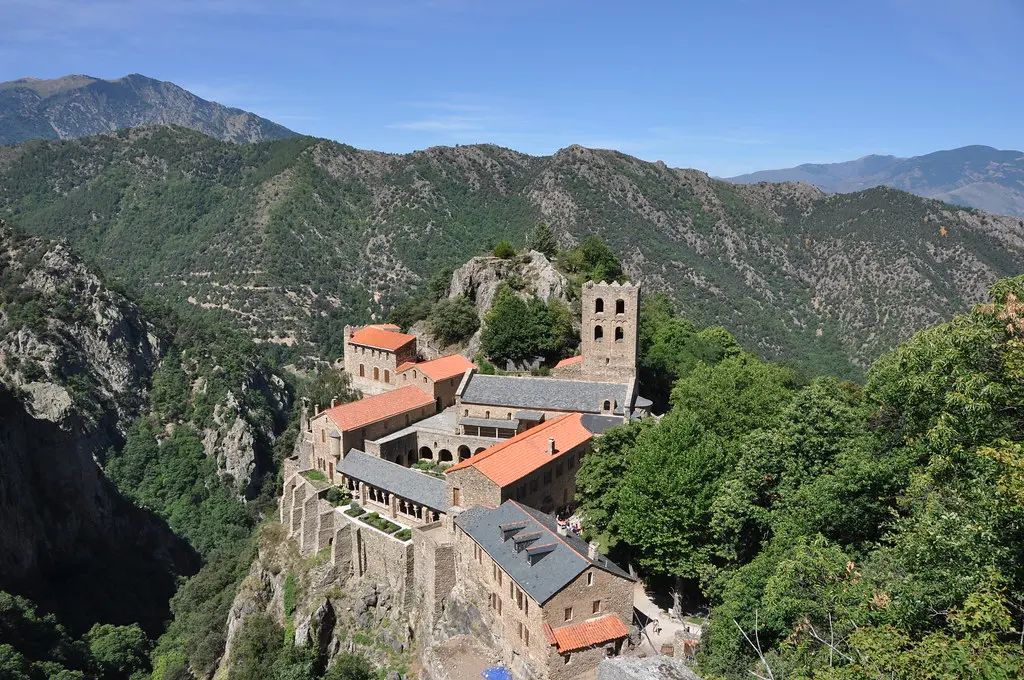
Image of Abbey of Saint-Martin-du-Canigou. Image source
Visit essentials
A quick read before you go
- Duration
- Half day including walk and tour.
- Etiquette
- Respect the active monastic community.
Overview
The Abbey of Saint-Martin-du-Canigou clings to a rocky spur on Mount Canigou's flank, a building that seems to grow from the mountain itself. Built between 1005 and 1009 by Count Guifred II of Cerdanya, it was raised as an act of atonement—a father's attempt to make peace with the death of his own son.
The count chose a location that made his offering unmistakable. At 1,094 meters altitude, accessible only by a demanding uphill path, the abbey embodied withdrawal from the world. No vehicle could reach it then; none can reach it now. Visitors must walk, as pilgrims have walked for over a thousand years.
The Benedictines remained for eight centuries until the Revolution. The abbey fell to ruin, was restored in the early twentieth century, and since 1988 has been home to the Community of the Beatitudes, who maintain monastic life and welcome pilgrims.
To climb to Saint-Martin is to participate in something older than tourism. The physical effort becomes offering; the arrival becomes grace. Above, the summit of Canigou rises toward whatever transcendence the mountain has always promised. Below, the world recedes.
Why this place is sacred
The thin quality at Saint-Martin-du-Canigou emerges from a specific human story elevated to universal significance. A father causes his son's death through circumstances the records do not fully explain. The guilt is unbearable. And from that unbearable guilt comes this: stone upon stone, raised on a cliff face, offered to God.
The location amplifies the atonement. Building here required enormous effort; living here required deliberate withdrawal. Guifred chose difficulty. He chose the mountain's discipline. And when the building was complete, he was not finished—he entered it, laid down his title, took the monk's cowl, and stayed until death.
For over a thousand years, that story has been retold to pilgrims who make their own climb. The physical effort of the ascent connects visitors to Guifred's spiritual effort. The arrival at the abbey mirrors the arrival at whatever peace might be possible after wrongdoing. The Romanesque architecture offers a vocabulary of solidity and weight—appropriate for a building meant to bear the burden of guilt.
The Community of the Beatitudes maintains the rhythm of prayer that has been continuous here, with interruption, for a millennium. The Liturgy of the Hours marks the day's passage. The silence between prayers holds what cannot be spoken. Visitors who arrive seeking a scenic destination often leave having encountered something unexpected—the possibility that guilt is not the end of the story.
The view from the abbey takes in the dramatic Pyrenean landscape that Guifred saw daily for his final fifteen years. Did he find peace? The stones suggest he did. The fact that he stayed suggests he did. But certainty belongs only to God.
Count Guifred II built the abbey between 1005-1009 as an act of atonement for the murder of his son. The first consecration occurred in November 1009.
After eight centuries of Benedictine presence, the Revolution closed the abbey and it fell to ruin. Restoration began in 1902 and continued through 1932. Since 1988, the Community of the Beatitudes has maintained monastic life and welcomed pilgrims.
Experience and orientation
Leave your car in Casteil, the village below, and begin to walk. The path is paved but steep, winding upward through chestnut forest with occasional views of the abbey above. You are doing what pilgrims have done for a thousand years. Let that thought accompany you.
The walk takes thirty to forty-five minutes depending on pace and fitness. It is not technical or dangerous, but it requires effort. Bring water. Notice how your breath changes with altitude. Notice how the concerns of the world below begin to seem smaller.
The abbey comes into view gradually—first the bell tower, then the walls emerging from the rock. The final approach reveals the full drama of the site: a monastery built into and from the mountain, as if the stone decided to pray.
Guided tours are required for most of the abbey. The guides are often members of the community, and their explanations carry the authority of residents rather than curators. You will see the Romanesque cloister with its recovered capitals, the tenth-century church with its shadowed depths, the tomb where Guifred finally rested.
Between tours, time permits contemplation. Sit where the view opens across the valley. Consider what it would mean to choose this place as the location for the rest of your life, as Guifred did. Consider what sin might require such choosing.
The descent is easier on the body, harder in some ways on the spirit. You are leaving. The monks stay. The prayer continues. Something has been offered here for over a thousand years, and your visit has briefly joined that offering.
Leave cars in Casteil and walk the paved path uphill for 30-45 minutes. The abbey is at 1,094 meters altitude. Guided tours depart at scheduled times; check the abbey website for current schedules.
Context and lineage
Count Guifred II of Cerdanya was the grandson of Wilfred the Hairy, founder of the Catalan nation, and the elder brother of Abbot Oliba of Saint-Michel-de-Cuxa. His family was powerful; his own power was considerable. And then, sometime before 1005, he became responsible for his son's death.
The records do not specify the circumstances—only that atonement was required and that Guifred chose the most demanding form. Between 1005 and 1009, he built an abbey on Mount Canigou's flank, in a location so inaccessible that the construction itself was a kind of penance. The first consecration occurred in November 1009.
The abbey prospered. Pilgrims came. The church was completed in the Romanesque style that would influence the region. And in 1035, Guifred completed his transformation. He renounced his title and became a monk in the monastery he had founded, spending his final fifteen years in prayer and silence. He died in 1050.
The Benedictines maintained the abbey for eight centuries. The Revolution brought dissolution; the buildings fell to ruin. In 1902, the Bishop of Perpignan acquired the site and began restoration, a process that continued through 1932. Since 1988, the Community of the Beatitudes has continued monastic presence.
Originally Benedictine for eight centuries. Since 1988, the Community of the Beatitudes—a Catholic community founded in 1973—maintains monastic life and welcomes pilgrims.
Count Guifred II of Cerdanya
Founder
Abbot Oliba of Saint-Michel-de-Cuxa
Guifred's brother
Traditions and practice
The Benedictines structured life around the Liturgy of the Hours, marking day and night with prayer. The abbey also served as a stop on the pilgrimage route to Santiago de Compostela.
The Community of the Beatitudes continues the rhythm of daily prayer. Guided tours introduce visitors to the abbey's history and architecture. Spiritual retreats are offered for those seeking deeper engagement. The annual feast of Saint Martin (November 11) brings special celebration.
Walk the path slowly, understanding the climb as the beginning of your encounter. Take a guided tour to understand what you are seeing. If time permits, stay for a prayer service. Let the abbey's atmosphere work on you rather than treating it as a checklist of sights.
Roman Catholicism / Monastic Life
ActiveThe abbey has been a center of Christian monasticism since 1009, representing the tradition of withdrawal from the world to seek God through prayer, silence, and community. Guifred's story adds a powerful dimension of atonement and conversion.
Liturgy of the Hours, daily Mass, spiritual hospitality, pilgrimage reception, retreats.
Perspectives and open questions
Saint-Martin-du-Canigou can be understood as a penitential foundation, as a masterpiece of early Romanesque architecture, as a continuing center of monastic prayer, or as a model for transformation through spiritual discipline.
Scholarly perspective
Architectural historians recognize the abbey as an important example of early Romanesque style in the Pyrenees. The foundation story exemplifies medieval patterns of aristocratic piety and monastic patronage.
Living and traditional perspectives
Within Catholic tradition, the abbey represents the monastic ideal of withdrawal from the world to seek God. Guifred's story exemplifies conversion—the possibility that even grave sin can lead to holiness through repentance and discipline.
Alternative interpretations
The abbey's location on sacred Mount Canigou has attracted interest from those exploring earth energies and sacred geography.
Open questions
The full circumstances of the murder that prompted Guifred's atonement remain unclear. The original extent of the medieval monastic community is not fully documented.
Plan your visit
Access and arrival
Limited facilities at the abbey for retreatants. Full accommodations in nearby villages including Vernet-les-Bains.
Respectful visit
Modest dress appropriate for a religious community. The walk requires comfortable shoes.
Some areas permit photography; others do not. Follow current guidelines and tour guide instructions.
Donations support the community's work. The small shop offers items made or selected by the community.
Most areas require guided tours. Some spaces are reserved for the community. No vehicle access.
The climb is real; bring appropriate footwear and water. Tours are guided and scheduled—check times before arriving. Respect the monastic community; this is their home.
Current practical details
Address
66820 Casteil, France
Phone
Hours
Hours, fees, and access can change — verify on the official source before you travel. Practical details last checked Jun 2026.
Location
Map loads as you approach this section.
Pilgrim reflections
A portrait of encounter, not a score
Pilgrims describe what they felt, how present they could become, and whether the place would shape a journey. There are no stars and no ranking of traditions.
No reviewed reflections yet
The first pilgrims can help describe the character of being here.
Share a reflection
Available after an account-backed “Been there.” Every reflection is reviewed before publication.
Nearby sacred places
Explore other sacred places in the region. Proximity does not establish access or travel time; check each place’s guidance.

References
Sources consulted for this page. Source categories describe the publication, not a guarantee that every claim is verified. Traditional accounts and outside interpretations may differ.
- 01A Thousand Years of History - Abbaye St Martin du Canigou — Abbey of Saint-Martin-du-CanigouofficialOfficial abbey website
- 02The Abbey of St Martin du Canigou - Conflent Canigo Tourisme — Conflent Canigo TourismeguideOfficial regional tourism
- 03Abbey of Saint-Martin-du-Canigou - Wikipedia — Wikipedia contributorsencyclopediaComprehensive overview
- 04St-Martin-Du-Canigou Abbey - Sacred Destinations — Sacred DestinationsacademicSacred sites specialist
Share a photo
Help visitors recognize Abbey of Saint-Martin-du-Canigou. Every submission is reviewed before publication.