Chair of Isis (Throne of Isis)
An ancient stone throne where seekers sit to receive the wisdom of the Divine Feminine
Understand sacred places, explore living traditions, and learn how to engage respectfully with Pilgrim Map.
Access has not been verified. Check current local guidance before planning a visit.
Rennes-les-Bains, Aude, France
Read the sources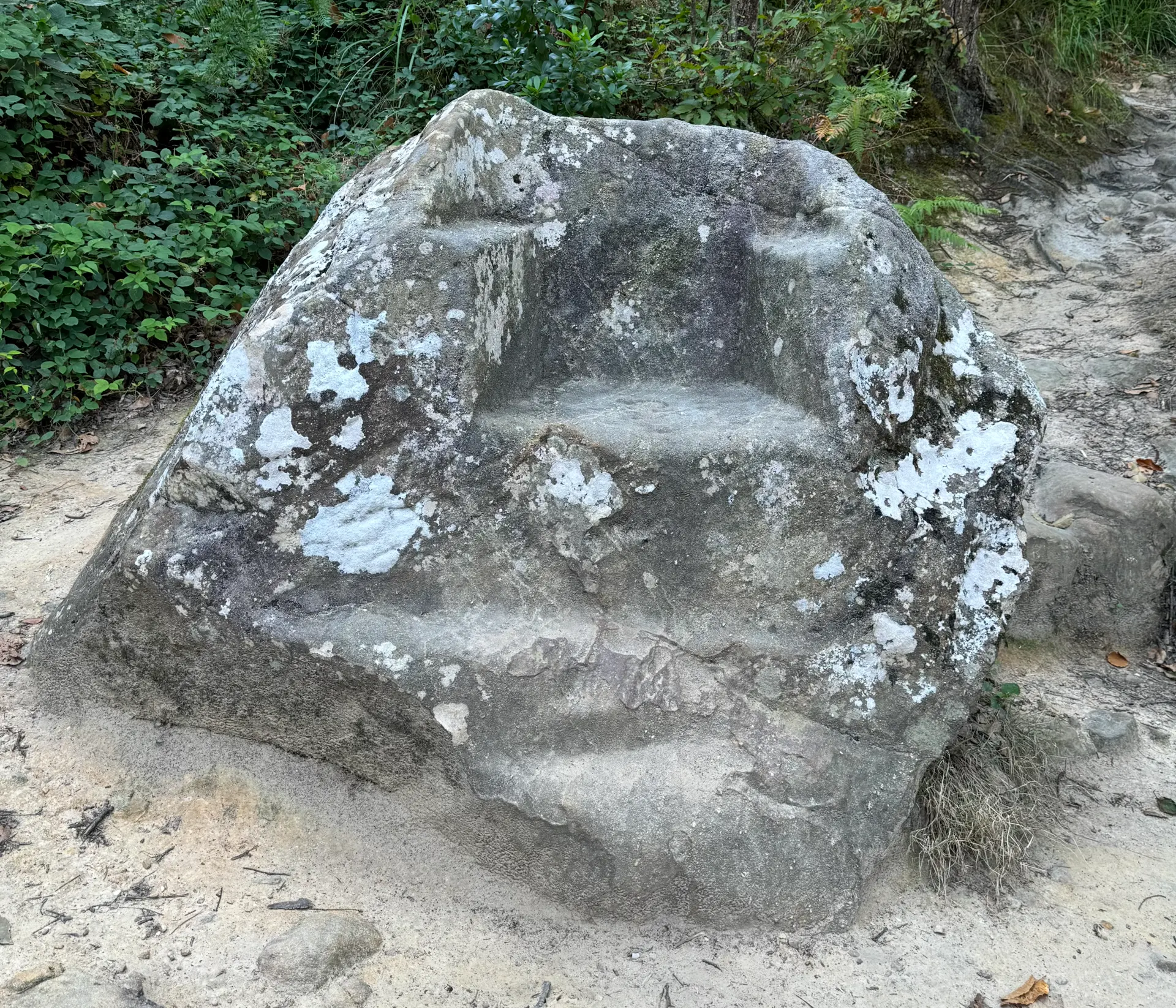
Visit essentials
A quick read before you go
- Duration
- Allow 2-3 hours total: approximately 1.5-2 hours for the hiking loop plus time at the Chair…
- Access
- Park at the lot opposite the Mairie (Town Hall) in Rennes-les-Bains.
Overview
In a forest clearing above Rennes-les-Bains, the Chair of Isis is a granite seat set into the earth beside the Source du Cercle spring. Its accumulated meanings run from purported pre-Christian rites through a carved PAX symbol read as an unsuccessful Church claim to its current role in Divine Feminine pilgrimage.
Researchers place it within a pentagram of mountain peaks and on the Paris Meridian from St. Sulpice to nearby Mt. Bugarach; whether these alignments are meaningful or coincidental remains unresolved. Visitors use the spring water for anointing, continuing a pattern of water veneration described as likely predating the site's recorded history.
Visitors report feeling held, receiving unbidden insights, or sensing a feminine presence when seated. Ancient chestnuts form a natural amphitheater around the clearing, intensifying its forest atmosphere.
Why this place is sacred
Some places acquire their power through sheer duration of use. The Chair of Isis sits in a landscape that has been recognized as sacred for so long that its original sanctification is lost to memory—only the persistent patterns of pilgrimage remain, adapting their language across centuries while maintaining the essential act of coming to sit, to receive, to be transformed.
The PAX symbol carved into the stone tells its own story. When early Christian missionaries encountered pagan sacred sites, they had three options: destroy them, ignore them, or claim them. Destruction was reserved for sites that could be erased from memory. The most powerful sites—those whose pull was too strong to deny—were Christianized instead. The PAX carved into this throne suggests that the Church recognized something here worth absorbing rather than abolishing.
Contemporary practitioners experience the site within a framework of goddess spirituality, understanding the throne as a seat of Isis—an initiatory chair where feminine wisdom is transmitted through the simple act of sitting. This interpretation may be modern, but the underlying pattern of seeking transformation through contact with the stone is ancient.
The original purpose remains uncertain. Local folklore attributes pre-Christian pagan worship to the site, likely connected to the adjacent spring. Some researchers connect it to a broader landscape of Roman-era healing cults centered on the thermal waters of Rennes-les-Bains.
The site's meaning has shifted across eras: from whatever nameless rites first sanctified it, through Christian appropriation marked by the PAX carving, to its 19th century documentation as part of the Cromleck of Rennes-les-Bains, and finally to its current revival as a destination for goddess spirituality practitioners. Each era has added interpretive layers while the fundamental act—sitting in the stone seat beside the spring—has remained constant.
Experience and orientation
The path to the Chair of Isis begins opposite the town hall in Rennes-les-Bains, following the Chemin des Fangalots into the forest. As you climb, the thermal village with its healing waters recedes below, and the forest closes around the trail. Ancient chestnuts create a canopy that visitors describe as enchanted—there is a listening quality to the silence here, an attentiveness in the trees.
The clearing appears without fanfare: a modest space in the forest where a granite boulder has been carved into the shape of a chair. The seat is weathered, bearing symbols whose origins span centuries—including the PAX that marks the Church's attempt to claim it. Beside the throne, water trickles from the hillside into the Source du Cercle, a small circular basin that has offered its waters to visitors since before memory.
The act of sitting in the chair is intimate and strange. The stone is cool, the forest alive with small sounds. Visitors report feeling held, supported, received. Some describe emotional releases, insights arising without being sought, a sense of feminine presence that the name Throne of Isis attempts to articulate. Others experience simply the silence of the forest and the patience of stone—which is its own form of transmission.
Friday the 13th draws practitioners who understand this day as sacred to the goddess, gathering to conduct ceremonies of anointing and initiation. But the throne receives visitors any day, asking nothing except presence.
The experience is one of pilgrimage in miniature—a brief ascent through forest to a clearing where something waits. The site rewards those who approach slowly, who treat the hike as preparation rather than obstacle.
Context and lineage
Contemporary spiritual tradition understands the Chair as an Initiatory Seat of Power for the Mystery School of Isis, a site where feminine wisdom has been transmitted since before recorded history. Local legend connects it to pre-Christian goddess worship, while mystery researchers link it to a buried Roman temple of Isis beneath Rennes-les-Bains itself—a theory supported by 19th century archaeological discoveries that documented temple foundations beneath the village.
The Chair exists at the intersection of multiple lineages: the undocumented pre-Christian worship that first sanctified it, the Roman healing cults centered on Rennes-les-Bains' thermal waters, the Christian appropriation marked by the PAX symbol, the 19th century antiquarian documentation, and the contemporary goddess spirituality that has given the site its current name and practices.
Abbé Boudet
19th century priest who documented the Cromleck of Rennes-les-Bains, mapping the Chair within a broader landscape of ancient monuments
Henry Lincoln
Researcher who identified the pentagram of mountain peaks within which the Chair sits, popularizing the region's mysteries through Holy Blood, Holy Grail
Traditions and practice
Pre-Christian practices at the site are lost to history. The presence of the spring suggests water veneration, while the carved seat implies ritual use—but the specific forms these took remain unknown.
Modern practitioners visit the Chair for seated meditation, seeking connection with the Divine Feminine. Water from the Source du Cercle is used for anointing, blessing the body before or after sitting in the throne. Group ceremonies include chanting, sound healing, and collective intention-setting. Friday the 13th gatherings celebrate the Day of the Goddess with formal initiation rites.
Approach the Chair as you would any seat of power—with presence rather than expectation. The twenty-minute hike serves as preparation; let it quiet your mind. At the clearing, greet the spring before sitting. Take time with the stone. Let the forest hold you. Use the spring water if it calls to you—for drinking, for anointing, for offering. Leave the site as you found it, carrying only what was given.
Contemporary Goddess Spirituality
ActiveModern practitioners understand the Chair as the Throne of Isis, an initiatory seat of power for feminine mysteries. The site is associated with fertility, sexuality, womb wisdom, and connection to the Divine Feminine. Sitting in the throne is understood as receiving transmission from the goddess.
Seated meditation on the throne, water anointing from the adjacent spring, chanting and sound healing ceremonies, group initiations particularly on Friday the 13th. Practitioners approach the site seeking wisdom, healing, and initiation into feminine mysteries.
Pre-Christian Pagan Worship
HistoricalThe site was reportedly a place of pagan worship powerful enough that Christianity chose appropriation over destruction. The carved seat and sacred spring suggest ritual use, while the PAX symbol marks the moment when the Church claimed what it could not erase.
Specific practices are lost to history. The presence of water veneration, carved seating, and later Christianization suggests organized ritual use.
Rennes-le-Château Mystery Tradition
ActiveThe Chair is part of the broader mystery landscape documented by Abbé Boudet and popularized by Henry Lincoln. Mystery researchers connect it to the Asmodeus statue in Saunière's church—the demon's crouching posture suggests sitting on an invisible throne, possibly this one. The site's position within the pentagram of peaks adds geometric significance.
Research pilgrimage, contemplation of landscape geometry, seeking connections between the Chair and other mystery sites in the region.
Perspectives and open questions
The Chair of Isis sits at the intersection of archaeology, folklore, esoteric research, and living spiritual practice. Each perspective illuminates different aspects of what this stone seat might mean.
Scholarly perspective
Academic study of the site is limited. The Chair is documented as part of the Cromleck of Rennes-les-Bains, a collection of carved stones and monuments in the region. Dating remains contested: some sources place the carving in the Neolithic period, others attribute it to an 18th century Count of Fleury. The connection to Isis worship is modern interpretation rather than archaeological evidence.
Living and traditional perspectives
Local folk tradition names the site the Devil's Armchair, reflecting the common European pattern of attributing pre-Christian sacred sites to demonic forces. This naming suggests the site held power that Christianity found threatening—power easier to demonize than to destroy.
Alternative interpretations
Esoteric researchers place the Chair within a web of geometric alignments: the Paris Meridian (Rose Line) running from St. Sulpice to Mt. Bugarach, and the pentagram of mountain peaks documented by Henry Lincoln. Within this framework, the Chair becomes a node in a sacred landscape, a seat of initiation within a geometric matrix. The connection to Isis—and to a possible buried Roman temple beneath Rennes-les-Bains—places it within the broader mysteries of the region.
Open questions
The Chair holds its mysteries close. We do not know who first carved it, what rites were performed here, or what the original practitioners understood themselves to be doing. We know only that people have been coming here for a very long time, sitting in the stone, drinking from the spring, and leaving changed.
Plan your visit
Access and arrival
Park at the lot opposite the Mairie (Town Hall) in Rennes-les-Bains. Take the Chemin des Fangalots at the parking lot exit, following signs toward Ruines du château de Blanchefort. The Chair is approximately 20 minutes uphill. Dogs are welcome on leash. The path is not wheelchair accessible.
Rennes-les-Bains offers modest accommodation including guesthouses and small hotels. The thermal baths remain operational for those wishing to combine forest pilgrimage with water healing.
Respectful visit
Practical hiking clothing appropriate for forest trails. The hike involves moderate elevation gain over uneven terrain.
Permitted. The light through the chestnut canopy creates distinctive atmospheric effects.
Some visitors leave small offerings at the spring or beside the chair. This practice is neither required nor discouraged. If leaving offerings, choose materials that will decompose naturally.
None. The site is on public hiking trails and receives visitors year-round. Fire restrictions may apply seasonally.
The Chair receives all visitors, but the forest path requires appropriate footwear and the hike involves elevation gain. Fire restrictions may limit access from June onwards. The site is shared between seekers and hikers—respect for all visitors is essential.
Current practical details
Address
11190 Rennes-les-Bains, France
Hours, fees, and access can change — verify on the official source before you travel. Practical details last checked Jun 2026.
Location
Map loads as you approach this section.
Pilgrim reflections
A portrait of encounter, not a score
Pilgrims describe what they felt, how present they could become, and whether the place would shape a journey. There are no stars and no ranking of traditions.
No reviewed reflections yet
The first pilgrims can help describe the character of being here.
Share a reflection
Available after an account-backed “Been there.” Every reflection is reviewed before publication.
Nearby sacred places
Explore other sacred places in the region. Proximity does not establish access or travel time; check each place’s guidance.


References
Sources consulted for this page. Source categories describe the publication, not a guarantee that every claim is verified. Traditional accounts and outside interpretations may differ.
- 01Les Fauteuils du Diable & d'Isis Guided Tour — Limouxin Tourism OfficeSource contextOfficial tourism office documentation
- 02Legends and voices of nature — Limouxin TourismSource contextOfficial tourism documentation of local legends
- 03Mysteries of the esoteric triangle — Aude TourismeSource contextOfficial departmental tourism documentation
- 04Circuit du Fauteuil du Diable — AllTrailsSource contextPractical hiking information with GPS coordinates
- 05The Devil's Armchair in Rennes-les-Bains — Priory of Sion ResearchSource contextHistorical documentation with 1920-1935 French postcard evidence
- 06The Devil's Armchair — RennesLeChateau.nlSource contextDocuments connection to Cromleck of Rennes-les-Bains
- 07Au coeur de Rennes - Les 2 Rennes — Local tourism siteSource contextLocal tourism information about hiking trails
- 08The Throne of Isis — Oratory of Holy Wisdom / Aletheia Pistis SophiaspiritualContemporary spiritual interpretation; presents esoteric perspective
Share a photo
Help visitors recognize Chair of Isis (Throne of Isis). Every submission is reviewed before publication.