Our Lady (Virgin) of Montserrat (La Moreneta)
InsideSanta Maria de Montserrat Abbey
Where pilgrims touch the hand of the Dark Madonna and children have sung the same hymn for seven centuries
Understand sacred places, explore living traditions, and learn how to engage respectfully with Pilgrim Map.
Access has not been verified. Check current local guidance before planning a visit.
Marganell, Barcelona, Spain
Read the sources
Visit essentials
A quick read before you go
- Duration
- A minimum half day allows for visiting the basilica, queuing to see the Black Madonna, attending…
- Access
- From Barcelona, the journey takes approximately one hour.
Overview
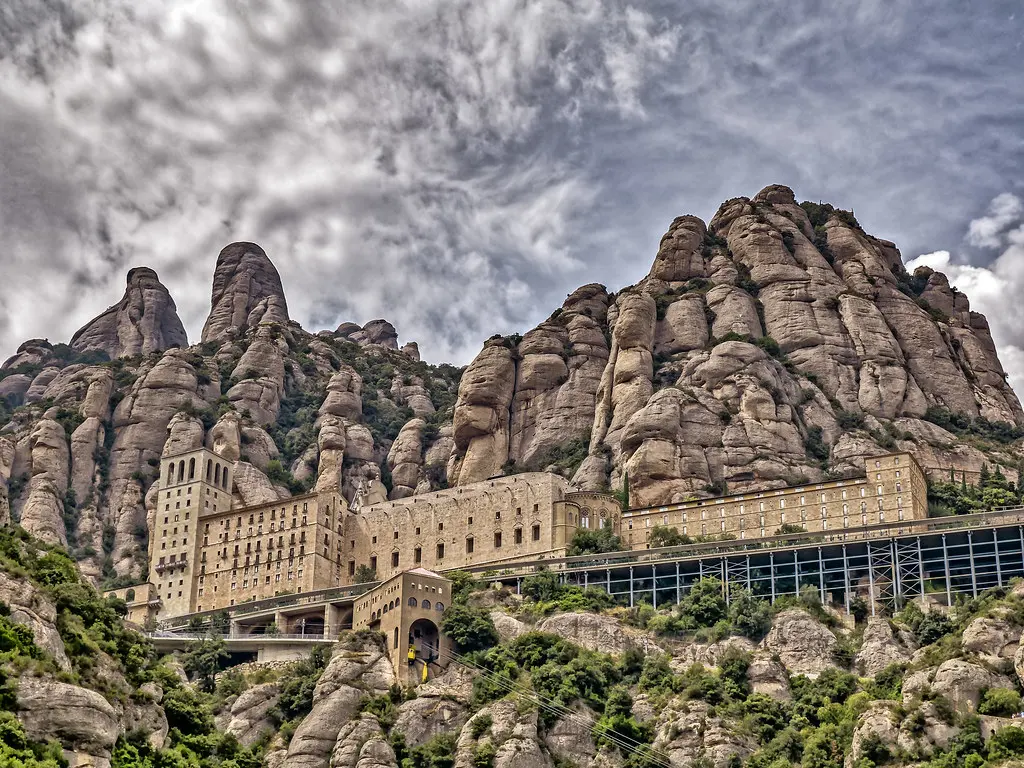
From Barcelona, Montserrat's serrated peaks rise like a stone crown. The Catalan name means 'serrated mountain,' though pilgrims have long understood more than geology.
Carved into a ledge between peaks, the Benedictine monastery of Santa Maria de Montserrat has held vigil for a millennium. Its twelfth-century wooden Virgin and Child is darkened by centuries of candle smoke and devotion. Catalans call her La Moreneta, the Little Dark One—their co-patroness, protector, and mother.
Pilgrims queue daily for her throne room, touching or kissing the sphere she holds, symbol of the cosmos, while offering silent prayers. Below, the Escolania choir, whose lineage traces to 1307, sings the Salve Regina through stone that has heard it for seven hundred years.
St. Ignatius of Loyola kept an all-night vigil before the statue in 1522, laid down his sword, and emerged to found the Jesuits. Smaller transformations still happen to countless visitors.
Why this place is sacred
Even before Christianity arrived, something about this mountain drew human attention. The dramatic rock formations, the caves, the springs emerging from stone—all spoke of forces that later traditions would name in their own terms.
According to Catholic tradition, the statue was carved by St. Luke in Jerusalem around 50 CE and brought to Spain in the apostolic era. When Moorish armies invaded in the eighth century, local Christians hid it in a mountain cave to protect it from destruction. For over a century it lay forgotten, until shepherd boys saw mysterious lights descending onto the mountain and heard angelic music rising from the rock.
The Bishop of Manresa came to investigate. When he attempted to move the statue to his cathedral, it became progressively heavier until it could not be lifted at all. The message was clear: the Virgin wished to remain on this mountain. A chapel was built at the discovery site, and pilgrimage began.
Scholars date the actual statue to the late twelfth century—a Romanesque carving in the Sedes Sapientiae tradition, depicting Mary as the Throne of Wisdom upon which Christ sits. The darkening of her face is attributed to candle smoke, varnish oxidation, and successive restorations. These facts do not diminish what the image has become through centuries of veneration. The statue's physical history is one thing; what it opens in those who approach it is another.
A thousand years of continuous monastic prayer creates an accumulated atmosphere. The monks have sung the same offices, offered the same masses, maintained the same presence through civil wars, invasions, and the monastery's destruction and rebuilding. When Napoleon's troops burned the buildings in 1811, local people carried the statue to safety and returned it when peace came. The continuity of devotion has never been broken.
The daily singing of the Escolania adds something particular. When the boys' voices rise in the Salve Regina, they are not performing—they are praying. The sound has not changed in its essence for seven centuries. Visitors weep hearing it, and not because of the music alone.
The Benedictine monastery was formally established in 1025 by Abbot Oliva to house and protect the venerated statue, to provide a place of pilgrimage, and to maintain continuous prayer. The Escolania was founded by the fourteenth century to train boys in liturgical music. From its origins, Montserrat has been simultaneously a place of Marian devotion, monastic contemplation, pilgrimage, and education.
What began as a mountain shrine became, through the centuries, a symbol of Catalan identity itself. The monastery preserved Catalan language and culture during periods of suppression, particularly under Franco's regime. The feast day of April 27 carries nationalist as well as religious significance. Yet Montserrat draws pilgrims from far beyond Catalonia—millions each year, from every continent, speaking every language, seeking blessing, healing, or simply the encounter with something they cannot name.
The papal coronation of 1881 formalized what pilgrims had known for centuries: this is one of Europe's great Marian shrines, comparable to Lourdes or Fatima. Unlike those sites, however, Montserrat's origins lie not in modern apparition but in medieval legend and accumulated devotion. The Virgin does not appear here; she simply is here, has always been here, waiting.
Experience and orientation
The experience begins with the approach. Whether by cable car, rack railway, or mountain road, the arrival at Montserrat involves a kind of ascent that feels symbolic even to secular visitors. The rock formations grow stranger and more dramatic. The monastery appears, improbably nestled into the mountain itself.
The basilica is ornate in the manner of Counter-Reformation Catholicism—gold, marble, painted ceilings. It could be overwhelming, but something holds the space together. Perhaps it is the centuries of prayer soaked into the stone. Perhaps it is the hush that falls even over tour groups as they enter.
The queue to see the Black Madonna moves slowly through a side passage and up into the camarín, the throne room where she sits behind glass. Only her hand, holding a sphere, extends through an opening. Pilgrims touch it, or kiss it, and offer their prayers. Many open their other hand toward the Christ Child, completing a gesture of reception.
The moment is brief, but visitors describe it as the heart of their pilgrimage—a point of contact across centuries of devotion.
The Escolania sings at 1pm on weekdays, during Sunday Mass, and at special liturgies. Arriving early to secure seating is recommended, but even standing at the back, the effect penetrates. The voices of the boys are not merely beautiful; they carry something the listeners struggle to name. When they sing the Virolai, the hymn composed for the Virgin of Montserrat, the basilica becomes a single held breath.
Many visitors describe a quality of peace that persists beyond the visit—a settling of something that had been unsettled. Others speak of clarity about decisions or relationships. Still others simply say they wept without knowing why, and felt lighter afterward. The experience resists categorization, but its consistency across cultures and belief systems suggests something genuine operating here.
Montserrat rewards those who come with intention rather than itinerary. Decide before you arrive what you seek: blessing, healing, guidance, or simply presence. You need not be Catholic, or even theist, to engage meaningfully. The Virgin has welcomed pilgrims for a thousand years; she does not ask for credentials.
When you touch the sphere in her hand, let your prayer or intention be specific. The gesture can feel perfunctory if you have not prepared it. Some pilgrims bring written prayers to leave in the designated boxes; others carry their intentions in silence.
Plan to attend the Escolania performance if at all possible. Arrive early enough to find seating. Let the music do its work; do not photograph or record. Something opens when attention is total.
Afterward, consider walking to Santa Cova, the Holy Cave where the statue was legendarily discovered. The path descends through stations of the rosary with sculptures by modernista artists including Gaudí. The cave itself holds a chapel and a quality of silence different from the basilica above.
Context and lineage
According to tradition, St. Luke the Evangelist carved the statue of the Virgin and Child in Jerusalem around 50 CE. Early Christians brought it to Barcelona, where it was venerated as La Jerosolimitana, the Jerusalemite. When Moorish armies invaded Spain in the eighth century, the statue was hidden in a cave on Montserrat to protect it from destruction. There it remained, forgotten, for over a century.
In 880 CE, shepherd boys from the nearby town of Monistrol saw strange lights descending onto the mountain and heard unearthly music rising from the rock. They told their parents and the local priest, who witnessed the same phenomena. The Bishop of Manresa came to investigate and discovered the statue in a cave—Santa Cova, the Holy Cave that remains a pilgrimage site today.
When the bishop attempted to carry the statue to his cathedral in the city, a wonder occurred. With each step away from the mountain, the statue grew heavier. Eventually it became immovable. The message was understood: the Virgin wished to remain on Montserrat. A chapel was built at the site, and the pilgrimage began that has never ceased.
Scholarly analysis dates the actual statue to the late twelfth century, identifying it as a Romanesque wood carving in the Sedes Sapientiae style characteristic of Catalan craftsmen of that era. The legend of St. Luke lacks historical support. Yet the legend has shaped how pilgrims approach the image for centuries, and it carries its own kind of truth about what this statue means to those who venerate it.
The Benedictine community has maintained continuous presence at Montserrat since 1025, interrupted only by destruction—never by abandonment. When Napoleon's troops burned the monastery in 1811, the monks scattered but the statue was saved by local faithful. The community returned and rebuilt. When the Spanish Civil War threatened in the 1930s, the monastery provided refuge.
The Escolania choir represents an unbroken tradition of sacred music since at least 1307, making it one of the oldest boys' choirs in Europe. The boys live and study at the monastery, receiving both academic and musical education. When they sing before the Black Madonna, they continue a practice seven centuries old.
This continuity distinguishes Montserrat from sites where tradition has been reconstructed or revived. The prayers have never stopped. The music has never fallen silent. The pilgrims have never ceased climbing the mountain.
The Virgin Mary
deity/saint
The Mother of Christ, venerated here in her aspect as the Black Madonna. She is understood as intercessor, protector, and spiritual mother. As co-patroness of Catalonia (alongside St. George), she holds particular significance for Catalan identity.
Abbot Oliva
historical
The Benedictine abbot who formally established the monastery at Montserrat in 1025, consolidating earlier chapels and hermitages into a proper monastic foundation.
St. Ignatius of Loyola
historical
The Basque soldier who kept an all-night vigil before the Black Madonna on March 25, 1522. He laid down his sword and military garments at her altar and emerged transformed, eventually founding the Society of Jesus (Jesuits).
Pope Leo XIII
historical
The pope who granted canonical coronation to the Virgin of Montserrat on September 11, 1881, officially recognizing her status as patroness of Catalonia and confirming Montserrat as a major pilgrimage shrine.
Traditions and practice
The primary devotional act is touching or kissing the sphere held in the Virgin's hand while offering a prayer or intention. The sphere symbolizes the cosmos; the gesture represents entrusting one's petition to Mary's intercession. Many pilgrims open their other hand toward the Christ Child, creating a posture of both offering and reception.
After visiting the statue, pilgrims exit through the Camí de l'Ave Maria, where candles can be lit as prayers to the Virgin. The soft glow of hundreds of flames creates an atmosphere of collective devotion.
The pilgrimage to Santa Cova, the Holy Cave of the statue's legendary discovery, follows a 1.5-kilometer path with fifteen sculptural stations representing the mysteries of the rosary. The path was adorned with works by modernista artists including Antoni Gaudí, Josep Llimona, and others. The cave itself holds a small chapel and a reproduction of the statue, allowing quieter contemplation than the busy basilica above.
Singing or listening to the Virolai, the hymn to Our Lady of Montserrat composed by Jacint Verdaguer in 1880, is a devotional practice particularly associated with the feast day (April 27) but performed throughout the year.
Daily Mass is celebrated by the Benedictine monks in the basilica, maintaining over a thousand years of continuous Eucharistic worship at this site. Visitors of any faith may attend.
The Escolania performs daily except Saturdays and during July and Christmas holidays. On weekdays, they sing the Salve Regina at 1pm. On Sundays, they sing during the noon Mass. The experience of hearing them is itself a form of prayer, whether or not one shares the Catholic faith.
Retreats can be arranged through the monastery for those seeking extended engagement. The guesthouse offers accommodation for visitors wishing to participate more fully in the monastic rhythm of prayer.
If you come seeking more than tourism, consider these invitations:
Before entering the basilica, spend time with the mountain itself. Walk the pathways around the monastery, letting the rock formations speak. What you encounter inside will land differently if you have first been held by the landscape.
When you touch the sphere in the Virgin's hand, let your prayer be specific and sincere. Do not rush the moment. Others will wait. This is what they came for too.
If possible, attend the Escolania performance. Arrive thirty minutes early to secure seating in the basilica. When the boys sing, simply listen. Resist the urge to record. Let the sound work on you without mediation.
After the intensity of the basilica, walk to Santa Cova. The descent through the rosary stations offers gradual re-entry. The cave chapel is quieter, more intimate. Some find their deepest moments there rather than above.
Roman Catholic
ActiveOur Lady of Montserrat is the co-patroness of Catalonia, crowned by papal authority in 1881. She is one of Europe's most venerated Black Madonnas and a major Marian pilgrimage destination. The statue represents the Sedes Sapientiae (Throne of Wisdom) iconographic tradition, depicting Mary as the seat upon which divine wisdom rests. For Catholics, she is a powerful intercessor whose image has mediated countless healings and transformations over the centuries.
Daily Mass celebrated by the Benedictine monks maintains continuous Eucharistic worship at the site. Pilgrims touch or kiss the sphere in the Virgin's hand while offering prayers. Candles are lit in the Camí de l'Ave Maria. The Escolania choir sings the Salve Regina and Virolai before the statue. The feast day (April 27) brings special liturgies and celebrations. Pilgrimage to Santa Cova honors the site of the statue's legendary discovery.
Benedictine monastic
ActiveThe monastery has been a Benedictine foundation since 1025, when Abbot Oliva established the community. The monks maintain the sanctuary, provide hospitality to pilgrims, celebrate the liturgy, and preserve Catalan cultural heritage including language, manuscripts, and music. The Escolania boys' choir, founded by the fourteenth century, continues the Benedictine commitment to sacred music as prayer.
The monks follow the Rule of St. Benedict, structuring their days around the Liturgy of the Hours (Divine Office) with its rhythm of prayer from dawn through night. They offer Mass daily in the basilica, provide spiritual direction and confession for pilgrims, and maintain the monastery's educational and publishing work. The guesthouse offers retreatants the opportunity to share in monastic rhythm.
Perspectives and open questions
The Black Madonna of Montserrat invites multiple interpretations that need not be reconciled. Catholic understanding sees her as a miraculous image through which Mary intercedes. Art historians see a fine example of Romanesque Catalan sculpture. Catalan nationalists see a symbol of their people's resilience. Seekers from outside these frameworks simply sense something present here. Each perspective illuminates; none exhausts what this place means.
Scholarly perspective
Art historical analysis dates the statue to the late twelfth century, identifying it as a Romanesque wood carving in the Sedes Sapientiae (Throne of Wisdom) iconographic tradition. This style, common in Catalan sculpture of the period, depicts Mary as the throne upon which Christ the divine wisdom sits. The statue's craftsmanship places it among the finest examples of its type.
The darkening of the statue has been attributed to various causes: centuries of candle smoke, oxidation of original varnish, and intentional darkening during successive restorations to maintain the appearance pilgrims expected. A 2001 restoration revealed that the original polychrome was considerably lighter. The question of whether Black Madonnas were originally dark or became so through age and accumulation remains debated in art historical scholarship.
The legendary attribution to St. Luke lacks historical support. The earliest documentation of the statue dates to the medieval period, consistent with its Romanesque style. However, scholars recognize that legendary origins shape how devotees relate to sacred images, creating meanings that exist alongside and separate from physical history.
Living and traditional perspectives
Catholic tradition holds that the statue was carved by St. Luke the Evangelist in the presence of the Virgin Mary herself, making it a contact relic of extraordinary power. Hidden during the Moorish invasion and miraculously revealed through heavenly signs, the statue chose Montserrat as its dwelling by becoming immovable when the bishop tried to relocate it. These narratives establish the statue's sanctity and explain why pilgrims have sought blessing here for over a millennium.
The Virgin of Montserrat is understood as a powerful intercessor. Miraculous healings and answered prayers are documented from the medieval period onward, though specific accounts are not extensively catalogued in accessible sources. The transformation of St. Ignatius of Loyola during his vigil stands as the most famous instance of the statue's transformative power.
For Catalan Catholics, the Virgin is not only a spiritual mother but a national protector. Her feast day (April 27) carries significance for Catalan identity alongside its religious meaning. During periods of cultural suppression, devotion to Montserrat served as a vehicle for preserving language and identity.
Alternative interpretations
Some alternative perspectives connect Black Madonnas generally to pre-Christian goddess traditions, noting iconographic similarities to Isis with Horus and suggesting continuity with earth mother archetypes. The dark coloring has been associated with esoteric symbolism, the Song of Songs ('I am black but beautiful'), and chthonic feminine divinity. Montserrat's dramatic mountain formations have attracted speculation about earth energies and sacred geography, with some interpreting the site as an energy center or power spot.
These interpretations lack support in mainstream scholarship and are not endorsed by the monastery or Catholic tradition. However, they represent how some contemporary seekers frame their experience of the site. The experience itself may be genuine even when the explanatory framework differs from traditional understanding.
Open questions
Genuine uncertainties remain. The precise date and circumstances of the statue's creation are unknown. Whether there was a pre-Christian cult site on Montserrat before Christian settlement is unclear, though the mountain's distinctive appearance makes earlier veneration plausible. The exact cause of the statue's darkening remains debated. The full extent of miracles attributed to the Virgin over the centuries has not been systematically documented in accessible sources.
Perhaps most fundamentally unknown is what actually happens to people here. The consistency of transformative reports across centuries and cultures suggests something genuine, but the mechanism—whether psychological, spiritual, or something our categories cannot capture—remains mysterious. The tradition does not require an explanation; it simply invites encounter.
Plan your visit
Access and arrival
From Barcelona, the journey takes approximately one hour. By public transport: take the FGC train (line R5) from Plaça Espanya to Monistrol de Montserrat (for the cremallera rack railway) or to Aeri de Montserrat (for the cable car). Both options offer dramatic approaches to the monastery. By car: follow the A-2 motorway then the C-55 and BP-1103 to the monastery parking area.
The basilica and throne room are accessible to visitors with mobility limitations. The Santa Cova path descends steeply and includes stairs; funicular assistance is available for part of the journey. The Sant Joan area requires hiking beyond the funicular terminus.
The monastery operates a guesthouse (Cel·les Abat Marcet) for visitors seeking extended stays or retreat experience. Hotel Abat Cisneros offers more standard accommodation at the monastery complex. The town of Monistrol de Montserrat has additional lodging options. From Barcelona, day trips are common, though staying overnight allows for early morning visits when crowds are thinnest.
Respectful visit
Modest dress is required for entering the basilica. Shoulders and knees should be covered. Tank tops, strapless tops, short skirts, shorts above the knee, and see-through clothing are not permitted. In warm weather, bring a shawl or light covering to wrap around shoulders. Beach attire and flip-flops are inappropriate. Remove hats upon entering the basilica.
Personal photography is allowed in most areas of the monastery complex, including the basilica when services are not in progress. Photography is prohibited during Mass and Escolania performances. Flash photography should be avoided in the basilica regardless. Drones are not permitted anywhere on the mountain. At Santa Cova, photography is allowed but the contemplative atmosphere deserves consideration.
Candles can be purchased and lit in the Camí de l'Ave Maria after visiting the Black Madonna. A suggested offering of 2 euros supports the visit to the statue. Written prayers can be left in designated boxes. Monetary donations support the monastery's continued operation and charitable work.
Only the sphere in the Virgin's hand is accessible to touch; the main body of the statue is protected behind glass. Do not attempt to touch other parts of the statue or its housing. Certain monastic areas are closed to visitors; respect all barriers and signage. Food and drink are not permitted in the basilica.
The queue to see the Black Madonna can exceed an hour during peak times. This waiting is itself part of the pilgrimage—a practice of patience among fellow seekers. Do not attempt to skip the line or rush others.
The basilica is an active place of worship, not a museum. Your presence is welcomed as a guest in someone's house of prayer. Behave accordingly.
Commercial tour groups sometimes treat Montserrat as a scenic excursion rather than a pilgrimage site. If you arrive with such a group, know that you can separate from the schedule to engage more deeply. The mountain will still be there when the bus leaves.
Location
Map loads as you approach this section.
Pilgrim reflections
A portrait of encounter, not a score
Pilgrims describe what they felt, how present they could become, and whether the place would shape a journey. There are no stars and no ranking of traditions.
No reviewed reflections yet
The first pilgrims can help describe the character of being here.
Share a reflection
Available after an account-backed “Been there.” Every reflection is reviewed before publication.
Nearby sacred places
Explore other sacred places in the region. Proximity does not establish access or travel time; check each place’s guidance.


References
Sources consulted for this page. Source categories describe the publication, not a guarantee that every claim is verified. Traditional accounts and outside interpretations may differ.
- 01Black Madonna (Our Lady of Montserrat, La Moreneta) - Montserrat Monastery WebsiteofficialOfficial monastery website with authoritative information
- 02Our Lady - Abadia de MontserratofficialOfficial abbey website
- 03Montserrat Black Madonna - University of DaytonacademicUniversity Marian research institute
- 04With Ignatius At Montserrat - Jesuits.orgofficialOfficial Jesuit source on St. Ignatius
- 05Escolania de Montserrat - Official WebsiteofficialOfficial choir school website
- 06The Iconic Paths of La Verge de Montserrat in Catalonia and BeyondacademicCambridge academic journal on cultural anthropology of the Virgin
- 07Virgin of Montserrat - WikipediaacademicWell-cited Wikipedia article with comprehensive historical overview
- 08Black Madonna at Montserrat, Spain - Montserrat Tourist GuideguideDetailed visitor information and historical context
- 09The feast of Our Lady of Montserrat: A Catholic celebration with a Catalan nationalist twistguideCatalan news source on cultural significance
- 10Escolania de Montserrat - One of the best choirs in the world — INTERKULTURofficialInternational choral organization
- 11Montserrat Monastery: A Timeless Symbol of Catalan Faith and CultureguideHistorical overview of monastery and cultural significance
- 12Who is the Black Madonna Our Lady of Montserrat?guideDetailed visitor information
- 13Our Lady of Montserrat, La Moreneta - Interfaith Mary PagespiritualInterfaith perspective on Marian devotion
Share a photo
Help visitors recognize Our Lady (Virgin) of Montserrat (La Moreneta). Every submission is reviewed before publication.