Zhongnan-shan
Where Laozi spoke the Dao De Jing and 5,000 hermits still practice in mountain caves
Understand sacred places, explore living traditions, and learn how to engage respectfully with Pilgrim Map.
Access has not been verified. Check current local guidance before planning a visit.
Chang'an District, Shaanxi, China

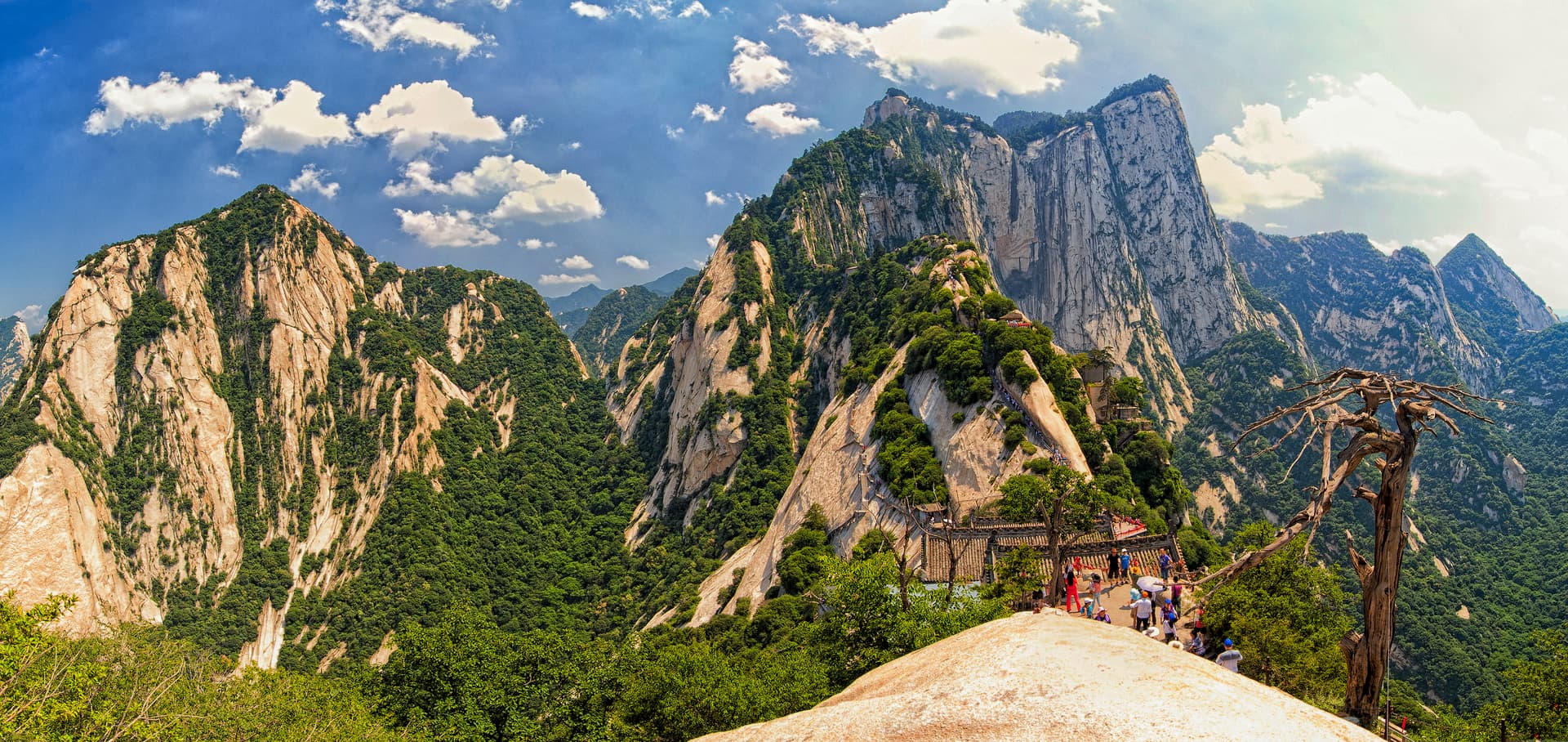
Image of Zhongnan-shan. Image source · CC-BY-SA-4.0
Visit essentials
A quick read before you go
- Duration
- Half day for a single temple visit.
- Etiquette
- Temple etiquette applies at formal sites.
Overview
Somewhere in Zhongnan Shan, people still meditate in caves for months, years, or decades, growing food, collecting water, and studying the mind. They continue a hermit tradition stretching back more than two millennia, before organized Taoism or Buddhism's arrival in China.
Louguantai is held as an origin point of Taoist philosophy, where Laozi is said to have spoken the Dao De Jing's 5,000 characters to the border guardian Yin Xi before vanishing west. Whether or not that event occurred historically, the tradition has made this landscape a spiritual homeland of Chinese mysticism. In the 12th century, Wang Chongyang founded the Quanzhen school here, Taoism's most significant reform movement, integrating Buddhist meditation into Taoist internal alchemy.
Buddhist presence is also deep. Nanwutai has drawn pilgrims for over 1,400 years, and Caotang Temple traces its origins to Indian Buddhism's early transmission into China. The traditions have coexisted here for centuries, and hermits draw from both without insisting on their boundary. Bill Porter's 1989 book 'Road to Heaven' brought international attention to this living practice, documenting young seekers and elderly masters who had spent decades in isolation.
Near Xi'an, China's ancient capital, the mountains create a sacred geography of withdrawal: city and hermitage remain within sight and reach, building the relationship between active and contemplative life into the landscape.
Why this place is sacred
The quality of encounter at Zhongnan Shan operates at a different register than a temple visit or a monument tour. The thinness here is atmospheric, distributed across a landscape rather than concentrated in a structure. Walking the mountain paths between temples, you are walking through a space where someone is practicing, somewhere, out of sight. The hermits are not an attraction to be viewed but a presence to be reckoned with.
Louguantai concentrates a specific dimension of this quality. The tradition places Laozi here at the moment of the Dao De Jing's composition, the instant when the most influential mystical text in Chinese history passed from one mind to another. Whether this happened as described is less important than the fact that the place has been honored as if it did for over two thousand years.
The accumulated devotion of those centuries has given Louguantai a weight that does not require belief in the literal story to be felt.
Wang Chongyang's cave in the Zhongnan Mountains is the origin point of Quanzhen Taoism, a movement that systematized the hermit tradition's insights into a monastic discipline. The cave itself is unremarkable. What matters is what happened inside it: a retired official stripped away his social identity and discovered something that millions of subsequent practitioners have considered worth devoting their lives to.
The Buddhist sites add a different texture. Nanwutai's temples climb a scenic mountain valley, each temple marking a stage of ascent that functions as an embodied metaphor for spiritual progress. Caotang Temple, associated with the early transmission of Indian Buddhist scholarship into China, connects the mountains to the vast intellectual project of making Buddhism Chinese.
The coexistence of Taoist and Buddhist traditions within a single landscape, without the sectarian conflict that characterizes much of Western religious history, embodies the Chinese genius for synthesis. Hermits of both traditions share the mountains, sometimes the same paths, sometimes the same teachings adapted to their own frameworks.
Sacred use documented for over 2,500 years. The Louguantai tradition dates Laozi's teaching to the 6th century BCE. The hermit tradition has been continuous for at least two millennia, with formal Taoist and Buddhist institutions developing alongside it.
The Tang dynasty (7th-9th century) marked the peak of both Taoist and Buddhist activity, with imperial patronage from the nearby capital of Chang'an. Wang Chongyang's founding of Quanzhen Taoism in the 1160s was the major institutional development. The hermit tradition survived every political upheaval including the Cultural Revolution, when some practitioners simply retreated deeper into the mountains. Bill Porter's 1989 documentation brought international awareness. The 21st century has seen growing interest alongside concerns about tourism's impact on the hermit tradition.
Experience and orientation
The experience of Zhongnan Shan depends on how deeply you choose to enter. The major temple sites, Louguantai, Nanwutai, and the Grand Chongyang Longevity Palace, are accessible as day trips from Xi'an and offer encounters with living Taoist and Buddhist communities. Monks and nuns maintain daily worship, and the temple grounds carry the particular atmosphere of places where routine devotion has been practiced for centuries.
Louguantai sits at the northwestern foot of the mountains, a complex of temples, a tower, and a spring associated with Laozi. The atmosphere is quiet and literary rather than monumental. Standing at the place where the Dao De Jing is said to have been spoken, the visitor confronts the paradox at the heart of Taoism: the text that begins 'The Dao that can be spoken is not the true Dao' was itself spoken here.
Nanwutai offers a more physically demanding experience, with multiple temples climbing a scenic mountain valley over 1,400 years of Buddhist history. The ascent from lower to upper temples creates a progression from populated devotional space to increasingly solitary and natural surroundings.
The deeper experience of Zhongnan Shan unfolds over multiple days for those who venture beyond the established temple circuits. Mountain trails connect sites through forests where the transition from temple to wilderness is gradual rather than abrupt. The awareness that hermits live in caves and huts throughout these mountains changes the quality of every path. Every stream might water a practitioner's garden. Every clearing might hide a meditation hut.
The contrast with Xi'an, visible from certain vantage points as a vast modern city sprawling across the plain below, provides constant context. The mountains are close enough to the city to make withdrawal a choice rather than an accident. The hermits could return to urban life in hours. They stay because they have found something in the mountains that the city does not offer.
Multiple entry points serve different sites. Louguantai is approximately 70 km southwest of Xi'an. Nanwutai is approximately 30 km south. The Grand Chongyang Longevity Palace is accessible from different routes. A car or organized tour is recommended for visiting multiple sites. For deeper mountain exploration, local guides familiar with the trails are advisable.
Context and lineage
The foundational narrative places Laozi at Louguantai, composing the Dao De Jing for the border guardian Yin Xi before departing westward from China. Yin Xi had seen a purple cloud approaching from the east and recognized it as the sign of a sage's approach. He asked the old philosopher to record his wisdom before leaving. Laozi composed the 5,000 characters that became the most influential Taoist text, then passed through the gate and was never seen again.
The purple cloud became a Taoist symbol of spiritual attainment.
Louguantai represents the origin of Taoist philosophy. The Quanzhen school, founded in the Zhongnan Mountains, became the dominant form of Taoism in northern China. The Buddhist temples connect to multiple Chinese Buddhist traditions including Chan and Pure Land. The hermit tradition draws from all these lineages while belonging to none exclusively.
Laozi
Legendary founder of Taoism, said to have composed the Dao De Jing at Louguantai before departing westward
Yin Xi
Border guardian who recognized Laozi's approach and asked him to record his wisdom
Wang Chongyang
Founder of Quanzhen Taoism (1113-1170), who practiced in a Zhongnan mountain cave before establishing the most significant reform movement in Taoist history
The Seven Perfected (Qizhen)
Wang Chongyang's seven disciples who spread the Quanzhen school across northern China
Bill Porter (Red Pine)
American author whose 1989 book 'Road to Heaven' documented the living hermit tradition and brought it to international attention
Traditions and practice
Taoist liturgy and scripture recitation at Louguantai and Quanzhen temples. Quanzhen monastic discipline including celibacy, vegetarianism, and internal alchemy (neidan) meditation. Buddhist Pure Land and Chan practice at Nanwutai and other monasteries. Hermit cultivation in mountain caves and huts: solitary meditation, qigong, herb gathering, and self-sufficient living aligned with natural cycles.
Daily services continue at major Taoist and Buddhist temples. An estimated 5,000 or more hermits maintain the cultivation tradition in mountain shelters. Some temples offer meditation or qigong instruction to visitors. Short-term retreat programs are available at select monasteries. Growing interest in hermit-style retreats has created a small but dedicated pilgrimage stream.
Visit Louguantai early in the morning when the temple grounds are quiet and the literary atmosphere of the site is most accessible. If you feel drawn to the hermit tradition, understand that the appropriate response is not to seek hermits out but to practice solitude yourself. Walk the mountain paths between temples slowly, without earbuds or phone, paying attention to the quality of silence. If a hermit near a path acknowledges you, respond with quiet respect.
At Nanwutai, climb the full circuit of temples and notice how the quality of the space changes with elevation. Bring a copy of the Dao De Jing and read it at Louguantai.
Taoism (Louguantai and Quanzhen)
ActiveZhongnan holds foundational significance for Taoism. Louguantai is the traditional site where Laozi conveyed the Dao De Jing, and Wang Chongyang founded the Quanzhen school here in the 12th century. Quanzhen integrated Buddhist monastic discipline and Chan meditation into Taoist practice, becoming the dominant form of Taoism in northern China.
Taoist liturgy at temples. Qigong and internal alchemy practice. Quanzhen monastic discipline. Laozi commemoration ceremonies. Mountain pilgrimage circuits connecting major temples.
Buddhism (Chan/Zen and Pure Land)
ActiveBuddhist presence stretches back over 1,400 years, with Nanwutai as the most important pilgrimage site and Caotang Temple connected to the early transmission of Indian Buddhism into China.
Chan meditation in monasteries and hermitages. Pure Land devotional practice. Guanyin devotion. Pilgrimage to Nanwutai. Mountain retreats combining meditation with physical cultivation.
Hermit Cultivation Tradition
ActiveThe world's largest surviving hermit community, with an estimated 5,000 or more practitioners living in caves, stone huts, and shelters throughout the mountains. The tradition stretches back over two millennia and has survived every political upheaval.
Solitary meditation. Qigong and tai chi. Herb gathering and traditional medicine. Self-sufficient living aligned with natural cycles. Scripture study. Minimal possessions and simple diet.
Perspectives and open questions
Zhongnan Shan invites interpretation as the birthplace of Taoist philosophy, as the home of the world's largest hermit community, and as a landscape where the relationship between withdrawal and engagement has been explored for over two millennia.
Scholarly perspective
Scholars recognize Zhongnan Shan as one of the most important sacred landscapes in Chinese religious history. The Louguantai tradition, while historically debated, represents a foundational Taoist narrative. Wang Chongyang's Quanzhen reform is well-documented as a pivotal moment in Taoist institutional history. The hermit tradition has drawn growing academic interest as anthropologists and religious studies scholars document its remarkable survival into the modern era.
Living and traditional perspectives
For Taoist practitioners, Zhongnan Shan is where the Dao was first expressed in human language and where the tradition of withdrawal and cultivation has been maintained since antiquity. The hermits are the living heirs of Laozi's teaching. For Chinese Buddhists, the mountain's temples represent important links in the chain of dharma transmission from India to China.
Alternative interpretations
The hermit tradition attracts seekers interested in qigong, internal alchemy, and claims of extraordinary longevity associated with advanced practitioners. The mountains' feng shui properties and their position south of the ancient imperial capital are interpreted by some as contributing to the landscape's spiritual potency.
Open questions
The exact number of hermits currently practicing in the mountains is unknown and probably unknowable. What specific meditation and cultivation techniques are transmitted among hermit lineages remains largely undocumented. Whether the historical Laozi existed and whether the Louguantai tradition is based on any historical event remains unresolved. How the hermit tradition relates to growing tourism pressure is an open question.
Plan your visit
Access and arrival
Xi'an offers the full range of accommodations as a major international tourism city. Some temples offer basic guesthouse facilities. Mountain huts and shelters exist along some trails but should not be relied upon without local knowledge.
Respectful visit
Modest clothing for temple visits, with shoulders and knees covered. Sturdy hiking shoes and layers for mountain trails. Rain gear in summer months. Warm layers for higher elevations and winter visits.
Generally permitted in outdoor temple areas. Ask permission inside temple halls. Do not photograph hermits without explicit permission. No flash photography near statues or murals. Drone use generally prohibited in temple areas.
Incense is available at temple shops and is appropriate at both Taoist and Buddhist temples. Follow local customs for offering protocol.
Do not enter hermit dwellings or cultivation areas uninvited | Do not photograph hermits without permission | Remove shoes when entering temple halls if requested | Walk clockwise around Buddhist structures | Stay on marked trails in nature reserve areas | Quiet behavior in temple areas | Do not disturb wildlife
Do not seek out hermit dwellings uninvited. The hermit tradition depends on solitude, and well-meaning visitors can be as disruptive as hostile ones. Some hermitages are on private or restricted land. The mountain terrain can be demanding, with steep trails and variable weather. Higher elevations require appropriate fitness and preparation.
Current practical details
Address
Zhongnan Shan, Chang'An, Xi'An, China, 710105
Hours, fees, and access can change — verify on the official source before you travel. Practical details last checked Jun 2026.
Location
Map loads as you approach this section.
Pilgrim reflections
A portrait of encounter, not a score
Pilgrims describe what they felt, how present they could become, and whether the place would shape a journey. There are no stars and no ranking of traditions.
No reviewed reflections yet
The first pilgrims can help describe the character of being here.
Share a reflection
Available after an account-backed “Been there.” Every reflection is reviewed before publication.
Nearby sacred places
Explore other sacred places in the region. Proximity does not establish access or travel time; check each place’s guidance.


Pilgrim glossary
- Dharma
- The teachings of the Buddha; also the universal law underlying them.
- Pure Land
- A Buddhist tradition focused on rebirth in Amida Buddha's western paradise through devotional practice.
Share a photo
Help visitors recognize Zhongnan-shan. Every submission is reviewed before publication.