Longmen Grottoes
Where four centuries of devotion carved 110,000 Buddhas into riverside stone
Understand sacred places, explore living traditions, and learn how to engage respectfully with Pilgrim Map.
Access has not been verified. Check current local guidance before planning a visit.
Luolong District, Henan, China
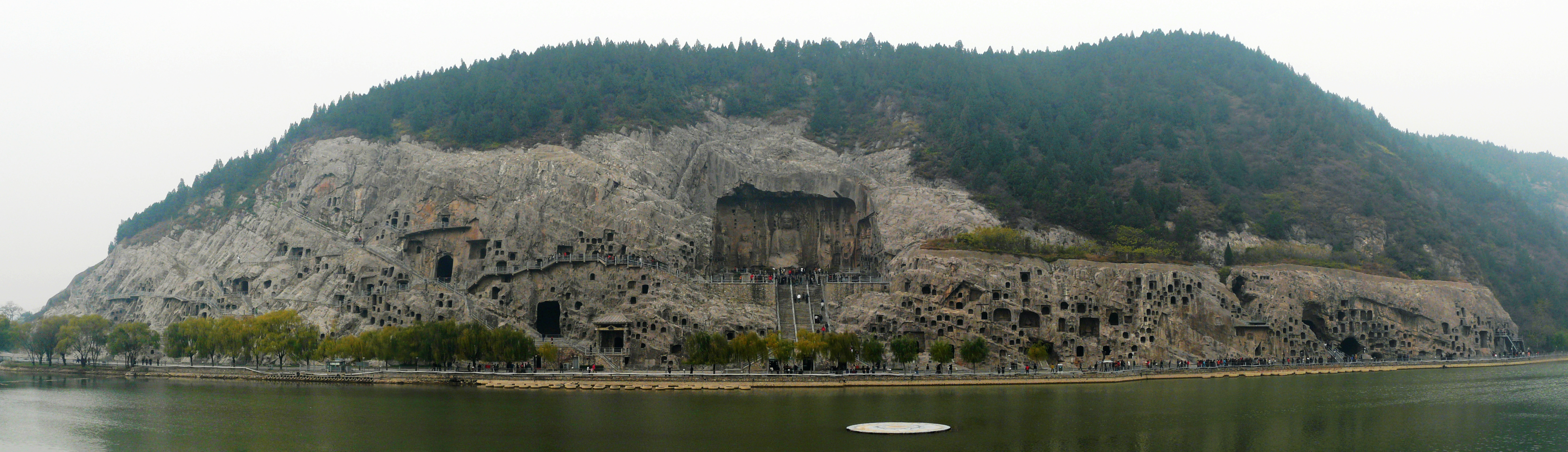
Image of Longmen Grottoes. Image source · CC-BY-SA-3.0
Visit essentials
A quick read before you go
- Duration
- Three to four hours for a thorough visit covering both banks of the Yi River.
- Access
- Located 12 km south of Luoyang city center, accessible by city bus (routes 53, 60, 67, 81) or…
Overview
Longmen's limestone cliffs beside the Yi River hold four centuries of Buddhist devotion. Over 2,300 caves and niches contain more than 110,000 statues, from figures barely larger than a thumbnail to the 17-meter Vairocana Buddha, whose equanimity has endured devotion and vandalism.
Carving began in 493 CE after the Northern Wei emperor moved his capital to Luoyang and continued for four hundred years through successive dynasties and their finest sculptors. Austere, elongated Northern Wei figures wear Chinese-style robes, marking Buddhism's transformation from an imported faith into a Chinese one. Two centuries later, Tang figures became naturalistic and serene, their rounded forms expressing a civilization at peak confidence.
The Vairocana Buddha of Fengxian Temple was completed in 675 CE under Empress Wu Zetian's patronage. Vairocana is the Dharmakaya Buddha, the reality body of enlightenment itself. Rendering that concept as a 17-meter figure flanked by bodhisattvas, heavenly kings, and wrathful guardians claimed that cosmic order could be visible. Whether its face resembles Wu Zetian remains debated; its complete serenity and power to absorb attention do not.
Why this place is sacred
The thinness at Longmen operates through volume. Not the volume of a single great statue, though the Vairocana achieves that, but the volume of accumulated intention. Inscription evidence reveals that donors came from every class. Emperors commissioned entire cave temples as displays of piety and power. Monks and nuns ordered niches for the merit of their communities.
Individual families carved a single small Buddha for the healing of a sick child or the safe passage of a parent through the afterlife. Each figure was an address to the unseen, a request shaped in stone.
The Yi River adds a dimension that the caves alone cannot provide. Water flows past stone. Impermanence runs alongside permanence. The river has not stopped moving in the fifteen centuries since the first chisel struck this cliff, and the Buddhas have not stopped sitting. This juxtaposition is not accidental in Buddhist thought: the heart of the teaching is that all things are impermanent, yet the aspiration toward awakening persists.
Then there is the damage. Many figures are headless, their faces chiseled away by collectors and thieves over the past two centuries and shipped to museums in Europe and America. This violence is visible everywhere at Longmen, a pattern of absence that makes the intact faces more precious. The Vairocana's survival, serene and complete above the broken figures below, creates a visual teaching about what endures and what does not.
The Longmen Grottoes served as a site of active Buddhist worship and merit-making from their inception in 493 CE through the end of the Tang Dynasty. Caves functioned as shrines where monks conducted liturgies before the carved images. Individual niches were commissioned by donors for specific meritorious purposes: healing illness, ensuring safe births, generating merit for deceased parents.
The inscriptions carved alongside the figures constitute one of the most extensive records of Buddhist patronage and belief in China, documenting the intentions of donors across centuries and social classes.
After the Tang Dynasty, major carving activity ceased and the grottoes gradually transitioned from active worship site to cultural monument. The associated monasteries declined. The site suffered extensive damage during the 19th and 20th centuries when Western collectors and their agents systematically removed heads and entire panels from the caves. The 2000 UNESCO World Heritage inscription recognized the grottoes as among the finest examples of Chinese Buddhist art.
Today, the site functions as an archaeological park and cultural tourist destination, though Chinese Buddhist pilgrims still visit and some offer silent prayers before the carved figures.
Experience and orientation
The experience begins on the west bank of the Yi River, where the majority of the caves face east across the water. The path follows the cliff face northward, and the grottoes reveal themselves in succession: small niches holding individual Buddhas give way to larger caves with multiple figures, which in turn give way to the great cave temples with their walls of carved devotion.
The earliest caves, dating from the Northern Wei period, set the tone. The figures here are slender, their faces elongated, their robes falling in parallel ridges that suggest Chinese brush painting translated into stone. There is an austerity to these figures that reflects the Buddhism of their time: serious, contemplative, still carrying the weight of a faith recently arrived from India and Central Asia.
As the path progresses, the style shifts. Sui Dynasty caves show transitional forms. Then the Tang Dynasty arrives, and the stone seems to soften. Figures become round-faced, full-bodied, naturalistic. The Wanfo Cave, the Ten Thousand Buddhas Cave, lives up to its name with 15,000 small Buddhas covering every surface, each one individually carved.
The approach to the Fengxian Temple is the climax. An open-air rock-cut shrine rises above the path, and the Vairocana Buddha emerges from the cliff face at a scale that shifts the relationship between viewer and viewed. At 17.14 meters, the figure is large enough to create its own gravity. The face looks down with an expression that generations of visitors have struggled to describe: serene, knowing, compassionate, remote, present. The flanking figures complete a stone mandala of cosmic order.
Throughout the walk, the damage is inescapable. Headless figures. Empty niches where statues once sat. Scarred surfaces where faces were chiseled free. This visible history of loss gives the intact figures a charged quality, as though they have survived something, which they have.
Enter from the west bank entrance and follow the path northward along the cliff face. Allow three to four hours for a thorough visit covering both banks. Bring an audio guide or guidebook to identify the major caves and their dynastic periods. The east bank offers panoramic views of the west cliff face and is worth the crossing. Early morning provides the softest light on the west-facing carvings. Late afternoon illuminates the Fengxian Temple most dramatically.
Comfortable walking shoes are essential as the path includes stairs and uneven sections.
Context and lineage
When the Northern Wei Emperor Xiaowen moved his capital from Datong to Luoyang in 493 CE, he brought with him a tradition of Buddhist cave carving that had already produced the monumental Yungang Grottoes near his former capital. The limestone cliffs flanking a narrow gorge called Dragon Gate on the Yi River provided a new canvas.
The name resonated with Chinese mythology: Dragon Gate was a threshold of transformation, a place where, according to legend, carp that swam upstream and leaped the falls would become dragons.
The Northern Wei were Xianbei nomads who had adopted Buddhism as both a matter of genuine devotion and a tool of political legitimation. Their cave temples at Longmen reflected the transition from Indian-influenced forms to something distinctly Chinese. Two centuries later, Empress Wu Zetian channeled enormous resources into the Fengxian Temple project. The colossal Vairocana, traditionally said to bear her likeness, served both religious and political purposes.
By identifying herself with the cosmic Buddha, Wu Zetian legitimated her unprecedented exercise of female imperial power through Buddhist cosmology. The face that looks across the Yi River today may be the face of the only woman to rule China as emperor in her own name.
The Longmen Grottoes belong to a tradition of Buddhist cave temple construction that originated in India with sites like Ajanta and Ellora, traveled along the Silk Road through Dunhuang and Yungang, and reached its Chinese culmination at Longmen. The Northern Wei caves show the last traces of Central Asian influence. The Tang caves represent the fully realized Chinese Buddhist aesthetic, a synthesis so complete that subsequent centuries looked back to Longmen as a standard.
The inscription tradition at Longmen connects it to the broader Chinese practice of carving prayers and records into stone, a practice that bridges Buddhist devotion with Confucian literary culture.
Empress Wu Zetian
China's only female emperor and the most prominent patron of the Tang-era carvings at Longmen. She channeled vast resources into the Fengxian Temple project, and the Vairocana Buddha is traditionally said to bear her likeness. Through Buddhist patronage, she legitimated her unprecedented rule, aligning her authority with the cosmic order embodied in the Dharmakaya Buddha.
Emperor Xiaowen of the Northern Wei
The emperor whose relocation of the Northern Wei capital to Luoyang in 493 CE initiated the carving of the Longmen Grottoes. A committed Buddhist and cultural reformer, he sought to create cave temples that would surpass the earlier Yungang Grottoes and express a more distinctly Chinese Buddhist aesthetic.
The anonymous donors
Tens of thousands of individual donors across four centuries, from aristocrats to farmers, who commissioned individual niches and figures as acts of merit-making. Their names and intentions survive in the inscriptions carved alongside their donated figures, forming one of the most complete records of ordinary Buddhist belief in Chinese history.
Amy McNair
Art historian whose scholarly work on Longmen's inscription evidence has revealed the complex social networks of patronage, faith, and political power that produced the grottoes. Her analysis demonstrates that the site was not merely imperial art but a collective expression of Buddhist devotion across all social classes.
Traditions and practice
During the centuries of active use, monks and nuns in monasteries associated with specific caves conducted regular Buddhist liturgies before the carved images. Imperial ceremonies at the Fengxian Temple marked the grandest expressions of state-sponsored Buddhist worship. Individual donors commissioned niches through a process that combined religious devotion with social display: inscriptions recorded the donor's name, their intention, and the merit being generated.
The act of commissioning a carved Buddha was itself a practice, understood to produce spiritual benefit for the donor and the named recipients of the merit.
No regular religious services are conducted at the caves. The site functions as an archaeological park with a designated visitor route along the cliff face. Chinese Buddhist visitors may offer silent prayers before the carved figures. The site's annual cultural festivals and academic conferences maintain its connection to Buddhist scholarship. Some visitors bring incense, though burning it is restricted in most areas for conservation reasons.
Slow your pace. The grottoes reward attention at multiple scales. At the broadest scale, notice how the artistic style shifts as you walk northward through time, from the austere Northern Wei to the confident Tang. At a middle scale, enter individual caves and let your eyes adjust to the dim light, noticing how the carved figures relate to each other within each space.
At the closest scale, look at individual faces: the variations of expression, the details of robes and jewelry, the individuality that emerges from what might initially seem like repetition.
At the Fengxian Temple, resist the impulse to photograph immediately. Stand at the base and look up at the Vairocana's face. Allow its expression to register before you try to capture it. Then move to the sides and notice how the expression changes with the angle of view. Scholars have debated for centuries whether the face smiles or is perfectly neutral. Form your own reading.
On the east bank, turn back toward the west cliff. From this distance, the individual figures merge into a pattern of carved devotion stretching along the stone. This is the view that conveys the scale of collective faith that produced this place.
Chinese Mahayana Buddhism (Northern Wei Period)
HistoricalThe earliest caves at Longmen, carved beginning in 493 CE, reflect the Buddhist faith of the Northern Wei Dynasty, originally Xianbei nomads who adopted Buddhism as both genuine devotion and political legitimation. The Northern Wei sculptures at Longmen mark a pivotal moment in Chinese art history: the transition from the Indian-influenced styles of the earlier Yungang Grottoes to a distinctly Chinese Buddhist aesthetic characterized by attenuated figures, contemplative expressions, and Chinese-style robes.
Imperial sponsorship of cave carving as a merit-making activity. Monastery-based liturgies conducted before the carved images. Individual donors commissioned niches for specific purposes: healing illness, safe birth, merit for deceased parents. Inscriptions carved alongside the figures recorded the donor's name and intention.
Chinese Mahayana Buddhism (Tang Dynasty Period)
HistoricalThe Tang Dynasty brought the second and greatest wave of sculpture at Longmen, culminating in the Fengxian Temple complex completed in 675 CE. Tang-era sculpture represents the fullest flowering of Chinese Buddhist art: naturalistic, serene, confident. The colossal Vairocana Buddha, patron-linked to Empress Wu Zetian, embodies the integration of Buddhist devotion with imperial power at its most ambitious scale.
Large-scale state-sponsored Buddhist ceremonies at the Fengxian Temple. The Vairocana represented the cosmic Buddha as a source of universal light and truth, with surrounding attendant figures forming a stone mandala of cosmic order. Merit-making through cave sponsorship continued across all social classes.
Cultural Heritage and Archaeological Stewardship
ActiveSince the 2000 UNESCO inscription, Longmen has been maintained as a cultural heritage site of international significance. Archaeological research, conservation work, and public interpretation continue to reveal new aspects of the grottoes' history and significance.
Ongoing archaeological research and documentation. Conservation efforts to stabilize deteriorating stone surfaces. Digital scanning and 3D modeling of the caves for preservation and study. International collaboration on the repatriation of looted sculptural elements. Public interpretation through guided tours, audio guides, and the on-site museum.
Perspectives and open questions
Longmen can be read as art history, as devotional record, as political statement, or as a meditation on what survives. Each reading reveals aspects the others miss.
Scholarly perspective
Art historians view Longmen as the most important site for understanding the development of Chinese Buddhist sculpture from the late 5th through 8th centuries. The transition from Northern Wei to Tang styles visible along the cliff face charts what scholars call the sinification of Buddhist art: the transformation of Indian and Central Asian forms into a distinctly Chinese aesthetic.
The inscription evidence, analyzed by scholars including Amy McNair, provides an invaluable record of Buddhist patronage, belief, and social history across class lines. The Vairocana Buddha at Fengxian Temple is consistently cited as the apex of Tang Buddhist sculpture, combining theological ambition with artistic mastery.
Living and traditional perspectives
For Chinese Buddhists, Longmen remains a place where the Dharma was inscribed in stone by the collective faith of countless devotees across four centuries. The Vairocana Buddha represents the timeless truth of Buddhism made visible. The damaged and looted caves are mourned as wounds to the Buddhist heritage, and efforts to repatriate looted heads from Western museum collections continue.
Alternative interpretations
Some visitors describe the density of carved Buddhas as creating a concentrated field of devotional energy that persists despite the site's transition from active worship to cultural monument. The Medical Prescription Cave, with its carved pharmaceutical formulas, has attracted attention from practitioners interested in the intersection of Buddhist healing traditions and traditional Chinese medicine.
Open questions
The original painted surfaces of the caves, now almost entirely lost, transformed the experience of the grottoes in ways that are impossible to fully recover. How color animated these stone figures, how the interplay of painted robes and gilded faces changed the atmosphere of the cave interiors, remains a matter of imagination informed by traces. The identity and fate of the master sculptors who created the finest works are lost to history.
They left 110,000 faces and not a single name.
Plan your visit
Access and arrival
Located 12 km south of Luoyang city center, accessible by city bus (routes 53, 60, 67, 81) or taxi in approximately 20 to 30 minutes. Luoyang is reached by high-speed rail from Xi'an (1.5 hours), Zhengzhou (40 minutes), or Beijing (3.5 hours). Entry fee is approximately 90 CNY, which includes access to both banks and associated temples. Hours are approximately 8:00 to 18:00 with seasonal variation, and last entry is one hour before closing.
Mobile phone signal is available throughout the site.
Luoyang offers accommodation at all price levels, from international hotels to budget guesthouses. The city center is the most convenient base, with easy access to Longmen by public transport. Luoyang is also a base for visiting the Shaolin Temple and the Luoyang Peony Festival in spring.
Respectful visit
Comfortable walking shoes are essential, as the path involves stairs and uneven surfaces stretching approximately one kilometer along the west bank. Sun protection is advisable for the open-air sections. No specific religious dress requirements apply.
Photography is permitted throughout the site. Flash photography is prohibited inside enclosed caves to protect any surviving ancient pigments. Do not use selfie sticks near the sculptures. Drones are not permitted within the scenic area.
The site is an archaeological monument rather than an active temple. While some visitors offer silent prayers before the Buddhist images, formal offerings are not part of the visitor experience.
Do not touch any sculptures or carved surfaces. Stay on designated paths and walkways. Do not climb on the rock face. Do not throw objects into the caves or niches. Do not carve graffiti into any surface.
The grottoes are a cultural heritage site, not an adventure destination. The stone surfaces are irreplaceable and already heavily damaged by centuries of looting and weathering. Do not touch any carved surfaces. The temptation to reach out is strong, particularly when a face is close at hand, but skin oils accelerate deterioration of ancient stone.
Current practical details
Address
13 Long Men Zhong Jie, Luo Long Qu, Luo Yang Shi, He Nan Sheng, China, 471023
Phone
Hours
Hours, fees, and access can change — verify on the official source before you travel. Practical details last checked Jun 2026.
Location
Map loads as you approach this section.
Pilgrim reflections
A portrait of encounter, not a score
Pilgrims describe what they felt, how present they could become, and whether the place would shape a journey. There are no stars and no ranking of traditions.
No reviewed reflections yet
The first pilgrims can help describe the character of being here.
Share a reflection
Available after an account-backed “Been there.” Every reflection is reviewed before publication.
Nearby sacred places
Explore other sacred places in the region. Proximity does not establish access or travel time; check each place’s guidance.


Photo gallery
3 curated photos
Pilgrim glossary
- Mandala
- A symbolic diagram of the cosmos used in meditation and ritual.
- Dharma
- The teachings of the Buddha; also the universal law underlying them.
Share a photo
Help visitors recognize Longmen Grottoes. Every submission is reviewed before publication.