Uxmal
The masterwork of Maya architecture where stone prayers for rain cover every surface
Understand sacred places, explore living traditions, and learn how to engage respectfully with Pilgrim Map.
Access has not been verified. Check current local guidance before planning a visit.
Santa Elena, Yucatán, Mexico
Read the sources
Visit essentials
A quick read before you go
- Duration
- 3-4 hours for thorough exploration
- Etiquette
- UNESCO World Heritage Site.
Overview
Unlike other major Mesoamerican cities, Uxmal had neither cenotes nor streams. Yet between 700 and 1000 CE its Maya builders created one of the ancient world's most sophisticated cities, collecting rain in underground chultunes for an estimated 20,000 to 25,000 people.
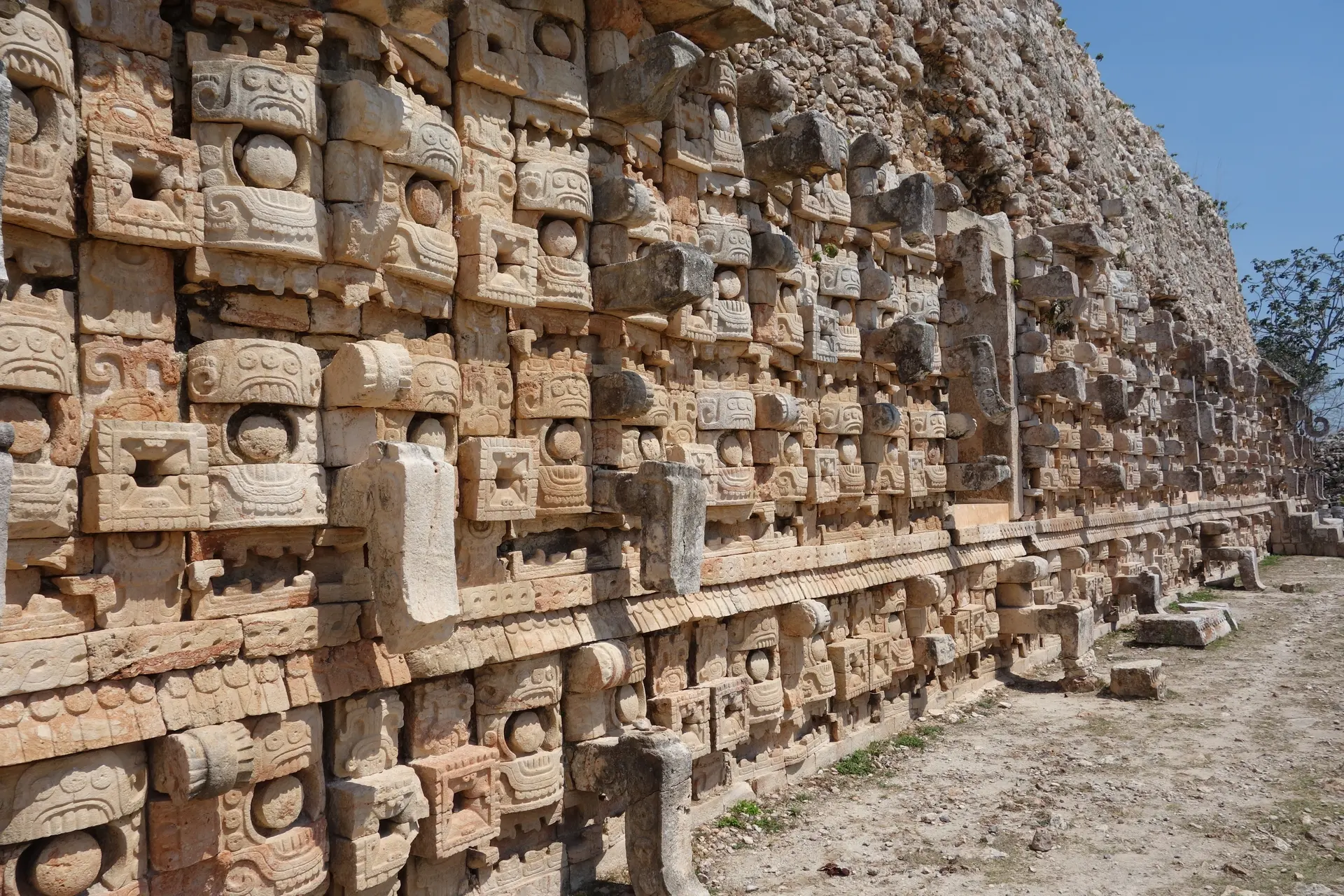
Dependence on rain made architecture prayer. Chaac's hooked nose and fanged mouth appear hundreds of times; over 200 masks cover the Governor's Palace in a limestone ch'a chaak ceremony, petitioning for life-giving water. The oval, rounded Pyramid of the Magician carries the legend of an egg-hatched dwarf who built it overnight and won Uxmal's rule, though whether this recalls rapid construction or later imagination is unknown.
Uxmal is the peak of Puuc architecture. Cut veneer stones over concrete cores form geometric patterns, latticework, step-frets, and serpents. At the Nunnery Quadrangle, four distinct facades enclose one ceremonial courtyard as a unified whole.
Why this place is sacred
Uxmal's sacred force is an architecture of need: Chaac masks are stone prayers for rain that filled cisterns sustaining 20,000 lives. Puuc cut-stone veneers, geometric patterns, step-frets, latticework, and divine imagery required advanced planning, skilled carvers, and coordination of thousands of stones. Labor itself declared that the gods could not be petitioned carelessly.
Oval and rounded rather than rectangular, the Pyramid of the Magician contains five construction phases, each temple built over the last. Its curves resist comprehension from any single angle. At the Nunnery Quadrangle, a southern vaulted passage moves visitors from outside into an enclosed decorated court, making the profane-to-sacred threshold architectural.
Since 1975, the Light and Sound Show has illuminated these facades while narrating Maya history. Despite its tourism apparatus, many visitors report it as genuinely moving: another language for what the builders left.
Regional capital and ceremonial center. Architecture as prayer for rain. Site of elaborate rituals connected to water, agriculture, and cosmic cycles.
Ceramic evidence suggests occupation from 800 BCE. Major construction 600-1000 CE. Peak influence under Lord Chac around 900 CE. Toltec influence arrived c. 1000 CE. Participated in League of Mayapan political alliance. Abandoned c. 1450 CE after league collapsed. Documented by Stephens and Catherwood 1839-1841. UNESCO inscription 1996. Evening Light and Sound Show since 1975.
Experience and orientation
The Pyramid of the Magician dominates first impressions, its oval form rising unexpectedly from the flat Puuc landscape. Unlike most Maya pyramids, this one curves, its rounded stages suggesting something organic rather than geometric. You cannot climb it, but you can walk its perimeter, experiencing how the shape shifts from different angles, never quite resolving into the familiar rectangular form you expect.
The legend of the dwarf magician who built it overnight through magic begins to seem appropriate for something so strange. Moving south, you approach the Nunnery Quadrangle through a vaulted entrance in its south building. The transition is deliberate: you pass from open space through a constructed threshold into an enclosed courtyard surrounded by four elaborately decorated structures.
Spanish conquistadors named it for its resemblance to a convent, but scholars believe it served as administrative or ceremonial function, perhaps housing priests or nobles. Each of the four buildings bears different decorative programs, from the relatively plain south building to the elaborate north structure with its stacked Chaac masks and lattice patterns. The Governor's Palace represents Puuc architecture at its peak. American architect Frank Lloyd Wright called it the greatest building in the Americas.
At 100 meters long, it sits atop a massive platform overlooking the site, its facade covered with over 20,000 individually carved stones creating geometric mosaics and more than 200 Chaac masks. The central doorway aligns with the rising Venus, demonstrating astronomical precision. Standing before it, you understand why UNESCO inscribed this site: this is human creative genius expressed in stone. The House of Turtles, near the Governor's Palace, offers intimate scale after monumental grandeur.
The carved turtles along its cornice connected to rain prayers, turtles being associated with water in Maya thought. The Ball Court, where ritual games enacted cosmic struggles between light and darkness, retains its ring through which players attempted to pass a rubber ball. Throughout your exploration, Chaac's face watches from every direction. The hooked nose, the fanged mouth, the square-spiral eyes, repeated endlessly across facades, create an atmosphere of omnipresent divine attention. You are seen here. The gods are present.
For the evening Light and Sound Show, stay past closing. Since 1975, the Nunnery Quadrangle has served as the main projection surface, the facades illuminated as narration tells Maya history. The same show Queen Elizabeth II witnessed on her 1975 Mexico visit continues, a theatrical way of encountering structures that daylight alone cannot fully reveal.
Enter from the main entrance and parking area. The Pyramid of the Magician rises immediately before you. The Nunnery Quadrangle is southwest of the pyramid. The Governor's Palace and House of Turtles are further south on elevated platforms. The Great Pyramid and other structures extend to the southwest. For the Light and Sound Show, remain at or return to the site after closing.
Context and lineage
According to legend recorded by Spanish chroniclers and maintained in local tradition, an old woman, possibly a witch, who lived near what would become Uxmal had no children. She found an egg, wrapped it in cloth, and cared for it until a dwarf hatched. The child grew rapidly in intelligence, learning to speak and walk within a year, but never grew taller than his original size.
When the dwarf reached adulthood, the woman instructed him to challenge the governor of Uxmal by striking a magical gong. The governor demanded the dwarf build a house taller than any existing structure by sunrise or face death. Through the old woman's magic, the dwarf awoke atop the newly created Pyramid of the Magician. In a final contest, both the governor and the dwarf had their heads struck with hard cocoyol fruit.
The dwarf's mother had protected his head with a corn tortilla beneath his hair; the governor's skull shattered. The dwarf became the new ruler of Uxmal.
Uxmal represents the finest expression of Puuc architectural style, a regional tradition that spread across northwestern Yucatan. The site is part of the UNESCO-inscribed Puuc Route along with Kabah, Sayil, Labna, and Xlapak. Uxmal's influence extended throughout the Maya lowlands, its architectural vocabulary adopted by cities across the region. The city participated in larger political networks including the League of Mayapan.
Lord Chac (Chan Chak K'ak'nal Ajaw)
John Lloyd Stephens
Frank Lloyd Wright
Traditions and practice
Maya religious practice at Uxmal centered on Chaac veneration and rain-calling ceremonies (ch'a chaak). The hundreds of Chaac masks served as perpetual stone prayers for the water essential to survival. Ball games in the ceremonial court enacted cosmic struggles between light and darkness, potentially ending in sacrifice. Astronomical observations, particularly of Venus whose rising aligned with the Governor's Palace doorway, governed ceremonial timing. Period-ending rituals marked significant calendar dates.
The ch'a chaak rain ceremony continues in some Maya communities around Uxmal, performed during drought to invoke Chaac's blessing. These are village ceremonies, not conducted at the archaeological site itself. At Uxmal, the evening Light and Sound Show offers cultural immersion since 1975. The Nunnery Quadrangle serves as the main projection surface, with narration telling Maya history as illumination plays across the carved facades. Self-guided meditation and contemplation are welcome throughout the site during operating hours.
Arrive at 8:00 AM opening to experience the site in relative solitude before tour buses arrive. Allow the Pyramid of the Magician's strange form to work on you; walk around it, experience its curves. Enter the Nunnery Quadrangle through the south passage and feel the transition into sacred space. Count the Chaac masks if you can; their repetition is itself a practice. Stand before the Governor's Palace and contemplate what Frank Lloyd Wright saw.
For a different encounter, stay for or return to the Light and Sound Show.
Ancient Maya Religion
HistoricalUxmal was a major ceremonial center where Chaac was invoked through architecture, ritual, and sacrifice. The city's water dependency made rain-calling ceremonies essential to survival. Ball games, astronomical observations, and period-ending rituals maintained cosmic order.
Chaac veneration through architectural iconography. Ch'a chaak rain-calling ceremonies. Ball game rituals. Astronomical observations tied to Venus and solar cycles. Human sacrifice as offerings to the gods.
Contemporary Maya Heritage
ActiveThe Maya people continue to live in the Yucatan, maintain their language, and practice traditions rooted in their heritage. The ch'a chaak ceremony persists in some communities. Sites like Uxmal serve as touchstones for cultural identity.
Community rain ceremonies in surrounding villages. Traditional calendar observances. Agricultural rituals. Cultural preservation.
Perspectives and open questions
Uxmal exists at the intersection of architectural achievement, environmental adaptation, Maya cosmology, and the enduring human impulse to petition the divine.
Scholarly perspective
Archaeologists recognize Uxmal as the finest example of Puuc architecture and one of the most important Maya sites. The sophisticated cut veneer stone construction technique represents advancement over earlier methods. The astronomical alignment of the Governor's Palace with Venus demonstrates advanced celestial knowledge. The city flourished as regional capital from roughly 700-1000 CE with a population of 20,000-25,000. The Terminal Classic decline coincided with broader collapse patterns, with possible drought contributing to abandonment.
The elaborate water collection systems (chultunes) reveal adaptation to water-scarce environment.
Living and traditional perspectives
Contemporary Maya communities maintain connection to their ancestors who built Uxmal. The ch'a chaak rain ceremony practiced in some villages echoes the ancient Chaac veneration evident in every facade. Maya elders view sites like Uxmal as ancestral places deserving respect, where the knowledge and spiritual power of the ancestors remain present. The architectural achievement serves as evidence of ancestral wisdom.
Alternative interpretations
Some spiritual seekers view Uxmal as a power place where ancient Maya wisdom can be accessed. The astronomical alignments are interpreted as evidence of cosmic consciousness. The Pyramid of the Magician's unusual shape is sometimes associated with energy vortexes. These interpretations are not endorsed by scholarly or indigenous communities but represent contemporary spiritual engagement with the site.
Open questions
The specific function of the Nunnery Quadrangle remains debated (palace, school, priestly residence?). Why Uxmal developed such elaborate water collection rather than relocating to areas with cenotes is unclear. The full meaning of the Pyramid of the Magician legend and whether it preserves historical memory is uncertain. Details of the religious practices conducted in various structures cannot be fully reconstructed. The exact nature of Uxmal's relationship with other Puuc cities requires further research.
Plan your visit
Access and arrival
Most visitors stay in Merida and day-trip. Hacienda hotels along the Puuc Route offer atmospheric alternatives. Lodge at Uxmal near the site entrance.
Respectful visit
Light, breathable clothing for hot conditions. Sturdy walking shoes for uneven terrain. Sun protection (hat, sunscreen) essential; the site has little shade. No formal dress code.
Personal photography permitted without additional fee. Professional video equipment and tripods require permits and fees. Drone use typically prohibited. Be respectful of other visitors.
Modern offerings are not part of visiting protocol at this archaeological site. Do not leave objects at structures.
Climbing on pyramids and structures is strictly prohibited. Stay within designated areas marked by ropes and signage. Do not touch, climb on, or remove any stones. Do not disturb or feed the iguanas who populate the ruins. Allow adequate time before closing to complete your visit.
Climbing structures is strictly prohibited. Stay within designated areas. Bring water as availability on-site is limited. Sun protection essential; the site has little shade. The evening Light and Sound Show requires additional time; public transport return may be challenging.
Current practical details
Address
Uxmal, Yucatan, Mexico
Hours, fees, and access can change — verify on the official source before you travel. Practical details last checked Jun 2026.
Location
Map loads as you approach this section.
Pilgrim reflections
A portrait of encounter, not a score
Pilgrims describe what they felt, how present they could become, and whether the place would shape a journey. There are no stars and no ranking of traditions.
No reviewed reflections yet
The first pilgrims can help describe the character of being here.
Share a reflection
Available after an account-backed “Been there.” Every reflection is reviewed before publication.
Nearby sacred places
Explore other sacred places in the region. Proximity does not establish access or travel time; check each place’s guidance.

References
Sources consulted for this page. Source categories describe the publication, not a guarantee that every claim is verified. Traditional accounts and outside interpretations may differ.
- 01Pre-Hispanic Town of Uxmal - UNESCO World Heritage Centre — UNESCOofficialOfficial UNESCO inscription page with criteria and management details
- 02Uxmal | Ancient Mayan City, Archaeological Site in Mexico — Encyclopaedia BritannicaacademicAcademic overview of history and architecture
- 03Uxmal and Puuc | Living Maya Time — National Museum of the American Indian, SmithsonianacademicSmithsonian museum resource on Maya culture
- 04The Maya Ruins at Uxmal Still Have More Stories to Tell — Smithsonian MagazineacademicArchaeological insights and ongoing research
- 05The Governor's Palace is the Greatest Work of Architecture in Uxmal — Instituto Nacional de Antropologia e Historia (INAH)officialOfficial Mexican heritage authority
- 06Rituals of the Modern Maya — Archaeology MagazineacademicAcademic perspective on living Maya traditions
- 07Uxmal - Wikipedia — Wikipedia contributorsacademicComprehensive general overview with citations
- 08Pyramid of the Magician - Wikipedia — Wikipedia contributorsacademicDetailed architectural and legendary information
- 09The Witch, the Dwarf and the Magic Tortilla: the Pyramid of the Magician — Historic MysteriesspiritualDetailed legend documentation
- 10The Governor's Palace | Maya Ruins of Uxmal — Maya RuinsacademicDetailed architectural analysis
- 11House of the Turtles | Maya Ruins of Uxmal — Maya RuinsacademicSymbolic and architectural details
- 12Uxmal - Yucatan Today — Yucatan TodayguideLocal tourism resource with practical visitor information
- 13Experience Uxmal — MexperienceguidePractical visitor guidelines
Photo gallery
3 curated photos
Share a photo
Help visitors recognize Uxmal. Every submission is reviewed before publication.