Traostalos Minoan Peak Sanctuary
A Minoan hilltop where clay prayers accumulated for five centuries above the eastern edge of Crete
Understand sacred places, explore living traditions, and learn how to engage respectfully with Pilgrim Map.
Access has not been verified. Check current local guidance before planning a visit.
Itanos Municipal Unit, Crete, Greece
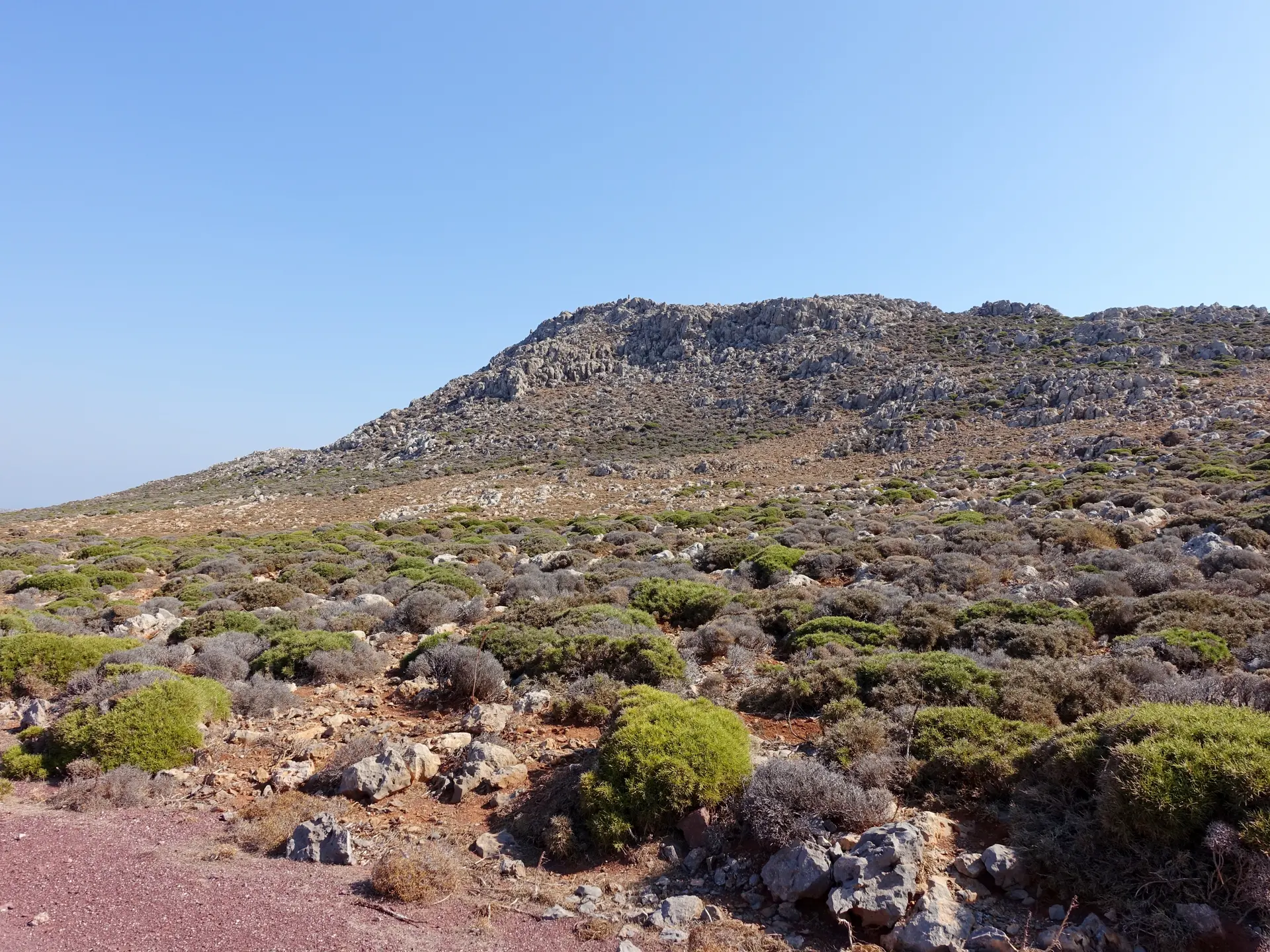
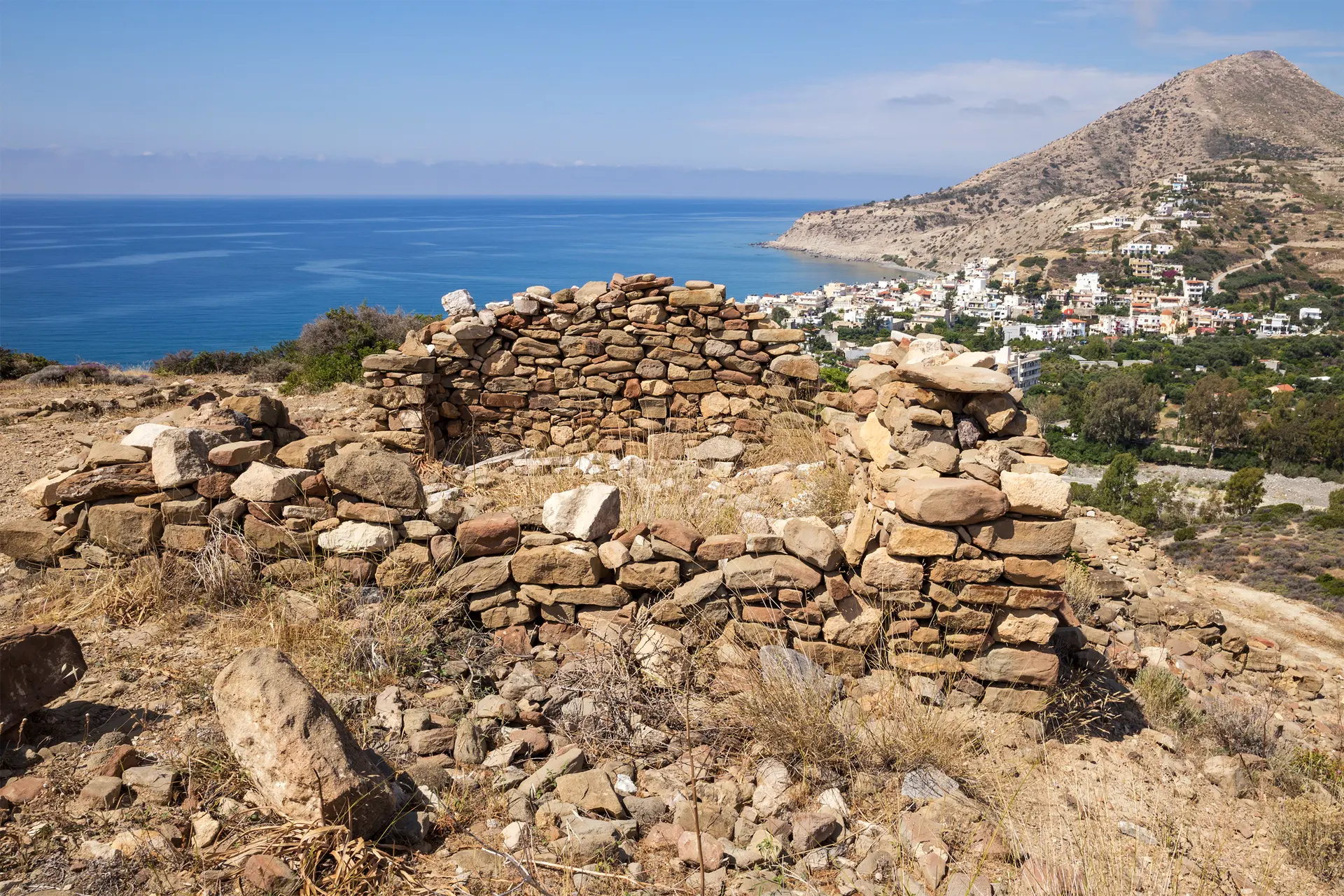
Image of Traostalos Minoan Peak Sanctuary. Image source · CC-BY-3.0
Visit essentials
A quick read before you go
- Duration
- Three to four hours round trip from Azokeramos village, including approximately one hour for the…
- Access
- Begin from Azokeramos village, located 10 kilometers south of Palekastro and approximately 14…
Overview
Above Azokeramos in far eastern Crete, Traostalos's entirely exposed summit plateau measures roughly twenty by twelve meters. It has no walls, reconstructed columns, or interpretive signs: only rock, wind, and a 360-degree panorama over the Zakros gorge south, Dionysades islets north, and sea toward Kasos and Karpathos east. On clear days the curved horizon dissolves sky and water into blue haze.
For roughly five centuries, about 2000-1450 BCE, nearby communities climbed here with offerings. They left over three hundred clay human and animal figurines, votive limbs, ceramic boat models, bronze needles, gold ribbons, and vessels inscribed in Linear A, expressing a sustained relationship between people below and a presence understood above. One woman offered her clay likeness with a swollen leg, seeking healing from whatever power listened. A human footprint pressed into wet clay survived thirty-five centuries.
Traostalos is a peak sanctuary, an open-air hilltop shrine type unique to Minoan Crete. Worship required no enclosure, only ascent, offering, wind, sky, and horizon. The sanctuary fell silent around 1450 BCE as destruction crossed Crete and the nearby Palace of Zakros absorbed regional ritual life. Offerings remained under thin soil until archaeologists began uncovering them in 1963.
Why this place is sacred
The sacredness of Traostalos was not constructed. It was recognized. The Minoans did not build a temple here; they brought offerings to a place that was already extraordinary by virtue of its position — a summit plateau at the eastern extremity of Crete where the land runs out and the sea takes over in every direction.
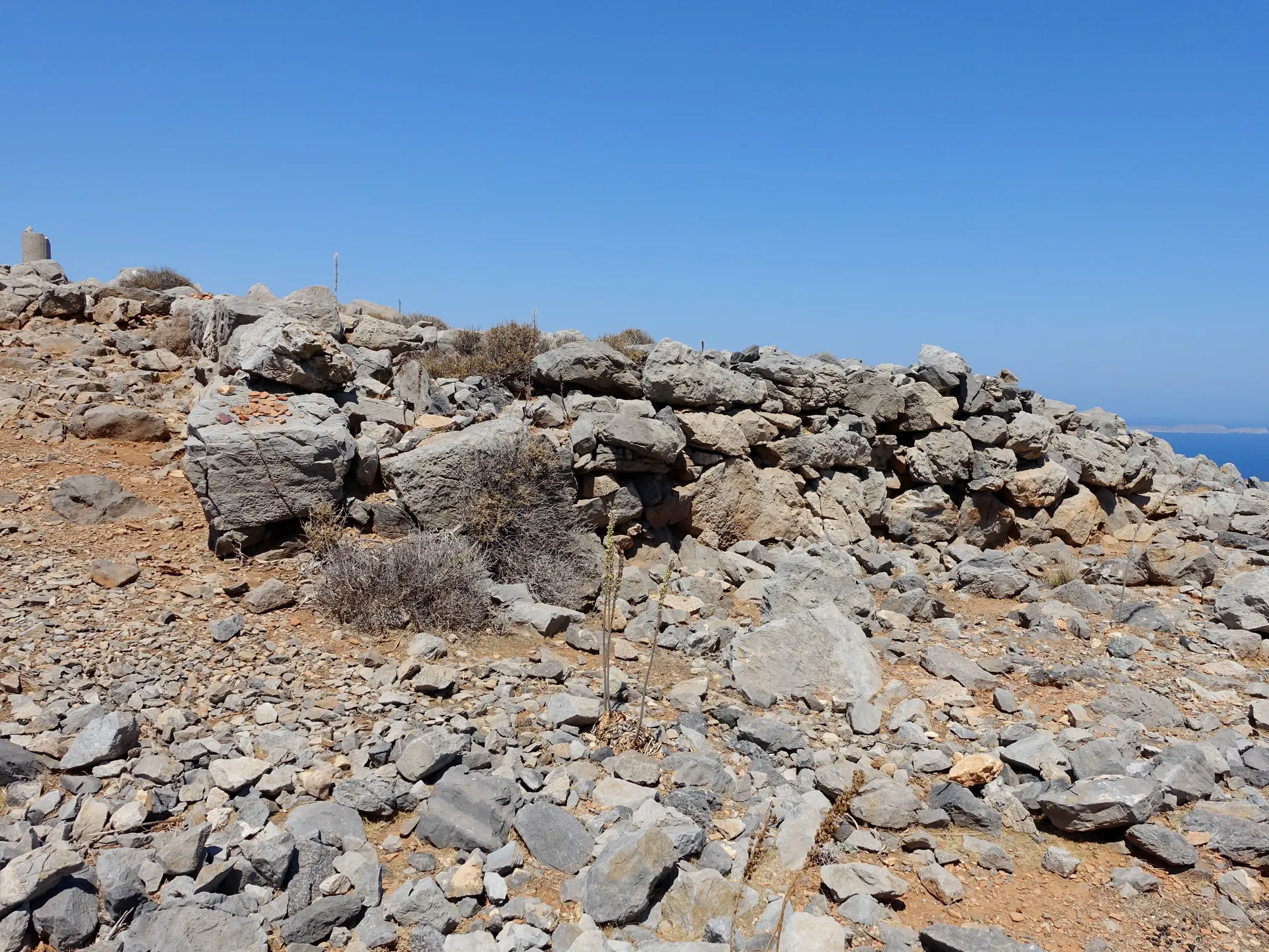
Stand on the plateau and the effect is immediate. The wind is constant. The ground underfoot is thin soil over limestone, studded with the remains of stone features that may have included altars. There is no shelter, no shade, no softening of the encounter between the human body and the elements.
The summit strips away the comforts of lower elevation and leaves only the essential relationship: a person standing on rock, surrounded by air, looking out at a world that extends further than the eye can resolve.
The thinness deepens when you consider what lies underfoot. The excavations of 1963, 1964, 1978, and 1995 recovered over three hundred votive figurines from this small area — clay humans standing with arms raised, clay animals, model boats, detached limbs with holes for hanging. Each of these was carried up the mountain by someone who made the hour-long climb for a reason. A woman modeled her own swollen leg in clay and left it here. Sailors left ceramic ships.
Someone pressed a bare foot into a wet clay plaque, creating what may be the most intimate object from Minoan religion — a literal imprint of a living person at the place where they believed the divine could be reached.
The accumulation matters. Five centuries of pilgrimage compressed into a twenty-by-twelve-meter plateau. The figurines were not scattered casually; they were deposited with intention at what appears to have been a focal point of worship, possibly a baetyl — a sacred stone that concentrated divine presence. The clay rhinoceros beetles found here, echoing similar finds at Piskokefalo, suggest a spiritual attention so fine-grained it extended to the smallest creatures of the natural world.
What makes Traostalos thin is the convergence of all these elements: the physical extremity of the location, the centuries of devotional intent embedded in the soil, and the absolute exposure of the summit to the sky. This was a place where the Minoans went to be as close to whatever they worshipped as geography would allow. The summit plateau was their uppermost reach, and they returned to it generation after generation, carrying their prayers in clay.
Traostalos served as a peak sanctuary — an open-air hilltop shrine central to Minoan religious practice. Communities from the surrounding area ascended to the summit to deposit votive offerings, seeking divine intervention for healing, maritime safety, agricultural fertility, and other needs. The sanctuary functioned as a node in a visible network of sacred high places across eastern Crete, with possible intervisibility with other peak sanctuaries and the nearby Pelekita Cave.
Vessels inscribed with Linear A suggest the sanctuary was also connected to palatial administration.
The sanctuary was established during the Middle Minoan I period, around 2000 BCE, as part of a broader wave of peak sanctuary creation across Crete. Activity was concentrated during the Protopalatial era (roughly 2000-1700 BCE), continued through the Neopalatial period, and ceased around 1450 BCE during the Late Minoan IB destruction events that reshaped Cretan civilization.
The abandonment may reflect the centralization of religious authority at the Palace of Zakros, 3.2 kilometers to the south — as palatial power grew, the autonomous hilltop sanctuaries were absorbed into palace-controlled religion. The summit was rediscovered by archaeologists in the twentieth century. Kostis Davaras conducted the first excavations in 1963-1964 and returned in 1978 to discover the footprint graffito and the majority of the votive assemblage. Stella Chryssoulaki led a rescue excavation in 1995.
The artifacts recovered are now housed in the Archaeological Museum of Agios Nikolaos. The site remains unattended and largely unvisited, a condition that preserves both its fragility and its capacity to affect those who make the effort to reach it.
Experience and orientation
The journey begins at Azokeramos, a small village ten kilometers south of Palekastro in the far east of Crete. A dirt road leads south and uphill from the village, passable by car for approximately eight kilometers, though the condition varies and may require a vehicle with reasonable clearance. At a certain point the road narrows or is blocked, and the remaining ascent — roughly five kilometers, gaining about 260 meters of elevation — must be made on foot.
The walk takes approximately one hour. The landscape is eastern Cretan garrigue: low scrub, wild herbs that release their scent underfoot, exposed limestone, and the occasional twisted olive tree. The path is not formally marked, though the route is generally evident. The ascent is steady but not steep. As you climb, the views begin to open: the Zakros gorge to the south, the coastal lowlands falling away behind you, and the sea appearing and reappearing as the terrain shifts.
The summit arrives without ceremony. The plateau is small and flat, ringed by low rock outcrops. There may be remnants of stone structures — wall fragments, possible altar bases — but these are subtle and easily overlooked without prior knowledge. What is not subtle is the view.
On a clear day, the panorama is among the most expansive in Crete: the Dionysades islets to the north, Kasos and Karpathos to the east across the Carpathian Sea, the mountainous spine of eastern Crete sweeping west, and to the south the deep cut of the Zakros gorge leading down to the coast where the Minoan palace once stood.
The wind is a constant presence. At 515 meters on an exposed summit with no windbreak, it can be powerful. This is not an inconvenience but a feature — the same wind that blew across this plateau four thousand years ago, the same wind that the Minoans who climbed here stood in while they placed their clay figures on the ground or against a sacred stone.
The site is completely unattended. There is no ticket office, no guard, no signage, no fence. You will very likely be alone. This solitude is one of the most striking aspects of Traostalos: a site of genuine archaeological and spiritual significance, accessible only to those willing to make the effort, and rewarding that effort with an experience that major sites cannot provide.
Take time to sit on the plateau. Let the wind settle your breathing after the climb. Consider the footprint plaque — somewhere in this small area, a person pressed their bare foot into clay and left it as an offering. Consider the woman with the swollen leg, who modeled her ailment in clay and carried it up the mountain. Consider the ceramic boats, left by people whose lives depended on the sea visible in every direction.
The objects are in the museum now. The intention remains here.
Approach Traostalos as a pilgrimage rather than a hike. Bring water, sun protection, and sturdy shoes — there is no shade and no water source on the route or summit. Start early in the morning to avoid heat and to have the clearest atmospheric conditions for the views. Allow three to four hours round trip from Azokeramos. At the summit, resist the urge to photograph immediately. Sit first. Let the scale register.
The twenty-by-twelve-meter plateau is small enough to walk in seconds but holds enough accumulated devotion to warrant an hour of attention. If you have studied the votive finds, let that knowledge inhabit the ground beneath you — over three hundred offerings lie just below the surface in this small space.
Context and lineage
The establishment of Traostalos as a sacred site around 2000 BCE coincided with a remarkable phenomenon across Minoan Crete: the emergence of peak sanctuaries. Over two dozen hilltop worship sites appeared during the Middle Minoan period, each occupying a commanding summit visible from the settlements below. No written account survives to explain why the Minoans began this practice.
The consensus among scholars is that it reflects a deepening relationship between an increasingly complex agricultural and maritime society and the forces — weather, wind, rainfall, sea — that governed survival. To climb to the highest point and leave an offering was to approach the source of those forces as closely as geography permitted.
Traostalos occupied a particularly powerful position in this network. Its summit commanded the eastern terminus of Crete, a position from which the sea routes to the Dodecanese and beyond were visible. The Palace of Zakros, which would later become the fourth great Minoan palace, stood 3.2 kilometers to the south in the gorge below. The Pelekita Cave, a sacred cavern with its own ritual deposits, lay just 1.2 kilometers away.
Together, these three sites — peak, palace, and cave — formed a sacred landscape that linked the underground, the surface, and the sky.
The nature of the offerings reveals the concerns of the worshippers. Anthropomorphic figurines with raised arms suggest gestures of prayer or invocation. Votive limbs — legs, feet with suspension holes — speak to petitions for healing; a female figure with a visibly swollen leg is among the most poignant objects in Minoan archaeology. Ceramic boat models testify to the maritime life of the eastern coast.
Bronze needles and gold ribbons indicate that some offerings were costly, suggesting pilgrims of means alongside those who brought simple clay. Vessels inscribed with Linear A connect the sanctuary to the literate world of the palaces, hinting at administrative or priestly involvement in the cult.
Traostalos belongs to the tradition of Minoan peak sanctuaries — open-air hilltop worship sites that emerged across Crete around 2000 BCE and represent one of the most distinctive features of Minoan religious practice. Over twenty-five peak sanctuaries have been identified across the island, forming a network of elevated ritual sites that were typically intervisible with the settlements they served.
The tradition appears to have originated in the Protopalatial period as Minoan society grew more complex, and it declined during the Neopalatial period as palace-centered religion absorbed the functions of the autonomous hilltop shrines. Traostalos specifically belonged to the sacred landscape of eastern Crete centered on the Palace of Zakros, with connections to the Pelekita Cave and possibly to the Petsofas peak sanctuary near Palekastro. The sanctuary's religious lineage ended with its abandonment around 1450 BCE.
No subsequent religious tradition adopted the specific summit, though the broader association of Cretan mountain peaks with worship continued through the Greek period and into Christianity, reflected in the chapels of Prophet Elijah that crown many Cretan summits — including mountains near Traostalos.
Kostis Davaras
Greek archaeologist who conducted the foundational excavations at Traostalos in 1963-1964 and returned in 1978, discovering the unique terracotta footprint graffito and the majority of the over three hundred votive figurines. His work established Traostalos as a site of primary importance for understanding Minoan peak sanctuary religion.
Stella Chryssoulaki
Greek archaeologist who led the 1995 rescue excavation at Traostalos, recovering additional material and contributing to the documentation of the site's stratigraphy and chronology.
Paul Faure
French scholar of Minoan religion who participated in early excavations at Traostalos alongside Davaras and contributed to the broader interpretation of Cretan peak sanctuaries within Minoan religious practice.
Arthur Evans
Though he never excavated Traostalos, Evans's work at Knossos established the framework within which all Minoan peak sanctuaries are understood. His identification of the Minoan civilization and its religious practices made sites like Traostalos intelligible as part of a coherent Bronze Age culture.
Nikolaos Platon
Greek archaeologist who excavated the Palace of Zakros beginning in 1961, revealing the major Minoan center that stood 3.2 kilometers from Traostalos and almost certainly administered or influenced the peak sanctuary during the Neopalatial period.
Traditions and practice
The worshippers who climbed Traostalos practiced a form of devotion inseparable from the physical landscape. The ascent itself was part of the ritual — an hour or more of climbing through scrubland and over limestone, carrying the objects that would be left at the summit. There were no enclosed temples at the top, no walls to separate sacred from profane space.
The boundary was the climb itself: the act of leaving the settlements below and entering the domain of wind and sky.
At the summit, offerings were deposited in or near what appears to have been a focal point of worship. Over three hundred clay figurines have been recovered, including anthropomorphic figures with raised arms, zoomorphic figures of animals, and the enigmatic terracotta rhinoceros beetles whose meaning remains unexplained. Votive limbs — legs and feet with suspension holes, perhaps hung from a sacred stone or post — suggest a healing function.
One female figure modeled with a visibly swollen leg provides direct evidence of petitions for physical remedy. Ceramic boat models speak to maritime concerns — protection for voyages, thanksgiving for safe returns, or perhaps prayers for the fishing and trade that sustained the coastal communities.
More precious offerings — bronze needles, gold ribbons — indicate that the sanctuary attracted worshippers of varying social status, or that some occasions warranted costlier gifts. Vessels inscribed with Linear A, the undeciphered script of the Minoan palaces, connect the sanctuary to the literate administration of the palatial centers, suggesting possible priestly oversight or formal record-keeping of ritual activity.
The most intimate object from Traostalos is the terracotta footprint graffito discovered by Davaras in 1978 — a clay plaque into which a human foot was pressed, leaving a permanent impression. Whether this was a personal devotional mark, a ritual imprint signifying the pilgrim's presence at the sacred place, or something else entirely, the object bridges four millennia with startling directness. Someone stood here and pressed their foot into clay so that something of them would remain.
No formal religious practice takes place at Traostalos. The Minoan cult ended around 1450 BCE, and no subsequent tradition has adopted the specific summit for worship. The site is visited occasionally by hikers, archaeology enthusiasts, and scholars. The artifacts recovered from the excavations are displayed at the Archaeological Museum of Agios Nikolaos, where the votive figurines and the footprint graffito can be examined at close range.
The ascent to Traostalos is itself a form of contemplative practice, whether or not you frame it as such. The climb requires sustained physical effort through a landscape that has not changed materially since the Minoan period — the same scrub, the same limestone, the same wind increasing as you gain elevation. Allow the effort to quiet the mind. Arrive at the summit and sit before you examine the ground. Let the panorama register.
The Minoans who came here were looking at the same sea, the same islands, the same sky.
Walk the small plateau slowly. Notice any stone features — wall fragments, possible altar bases, flat surfaces that might have received offerings. Consider that beneath the thin soil, hundreds of clay figures were deposited over five centuries. Each one was carried up the same path you climbed, by someone with a specific need or gratitude.
If you visit the Archaeological Museum in Agios Nikolaos before or after, study the Traostalos figurines. Then return to the summit in your mind and place them back where they were found. The museum preserves the objects; the summit preserves the intention.
Minoan Peak Sanctuary Religion
HistoricalTraostalos was one of the most important Minoan peak sanctuaries in eastern Crete, active from the Middle Minoan I period through Late Minoan IB (approximately 2000-1450 BCE). Peak sanctuaries were open-air hilltop worship sites central to Minoan religious practice, where communities ascended to deposit votive offerings and commune with deities associated with the sky, weather, and natural forces. Traostalos's commanding position and the richness of its votive assemblage — over three hundred figurines, model boats, healing votives, and inscribed vessels — place it among the better-documented examples of this uniquely Minoan tradition.
Perspectives and open questions
Traostalos can be read as an archaeological data point for understanding Minoan religion, as a landscape of devotional accumulation, or as a place where the physical act of ascending becomes its own form of meaning. Each reading illuminates something the others cannot reach.
Scholarly perspective
Archaeological consensus places Traostalos among the significant Minoan peak sanctuaries of eastern Crete, primarily active during the Proto- and Neopalatial periods. The over three hundred figurines recovered from the summit plateau provide one of the larger votive assemblages from any Cretan peak sanctuary, offering direct evidence of the types of petitions — healing, maritime safety, agricultural fertility — that motivated pilgrimage to these sites.
The presence of Linear A-inscribed vessels connects the sanctuary to the literate world of the palaces, supporting the interpretation that peak sanctuaries were not purely spontaneous folk religion but were integrated into the administrative and religious structures of palatial society. The sanctuary's abandonment in Late Minoan IB is read as evidence for the broader transformation of Minoan religion during the Neopalatial period, as centralized palace authority absorbed the functions of autonomous hilltop shrines.
However, scholars note that the majority of East Cretan peak sanctuaries remain unpublished, limiting comparative analysis and leaving open the possibility that the picture will change as more data becomes available.
Living and traditional perspectives
No living religious tradition claims Traostalos as its own. The Minoan religion that animated the sanctuary ended over three millennia ago, leaving no documented successors. However, the broader pattern of mountain-peak worship in Crete has deep continuity. The Orthodox tradition of building chapels to the Prophet Elijah on mountain summits echoes the Minoan impulse to seek the divine at high places, and the association of eastern Crete's peaks with spiritual significance continues in local culture.
One source notes the Profitis Ilias tradition in connection with Traostalos, suggesting that the mountain's sanctity, if not its specific cult, has persisted in cultural memory even as the tradition changed.
Alternative interpretations
Visitors who reach the summit frequently describe an experience that exceeds the archaeological facts — a sense of standing at a genuine threshold, a place where the accumulation of centuries of devotion has left an atmosphere that the wind cannot disperse.
The solitude of the site, the effort required to reach it, and the panoramic exposure at the top combine to produce what some describe as a natural pilgrimage experience, one that does not require belief in Minoan deities to be meaningful. The footprint graffito, in particular, resonates with visitors as an act of devotional presence that transcends its cultural context — the impulse to say 'I was here, in this sacred place' is not specific to the Minoans.
Open questions
Several mysteries persist at Traostalos. The meaning of the terracotta rhinoceros beetle figurines — found here and at Piskokefalo but nowhere else — remains unexplained. Were they symbols of regeneration, offerings connected to agriculture, or something entirely outside modern interpretive frameworks? The exact nature of the sanctuary's relationship with the nearby Pelekita Cave is unclear: were the peak and the cave used simultaneously as complementary elements of a single ritual landscape, or did practice alternate between them across different periods?
The footprint graffito's purpose continues to be debated — personal devotional mark, ritual imprint of presence, or a convention whose meaning was clear to the Minoans but opaque to us? Whether the sanctuary served a single community or attracted pilgrims from across eastern Crete remains unknown.
And the fundamental question of what the Minoans experienced at this summit — what they understood to happen when they placed their clay figures on the wind-scoured rock — lies beyond the reach of archaeology.
Plan your visit
Access and arrival
Begin from Azokeramos village, located 10 kilometers south of Palekastro and approximately 14 kilometers from Sitia in eastern Crete. A dirt road leads from the village toward the summit, drivable with a standard car for roughly 8 kilometers. The final section may be blocked or impassable, requiring the remaining 5 kilometers and 260 meters of elevation gain to be covered on foot. The path is not formally marked but follows an evident route along the ridge.
Coordinates: 35.1266 degrees North, 26.2671 degrees East. No facilities exist anywhere on the route — no water, no food, no restrooms, no shelter. Bring all supplies. The nearest services are in Palekastro or Sitia. Mobile phone signal is intermittent at best along the approach road and may be available on the summit due to elevation and line-of-sight, but should not be relied upon.
In case of emergency, the nearest medical facilities are in Sitia, approximately 30-40 minutes by car from Azokeramos. A rental car is effectively required to reach the trailhead; no public transport serves Azokeramos directly.
The nearest accommodations are in Palekastro, a small town 10 kilometers north of Azokeramos with several guesthouses, small hotels, and tavernas. Sitia, the regional center 30 kilometers to the northwest, offers a wider range of hotels and services. Kato Zakros, the coastal settlement below the Palace of Zakros, has a handful of rooms to rent and tavernas for those combining the peak sanctuary visit with the palace.
For those wanting to minimize driving on the day of the hike, staying in Palekastro provides the shortest approach.
Respectful visit
Sturdy hiking shoes with good ankle support are essential — the terrain is rocky and uneven, with loose gravel on the approach. Sun protection is critical: hat, sunscreen, and long sleeves are recommended, as there is no shade at any point on the route or summit. A windbreaker is advisable even in summer, as the summit wind can be strong and cold. In spring and autumn, layers are necessary for temperature changes between valley and summit.
No restrictions apply. The site is unattended and open. The panoramic views from the summit are the primary photographic subject. Documenting any visible archaeological features can contribute to the scholarly record, particularly if shared with the Archaeological Museum of Agios Nikolaos.
Do not leave objects, stones, flowers, or any material at the site. This is an archaeological monument, not an active place of worship. Additions to the surface can confuse future archaeological work and damage the fragile depositional context.
Do not dig, scrape, or probe the ground. Do not move or stack stones. Do not remove any material — pottery, stone, or otherwise — from the site. The summit plateau is a protected archaeological area even though it lacks visible boundaries or signage.
Do not dig, disturb the ground, move stones, or leave objects at the summit. The archaeological remains are fragile and the site is unprotected. The summit is fully exposed to wind and sun — conditions can change rapidly at this elevation. Bring all supplies including water, as there is nothing available between Azokeramos and the summit. The descent requires care on loose terrain, particularly in the late afternoon when light angles can obscure footing.
Current practical details
Address
Kato Zakros 723 00, Greece
Hours
Hours, fees, and access can change — verify on the official source before you travel. Practical details last checked Jun 2026.
Location
Map loads as you approach this section.
Pilgrim reflections
A portrait of encounter, not a score
Pilgrims describe what they felt, how present they could become, and whether the place would shape a journey. There are no stars and no ranking of traditions.
No reviewed reflections yet
The first pilgrims can help describe the character of being here.
Share a reflection
Available after an account-backed “Been there.” Every reflection is reviewed before publication.
Nearby sacred places
Explore other sacred places in the region. Proximity does not establish access or travel time; check each place’s guidance.
Share a photo
Help visitors recognize Traostalos Minoan Peak Sanctuary. Every submission is reviewed before publication.