Petsofas Minoan Peak Sanctuary
Where Bronze Age Cretans climbed toward the gods, leaving thousands of clay prayers on a windswept peak
Understand sacred places, explore living traditions, and learn how to engage respectfully with Pilgrim Map.
Access has not been verified. Check current local guidance before planning a visit.
Itanos Municipal Unit, Crete, Greece
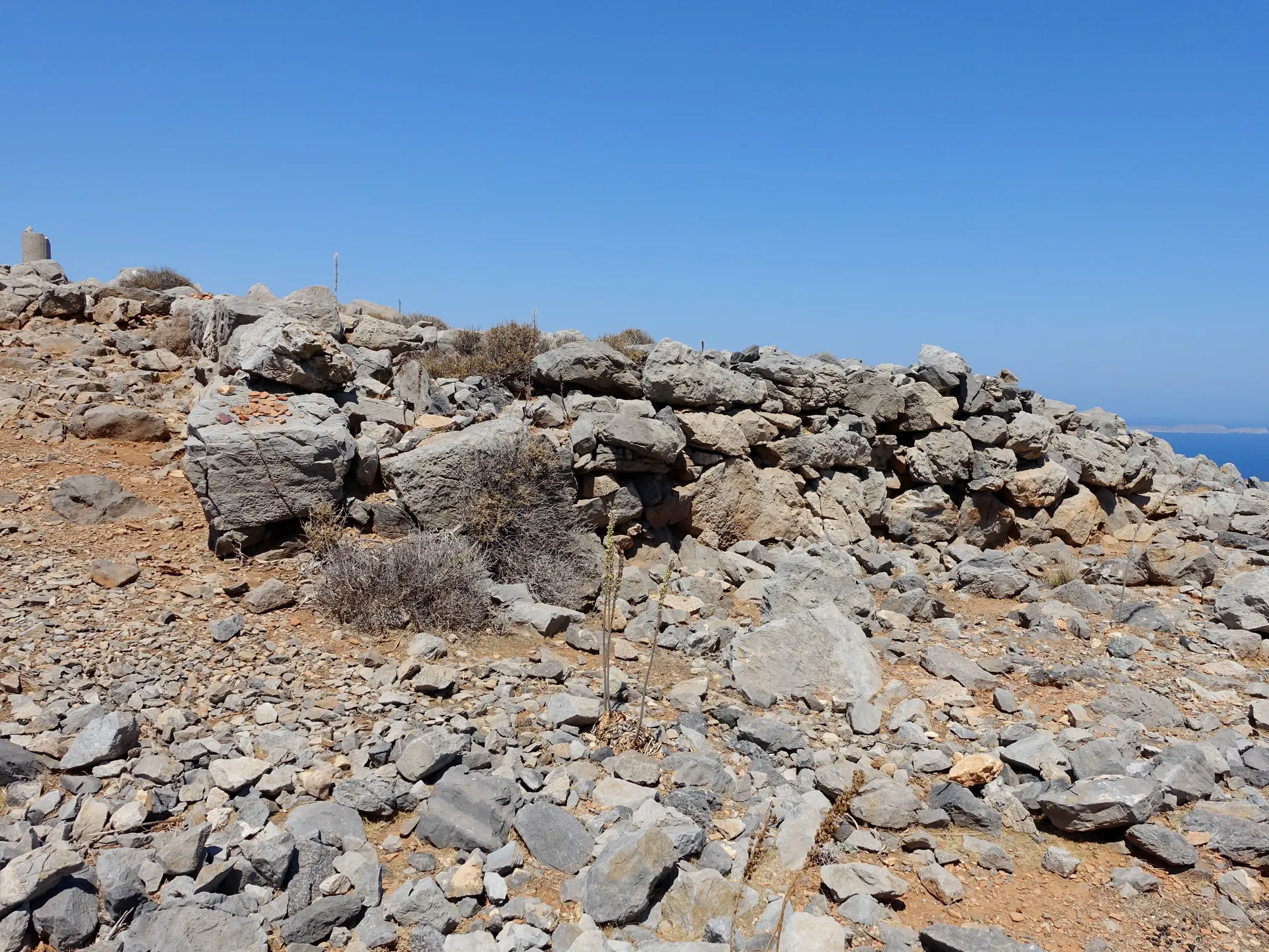
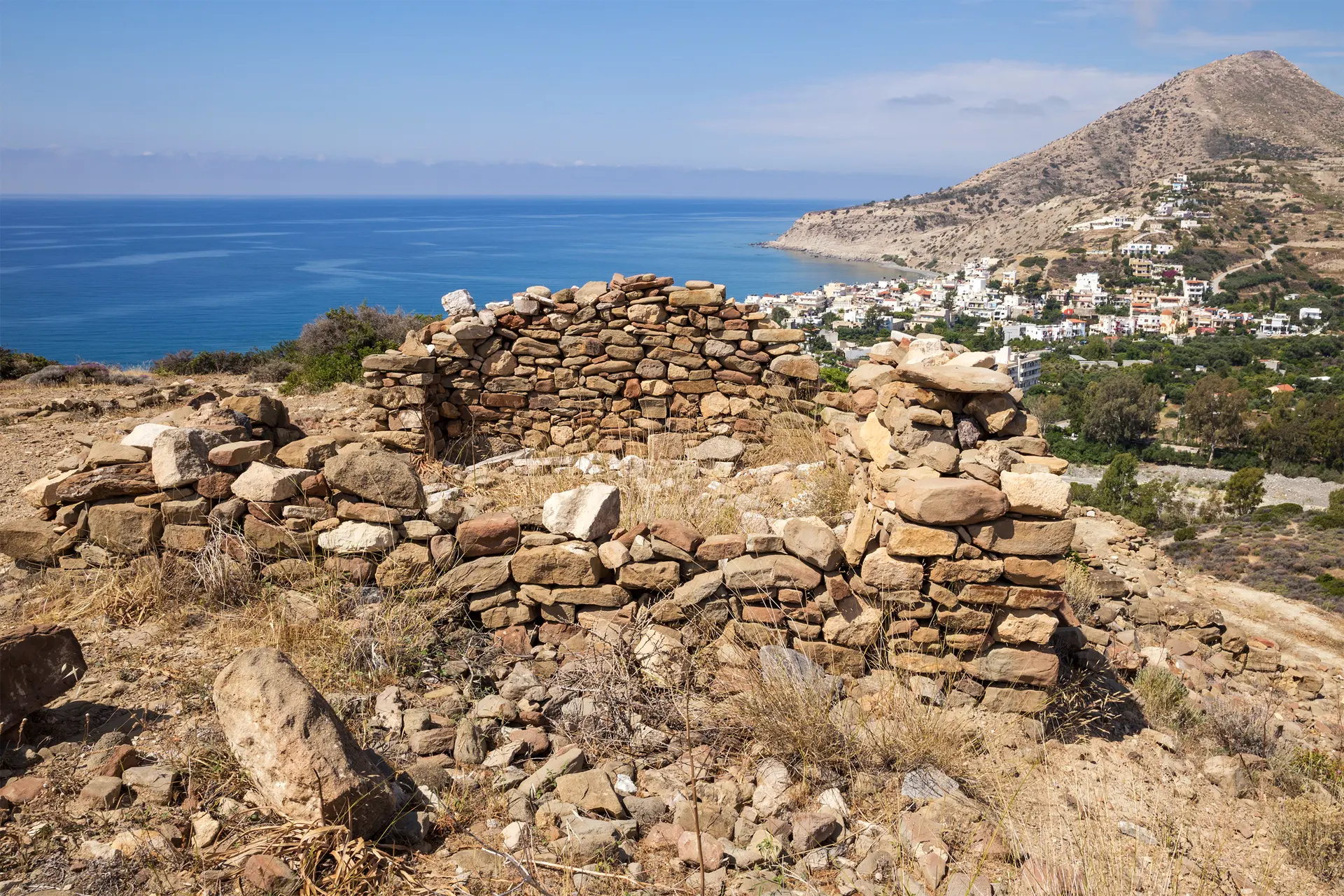
Image of Petsofas Minoan Peak Sanctuary. Image source · CC-BY-3.0
Visit essentials
A quick read before you go
- Duration
- Allow 1.5 to 2 hours for the round-trip hike from Agathias to the summit and back, plus at least…
- Access
- Start from Palekastro village square, walking east through Agathias (1.3 km from Palekastro).
Overview
Petsofas rises between 215 and 270 meters, depending on the source, above eastern Crete's coastal plain. Less than half an hour from the former Minoan settlement at Palaikastro, its moderate ascent crosses rough terrain to a summit open to wind, sun, and uninterrupted Aegean views.
For at least five hundred Bronze Age years, this modest hilltop was among Minoan Crete's most frequented sacred places. In an open-air enclosure of approximately 170 square meters, worshippers left thousands of clay figurines: men and women in Minoan dress; cattle, goats, sheep, and dogs; and unusual weasels, tortoises, hedgehogs, and beetles. Clay arms, legs, and torsos likely petitioned healing for particular afflictions, and burnt offerings accompanied the deposits.
In the later Neopalatial period, a multi-roomed structure covered the enclosure and offerings grew more refined: serpentine libation tables inscribed in still-undeciphered Linear A, double-axes, and naturalistic figurines.
British archaeologist John L. Myres's April 1903 excavation defined the category of Minoan peak sanctuaries—open-air hilltop shrines now understood as central to Minoan religion. In 2014, leading researchers Christine Morris and Alan Peatfield called Petsofas the best known excavated example. Four millennia after its founding, scattered stones remain on an open hilltop visited more by hikers than scholars, preserving devotion barely begun to be fully read.
Why this place is sacred
Minoan peak sanctuaries were not chosen arbitrarily. They occupied prominent hilltops visible from nearby settlements, creating a vertical relationship between the human community below and the sacred precinct above. The act of climbing was not incidental to worship; it was part of it.
Scholars of Minoan religion describe the ascent as a transformative journey, a physical and symbolic movement from the mundane space of the settlement toward the liminal space between earth and sky where communication with the divine became possible.
Petsofas embodies this pattern with particular clarity. The hilltop overlooks the Palaikastro coastal plain, including the major Minoan town of Roussolakkos, which was the settlement the sanctuary served. The walk from the settlement to the summit takes less than thirty minutes, a journey that would have been familiar to generations of worshippers over five centuries. Each ascent was a repetition, and each repetition deepened the path's sacred associations.
Once on the summit, the worshipper entered a concentrated space. The original open-air enclosure measured only about 170 square meters, a compact area that received thousands of figurine offerings over its centuries of use. The density of devotional intent in this small space is difficult to overstate. Each figurine represented a specific act of petition, gratitude, or dedication. The anatomical votives, clay limbs and torsos, carried individual stories of suffering and hope.
The animal figurines encoded relationships with the divine that remain only partly understood.
The panoramic views from the summit encompass the Agathias, Palekastro, and Kouremenos coastal area, the eastern Cretan mountains, and the Aegean Sea stretching toward the horizon. Research by Blomberg and Henriksson has suggested that the site may have been oriented toward the summer solstice sunrise, adding an astronomical dimension to its sacred geography. The hilltop sits within a broader sacred landscape that includes the nearby sanctuary of Dictaean Zeus at Palaikastro and, further afield, the great cave sanctuary at Psychro.
What persists at Petsofas is not any single dramatic quality but something subtler: the sense of a place chosen, used, and charged with meaning by sustained human attention over centuries.
Petsofas served as the primary hilltop religious site for the Minoan settlement at Palaikastro and Roussolakkos. It was an open-air communal sanctuary where worshippers deposited clay votive figurines, performed burnt offerings, and conducted libation rituals. The site likely functioned as a place of petition and healing, where individuals could seek divine favor through figurine offerings that represented their specific needs.
The diversity of animal figurines, particularly weasels and tortoises found here but not at other peak sanctuaries, suggests a connection to a Minoan goddess of animals and possibly to childbirth rituals.
The sanctuary's history spans two broad phases. During the earlier Protopalatial period, beginning around 2000 BCE, worship took place in an open-air enclosure where thousands of figurines and burnt offerings accumulated. This communal, open-access character was typical of early Minoan peak sanctuaries. During the later Neopalatial period, roughly 1700 to 1450 BCE, the open enclosure was built over with a multi-roomed structure, and the nature of offerings shifted toward higher-quality objects: inscribed serpentine libation tables, double-axes, and more refined figurines.
This transition is widely interpreted as reflecting increased elite or palatial control over what had been a popular communal practice. Most Minoan peak sanctuaries were abandoned after the Protopalatial period, but Petsofas continued in use, one of relatively few to persist into the Neopalatial era. Cult activity ceased around 1450 BCE, possibly in connection with the broader disruptions that ended Minoan palatial civilization.
Experience and orientation
The approach begins in Palekastro, a small town in the far east of Crete, far from the island's mass tourism. From the village square, the walk passes through the settlement of Agathias, about 1.3 kilometers to the east. After Agathias, an unpaved road continues eastward, and after approximately 200 meters a sign marked 'Peak Sanctuary' directs you to the right.
The trail to the summit covers about 1.9 kilometers from Agathias, gaining roughly 235 meters of elevation through rough, scrubby terrain.
The walk itself is the first dimension of the experience. You are following, approximately, the route that Minoan worshippers followed for five centuries. The path rises steadily through low vegetation under an open sky. There is no shade. The landscape is dry and aromatic in summer, greener in spring. The wind, which is nearly constant in eastern Crete, becomes more pronounced as you gain elevation.
The summit, when you reach it, does not present dramatic ruins. There are low stone walls, foundations, and scattered remains of the Neopalatial building that replaced the earlier open enclosure. The site is unenclosed, unfenced, with no interpretive panels or visitor infrastructure. You stand on an archaeological surface that has yielded thousands of figurines to two separate excavation campaigns, in 1903 and 1971, and whose deposits remain only partly published.
What the summit does offer is perspective. The views extend across the entire Palekastro coastal plain to the sea. On clear days, the relationship between the settlement below and the sanctuary above becomes legible. You can see where the Minoan town of Roussolakkos spread across the plain, the archaeological site still partly visible as a patchwork of low walls and excavation trenches.
The spatial logic of the peak sanctuary snaps into focus: the settlement there, the sacred peak here, the worshippers moving between them.
The solitude is likely to be complete. Petsofas receives few visitors. There are no crowds, no guides, no vendors. There is wind, light, stone, and the knowledge that you are standing where thousands of clay figurines once accumulated, each one shaped by human hands to carry a specific hope upward.
For those drawn to the wider landscape, the circular route from Palekastro through Petsofas and on to Skinias Beach covers 13 kilometers and takes four to five hours. This longer walk descends the eastern side of the hill to the coast, passing through terrain that has changed little in millennia.
Arrive early in the morning to avoid heat and to catch the eastern light at its best. Carry at least a liter of water per person; there is no water source on the trail or summit. Wear sturdy shoes with good grip. Before ascending, consider visiting the Heraklion Archaeological Museum, where figurines from Petsofas are displayed, so that you can hold in mind what was deposited here while standing at the place of deposition.
On the summit, allow at least twenty minutes of stillness. Sit, if you are comfortable doing so, and let the panorama settle. The Minoan worshippers did not rush.
Context and lineage
No founding narrative survives. The Minoan Linear A script, found inscribed on libation tables at the site, remains undeciphered, and no Minoan mythological texts exist in any readable form. The selection of this particular hilltop was likely determined by its prominence and visibility from the nearby settlement at Palaikastro, its moderate elevation offering accessibility while still marking a clear transition from the plain below, and possibly its orientation toward astronomical phenomena.
Blomberg and Henriksson have proposed a connection to the summer solstice sunrise, suggesting the site may have been chosen partly for its relationship to solar events. The deeper logic is shared across all Minoan peak sanctuaries: the impulse to climb, to separate from the settlement, to reach a point where the boundary between earth and sky grows thin.
Petsofas belongs to the broader phenomenon of Minoan peak sanctuaries, approximately forty of which have been identified across Crete, with about twenty-five confirmed through excavation. These open-air hilltop shrines emerged during the Protopalatial period, around 2000 BCE, and most were abandoned by the end of that era.
Petsofas is distinguished by its unusually long use into the Neopalatial period, its role as the first peak sanctuary to be systematically excavated, the exceptional diversity of its animal figurine assemblage, and the presence of Linear A inscribed libation tables.
The nearby settlement of Roussolakkos, with its later sanctuary of Dictaean Zeus and the famous Palaikastro Kouros figurine, situates Petsofas within a sacred landscape that remained active, under different religious traditions, from the Bronze Age through at least the Roman period.
John L. Myres
British archaeologist who conducted the first systematic excavation of Petsofas in April 1903 as part of a British School at Athens expedition to Palaikastro. His discovery of thousands of human and animal figurines effectively defined the entire category of Minoan peak sanctuaries. His colleague Robert Carr Bosanquet described the results as 'brilliant.'
Charles Trick Currelly
Canadian archaeologist who continued the 1903 excavation after Myres returned to Oxford. Currelly approximately doubled the number of finds recovered from the site, significantly expanding the figurine assemblage that would become central to understanding Minoan peak sanctuary worship.
Costis Davaras
Greek archaeologist (Professor Emeritus, National and Kapodistrian University of Athens) who re-excavated Petsofas in 1971 in response to reports of looting. He explored areas east and south of the Neopalatial building that Myres had not reached, discovering what he considered the main deposits, including two serpentine libation tables inscribed in Linear A. Much of this excavation material remains unpublished.
Christine Morris
Scholar at Trinity College Dublin who, with Alan Peatfield, has conducted leading research on Petsofas and Minoan peak sanctuaries broadly. Co-described Petsofas as 'the best known of all the excavated Minoan peak sanctuaries' in a 2014 publication. Involved in the 3D scanning of peak sanctuary figurines, bringing new analytical methods to century-old finds.
Alan Peatfield
Director of the East Cretan Peak Sanctuaries Project at the Institute for the Intellectual History of the Sacred and Art, leading the effort to publish the unpublished Davaras excavation material from 1971. His research on the phenomenology of Minoan peak sanctuaries emphasizes the embodied experience of ascent and the performative aspects of ritual at these sites.
Traditions and practice
The ritual life of Petsofas centered on the making and depositing of clay figurines within the hilltop enclosure.
The figurines fell into several categories: human figures in characteristic Minoan dress, both male and female, often in attitudes of worship with arms raised or hands pressed to the chest; sacrificial animals including cattle, goats, sheep, and swine; domestic animals, particularly dogs; and a set of creatures found at Petsofas but rarely or never at other peak sanctuaries, including weasels, tortoises, hedgehogs, beetles, and birds. This last category has provoked particular scholarly interest.
A peer-reviewed study in the journal Religions connected the weasel figurines to Minoan midwifery practices, noting that a weasel-based drug was used as an effective oxytocic in ancient Mediterranean obstetrics. The combination of weasel figurines with childbirth votives at Petsofas may indicate a cult dedicated to a Minoan goddess of childbirth, a proto-Eileithyia.
Anatomical votives, clay models of limbs and torsos, were also deposited in significant numbers. These are widely interpreted as healing petitions, representations of the specific body part for which divine intervention was sought. The practice has parallels across Mediterranean religious traditions spanning millennia.
Burnt offerings accompanied the figurine deposits in the early phase of the site's use. During the later Neopalatial period, libation rituals became prominent, evidenced by eleven serpentine libation tables found at the site, some inscribed with Linear A dedications whose content remains unknown. The shift from open communal worship to a more formalized setting with higher-quality offerings suggests that elite or palatial interests gradually assumed control over what had been a broadly accessible practice.
No religious services, ceremonies, or organized spiritual practices take place at Petsofas. The site exists as an archaeological location and hiking destination.
Approaching Petsofas as a contemplative experience rather than a sightseeing destination honors the site's character. The walk itself is the primary practice. Begin from Palekastro or Agathias and walk the route slowly, as a journey rather than a workout. Notice the moment when the settlement falls behind and the hilltop opens above you. The Minoan worshippers understood this transition as a movement from the profane to the sacred, and the landscape still communicates the shift.
On the summit, find a place to sit away from the archaeological remains. Do not sit on walls or foundations. Let the panorama settle around you. The Minoan worshippers came here carrying shaped clay in their hands, each figurine an encoded message to the divine. Consider what it means that people climbed this hill for five hundred years to leave such messages, and that the messages remain partly unreadable to us.
The undeciphered Linear A inscriptions on the libation tables are a reminder that not everything can be translated.
If you visit during the summer solstice period, around June 21, you may wish to observe the sunrise from the summit, given the research suggesting an astronomical alignment between the site and the solstice sunrise. Arrive well before dawn and bring warm layers; hilltop mornings in eastern Crete can be cold.
Minoan Peak Sanctuary Worship
HistoricalPetsofas was one of the most important peak sanctuaries in Minoan Crete, serving as the primary hilltop shrine for the palatial settlement at Palaikastro from approximately 2000 to 1450 BCE. Described by leading scholars as 'the best known of all the excavated Minoan peak sanctuaries,' it was the first such site to be systematically excavated and the one that defined the category for all subsequent research.
Minoan Goddess Cult (Hypothesized)
HistoricalThe unique diversity of animal figurines at Petsofas, including weasels, tortoises, hedgehogs, and beetles found here but not at other peak sanctuaries, has led scholars to hypothesize that the site was dedicated to a Minoan Goddess of Animals (Potnia Theron). The combination of weasel figurines with childbirth votives suggests a possible connection to a Minoan childbirth goddess, a proto-Eileithyia, linked to midwifery practices in which weasel-derived substances served as oxytocics.
Perspectives and open questions
Petsofas can be read through multiple lenses: as an archaeological site that defined a category, as a window into Minoan religious life, as evidence for ancient medical and midwifery practices, and as a landscape that still communicates the Minoan understanding of sacred geography.
Scholarly perspective
There is strong scholarly consensus that Petsofas was a major Minoan peak sanctuary serving the nearby settlement at Palaikastro. The site is recognized as the first peak sanctuary to be systematically excavated, through Myres's 1903 work, and is considered the best documented of all excavated examples. Scholars agree on the basic chronology, from Middle Minoan I through the Neopalatial period, and on the function of the site as a communal ritual space.
The transition from an open-air sanctuary to a more formalized building with elite offerings in the Neopalatial period is interpreted as reflecting increased palatial control over religious practice, a pattern observed at other surviving peak sanctuaries. The interpretation of anatomical votives as healing requests has broad scholarly support. More recently, work on the connection between the site's unique weasel figurines and Minoan childbirth practices has opened a new dimension of understanding.
The East Cretan Peak Sanctuaries Project, led by Peatfield, is working to publish Davaras's 1971 excavation material, which could significantly expand knowledge of the site.
Living and traditional perspectives
No indigenous or traditional community maintains active claims to Petsofas. The Minoan civilization, which ceased to exist over three thousand years ago, has no direct cultural descendants in the sense that some indigenous cultures maintain continuity with ancient traditions. Modern Cretans regard the Minoan heritage with considerable pride as part of their deep cultural identity, but no specific oral traditions about Petsofas survive.
The broader Greek cultural tradition connects the Palaikastro area to the myth of Zeus through the nearby Sanctuary of Dictaean Zeus, but this represents a later Archaic and Classical Greek overlay rather than continuity from Minoan religion.
Alternative interpretations
Some contemporary pagan and neopagan communities reference Petsofas as part of a broader interest in Minoan goddess worship. The site appears in pagan heritage directories. The Minoan peak sanctuary phenomenon has drawn attention from those interested in prehistoric goddess-centered religions, earth-based spiritualities, and theories of sacred landscape. The astronomical alignment research by Blomberg and Henriksson has attracted archaeoastronomy enthusiasts.
However, no established esoteric tradition is specifically centered on Petsofas, and visitors should be cautious about projecting modern spiritual frameworks onto a Bronze Age site whose practitioners' beliefs remain largely inaccessible.
Open questions
The specific deity or deities worshipped at Petsofas remain unidentified. While the Goddess of Animals and a proto-Eileithyia figure are suggested by the figurine assemblage, no inscriptional evidence confirms either hypothesis, and Linear A remains undeciphered. The exact nature of the rituals, the prayers spoken, the songs sung, the performative elements that accompanied the figurine depositions, are lost entirely. Why Petsofas continued in use during the Neopalatial period when most other peak sanctuaries were abandoned is not fully explained.
The significance of the unusual animal figurines, particularly the weasels, tortoises, and hedgehogs, is still being investigated. The content of the Linear A inscriptions on eleven libation tables found at the site represents perhaps the most tantalizing unknown: decipherment of Linear A could transform understanding of who was worshipped here and what was asked of them.
And much of the 1971 Davaras excavation material remains unpublished, meaning a significant portion of the archaeological evidence from this site is not yet available to the scholarly community.
Plan your visit
Access and arrival
Start from Palekastro village square, walking east through Agathias (1.3 km from Palekastro). From Agathias, follow the unpaved road east for approximately 200 meters to a sign marked 'Peak Sanctuary' directing you right. The trail to the summit is 1.9 km from Agathias with approximately 235 meters of elevation gain. AllTrails rates the trail as moderate difficulty, averaging 1 hour 28 minutes. Alternatively, a dirt track suitable for most vehicles reaches close to the base of the hill.
Palekastro is approximately 20 km east of Sitia, the nearest city with full services. No public transport runs directly to the trailhead; a car or taxi from Palekastro or Sitia is necessary. The site is not wheelchair accessible. Mobile phone signal is generally available in the Palekastro area but may be intermittent on the hilltop. The nearest emergency services are in Sitia. For serious emergencies on the trail, the European emergency number 112 connects to Greek services.
Palekastro offers small hotels, guesthouses, and rooms to rent. The village is modest and relatively untouristed by Cretan standards, with several tavernas and basic services. Sitia, 20 km to the west, provides a wider range of accommodation and full urban services. The Kouremenos area, east of Palekastro, is popular with windsurfers and has beachside accommodation.
Respectful visit
Sturdy walking shoes with good grip are essential for the uphill trail and rough summit terrain. Sun protection is strongly advised: hat, sunscreen, and long sleeves, as the hilltop is fully exposed. In spring and autumn, a windbreaker is useful. In winter, layer for cold wind at elevation.
No restrictions on photography. The site is open-air and unmanaged. Drones are subject to Greek aviation regulations and may require permits near archaeological sites.
Do not leave offerings, coins, flowers, or any objects at the site. This is an active archaeological surface and any additions contaminate the record.
Do not remove any stones, pottery, or other materials. Do not dig or probe the ground surface. Do not sit on or lean against archaeological remains. Greek law treats the removal of archaeological material as a serious criminal offense.
This is an unenclosed archaeological site with no facilities, no shade, and no water. The terrain is rough and uneven. There is no formal site management or security presence. Standard archaeological ethics apply strictly: take nothing, leave nothing, do not dig or disturb the ground surface. The site is under the jurisdiction of the Greek Archaeological Service, and removal of any material, however small, is a criminal offense under Greek law.
Current practical details
Address
Petsofas, Itanos 723 00, Greece
Hours, fees, and access can change — verify on the official source before you travel. Practical details last checked Jun 2026.
Location
Map loads as you approach this section.
Pilgrim reflections
A portrait of encounter, not a score
Pilgrims describe what they felt, how present they could become, and whether the place would shape a journey. There are no stars and no ranking of traditions.
No reviewed reflections yet
The first pilgrims can help describe the character of being here.
Share a reflection
Available after an account-backed “Been there.” Every reflection is reviewed before publication.
Nearby sacred places
Explore other sacred places in the region. Proximity does not establish access or travel time; check each place’s guidance.
Share a photo
Help visitors recognize Petsofas Minoan Peak Sanctuary. Every submission is reviewed before publication.