Pyrgos Minoan Temple
A Minoan hilltop where goddess worship, wine, and administration converged above the Libyan Sea
Understand sacred places, explore living traditions, and learn how to engage respectfully with Pilgrim Map.
Access has not been verified. Check current local guidance before planning a visit.
Ierapetra Municipal Unit, Crete, Greece
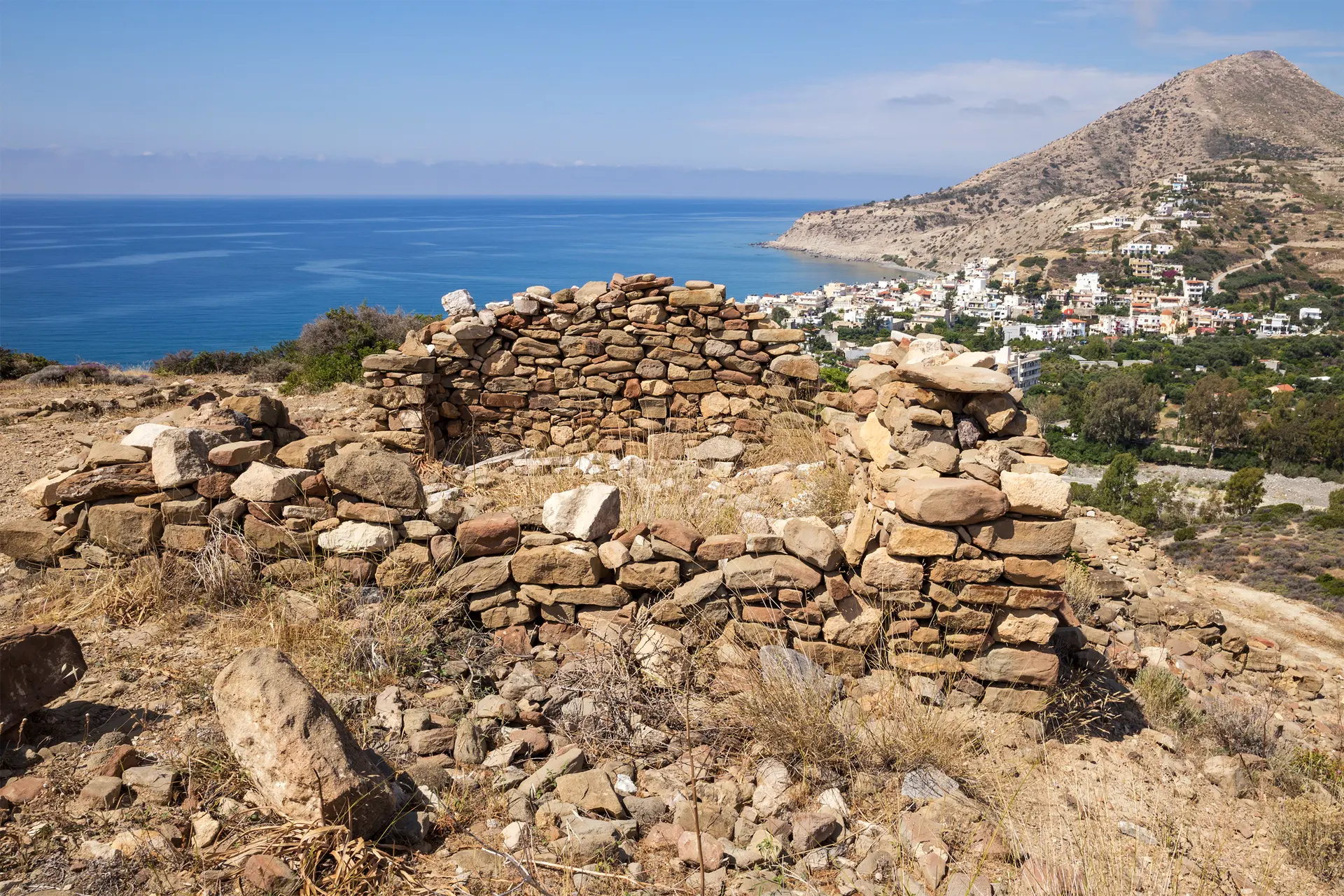
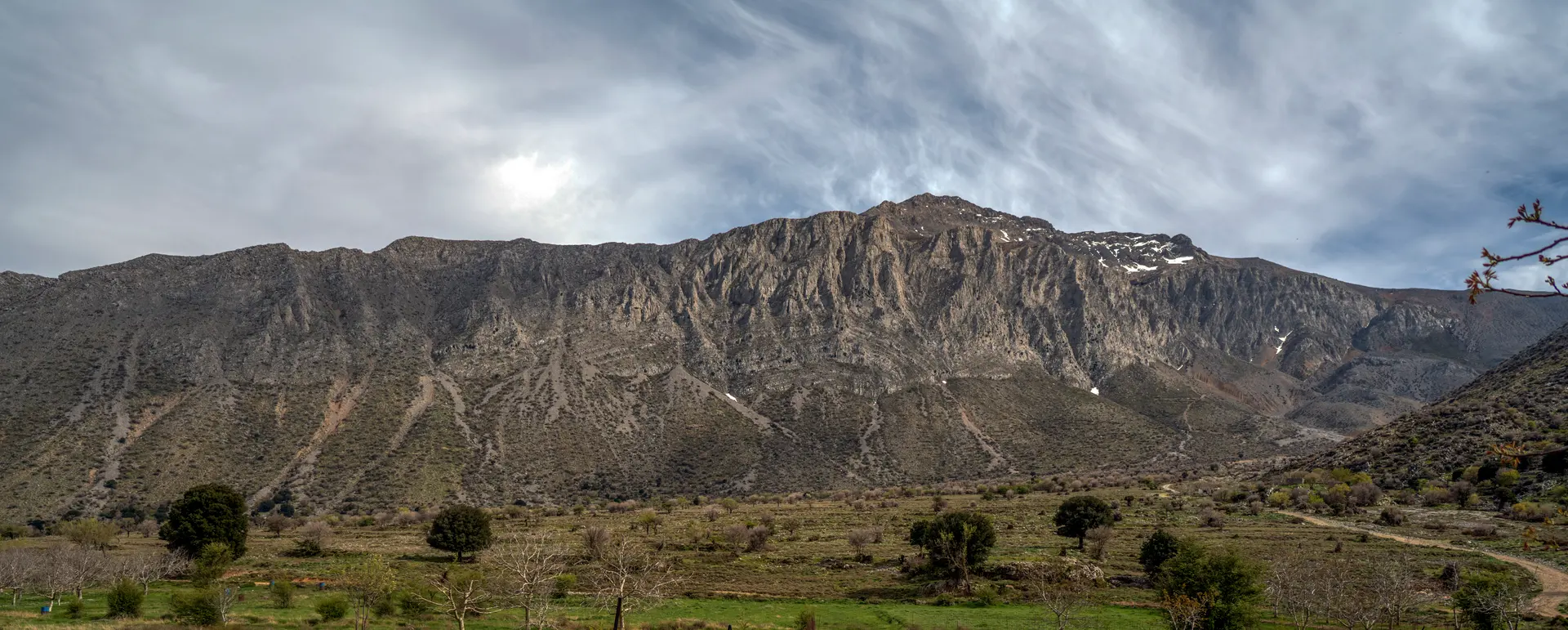
Image of Pyrgos Minoan Temple. Image source · CC-BY-4.0
Visit essentials
A quick read before you go
- Duration
- Allow 45 to 60 minutes for the archaeological site including the hillside climb and exploration…
- Access
- Located east of Myrtos village, approximately 14 km west of Ierapetra on Crete's south coast.
Overview
Above Myrtos on Crete's southern coast, white, grey, and purple stone walls emerge beside a steep path. Between roughly 2200 and 1450 BCE, the settlement grew from modest houses into a country house with a central court, wine press, tomb, and provincial administration. From the summit, the Libyan Sea reaches toward Africa and the Dikti mountains rise northward.
Pyrgos lacks the scale of Knossos or Phaistos, but reproduces their ritual architecture in miniature through pillar crypts, lustral basins, and central courts. These shared forms suggest that Minoan religious life extended beyond grand sanctuaries into provincial landscapes.
Three and a half kilometers west, the predecessor settlement Fournou Korifi yielded the Goddess of Myrtos: a hollow terracotta woman holding a libation vessel, dated around 2600 BCE. Among the oldest known Minoan representations of divinity, she predates the Snake Goddess by nearly a thousand years. When Fournou Korifi was abandoned around 2200 BCE, habitation shifted to Pyrgos. The figure remained behind, but the impulse she embodied—to shape the sacred and offer something back—continued in the same landscape.
Why this place is sacred
Stand at the top of the Pyrgos hill and the geography speaks before the ruins do. To the south, the Libyan Sea opens toward North Africa. To the north, the Dikti mountains rise in a wall of grey rock, the same mountains where, according to myth, Zeus was born in a cave. The settlement sits between these two forces -- water and stone, vastness below and vastness above -- and the position alone suggests why people chose this place.
It is a location where the horizontal world of the sea meets the vertical world of the mountains, and a human community can stand at the intersection.
But the thinness of Myrtos-Pyrgos reaches deeper than geography. It lies in duration. For more than twelve centuries, from approximately 2800 BCE to 1450 BCE, people lived, worshipped, and buried their dead along this stretch of coast. First at Fournou Korifi, where the Goddess of Myrtos was shaped from clay and used to pour sacred liquids onto an altar.
Then at Pyrgos, where a more hierarchical society built rooms with pillar crypts and a tomb where men were buried with triton shells, daggers, and ceremonial vessels. The continuity is not seamless -- there may have been a gap between the abandonment of one site and the establishment of the other -- but the landscape held its inhabitants across a span of time that dwarfs the entire history of most modern nations.
The Goddess of Myrtos herself contributes something irreplaceable to the site's resonance. Though she now resides in the Archaeological Museum of Agios Nikolaos, she was made here, from the clay of this coast, by hands that understood her as something more than decoration. Her hollow body was designed to receive liquid and pour it out through the vessel she cradles in her arms -- a functional theology in terracotta. The act of pouring was the prayer.
The object was the intermediary between human intention and something beyond human comprehension.
The deliberate burning of the country house around 1450 BCE adds a final, unsettling layer. When the Neopalatial period ended across Crete -- an era of widespread destruction whose causes remain debated -- the country house at Pyrgos was set alight while the surrounding buildings were left standing. Whatever happened here was targeted. Whether the act was political, ritual, or both, it marked the end of this hilltop's life as an inhabited place.
The ruins that remain carry the weight of that ending.
The Myrtos area served as a center of Minoan habitation and worship on Crete's south coast, evolving from the egalitarian Early Minoan village at Fournou Korifi into the hierarchical provincial settlement at Pyrgos. The sites together demonstrate the development of Minoan religious practice from household shrine to palatial ritual architecture, including goddess veneration, funerary ritual, and the merging of administrative and sacred functions that characterized Minoan civilization.
Habitation began at Fournou Korifi around 2800 BCE, where a compact village of roughly ninety rooms housed a community that produced one of the earliest Minoan goddess figurines. When that settlement was abandoned around 2200 BCE -- possibly due to fire or environmental change -- the population appears to have shifted to the Pyrgos hilltop.
Over the following centuries, Pyrgos grew from a simple settlement into a multi-period complex with a country house, wine press, settlement tomb, and administrative apparatus including seals and inscriptions in Cretan Hieroglyphic and Linear A. The country house, built during the Neopalatial period (approximately 1700-1450 BCE), replicated in miniature the ritual architecture of the great palaces: central court, multi-story construction, pillar crypts. Its deliberate destruction around 1450 BCE coincided with the wider collapse of the Neopalatial order across Crete.
The site lay abandoned and forgotten until Peter Warren excavated Fournou Korifi in 1968-1969 and Gerald Cadogan began work at Pyrgos in 1970, with additional seasons through 1982. Today both sites are open, unfenced archaeological monuments.
Experience and orientation
Begin in Myrtos village, a quiet coastal settlement on Crete's south shore where white-walled houses face the sea and life moves at Mediterranean pace. The archaeological site of Pyrgos lies east of the village, and the approach is not signposted with the confidence of Knossos or Phaistos. You may need to ask locally.
The path leads uphill through scrub and wild herbs, and almost immediately the ruins begin to appear -- stone walls and foundations emerging from the hillside, their masonry a striking range of colors from white limestone to deep purple schist.
The climb is steep and unshaded. There is no paved path, no handrail, no ticket booth. The site is unfenced and unattended, which means you will likely have it entirely to yourself. This solitude is part of the experience. At Knossos, the Minoans are mediated through reconstruction, crowds, and interpretation. Here, they are simply present in the stone.
As you ascend, floors and foundations become legible. Walls define rooms. Stairways lead between levels. The country house, at or near the summit, once rose to multiple stories with a central court -- a scaled-down version of the great palatial centers. Its stones are tumbled now, but the footprint remains discernible.
Somewhere in these rooms, administrators pressed seals into clay, scribes incised Cretan Hieroglyphic and Linear A characters onto vessels, and someone operated a wine press whose products may have served both practical and ceremonial purposes.
The settlement tomb lies nearby, though its exact location may require some searching among the ruins. Here, exclusively male burials were found with grave goods that speak to Minoan beliefs about what the dead might need or deserve: clay vessels, knives, daggers, and triton shells. The triton shells are particularly evocative -- large marine shells that, when blown, produce a low, resonant sound. Whether they were musical instruments, ritual objects, or markers of status remains an open question.
From the hilltop, the reward is the view. The Libyan Sea occupies the entire southern horizon, a deep blue expanse that on clear days seems to extend forever. To the north, the Dikti mountains rise abruptly, their slopes shifting from green lowlands to bare grey rock. The Myrtos valley, through which the Krygios river flows, opens below.
This is the landscape that sustained twelve centuries of habitation and inspired the creation of the Goddess of Myrtos -- a landscape of sea, mountain, and cultivated valley that provided everything a Bronze Age community needed.
After descending, visit the Archaeological Collection of Myrtos, located approximately 700 meters from the site. This small museum (free admission, open April through October, Monday to Saturday 08:30 to 13:00) displays finds from both Pyrgos and Fournou Korifi. The Goddess of Myrtos herself is in the Archaeological Museum of Agios Nikolaos, but reproductions and contextual material here help bridge the gap between what you have seen in the landscape and what the landscape once contained.
Allow 45 to 60 minutes for the archaeological site including the climb, and add 30 minutes for the Myrtos Museum. Wear sturdy shoes -- the hillside is steep, rocky, and unimproved. Bring water, as there is no shade and no facilities at the site. Morning visits offer cooler temperatures and gentler light on the ruins. The site faces generally south, so afternoon sun can be intense.
If you visit Fournou Korifi as well (3.5 km west), budget additional time for what becomes a full morning of engagement with Minoan south-coast civilization.
Context and lineage
No mythological origin story attaches specifically to Pyrgos -- the site predates the written mythologies of later Greece by over a millennium, and the Minoans left no deciphered narrative texts that might preserve such stories. What the archaeology reveals instead is an origin rooted in practical choice and sacred instinct working together.
The first community in this landscape established itself at Fournou Korifi around 2800 BCE, drawn by the fertile Myrtos valley, the Krygios river, and proximity to the sea. In this village of roughly ninety rooms, someone created the Goddess of Myrtos -- a terracotta woman approximately 21 centimeters tall, her body decorated with cross-hatched patterns that scholars interpret as woven cloth. She is hollow. She holds a small jug or vessel against her body.
Liquid poured into her would flow out through this vessel onto an altar below. She was, in the most literal sense, a conduit between human intention and divine presence. The feminist theologian Carol P. Christ has argued that her decoration with weaving patterns connects goddess worship to women's economic roles, suggesting that in Early Minoan society, the sacred and the productive were not separate categories.
When Fournou Korifi was abandoned around 2200 BCE, the Pyrgos hill became the new center of settlement. The community that grew here over the following centuries was more hierarchical, more administratively complex, and more architecturally ambitious. But it occupied the same landscape and drew on the same relationship between sea, mountain, and valley that had sustained its predecessor. The country house that crowned the hill during the Neopalatial period was not merely a residence.
It was a statement of belonging to the Minoan world -- its central court and multi-story plan echoing the great palaces that governed Crete from the north.
Myrtos-Pyrgos belongs to the Minoan religious tradition, which scholars understand as centering on goddess or female deity worship, nature veneration, and the integration of sacred practice into domestic and administrative life. The tradition expressed itself through libation ritual, pillar crypts, lustral basins, settlement burials, and the use of natural features -- caves, mountaintops, trees -- as sites of devotion.
The paired Myrtos sites demonstrate the evolution of this tradition from egalitarian village shrine (Fournou Korifi) to hierarchical provincial center (Pyrgos) over approximately eight centuries. The tradition ended abruptly across Crete around 1450 BCE with the collapse of the Neopalatial order, an event whose causes -- Mycenaean invasion, volcanic aftermath, internal upheaval -- remain debated.
No continuous religious lineage connects Minoan practice to later Greek religion, though scholars have traced possible echoes in Cretan Zeus worship, the cult of the Cretan goddess Britomartis, and the prominence of female deities in later Greek tradition.
Gerald Cadogan
British archaeologist who excavated Myrtos-Pyrgos in 1970 and 1981-1982, identifying the country house, settlement tomb, and administrative apparatus. His work established Pyrgos as a key example of Minoan provincial architecture and ritual practice, demonstrating that palatial forms extended far beyond the major centers.
Peter Warren
British archaeologist who excavated the neighboring Fournou Korifi settlement in 1968-1969 and discovered the Goddess of Myrtos. His meticulous documentation of the Early Minoan village provided the foundation for understanding the older phase of the Myrtos sacred landscape.
Carol P. Christ
American feminist theologian and scholar of goddess traditions who interpreted the Goddess of Myrtos as evidence of a pre-patriarchal religious culture in which women held central spiritual and economic roles. Her writing brought the figurine into broader public awareness beyond specialist archaeology.
The creator of the Goddess of Myrtos
Anonymous Minoan artisan, active around 2600 BCE, who shaped one of the earliest known devotional images in the Aegean world. Working with local clay, this person created a hollow female figure designed to function as both a representation of divinity and a practical vessel for libation ritual -- fusing art, theology, and liturgical function into a single object.
Arthur Evans
British archaeologist whose excavations at Knossos (beginning 1900) defined Minoan civilization and established the chronological framework within which Myrtos-Pyrgos and Fournou Korifi are understood. His identification of Minoan religion as centering on goddess worship provided the interpretive context for the Goddess of Myrtos discovery decades later.
Traditions and practice
The ritual life of the Myrtos landscape unfolded across two sites and more than a millennium. At Fournou Korifi, the earliest documented practice was the libation ritual associated with the Goddess of Myrtos. The hollow figure was designed to receive liquid -- likely wine, oil, or water -- and pour it through the vessel she cradles onto an altar or sacred surface below. This was not metaphorical offering.
It was physical transaction: something given, something poured out, something received by the earth or the stone. The cross-hatched decoration on the goddess's body, interpreted by some scholars as woven cloth, suggests that the woman who performed this ritual may have understood herself as engaged in work continuous with weaving, grinding, and other forms of productive labor that sustained the community.
At Pyrgos, the practices evolved with the settlement's growing complexity. The country house contained architectural features associated with Minoan ritual: pillar crypts, where the worship of sacred pillars or columns may have taken place, and lustral basins, sunken rooms accessed by stairs that may have been used for purification ceremonies.
The wine press found at the site raises the possibility that wine production carried ceremonial as well as economic significance -- a possibility strengthened by the ritual importance of wine in later Cretan and Mediterranean cultures.
The settlement tomb contained exclusively male burials accompanied by grave goods of striking specificity: clay vases and cups, knives and daggers, and triton shells. The shells are particularly notable. These large marine gastropods produce a deep, carrying sound when blown, and their presence in burial contexts across the Aegean suggests they held symbolic or ritual meaning. Whether the men buried here were warriors, priests, administrators, or some combination remains unknown.
What is clear is that their community understood death as requiring preparation -- the provision of objects for whatever followed.
Administrative practices at Pyrgos carried their own ritual dimension. The use of carved seals to impress marks on clay documents and vessel stoppers was not merely bureaucratic. In the Minoan world, seals were personal and often bore sacred imagery -- animals, deities, ritual scenes. The act of sealing was simultaneously an act of authority and an act of sacred authentication.
No religious or spiritual practice takes place at Myrtos-Pyrgos today. The site has been uninhabited for approximately 3,500 years. The Archaeological Collection of Myrtos and the Archaeological Museum of Agios Nikolaos serve as repositories for the material evidence of Minoan worship at both sites.
Climb the hill slowly. The steep ascent replicates something of the ancient approach to this elevated settlement -- the physical effort required to reach a place of significance. As you pass through the ruins, pause where walls define former rooms.
Consider what it meant to live in a community where the administrative and the sacred were housed in the same building, where sealing a jar of wine and pouring a libation to a goddess were parts of the same cultural vocabulary.
At the summit, face south. The Libyan Sea fills the horizon. This is what the Minoans saw every day -- this expanse of water that connected them to Egypt, to the Levant, to the wider Bronze Age world. Then turn north to the Dikti mountains, where myth would later place the birth of Zeus. You stand between sea and mountain, between two immensities, in the place where an ancient community chose to build its life.
If you visit the Myrtos Museum afterward, look closely at any reproductions or contextual material related to the Goddess of Myrtos. Consider the simplicity and sophistication of the concept: a human-shaped vessel designed to pour sacred liquid. The theology is in the form itself -- divinity as a channel through which something flows from human hands to something beyond.
Minoan Religion -- Goddess Worship and Domestic Ritual
HistoricalThe Myrtos landscape preserves evidence of some of the earliest goddess worship in the Aegean. The Goddess of Myrtos figurine from Fournou Korifi (c. 2600 BCE) is one of the oldest known Minoan representations of divinity. The paired sites demonstrate the evolution of Minoan religion from intimate household shrines in egalitarian villages to architecturally formalized ritual spaces in hierarchical provincial centers. Pillar crypts, lustral basins, and the integration of sacred and administrative functions at Pyrgos mirror patterns found at the great palaces, suggesting a unified Minoan religious vocabulary that extended across the island.
Perspectives and open questions
Myrtos-Pyrgos can be read as an archaeological footnote to the great palaces, as a window into provincial Minoan life, or as the landscape where one of humanity's earliest devotional images took form. Each reading reveals a different face of a civilization that left no readable literature but spoke eloquently through its buildings, objects, and chosen places.
Scholarly perspective
Archaeological scholarship positions Myrtos-Pyrgos as a key example of how Minoan administrative and ritual architecture extended beyond the major palatial centers. Gerald Cadogan's excavations demonstrated that the country house at Pyrgos replicated, in miniature, the architectural vocabulary of Knossos and Phaistos -- central courts, multi-story construction, pillar crypts, administrative record-keeping through seals and script. The site's sealing practices, documented through Cretan Hieroglyphic and Linear A inscriptions, provide valuable evidence for the development of Minoan bureaucracy.
The deliberate burning of the country house around 1450 BCE, while surrounding structures survived, is significant in the ongoing scholarly debate about the nature of the Late Minoan I destructions across Crete -- whether they resulted from Mycenaean invasion, internal conflict, or other factors. The Goddess of Myrtos from Fournou Korifi remains central to discussions of early Minoan religion, with scholars debating whether she represents a household deity, a communal goddess, or a priestess performing ritual action.
Living and traditional perspectives
No living traditional perspective on Myrtos-Pyrgos exists in the sense of a continuous religious lineage. Modern Cretans regard the Minoan remains as ancestral heritage -- evidence of their island's deep past. The Goddess of Myrtos has become an informal symbol of Crete's archaeological richness, reproduced in local museums and gift shops.
Among contemporary Cretans, there is pride in the antiquity and sophistication of Minoan civilization, understood as a foundation layer beneath later Greek, Roman, Venetian, and Ottoman cultures that shaped the island.
Alternative interpretations
Feminist theologians and scholars of goddess traditions have found in the Myrtos sites some of their most compelling evidence for pre-patriarchal religious culture in the Aegean. Carol P. Christ's interpretation of the Goddess of Myrtos emphasizes the figurine's connection to women's productive labor: the cross-hatched patterns on her body recall woven cloth, linking goddess worship to the economic and creative roles of women in the community.
In this reading, the Goddess of Myrtos is not merely a cult object but evidence of a social order in which the sacred and the feminine were not separate categories. This perspective, while influential in feminist theology and goddess spirituality movements, remains debated among mainstream archaeologists who caution against projecting modern categories onto Bronze Age societies.
Open questions
Several fundamental questions about Myrtos-Pyrgos remain unanswered. Why was the country house deliberately burned while surrounding structures were left standing? Was this destruction political, punitive, or ritual -- and is it possible to distinguish between these categories in a civilization whose political and sacred functions were so intertwined? The settlement tomb contained exclusively male burials, raising questions about gender and death in Minoan society: were women buried elsewhere, in a different manner, or not at all in this particular community?
The exact relationship between the Fournou Korifi and Pyrgos populations is unclear -- did the same families relocate when the earlier site was abandoned, or did a new group establish the hilltop settlement? And the triton shells in the tomb continue to provoke discussion: musical instruments used in funerary ceremony, status symbols of maritime authority, or something else entirely?
Plan your visit
Access and arrival
Located east of Myrtos village, approximately 14 km west of Ierapetra on Crete's south coast. Coordinates: 35.0072 N, 25.5904 E. The site is unfenced with free access at all times. No formal parking lot -- visitors park along the road near Myrtos and walk to the site. A hiking trail of sorts leads up the hillside through the ruins, but it is not maintained or formally marked. Nearest town: Myrtos village (walking distance).
Nearest city: Ierapetra (14 km east), which has full services including hospital, pharmacies, ATMs, and car rental. KTEL bus service connects Ierapetra to Heraklion and other major towns. The nearest major airport is Heraklion (approximately 100 km north, about 1.5 hours by car via the national road). Mobile phone signal is generally available in the Myrtos area, though coverage may be intermittent on the hillside itself. No emergency facilities at the site -- nearest medical services in Ierapetra.
Myrtos village offers small hotels, apartments, and rooms to let -- a quiet, authentic alternative to the tourist centers of northern Crete. Ierapetra (14 km east) has a wider range of accommodation and services. The south coast of Crete sees fewer tourists than the north, and accommodation here tends to be simpler, less expensive, and more personal.
Respectful visit
Sturdy walking shoes with good grip are essential -- the hillside is steep, rocky, and without a maintained trail. Sun protection is critical: hat, sunscreen, and long sleeves are advisable, as the site is fully exposed with no shade. In cooler months, a windbreaker is useful at the exposed summit.
No restrictions. The site is open and unattended. The colorful stone walls, panoramic views, and intimate scale of the ruins offer distinctive photographic opportunities unavailable at more heavily visited Minoan sites.
Not applicable. This is an archaeological site with no active worship tradition. Do not leave objects, flowers, or personal items at the ruins.
Do not remove stones, pottery fragments, or any material from the site. Do not dig, scrape, or disturb any surface. Respect the archaeological integrity of all visible structures. The site is protected under Greek archaeological heritage law regardless of its unfenced, unattended status.
The site is unfenced, unattended, and unshaded. There are no facilities, no water, and no emergency services at the ruins. The hillside is steep with loose rock and no formal trail in places. Visit with appropriate footwear, sun protection, and water. Do not remove any material from the site or disturb the stone structures. Though the site appears neglected, it is a protected archaeological monument under Greek law.
Location
Map loads as you approach this section.
Pilgrim reflections
A portrait of encounter, not a score
Pilgrims describe what they felt, how present they could become, and whether the place would shape a journey. There are no stars and no ranking of traditions.
No reviewed reflections yet
The first pilgrims can help describe the character of being here.
Share a reflection
Available after an account-backed “Been there.” Every reflection is reviewed before publication.
Nearby sacred places
Explore other sacred places in the region. Proximity does not establish access or travel time; check each place’s guidance.
Share a photo
Help visitors recognize Pyrgos Minoan Temple. Every submission is reviewed before publication.