Torrylin Cairn
Where Neolithic dead rest in stone chambers aligned to a volcanic island rising from the sea
Understand sacred places, explore living traditions, and learn how to engage respectfully with Pilgrim Map.
Access has not been verified. Check current local guidance before planning a visit.
Kilmory, Scotland, United Kingdom
Read the sources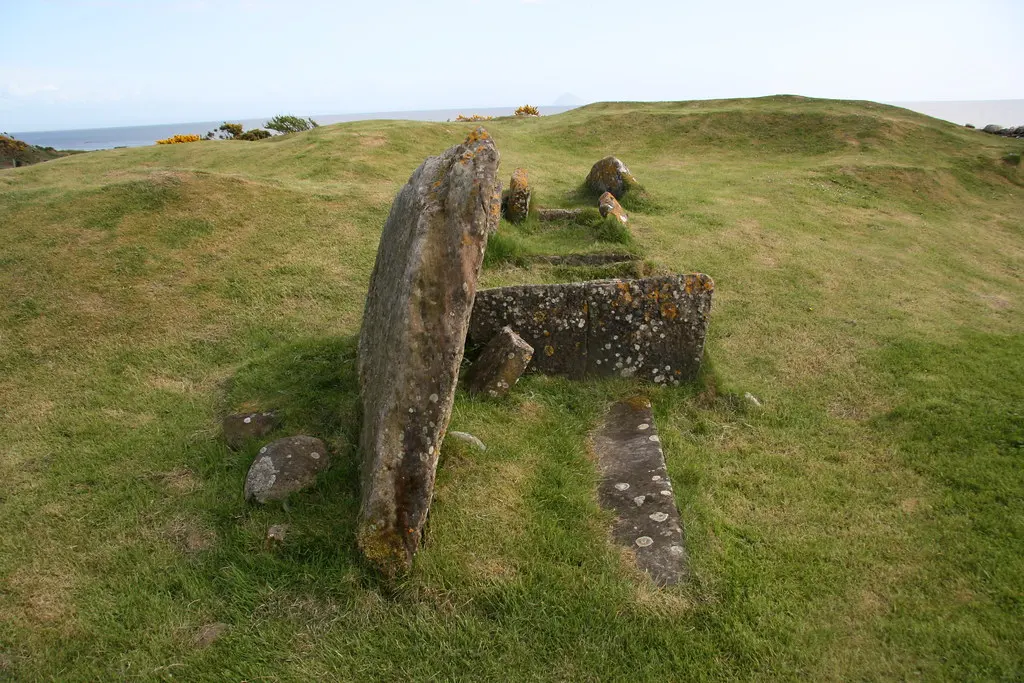
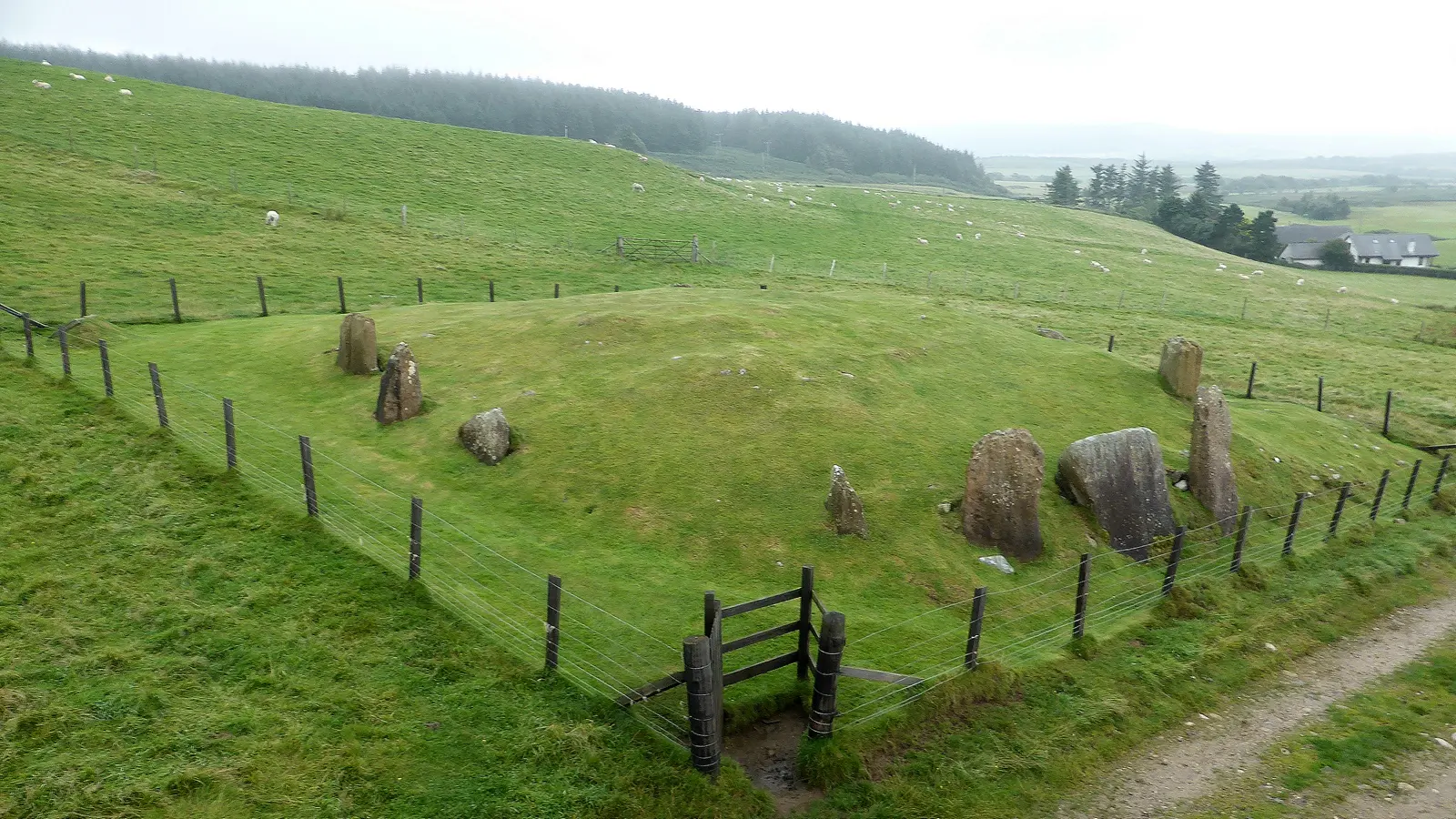
Image of Torrylin Cairn. Image source
Visit essentials
A quick read before you go
- Duration
- 45-60 minutes including walk and beach
- Etiquette
- The cairn has stood for five thousand years and contains human remains.
Overview
From Kilmory village hall, a farm path approaches Torrylin Cairn without ceremony: a low stone mound beside a stream, easily overlooked. Yet five thousand years ago its builders gave this place profound significance. They made an elongated slab chamber with four compartments, aligned toward Ailsa Craig, the volcanic island rising like a pyramid from the Firth of Clyde.
The innermost chamber held six adults, a child, and an infant, accompanied by a flint tool and pottery shard. Their sorted, arranged bones suggest care governed by practices we can glimpse but not recover fully. Animal bones indicate feasting: the living ate at the house of the dead, perhaps sharing with ancestors or marking a newly deceased person's passage into their company.
A crescent-shaped forecourt framed by slender uprights once formed a threshold between the living and the tomb. It and much of the cairn's mass are now lost to stone robbers or obscured by field stones dumped over centuries. The chamber remains open to the sky, and its alignment with Ailsa Craig is unchanged since the first stone was set.
Why this place is sacred
The thinness of Torrylin operates through intimacy rather than grandeur. This is not a monument that overwhelms with scale or spectacle. It is a low gathering of stones beside a stream, close to the sea, on an island that itself sits between the Scottish mainland and the open Atlantic. Everything about the place speaks of thresholds and boundaries.
The chamber walls are thin partitions of stone separating compartment from compartment, the living from the dead, this world from whatever the builders believed lay beyond it. The alignment with Ailsa Craig adds a dimension that extends beyond the physical boundaries of the cairn. Stand at the chamber and look south along its axis, and the volcanic island appears on the horizon, rising sharply from the sea. For the Neolithic builders, this sightline was deliberate.
Ailsa Craig was not incidental to the tomb; it was integral. The dead were oriented toward it. Whatever the island meant to them, it was significant enough to determine where and how they laid their people to rest. The evidence of feasting brings another kind of thinness. The animal bones suggest that the boundary between the dead and the living was not absolute. The living came here, prepared food, ate in the company of the dead.
The meal was shared across the threshold. This is not a place where death was hidden or sanitized; it was a place where death was engaged with directly, physically, communally. Five thousand years later, standing beside the open chamber, you stand where those meals were shared.
Torrylin Cairn was constructed during the Neolithic period, approximately 3000-2000 BC, as a Clyde-type chambered tomb for communal burial. The four-compartment chamber, crescent-shaped forecourt, and alignment with Ailsa Craig indicate a monument designed to serve both as a repository for the dead and as a ritual space where the community gathered for funerary ceremonies and feasting.
The cairn was disturbed over centuries by stone robbing and field-stone dumping, which obscured its original form. It was excavated in 1861, again in 1896, and most thoroughly in 1900 by James Bryce, who found that only the innermost compartment remained intact. Artefacts recovered, including a bowl fragment and a flint knife, are held by the National Museum of Scotland. The cairn is now a scheduled ancient monument managed by Historic Environment Scotland, accessible to visitors year-round.
Experience and orientation
Arriving on Arran means taking the ferry from Ardrossan to Brodick, a crossing of nearly an hour across the Firth of Clyde. From Brodick, the road south follows the coast through Lamlash and Whiting Bay before turning west toward Kilmory, a small settlement on the south coast. The landscape changes as you travel: the dramatic granite peaks of northern Arran give way to the gentler, greener country of the south.
Torrylin Cairn lies a short walk from Kilmory village hall, following a path through farmland toward the coast. The path can be muddy; wear sturdy footwear. The cairn appears in a field beside Kilmory Water, low and unassuming. There is no visitor centre, no interpretive panel demanding attention, no admission desk. There is a small information board from Historic Environment Scotland. Beyond that, you are alone with the stones.
The chamber is open to the sky, its compartments visible as divisions in the stone. Walk around the cairn first, taking in its setting: the stream, the fields, the coast nearby, the hills behind. Then stand at the chamber and orient yourself along its axis. Look south. If the day is clear, Ailsa Craig will be visible on the horizon, a volcanic island rising to a sharp peak. This is the sightline the builders chose.
For five thousand years, the dead in this chamber have been oriented toward that island. After the cairn, the path continues to Torrylin beach, a stretch of sand and rock where the Kilmory Water meets the sea. The combination of the cairn and the beach creates a natural circuit, perhaps thirty minutes to an hour if you take your time. The south coast of Arran is one of the quietest parts of the island.
In this quietness, the cairn speaks most clearly.
Torrylin Cairn lies beside Kilmory Water on the south coast of the Isle of Arran, near the hamlet of Lagg. It is one of over 25 Clyde-type chambered cairns on Arran, part of one of the densest concentrations of Neolithic burial monuments in Britain. The chamber axis aligns southward toward Ailsa Craig.
Context and lineage
Sometime around 3000 BC, Neolithic communities on the south coast of Arran chose a site beside Kilmory Water, close to the sea, with a clear sightline south to Ailsa Craig. They built a chambered tomb of the type archaeologists now call a Clyde cairn, a regional form found across south-west Scotland. The chamber was elongated, roughly 6.7 metres long and 1.2 metres wide, divided into four compartments of about 1.4 metres each.
A crescent-shaped forecourt of slender upright stones framed the entrance, creating a ritual threshold. The cairn itself, a mound of stones covering the chamber, would have been substantially larger than what survives today. Over the centuries and millennia that followed, the cairn served as a place of communal burial. At least eight individuals were placed in the innermost compartment: six adults, a child, and an infant.
Their bones were sorted and arranged, suggesting ongoing interaction with the remains rather than a single act of interment. A flint tool and pottery fragment were placed with them. Animal bones found in the cairn indicate feasting, the living sharing meals at the threshold of death. Eventually the cairn fell out of active use. Centuries of stone robbing reduced its mass. Field stones were dumped on and around it. Its original form was obscured.
But the chamber survived, and the alignment with Ailsa Craig endured. In 1861, the cairn was excavated for the first time. Further excavations followed in 1896 and 1900. James Bryce's 1900 excavation of the southernmost compartment recovered a bowl fragment and a flint knife, now in the National Museum of Scotland. An excavator writing in 1873 recorded that Arran's islanders regarded their burial cairns with trepidation, and tradition held that the farmer who quarried Torrylin met a particularly grim end.
Torrylin belongs to the Clyde cairn tradition of south-west Scotland, a regional form of Neolithic chambered tomb characterised by elongated chambers, segmented compartments, and crescent-shaped forecourts. Arran has over 25 such cairns, making it one of the richest concentrations in Britain. Related monuments on the island include Carn Ban, the Giants' Graves at Whiting Bay, and numerous other cairns. The tradition reflects a culture in which communal burial and ongoing engagement with the dead were central to community life.
James Bryce
Traditions and practice
The original Neolithic practices at Torrylin included communal burial in the segmented chamber, with bones sorted and arranged over time. Ritual feasting took place at or near the cairn, evidenced by animal bones. The forecourt likely served as a ceremonial space for rites accompanying new interments, as documented at other Clyde cairns. These practices ceased when the cairn went out of active use, likely by the late Neolithic or early Bronze Age.
Today visitors come to Torrylin as part of exploring Arran's rich prehistoric landscape. The walk from Kilmory village through farmland to the cairn and onward to the beach creates a natural circuit that many experience as contemplative. Some visitors familiar with Arran's archaeology visit multiple cairns across the island. There are no organised rituals or ceremonies at the site.
Approach from Kilmory village on foot, letting the walk through farmland serve as preparation. Arrive at the cairn without haste. Walk around it first, noting its relationship to the stream, the coast, and the surrounding landscape. Then stand at the chamber and look south along its axis toward Ailsa Craig. Consider that eight people were placed here five thousand years ago and that their bones were tended by the living. Consider the meals that were shared here.
Then continue to the beach if you wish, letting the sound of the sea complete what the stones began.
Neolithic communal burial practice
HistoricalThe cairn was built during the Neolithic period as a communal tomb for an extended community, part of the Clyde cairn tradition of south-west Scotland.
Communal burial in segmented chambers. Selective sorting and arrangement of human remains. Ritual feasting. Deposition of grave goods. Alignment of the chamber with significant landscape features.
Arran folk tradition
HistoricalLocal tradition maintained an awareness that the burial cairns of Arran were places of power and danger, not to be disturbed lightly.
Avoidance and respect for burial cairns. Oral traditions warning of consequences for disturbing the dead.
Perspectives and open questions
Torrylin Cairn invites understanding through archaeology, landscape studies, and the quiet encounter with a place where people were buried and mourned five thousand years ago.
Scholarly perspective
Archaeologists classify Torrylin as a Clyde-type chambered cairn, a regional form of Neolithic communal burial monument found across south-west Scotland. The four-compartment chamber measuring 6.7 metres by 1.2 metres, the crescent-shaped forecourt, and the facade of slender upright stones are all characteristic of the type. Excavations in 1861, 1896, and 1900 revealed that only the innermost compartment remained intact, containing the remains of six adults, a child, and an infant.
The selective arrangement of bones suggests ongoing ritual engagement with the dead rather than single acts of burial. Animal bones indicate feasting at the site. The chamber's alignment with Ailsa Craig is considered architecturally and cosmologically significant.
Living and traditional perspectives
No specific indigenous traditions survive regarding Torrylin Cairn. However, Arran folklore maintained that the island's burial cairns were places to be approached with caution. An excavator writing in 1873 recorded that islanders regarded the cairns with trepidation. The tradition that the farmer who quarried Torrylin met a grim end speaks to an enduring folk awareness that these places belong to the dead and should not be disturbed by the living.
Alternative interpretations
The deliberate alignment of the chamber with Ailsa Craig has drawn attention from those exploring sacred geography and landscape alignments in prehistoric Britain. Ailsa Craig's volcanic origin, distinctive pyramidal profile, and isolated position in the Firth of Clyde lend it a quality that transcends the geological. Some visitors experience the south coast of Arran, with its concentration of Neolithic monuments and its proximity to the sea, as a landscape carrying a particular presence or charge.
Open questions
The original form and dimensions of the cairn cannot be recovered. The identities and relationships of the eight individuals buried in the innermost compartment remain unknown. Whether the three outer compartments, found empty by excavators, were also used for burial or served different purposes is uncertain. The precise cosmological significance of Ailsa Craig to the builders, and the full meaning of the ritual feasting evidenced by animal bones, lie beyond what archaeology can reconstruct.
Plan your visit
Access and arrival
Limited accommodation near Kilmory. The Lagg Hotel is approximately 1 mile away. Brodick has the widest range of accommodation on Arran. Book in advance during summer months.
Respectful visit
Dress for Scottish island weather. Waterproofs recommended. Sturdy footwear essential for the muddy path through farmland.
Photography permitted. The alignment with Ailsa Craig is best captured on clear days.
Not appropriate. Presence and attention are sufficient.
Do not disturb the stones. Do not use metal detectors. Follow the Scottish Outdoor Access Code. Close farmland gates.
The path to the cairn crosses farmland and can be muddy. Scottish weather is unpredictable; carry waterproofs. The site is exposed to wind off the sea.
Current practical details
Address
Lagg, Isle of Arran KA27 8PQ, UK
Hours
Hours, fees, and access can change — verify on the official source before you travel. Practical details last checked Jun 2026.
Location
Map loads as you approach this section.
Pilgrim reflections
A portrait of encounter, not a score
Pilgrims describe what they felt, how present they could become, and whether the place would shape a journey. There are no stars and no ranking of traditions.
No reviewed reflections yet
The first pilgrims can help describe the character of being here.
Share a reflection
Available after an account-backed “Been there.” Every reflection is reviewed before publication.
Nearby sacred places
Explore other sacred places in the region. Proximity does not establish access or travel time; check each place’s guidance.
References
Sources consulted for this page. Source categories describe the publication, not a guarantee that every claim is verified. Traditional accounts and outside interpretations may differ.
- 01Torrylin Cairn - Historic Environment Scotland — Historic Environment ScotlandofficialOfficial heritage body with visitor and historical information
- 02Torrylin Cairn: History - Historic Environment Scotland — Historic Environment ScotlandofficialDetailed archaeological and historical information from the official heritage body
- 03Arran, Torlin - Canmore — Historic Environment Scotland / CanmoreSource contextNational Record of the Historic Environment entry with excavation records
- 04Torrylin Cairn - Wikipedia — Wikipedia contributorsencyclopediaOverview with coordinates, excavation history, and structural details
- 05The Isle of Arran: Torrylin chambered cairn - Dr Aaron Watson — Dr Aaron WatsonacademicArchaeological specialist with interpretive perspective on the cairn's landscape setting
- 06Torrylin Cairn - Isle of Albion — Isle of AlbionacademicSpecialist megalithic site database with detailed description
- 07Torrylin Cairn, Arran - Britain Express — Britain ExpressguideVisitor-oriented guide with historical context and photographs
- 08Torrylin Cairn Feature Page - Undiscovered Scotland — Undiscovered ScotlandguideVisitor guide with location details and historical summary
- 09Torrylinn Cairn - Ayrshire and Arran — Ayrshire and ArranguideRegional tourism guide with historical and visitor information
- 10Chambered Cairns on Arran - Visit Arran — Visit ArranguideOfficial Arran tourism board overview of chambered cairns
- 11Torrylin cairn and beach, Kilmory - WalkHighlands — WalkHighlandsguideWalking guide with route details to the cairn and beach
- 12Torrylin Cairn, Isle of Arran - SpottingHistory — SpottingHistoryacademicHistorical site database entry with overview details
Share a photo
Help visitors recognize Torrylin Cairn. Every submission is reviewed before publication.