Machrie Moor Stone Circles
Where timber became stone and the midsummer sun still rises through the glen as it did four thousand years ago
Understand sacred places, explore living traditions, and learn how to engage respectfully with Pilgrim Map.
Access has not been verified. Check current local guidance before planning a visit.
Machrie, Scotland, United Kingdom
Read the sources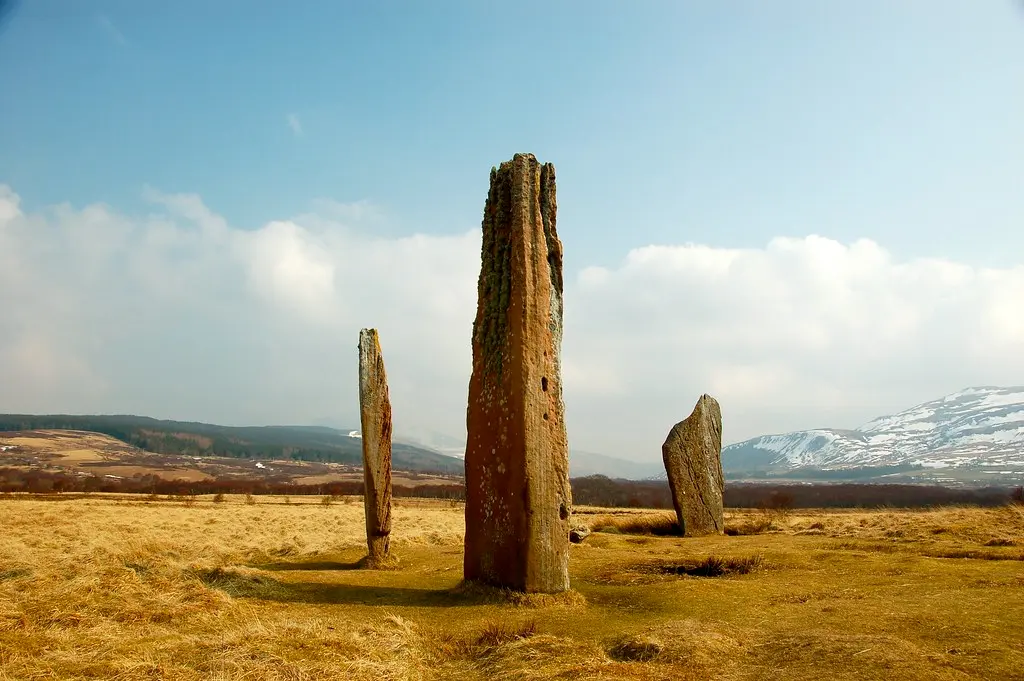
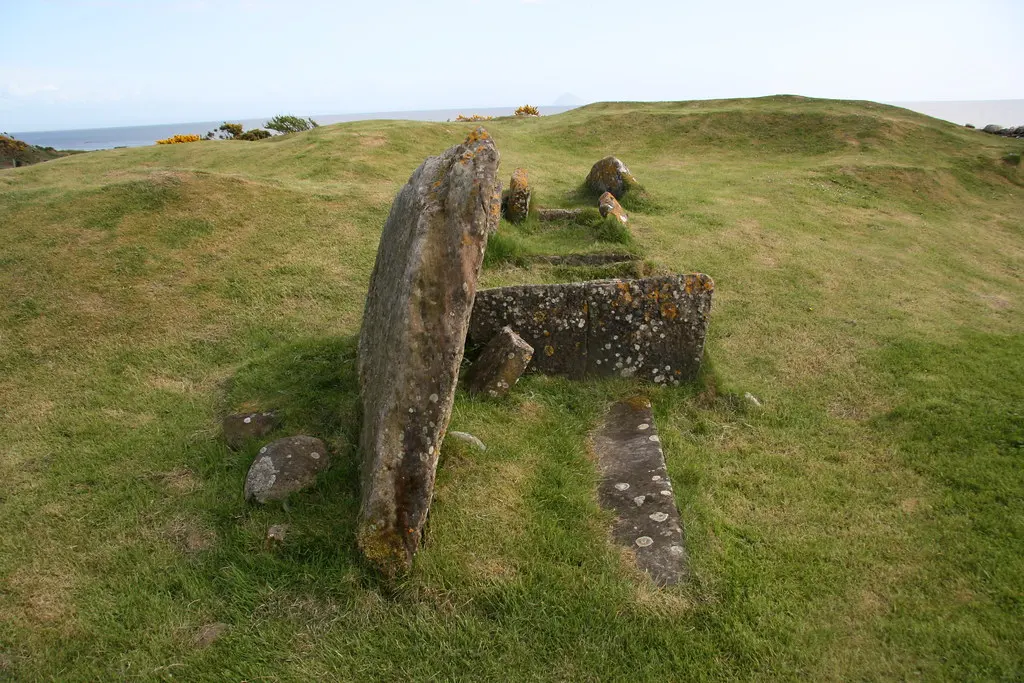
Image of Machrie Moor Stone Circles. Image source
Visit essentials
A quick read before you go
- Duration
- 2-3 hours to explore all circles and surrounding features
- Etiquette
- The stones have stood for four thousand years.
Overview
From the small coast-road car park, a farm track runs east across moorland, past a Bronze Age cairn, through gates, and beside fields. Arran's interior mountains appear as traffic fades; the walk gives the sacred approach that a car cannot.
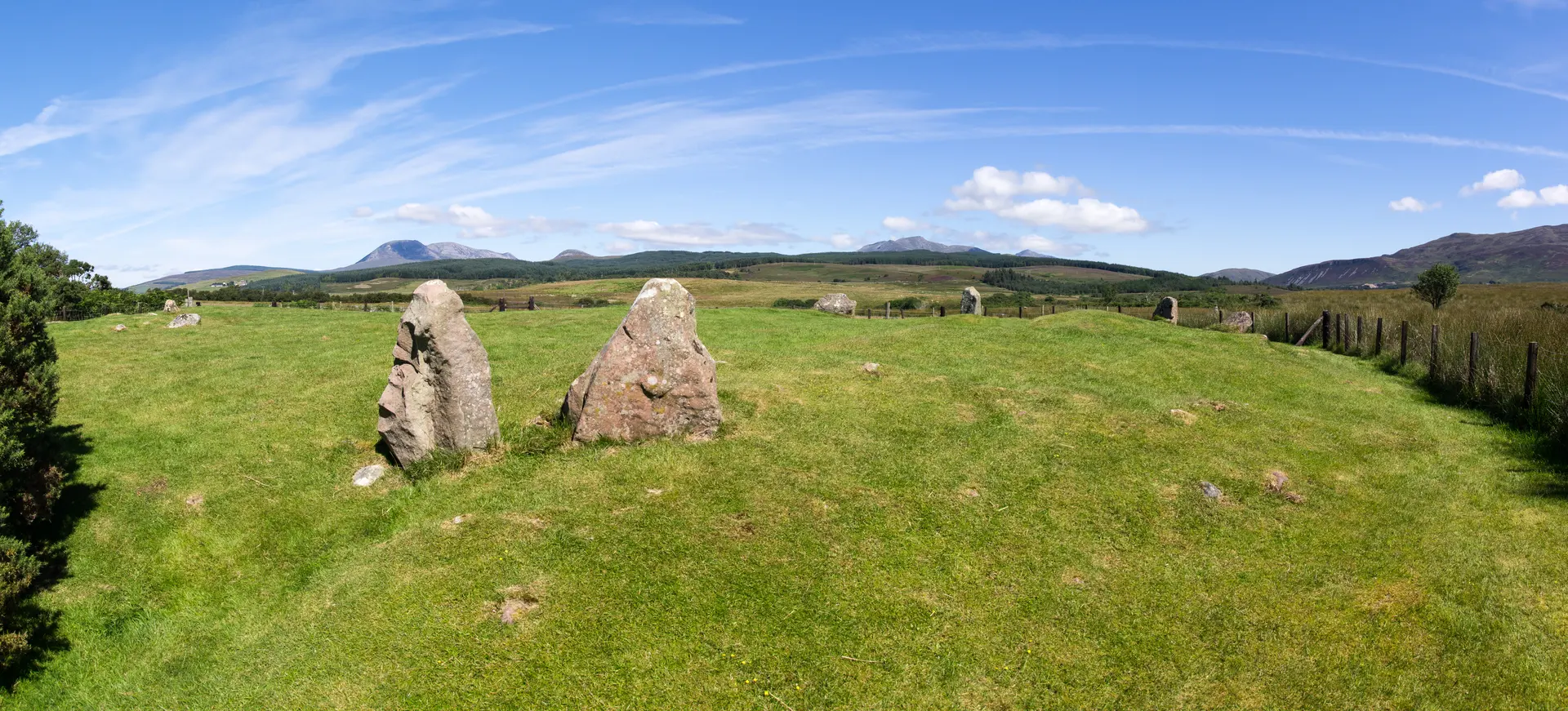
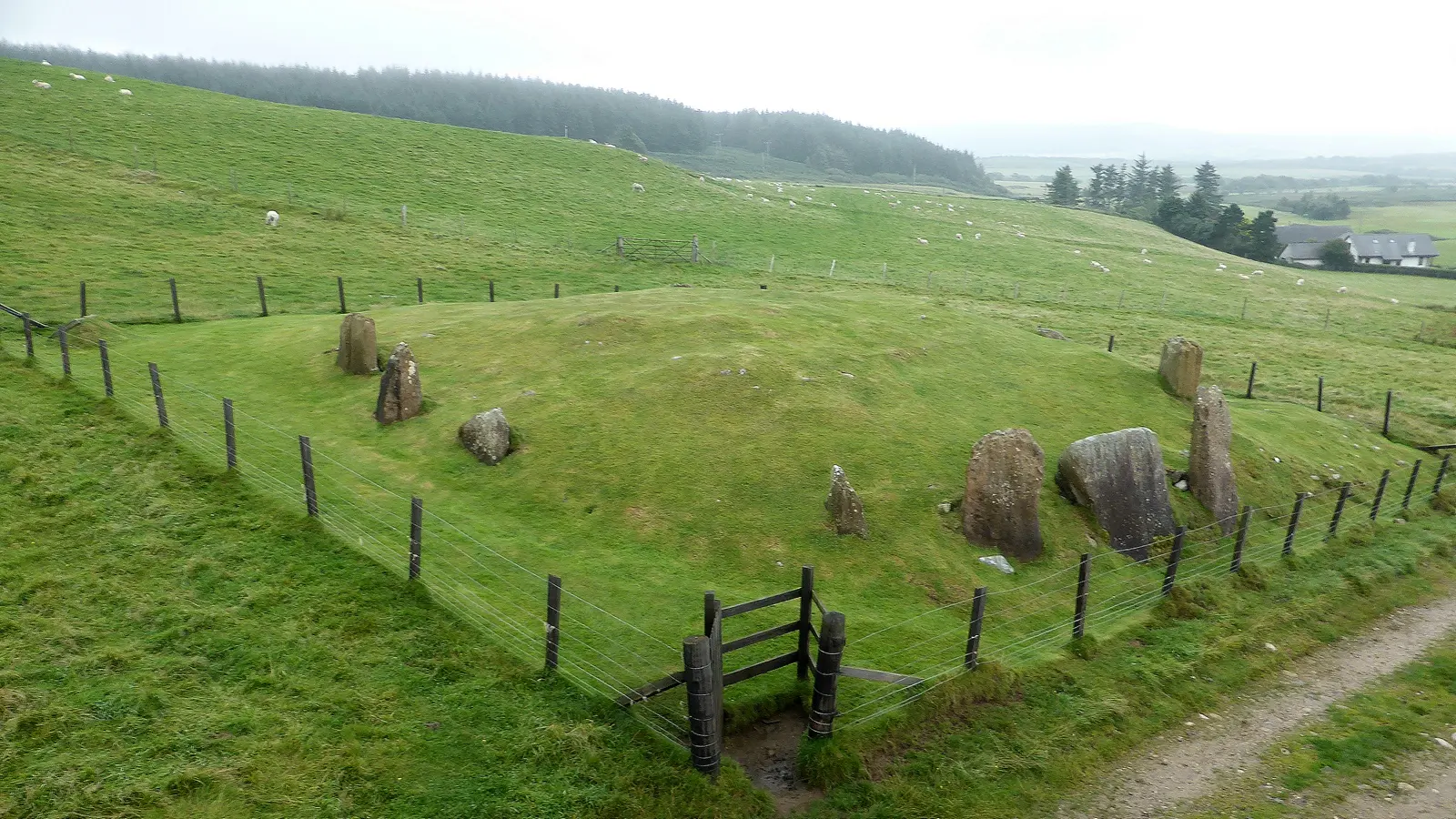
Machrie Moor holds six distinct stone circles within a few hundred metres. Low, rounded granite stones sit close to earth; tall, slender red sandstone rises upward, including a surviving stone over five metres high. Builders could use both materials and deliberately chose them for different circles. Why remains unknown; the choice itself carries meaning.
Excavations in the 1980s found timber circles on exactly the same ground, elaborate wooden structures built around 2500 BCE and replaced in stone around 2000 BCE. Between phases the land was farmed: people ploughed where parents worshipped before their children built again. The place retained power across generations, material cultures, and wood-to-stone change.
At midsummer sunrise, the sun rises through a notch at Machrie Glen's head, visible from four circles. This summer-solstice alignment was deliberate, binding ceremony to the year's turn. Later generations added cremation and inhumation burials, perhaps for prominent community members, making ceremonial circles places of the dead and thresholds between what was and what continued.
Why this place is sacred
The thinness of Machrie Moor builds through the walk. The mile and a half of farm track and moorland path is not an obstacle but an invitation to arrive gradually, shedding the pace and noise of the everyday world with each step. By the time you reach the first stones, you are already in a different state of attention. The moor itself creates this.
Open, exposed, with the mountains of Arran rising to the east and the Atlantic somewhere behind you to the west, the landscape offers no distractions, no shelter, no reason to be here except intention. The circles deepen the experience because they are plural. This is not one monument but six, each with its own character: granite circles crouching low against the ground, sandstone pillars reaching upward.
Moving between them, you encounter different qualities of stone, different scales of ambition, different relationships with the earth and sky. The diversity resists simple interpretation. Something complex was happening here, something that required multiple circles, multiple materials, multiple orientations. Below the stones, the timber circles remain in memory. What stands in stone once stood in wood. The builders renewed what their ancestors had begun, choosing permanence over the temporary. The timber rotted; the stone endures.
But the act of building on the same ground, in the same configurations, tells you that the place mattered more than the material. Whatever made this moor sacred, it was not the circles themselves but something in the land, in the alignment with the sun, in the relationship between moor and mountain and sky.
The earliest activity at Machrie Moor dates to approximately 3500 BCE with pit-digging. Timber circles were erected around 2500-2300 BCE, and stone circles replaced them on the same sites around 2000-1750 BCE. The alignment with the midsummer sunrise through Machrie Glen suggests astronomical ceremony. Burials placed within the circles indicate the site accumulated funerary significance over centuries.
The site evolved through distinct phases: early Neolithic pit-digging (3500 BCE), timber circle construction (2500-2300 BCE), a period of cultivation, stone circle construction (2000-1750 BCE), and subsequent Bronze Age burial use. Excavations by Aubrey Burl (1978-1979) and Alison Haggarty (1985-1986) revealed this sequence. Gaelic tradition later associated the stones with the giant Fingal. Today the site is a Scheduled Ancient Monument managed by Historic Environment Scotland, freely accessible year-round.
Experience and orientation
You reach Arran by ferry from Ardrossan, arriving in Brodick on the island's eastern coast. The drive west crosses the island's mountainous spine before descending to the gentler western shore. The car park is small, signed, on the coast road south of the Machrie Water bridge. From here, the walk begins. The farm track leads east through a gate, past Moss Farm Road Cairn, across fields and then onto open moorland. The ground can be wet; strong shoes are necessary.
The mountains of central Arran fill the eastern horizon. The track is well-marked but the ground is rough in places, and the moor stretches wide and flat around you. After about a mile and a half, the first stones appear. They do not announce themselves from a distance. The granite circles sit low against the moor, their boulders rounded and earth-colored. You might walk past them before realizing they form a circle. The sandstone circles are different.
Their pillars stand tall and distinct, red-brown against the green and brown of the moor, impossible to miss once you are close enough. Three tall sandstone pillars of Circle 2 often appear in photographs, but seeing them against the actual landscape is another matter entirely. Move between the circles. Each has its own character. The granite circles feel grounded, settled, part of the earth. The sandstone circles feel aspirational, reaching upward, claiming the sky.
Whether this distinction carried meaning for the builders cannot be known, but it carries meaning for you, standing here. The six circles are close enough to be experienced as a single landscape yet distinct enough that each asks for its own encounter. Look northeast from any of the circles toward the head of Machrie Glen. A prominent notch in the skyline marks the point where the midsummer sun rises. Four of the circles align with this feature.
At solstice, the sun appears precisely in the notch, illuminating the stones. The builders saw this. They designed for it. Four thousand years later, the alignment holds.
Machrie Moor lies on the west coast of the Isle of Arran, approximately 3 miles north of Blackwaterfoot. The stone circles are reached by a 1.5-mile walk east from the A841 coast road. Six circles are clustered within a few hundred metres on the open moor. Mountains rise to the east; the Atlantic lies to the west. The midsummer sunrise alignment points northeast through Machrie Glen.
Context and lineage
Around 3500 BCE, Neolithic people began modifying Machrie Moor, digging pits and gullies in ways that suggest ceremonial purpose. A thousand years later, around 2500-2300 BCE, their descendants erected timber circles on the moor, elaborate wooden structures whose post-holes were discovered during excavations in the 1980s. Then something remarkable happened. The land was cultivated. People ploughed the ground where the timber circles had stood. Then, around 2000-1750 BCE, stone circles were built on exactly the same sites.
The timber had gone; the memory had not. The new builders chose their materials with evident care. Some circles were constructed of granite boulders, low and rounded. Others were built of tall red sandstone pillars, the tallest reaching over five metres. A survey by John Barnatt in 1978 revealed that four of the circles aligned with the midsummer sunrise visible through a notch at the head of Machrie Glen.
The circles were not simply markers on the landscape but instruments of astronomical observation, tuned to the turning of the year. In time, burials were placed within the circles. Cremations and inhumations, perhaps of prominent community members, transformed the ceremonial circles into monuments of the dead. The site accumulated layers of meaning: ceremony, observation, burial, memory. Gaelic tradition added another layer.
The circle known as Fingal's Cauldron Seat became part of the mythology of the giant Fingal, the Scottish counterpart of the Irish Fionn Mac Cumhail. A stone with a natural hole was said to be where Fingal tethered his dog Bran while eating within the inner ring. The myth does not explain the stones; it acknowledges them. Today the circles stand as they have for millennia, visited by those who walk the moor to encounter what remains.
Machrie Moor belongs to the great tradition of Neolithic and Bronze Age ceremonial monument-building in the Atlantic fringe of Britain. Contemporary with other stone circle complexes in Scotland, including Callanish on Lewis and the Ring of Brodgar on Orkney, Machrie Moor is distinguished by its plurality of circles, its use of contrasting stone types, and the documented timber-to-stone transition.
The Isle of Arran's position between Scotland and Ireland made it a crossroads of cultural exchange, reflected in the Fingal mythology shared with Irish tradition.
John Barnatt
Aubrey Burl
Alison Haggarty
Traditions and practice
Original Neolithic and Bronze Age practices involved ceremonial use of timber and stone circles, observation of the midsummer sunrise through Machrie Glen, and burial of community members within the circle precincts. The transition from timber to stone on the same sites suggests renewal ceremonies. The contrasting use of granite and sandstone may have carried specific ritual meaning now lost.
Contemporary visitors walk the farm track across the moor to reach the circles. Some time visits to the summer solstice. The site is valued by those interested in prehistoric archaeology, earth-based spiritual traditions, and contemplative walking. The required walk creates a natural separation from the everyday world.
Begin at the car park and walk the farm track east. Let the walk prepare you. Notice the Moss Farm Road Cairn near the start. As the moor opens, allow the landscape to settle around you. When the first circles appear, approach slowly. Move between granite and sandstone circles, noticing the different qualities of stone. Stand within a circle and look northeast toward Machrie Glen. If you visit at midsummer, arrive before dawn. Otherwise, any time of day will do.
The walk back offers time for integration.
Neolithic and Bronze Age ceremonial practice
HistoricalMachrie Moor saw continuous ceremonial activity from approximately 3500 to 1500 BCE, spanning timber circles, stone circles, and burial use.
Timber circle construction, replacement with stone circles, astronomical observation of midsummer sunrise, burial of community members within circles.
Gaelic Fingal mythology
ActiveThe association with the giant Fingal connects the stones to the Fenian cycle shared between Scotland and Ireland.
Storytelling tradition identifying the circles as Fingal's Cauldron Seat, where the giant tethered his dogs and took his meals.
Contemporary contemplative and spiritual practice
ActiveModern visitors experience the walk across the moor and encounter with the stones as a form of pilgrimage and contemplation.
Walking meditation on the approach track. Solstice visits for the sunrise alignment. Quiet contemplation among the circles. Engagement with the contrasting stone types.
Perspectives and open questions
Machrie Moor invites interpretation through archaeology, mythology, and direct encounter. The plurality of circles, the contrasting materials, and the astronomical alignment create a site of unusual complexity.
Scholarly perspective
Archaeologists recognize Machrie Moor as one of Scotland's most significant Bronze Age ceremonial landscapes. Excavations by Aubrey Burl (1978-1979) and Alison Haggarty (1985-1986) revealed a sequence spanning two thousand years: Neolithic pit-digging (3500 BCE), timber circles (2500-2300 BCE), cultivation, then stone circles on the same sites (2000-1750 BCE). A radiocarbon date of 2030 plus or minus 180 BCE was obtained for timber at Circle 1. John Barnatt's 1978 survey demonstrated the midsummer sunrise alignment through Machrie Glen.
The use of contrasting stone types is considered deliberate and potentially symbolic. Subsequent burial use extended into the Bronze Age.
Living and traditional perspectives
Gaelic tradition connects the stones to Fingal (Fionn Mac Cumhail), the mythic giant of the Fenian cycle. The circle called Fingal's Cauldron Seat preserves the legend that the giant tethered his dog Bran to a perforated stone while eating within the inner ring. This tradition locates the stones within a shared Scottish-Irish mythological landscape, acknowledging their power through narrative.
Alternative interpretations
Contemporary spiritual practitioners value Machrie Moor for the contemplative quality of the approach walk, the energetic contrast between granite and sandstone circles, and the solar alignment. The site is recognized as a place where the land itself holds power, evidenced by two thousand years of continuous ceremonial investment. Some interpret the contrasting stone types as representing complementary energies or elemental qualities.
Open questions
Why the builders chose this particular stretch of moorland remains uncertain. The symbolic significance of granite versus sandstone circles is debated. The ceremonies that accompanied midsummer sunrise observation are lost. The relationship between the six circles and their distinct functions cannot be determined from archaeological evidence alone. Why timber circles were replaced with stone on the same ground after a phase of cultivation is one of the site's deepest questions.
Plan your visit
Access and arrival
Accommodation available in Blackwaterfoot, Machrie, and throughout the Isle of Arran. Brodick (main town, 12 miles east) has the widest range. Book in advance during summer months.
Respectful visit
Strong walking shoes or boots essential. The moor is often boggy. Waterproof outer layers advisable. Dress in layers for changeable conditions.
Photography permitted and rewarding. The red sandstone pillars against mountain backdrops create memorable images. Morning and evening light enhance the stone colors.
Not traditionally associated with offerings. Presence and attention are the appropriate response.
Do not climb on the stones. Do not damage the monument. Leave no trace. Follow the Countryside Code.
The moor can be very boggy after rain. Strong waterproof footwear essential. No facilities at the site. The walk is approximately 3 miles round trip across open, exposed terrain. Weather on Arran can change rapidly.
Current practical details
Address
Isle of Arran KA27 8DX, UK
Hours
Hours, fees, and access can change — verify on the official source before you travel. Practical details last checked Jun 2026.
Location
Map loads as you approach this section.
Pilgrim reflections
A portrait of encounter, not a score
Pilgrims describe what they felt, how present they could become, and whether the place would shape a journey. There are no stars and no ranking of traditions.
No reviewed reflections yet
The first pilgrims can help describe the character of being here.
Share a reflection
Available after an account-backed “Been there.” Every reflection is reviewed before publication.
Nearby sacred places
Explore other sacred places in the region. Proximity does not establish access or travel time; check each place’s guidance.
References
Sources consulted for this page. Source categories describe the publication, not a guarantee that every claim is verified. Traditional accounts and outside interpretations may differ.
- 01Machrie Moor Standing Stones — Historic Environment ScotlandofficialOfficial heritage body managing the site
- 02Machrie Moor Standing Stones: History — Historic Environment ScotlandofficialDetailed historical interpretation from official heritage body
- 03Machrie Moor, Arran: recent excavations at two stone circles — Proceedings of the Society of Antiquaries of ScotlandacademicPeer-reviewed excavation report
- 04Machrie Moor Stone Circles — WikipediaencyclopediaWell-referenced encyclopedia article with archaeological citations
- 05Machrie Moor Stone Circles — Undiscovered ScotlandguideComprehensive regional guide with good historical detail
- 06Machrie Moor stone circles walk — WalkHighlandsguidePractical walking and access information
- 07Machrie Moor 1 Stone Circle — The Megalithic PortalSource contextSpecialist megalithic database with coordinates and measurements
- 08Machrie Moor: Scotland's Menagerie Of Ancient Monuments — DigVenturesacademicArchaeology organization with accessible interpretation
Share a photo
Help visitors recognize Machrie Moor Stone Circles. Every submission is reviewed before publication.