Auchagallon Curved Cairn
A Bronze Age burial cairn above Machrie Bay, where fifteen red and grey stones hold watch over the western sea
Understand sacred places, explore living traditions, and learn how to engage respectfully with Pilgrim Map.
Access has not been verified. Check current local guidance before planning a visit.
Machrie, Scotland, United Kingdom
Read the sources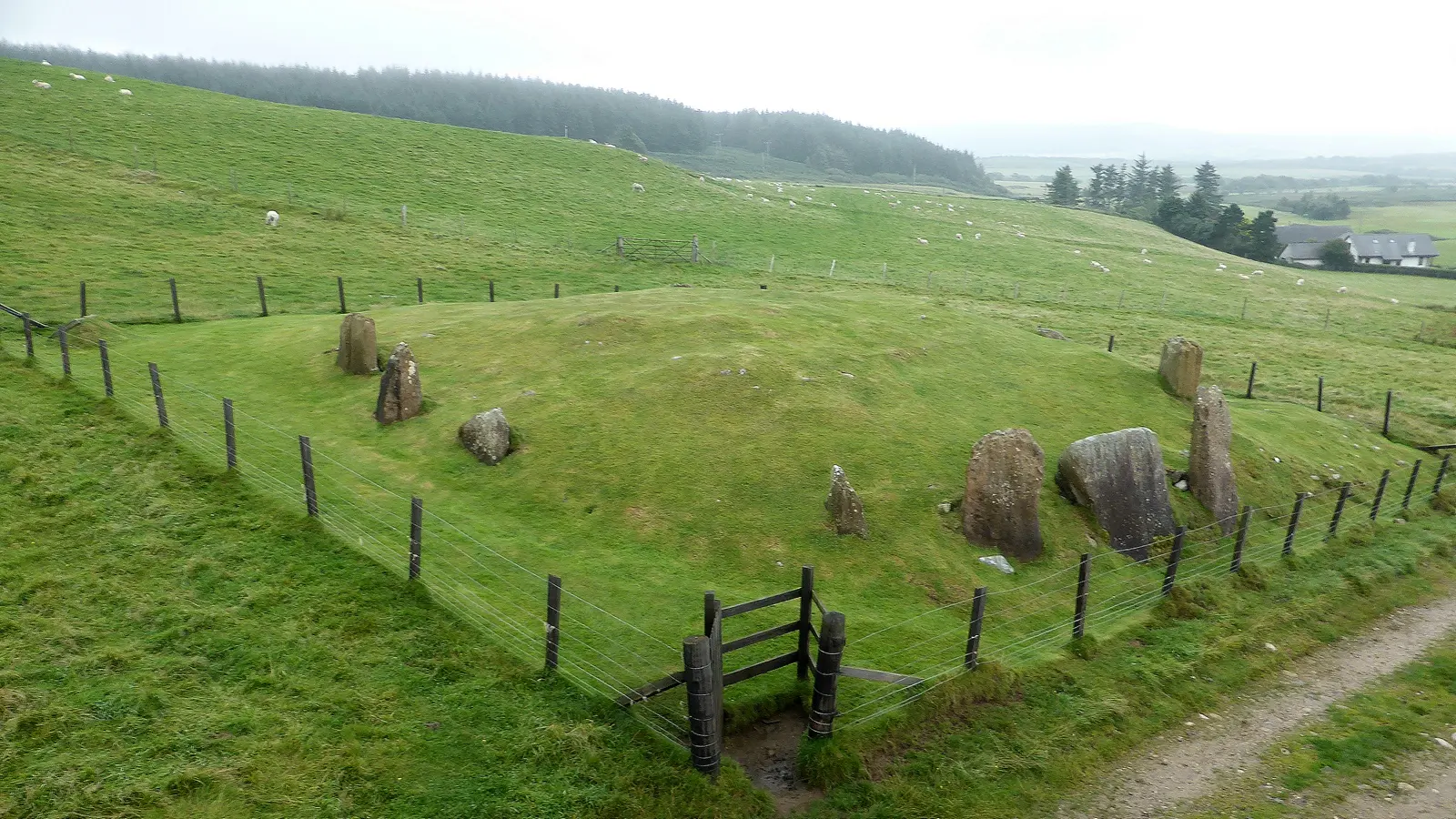
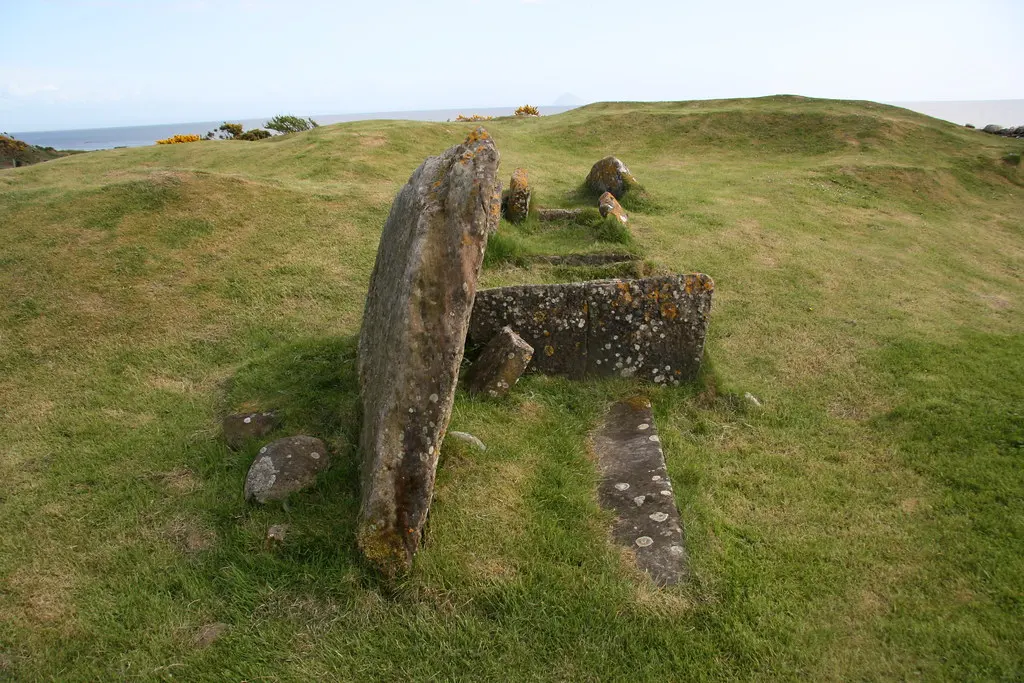
Image of Auchagallon Curved Cairn. Image source · CC-BY-SA-2.0
Visit essentials
A quick read before you go
- Duration
- 45-60 minutes to fully experience the site and the views
- Etiquette
- Free access.
Overview
A short, steep path leaves the road within five minutes for a hillside shelf chosen four thousand years ago to honour the dead. Auchagallon's fifteen stones form a rough circle 14.5 metres across around a vanished cairn once heaped over a burial. Erosion or removal took most cairn material, but deeply planted kerb stones remain: thirteen in western Arran's warm red sandstone and two in cool grey granite.
Whether the contrast meant something or merely reflected availability is unknown, though the granite draws the eye as if set apart. Their deliberate grading placed the tallest stones, up to 2.3 metres, on the western downhill side toward Machrie Bay and half-metre stones uphill to the east, creating a level profile from below. From within, stone encloses the uphill side while sea opens downhill across the bay and Kilbrannan Sound toward Kintyre beneath Arran's rarely still sky.
South lies Machrie Moor, where six circles mark one of Scotland's most significant prehistoric ceremonial landscapes. Auchagallon belongs to that ritual world yet stands apart, elevated and outward-looking, where the dead faced setting sun and open water—a choice still legible.
Why this place is sacred
Auchagallon holds something that more thoroughly investigated sites have surrendered: the unknown. Victorian antiquarians dug into the centre and found a cist, a stone box designed to hold a burial. But what the cist contained, whether bones remained, what grave goods accompanied the dead, whether the body lay crouched as was customary, none of this was recorded. The excavators took what they found and left no account.
This incompleteness is not a failing of the monument but a condition of its power. You stand among the stones knowing that someone lies beneath your feet, honoured four thousand years ago with an elaborate cairn and a ring of graded stones, and you cannot know who they were. The site resists the closure that knowledge brings. The setting amplifies this quality.
The west-facing hillside receives the afternoon and evening light directly, warming the red sandstone to the colour of old terracotta. The two grey granite stones catch the light differently, cooler, more reflective. As the sun moves westward over the sea, the monument shifts through registers of colour and shadow that the builders may have intended or may simply have received as a gift of the stone they chose. The view is expansive.
Machrie Bay lies below, its curve of sand and farmland reaching toward the sea. The Kilbrannan Sound separates Arran from the long spine of Kintyre. On clear days the coast opposite is visible; on others, the sea and sky merge into a single grey expanse. This is a place positioned between the known and the unknown, the land and the sea, the living and the dead.
Auchagallon was built as a kerbed burial cairn approximately 2000 BC. The body of a person of importance was placed in a cist, a stone-lined burial chamber, beneath the ground. Prestigious objects were likely placed beside the body. The cairn was then heaped over the cist and edged with a kerb of graded upright stones. The monument served as a visible marker in the landscape, honouring the dead and asserting the presence of the living community.
The cairn was built in the Early Bronze Age. At some unknown point, the cairn material above the cist was lost to erosion or removal, leaving the kerb stones standing as an apparent stone circle. In the 19th century, unnamed antiquarians excavated the centre and found the cist, but left no proper records. The site was taken into state care and is now managed by Historic Environment Scotland as a scheduled ancient monument. No modern archaeological excavation has been conducted.
Experience and orientation
You will likely be alone. Auchagallon does not appear in most guidebooks, and even visitors who come to Arran for its prehistoric sites often head straight to Machrie Moor without stopping here. This is the site's gift. The approach is signposted from the A841 coast road, at the junction near Machrie golf course, about four miles north of Blackwaterfoot. A short lane leads uphill.
There is space to park at the roadside, and a sign asks visitors to walk up the lane rather than crossing the fields. The walk takes five minutes and carries you from the level coast to an elevated shelf where the light and the air change. You are higher now, and the bay opens below. The stones appear as you crest the slope.
They are not dramatic in the manner of tall standing stones; the tallest reaches 2.3 metres, and many are shorter. Their power lies in their arrangement, their colours, and their setting. Walk around the outside first, noting how the heights change, tallest facing the sea, shortest facing the hill. Then enter the circle and stand at the centre where the cist was found. Look west.
The builders placed this monument so the dead would face the open water and the setting sun. The evening light is particularly fine here. If you visit in late afternoon, the red sandstone glows and the shadows lengthen eastward up the hill. The two grey granite stones stand out like sentinels of a different order. From this vantage you can also see southward toward Machrie Moor, where the stone circles stand on the level ground below.
Auchagallon and Machrie Moor together represent a landscape of ritual activity spanning centuries, perhaps millennia. Walking between them, along the coast road or across the hillside, connects the elevated burial site to the ceremonial arena on the moor.
Auchagallon stands on a west-facing hillside above Machrie Bay on the Isle of Arran. The stones form a circle approximately 14.5 metres in diameter. The tallest stones are on the western (downhill) side, the shortest on the eastern (uphill) side. The centre of the circle, where the cist was found, is the focal point. Machrie Moor stone circles lie approximately 1.5 miles to the south.
Context and lineage
Around 2000 BC, a community on the western coast of the Isle of Arran selected a shelf of hillside above Machrie Bay as the burial place for a person of significance. They dug a cist, a box of stone slabs, into the earth, placed the body inside with whatever grave goods custom demanded, and sealed it. Over the cist they heaped a cairn of stones.
Around the cairn they set fifteen upright slabs as a kerb, grading the heights so that the tallest stones faced the sea and the shortest faced the hill. Thirteen stones were red sandstone, the local rock. Two were grey granite, sourced separately, deliberately different. The result was a monument visible from the bay below, its profile even against the sky, marking the place where the dead rested above the living world. The cairn stood for centuries, then millennia.
The heaped stones were eventually lost. The kerb stones endured. In the 19th century, diggers opened the centre and found the cist. What else they found, they did not record. The monument passed into state care. It stands now as it has stood for four thousand years: fifteen stones on a hillside, looking west.
Auchagallon belongs to the tradition of kerbed cairns found across western Scotland and Ireland during the Early Bronze Age. It is part of the broader prehistoric landscape of western Arran, which includes the Machrie Moor stone circles (six circles dating from Neolithic to Bronze Age), Tormore, and other ceremonial and funerary sites. This concentration of monuments indicates that the western coast of Arran was a significant ritual landscape for at least two thousand years.
Unknown 19th-century antiquarians
Traditions and practice
The cairn was a funerary monument. The dead were placed in a cist beneath the cairn with grave goods. The construction of the kerb, with its graded heights and contrasting stone types, may have been a ritualised act in itself. The relationship to Machrie Moor below suggests the cairn was part of a wider system of ritual movement through the landscape.
Visitors walk to the site for quiet contemplation and to experience the prehistoric landscape of western Arran. Some combine a visit with Machrie Moor stone circles as part of a walking route through the ancient sites. Photography, particularly in the late afternoon light, is common.
Approach on foot from the signposted lane. Let the short uphill walk transition you from the road to the monument. Walk around the outside of the circle first, observing the graded heights and the two grey granite stones. Then enter and stand at the centre. Face west, toward the sea. Consider that the person buried here was placed to face this same view four thousand years ago.
If time allows, walk south to Machrie Moor to connect the elevated burial site with the ceremonial landscape on the moor below.
Bronze Age kerbed cairn burial tradition
HistoricalThe cairn was built approximately 2000 BC as an elaborate burial monument. The kerbed construction, graded stone heights, and use of contrasting stone materials indicate a ritual tradition with specific conventions about how the dead should be honoured and the living landscape marked.
Cist burial beneath a cairn of heaped stones, edged with a kerb of upright slabs. Probable deposition of pottery and flint tools as grave goods. Deliberate selection of site on elevated ground facing the western sea.
Contemporary contemplative visiting
ActiveModern visitors drawn to Arran's prehistoric landscape include Auchagallon as a quieter, more intimate alternative to Machrie Moor.
Walking to the site, standing among the stones, contemplating the views and the unknown burial beneath. Photography. Combining the visit with walks to other prehistoric sites on the western coast.
Perspectives and open questions
Auchagallon invites interpretation through archaeology, landscape, and the quality of not-knowing that an unexcavated site preserves.
Scholarly perspective
Archaeologists now classify Auchagallon as a kerbed cairn rather than a true stone circle. The fifteen upright stones formed the kerb of a burial cairn, with a cist found at the centre during 19th-century excavation. The graded stone heights may have served to present a uniform profile when viewed from below, or may reflect ritual significance. The two grey granite stones among the red sandstone majority remain unexplained. The site dates to the Early Bronze Age, approximately 2000 BC.
No modern excavation has been conducted, leaving many questions unanswered.
Living and traditional perspectives
No specific folk traditions are recorded for Auchagallon. The broader Arran landscape carries Gaelic place names and associations with Finn MacCool (Fionn mac Cumhaill), the mythical giant warrior of Gaelic tradition, particularly at nearby Machrie Moor where the stone circles are sometimes called 'Fingal's Cauldron Seat.' The Isle of Arran sits in the Firth of Clyde, a crossing point between the Gaelic west and the Lowland east, and its monuments belong to both worlds.
Alternative interpretations
The cairn's west-facing position overlooking the sea has drawn interpretations connecting it to beliefs about the dead journeying westward. In many Atlantic cultures, the west, where the sun sets over the ocean, was associated with the otherworld or the land of the dead. Auchagallon's orientation may reflect this cosmology, placing the deceased to face their destination.
Open questions
Almost everything about Auchagallon remains uncertain. The 19th-century excavation produced no proper records. Whether the cist contained a single burial or multiple remains, what grave goods accompanied the dead, whether the cairn had a passage or entrance, and whether the graded stones and mixed materials held specific symbolic meaning are all unknown. The site has never been excavated using modern methods. This is simultaneously a gap in knowledge and a preservation of mystery.
Plan your visit
Access and arrival
Accommodation available in Blackwaterfoot (4 miles), Machrie, and Brodick. The island has a range of B&Bs, hotels, and self-catering options. Book in advance for summer.
Respectful visit
Sturdy footwear for the uphill walk. Waterproofs advisable in Scottish island weather.
Freely permitted. Late afternoon light on the red sandstone is particularly rewarding.
Do not leave offerings or disturb the scheduled monument.
Scheduled ancient monument. No disturbance, no metal detecting, no removal of material.
The hillside can be wet and slippery in rain. Arran weather changes quickly. The site is exposed to wind from the west.
Current practical details
Address
Auchangallon Jetty, Isle of Arran KA27 8DZ, UK
Hours
Hours, fees, and access can change — verify on the official source before you travel. Practical details last checked Jun 2026.
Location
Map loads as you approach this section.
Pilgrim reflections
A portrait of encounter, not a score
Pilgrims describe what they felt, how present they could become, and whether the place would shape a journey. There are no stars and no ranking of traditions.
No reviewed reflections yet
The first pilgrims can help describe the character of being here.
Share a reflection
Available after an account-backed “Been there.” Every reflection is reviewed before publication.
Nearby sacred places
Explore other sacred places in the region. Proximity does not establish access or travel time; check each place’s guidance.
References
Sources consulted for this page. Source categories describe the publication, not a guarantee that every claim is verified. Traditional accounts and outside interpretations may differ.
- 01Auchagallon Cairn - Historic Environment Scotland — Historic Environment ScotlandofficialOfficial heritage body with visitor and historical information
- 02Auchagallon Cairn: History - Historic Environment Scotland — Historic Environment ScotlandofficialDetailed archaeological history including dating and construction details
- 03Arran, Auchengallon - Canmore — Historic Environment Scotland / CanmoreSource contextNational Record of the Historic Environment
- 04Auchagallon Stone Circle - Wikipedia — Wikipedia contributorsencyclopediaGeneral overview with coordinates and physical description
- 05Auchagallon Stone Circle - The Megalithic Portal — The Megalithic PortalacademicSpecialist megalithic database with detailed coordinates, visitor ratings, and descriptions
- 06The Isle of Arran: Auchagallon Cairn - Dr Aaron Watson — Dr Aaron WatsonacademicArchaeological researcher's documented visit with landscape context
- 07Auchagallon Stone Circle, Isle of Arran - Britain Express — Britain ExpressguideVisitor-oriented guide with historical context and access details
- 08Auchagallon Stone Circle - Undiscovered Scotland — Undiscovered ScotlandguideDescriptive guide with setting and context information
- 09Saints and Stones: Auchagallon Kerbed Cairn — Saints and StonesacademicExperiential guide to the site as part of sacred landscape
- 10Auchagallon Cairn - Scotland Off the Beaten Track — Scotland Off the Beaten TrackguideVisitor experience and atmospheric description
Share a photo
Help visitors recognize Auchagallon Curved Cairn. Every submission is reviewed before publication.