Tomb of Christ, Shingo, Japan
A meditation on sacred sites themselves in a remote Japanese village
Understand sacred places, explore living traditions, and learn how to engage respectfully with Pilgrim Map.
Access has not been verified. Check current local guidance before planning a visit.
Shingo, Aomori Prefecture, Japan
Read the sources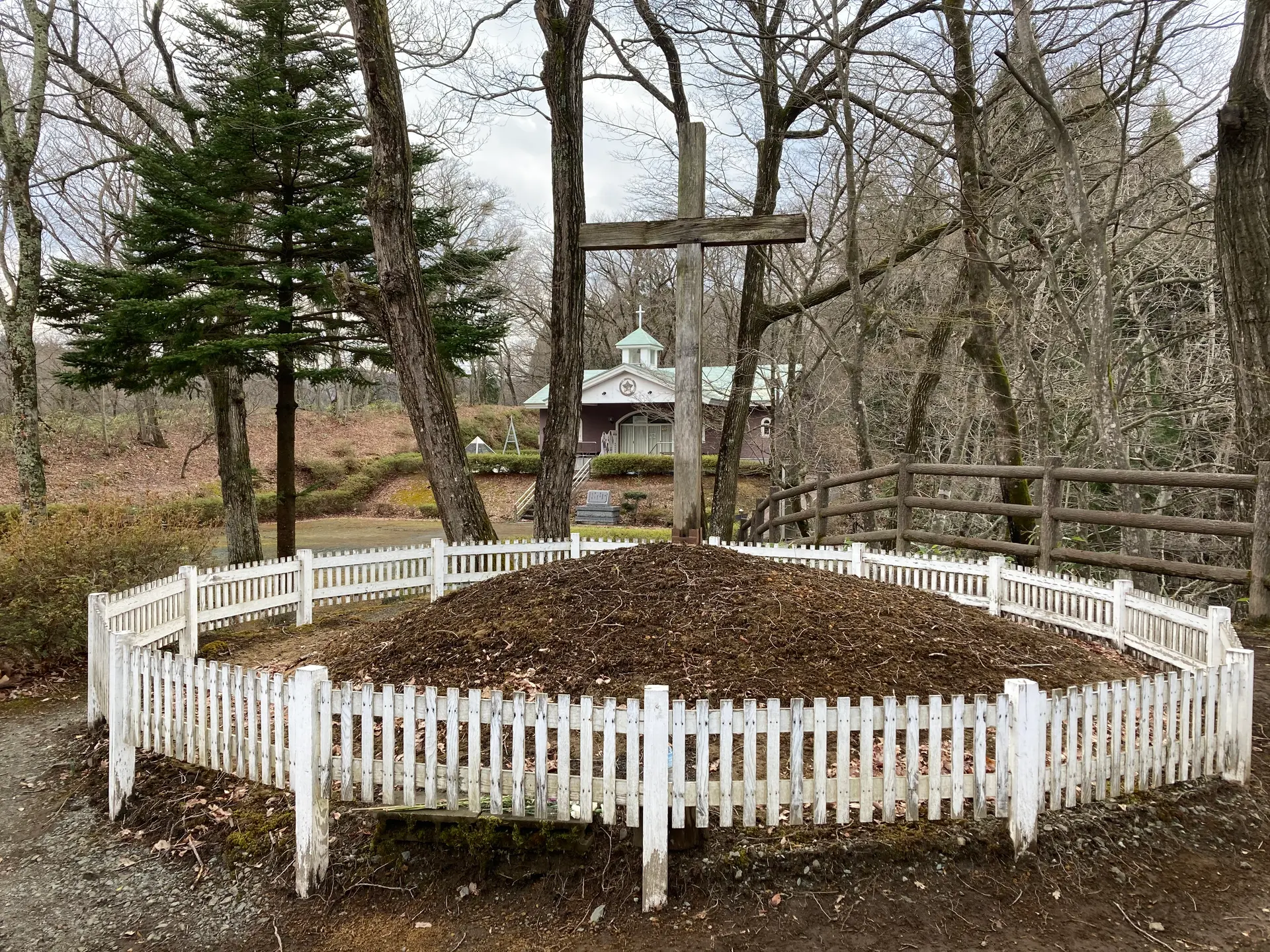
Visit essentials
A quick read before you go
- Duration
- 1-2 hours including museum
- Access
- Open year-round during daylight hours.
Overview
In Aomori Prefecture's mountains, Shingo maintains two earthen mounds beneath wooden crosses. The Takeuchi documents, discovered in 1935 and swiftly proven modern forgeries, claim that Jesus came to Japan at age 21, studied for twelve years, returned to Judea while his brother Isukiri took his place on the cross, and escaped through Siberia back to Japan.
In Herai, as the village was then called, he supposedly became garlic farmer Daitenku Taro Jurai, married Miyuko, fathered three daughters, and died peacefully at 106.
Historians dismiss the legend entirely, yet a genuine tradition has grown here. Each June since 1964, a Christ Festival combines a Shinto priest's norito prayers at the gravesite with local shishimai lion dances and bon odori around the mounds. The Israeli embassy sent a delegation in 2004, when Ambassador Eli Cohen dedicated a Hebrew plaque. Over 10,000 people visit annually, more than thirty percent from overseas.
Asked about Shinto ceremonies for a Christian figure, the priest replied that even if Jesus were buried here, Shinto's myriad gods made that no problem. Villagers beautifully maintain the site despite not believing the legend themselves. The paradox makes the Tomb of Christ a meditation on how human attention can transform ordinary ground into a sacred site, with questions more valuable than any answer.
Why this place is sacred
The Tomb of Christ presents an inverse form of sacred site. Its historical claims are false, its origins are documented forgery, yet genuine spiritual significance has accumulated through human attention. The villagers who maintain the grounds do not believe Jesus is buried here, yet they tend the site with evident care. The Shinto priest who offers prayers does not need to verify the legend to sanctify the ground.
The pilgrims who visit, whether curious tourists or seekers of alternative histories, contribute to a continuously renewing attention that itself creates meaning.
Scholars of religion call such places 'authentic fakes,' genuine in cultural function despite fictitious origins. But this clinical framing misses something the site offers more directly. Standing at the mounds in this quiet mountain village, one can feel how human reverence sanctifies space regardless of historical accuracy. The love villagers show in maintaining a place they know is spurious teaches something about sacred sites that factual pilgrimage destinations cannot.
For seekers questioning the nature of their own spiritual seeking, the Tomb of Christ offers unusual reflection. The veil it thins is not between worlds but between belief and practice, between fact and meaning, between what we know and what we honor.
The site was created in 1935 by Kiyomaro Takeuchi to support spurious documents claiming ancient Japanese heritage for world religions. His motivations remain unclear, possibly nationalist, possibly sincere belief in the documents' authenticity.
Despite immediate scholarly debunking, the site developed genuine cultural life. The village embraced the legend as local identity, beginning the annual festival in 1964. International attention, including the Israeli embassy's participation, transformed the site from local curiosity to unique pilgrimage destination. The site now draws visitors interested in Japanese spirituality, alternative histories, and questions about sacred site formation.
Experience and orientation
The Tomb of Christ occupies a small park on a quiet hillside above Shingo village. Two earthen mounds sit beneath wooden crosses, surprisingly modest given the legend they support. The larger mound supposedly holds Jesus; the smaller contains his brother's ear and a lock of Mary's hair, brought from Judea by the escaped savior. Wildflowers and carefully maintained grass surround the simple markers.
A small museum nearby tells the legend through displays of artifacts and the Takeuchi documents. A 'Jerusalem stone,' a gift from Israel, sits prominently. The tone throughout balances respectful presentation with implicit acknowledgment of the story's improbability. Visitors sense the village treats its famous legend with affectionate bemusement rather than literal belief.
The surrounding landscape offers typical rural Japan: forested mountains, terraced fields, quiet roads. The remoteness contributes to the site's atmosphere. One does not stumble upon the Tomb of Christ; reaching it requires intention. This pilgrimage quality, even for skeptical visitors, creates space for reflection that more accessible sites cannot.
During the Christ Festival in June, the site transforms. Shinto ceremonies, lion dances, and community celebration fill the usually quiet park. Seeing a Shinto priest offer prayers at Christ's grave while villagers perform traditional Japanese festival activities crystallizes what makes this place unique: the human capacity to create sacred space through attention alone.
Approach as contemplation rather than conventional pilgrimage. Visit the mounds first, allowing the paradox to settle. Explore the small museum for the full legend. Consider what draws you here and what you are actually seeking. If visiting during the June festival, arrive early for the ceremony.
Context and lineage
In 1935, Kiyomaro Takeuchi claimed to discover ancient documents proving that Jesus Christ traveled to Japan, lived here as a garlic farmer, and was buried in this village. Historian Kokichi Kano immediately proved the documents were modern forgeries. Despite this, the village developed the site as a cultural attraction, and the annual Christ Festival began in 1964.
The site exists outside traditional religious lineages. The Shinto priest who conducts festival ceremonies represents mainstream Shinto practice applied with characteristic Japanese flexibility to an unconventional subject.
Kiyomaro Takeuchi
Site creator
Kokichi Kano
Historian
Eli Cohen
Israeli Ambassador
Traditions and practice
The annual Christ Festival (first Sunday of June) features Shinto norito prayers at the gravesite, shishimai lion dance performances, and bon odori dancing around the mounds. These traditional Japanese forms applied to a supposedly Christian site exemplify Japanese religious syncretism.
Year-round, visitors come for museum exploration, photography, and contemplation. The village welcomes all visitors regardless of their interpretation of the site. No specific practices are expected or required.
Approach with open curiosity rather than judgment. Stand at the mounds and notice what arises in you. Consider why you came and what sacred means to you. If visiting during the festival, observe how traditional Japanese spirituality absorbs and honors even improbable claims. Use the site as meditation on what makes any place holy.
Japanese Syncretic Spirituality
ActiveThe Christ Festival exemplifies Japanese religious flexibility. A Shinto priest leads ceremonies with norito ritual prayers despite the Christian association. This demonstrates how Japanese spirituality absorbs and adapts foreign religious elements without conflict.
Annual Christ Festival with Shinto ceremony, shishimai lion dance, bon odori dancing around the gravesite
Perspectives and open questions
The Tomb of Christ uniquely illuminates how different perspectives create different meanings at sacred sites.
Scholarly perspective
Historians unanimously agree the Takeuchi documents are modern forgeries with no historical basis. However, scholars of religion find the site fascinating as an example of how sacred sites can be manufactured and how Japanese spirituality absorbs foreign elements. The site represents what academics call an 'authentic fake,' genuine in cultural function despite fictitious origins.
Living and traditional perspectives
The local Shinto priest conducts proper ceremonies regardless of the graves' occupants, reflecting Shinto's characteristic flexibility. In this view, proper ritual attention can sanctify any space, and the identity of those buried matters less than the reverence shown.
Alternative interpretations
Some alternative history enthusiasts take the legend seriously, seeing it as suppressed truth about Jesus's travels. The site attracts seekers interested in theories about connections between ancient cultures and hidden histories.
Open questions
Why Kiyomaro Takeuchi chose this particular village for his claims remains unclear. His motivations, whether nationalist ideology, sincere belief, or something else, have never been definitively established. The identity of those actually buried in the mounds, if anyone, is unknown.
Plan your visit
Access and arrival
Open year-round during daylight hours. Free admission. Located 45 minutes by car from Lake Towada or Hachinohe. Car essential; public transportation extremely limited.
Limited accommodations in the immediate area. Lake Towada and Hachinohe offer more options. Consider combining with visits to other northern Tohoku sacred sites.
Respectful visit
No specific requirements. Casual attire acceptable.
Permitted throughout.
Not expected but acceptable if desired.
{"Treat the site with basic respect","Do not disturb the graves or markers","Match the village's good-humored but respectful tone"}
The legend is historically unfounded. Approach as cultural curiosity or philosophical reflection rather than factual pilgrimage. The village treats the site with good-humored respect; visitors should match this tone.
Current practical details
Address
Nozuki-33-1 Herai, Shingo, Sannohe District, Aomori 039-1801, Japan
Phone
Hours
Hours, fees, and access can change — verify on the official source before you travel. Practical details last checked Jun 2026.
Location
Map loads as you approach this section.
Pilgrim reflections
A portrait of encounter, not a score
Pilgrims describe what they felt, how present they could become, and whether the place would shape a journey. There are no stars and no ranking of traditions.
No reviewed reflections yet
The first pilgrims can help describe the character of being here.
Share a reflection
Available after an account-backed “Been there.” Every reflection is reviewed before publication.
Nearby sacred places
Explore other sacred places in the region. Proximity does not establish access or travel time; check each place’s guidance.



References
Sources consulted for this page. Source categories describe the publication, not a guarantee that every claim is verified. Traditional accounts and outside interpretations may differ.
- 01The Little-Known Legend of Jesus in Japan — Smithsonian MagazineacademicScholarly perspective on the legend
- 02The Grave of Jesus Christ — Japan National Tourism OrganizationSource contextOfficial tourism information
- 03Authentic fakes: the case of the Tomb of Christ in Japan — IIAS (International Institute for Asian Studies)academicAcademic analysis of the phenomenon
- 04Kirisuto no Haka - Wikipedia — Wikipedia contributorsencyclopediaComprehensive overview with historical context
- 05Keeping the Faith: Christ's Tomb in Aomori and Japanese Religion — Nippon.comspiritualCultural significance analysis
Share a photo
Help visitors recognize Tomb of Christ, Shingo, Japan. Every submission is reviewed before publication.