The Sanctuary of Tindari
A Black Madonna on a cliff where ancient fertility goddesses were worshipped
Understand sacred places, explore living traditions, and learn how to engage respectfully with Pilgrim Map.
Access has not been verified. Check current local guidance before planning a visit.
Patti, Messina, Italy
Read the sources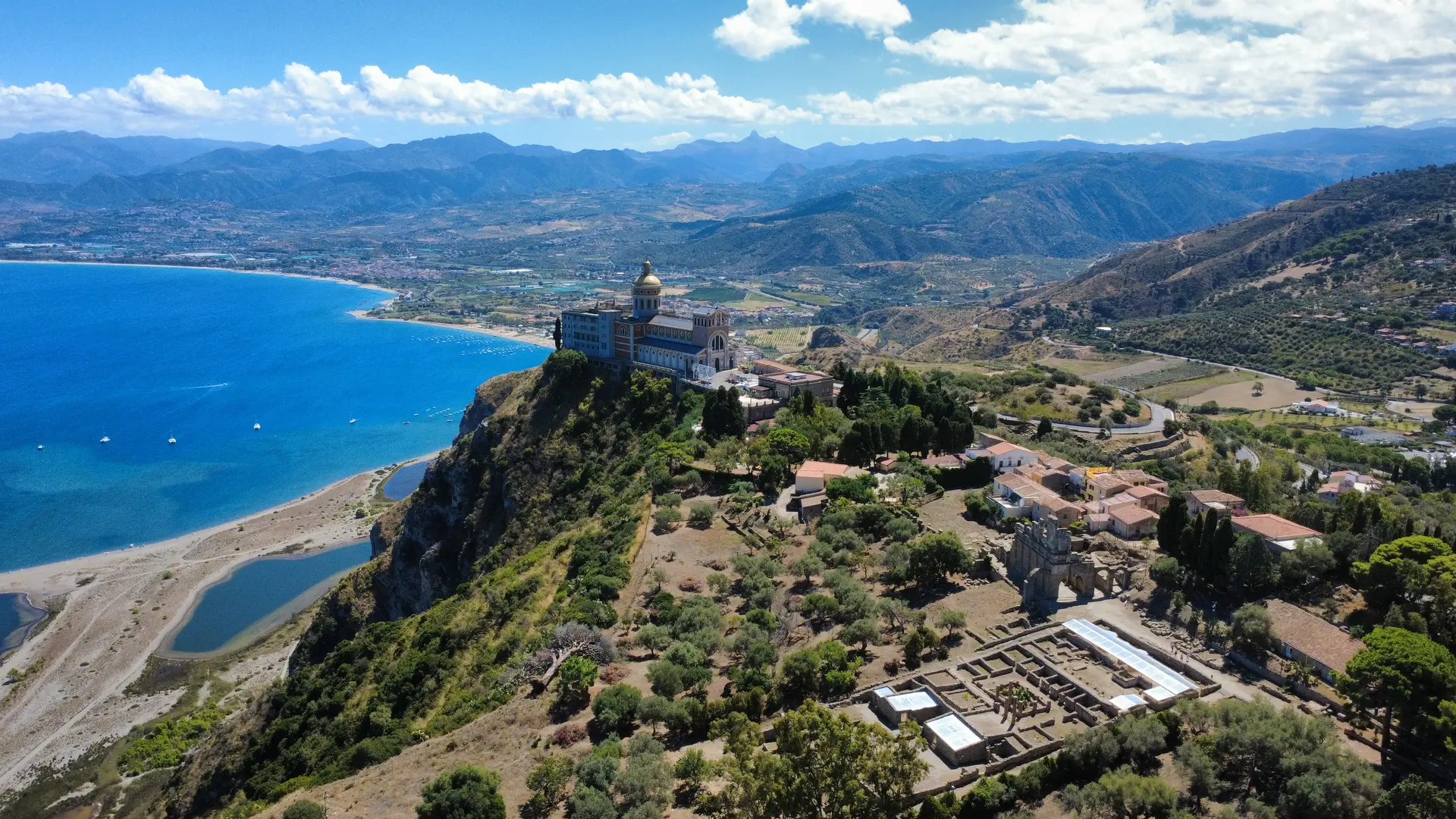
Image of The Sanctuary of Tindari. Image source · CC-BY-SA-4.0
Visit essentials
A quick read before you go
- Duration
- 1-2 hours for the sanctuary.
- Etiquette
- Respect the basilica as an active place of Catholic worship.
Overview
Tindari's promontory rises sheer from the sea in one of Sicily's most dramatic sacred landscapes, visible to sailors for miles. Greeks founding Tyndaris in 396 BC saw opportunity in that visibility; later generations saw providence.
Tradition places the Byzantine Black Madonna's arrival during eighth- or ninth-century iconoclasm. Sailors smuggling sacred images from Constantinople encountered a storm that calmed when they offloaded the statue at Tindari; the ship could not sail until the image was removed. Fishermen carried it to the hilltop, where it has remained.
The sanctuary stands over a temple to Ceres, Roman goddess of grain and fertility. Across the Mediterranean, Marian veneration absorbed and transformed earlier goddess worship, especially fertility and earth-bounty cults; the Black Madonna's dark cedarwood form continues this pattern.
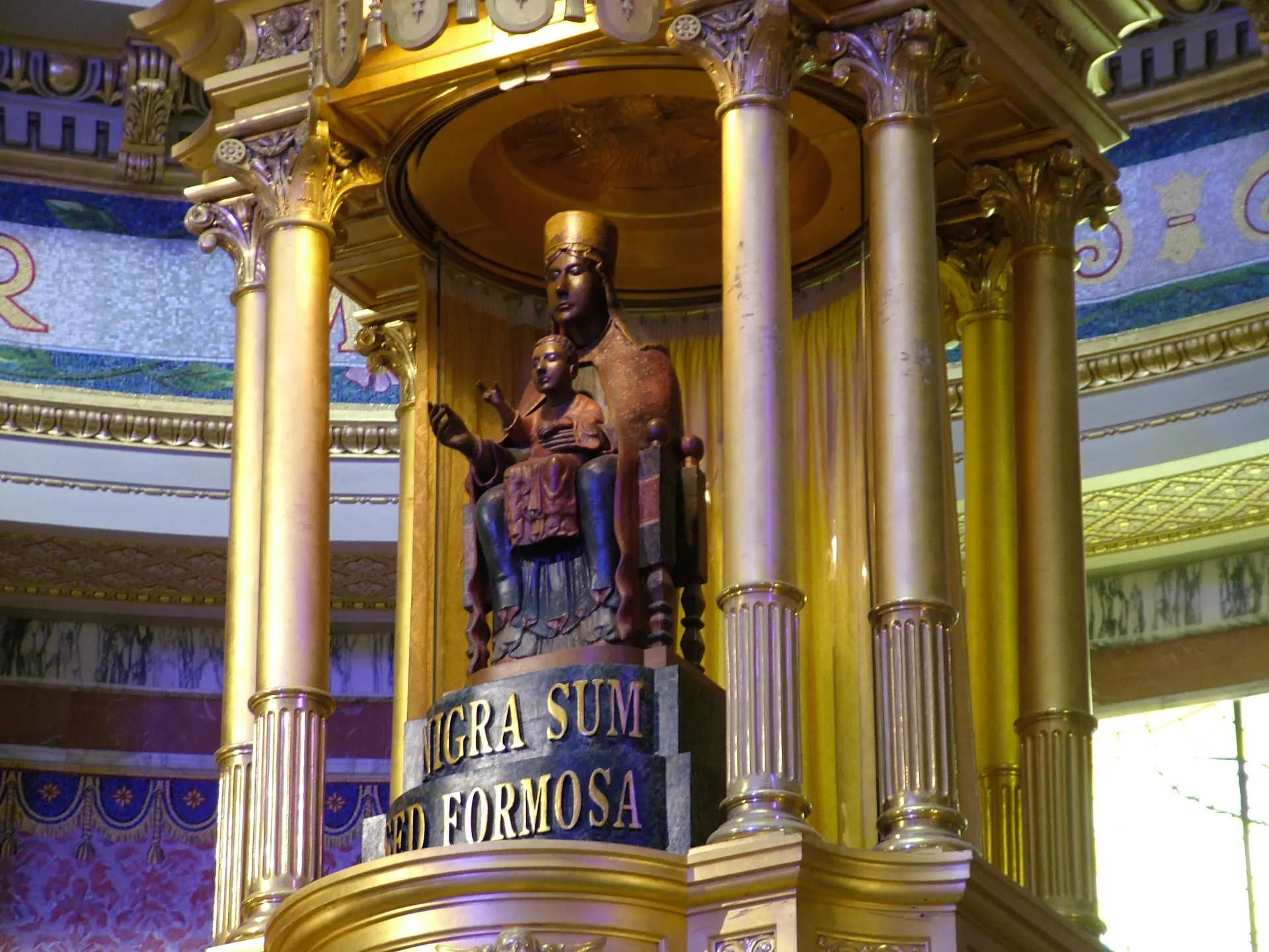
Her base reads 'Nigra Sum Sed Formosa' ('I am black but I am beautiful') from the Song of Songs. The phrase has been interpreted as an allegory of the Church, while thousands of Sicilians named Tindaro or Tindara know her as Matri 'u Tinnaru, Mother of Tindari, protector of the faithful and beacon at sea. In 2018, Pope Francis elevated the church to Minor Basilica, recognizing a cliff where ancient and Christian sacred traditions merge.
Sites inside
Why this place is sacred
The thin quality at Tindari emerges from the layering of sacred traditions in a landscape of extraordinary natural beauty. The promontory itself seems designed for transcendence: the sheer cliff, the endless sea, the Aeolian Islands floating on the horizon, the Marinello lagoon below that changes shape with each tide. Before anyone built anything here, this place demanded attention.
The Greeks who founded Tyndaris in 396 BC recognized the promontory's power. They built a temple to Ceres, goddess of grain and harvest, whose worship guaranteed fertility and prosperity. When the Byzantine statue arrived centuries later, it found a place already prepared for the feminine divine. The transformation from Ceres to Mary was not replacement but translation.
The Black Madonna herself carries thinning power. Her dark cedarwood form connects to ancient Eastern Christian traditions and to even older goddess imagery. The inscription 'I am black but I am beautiful' invites meditation on beauty that transcends conventional appearance, on divinity that manifests in darkness as well as light.
She is a Bassilissa, a Byzantine empress, holding the Christ child while seated on her throne, but she is also something older, something that links to the Mediterranean's deepest memories of the sacred feminine.
For the faithful who climb to Tindari, the thinness operates through relationship. This is Matri 'u Tinnaru, their mother, their protector, the one who hears their prayers and answers them. The thousands of ex-votos left by grateful pilgrims testify to answered prayers, to healings, to interventions that seem miraculous. The boundary between heaven and earth thins not through historical awareness but through personal encounter with a mother who listens.
The view from the sanctuary encompasses it all: the sea that brought the statue, the lagoon that shifts below, the ruins of ancient Tyndaris surrounding the basilica, the islands on the horizon where other gods were worshipped. Stand at the edge and feel how much sacred history converges here.
A temple to Ceres (Roman goddess of grain/fertility) marked this promontory as sacred before Christianity. The sanctuary continues the pattern of feminine divine presence at this location.
From pagan temple to Byzantine icon shrine to Benedictine sanctuary to modern basilica, the site has maintained continuous sacred function for over two millennia while the forms of worship transformed.
Experience and orientation
The approach to Tindari creates anticipation. Whether you drive the winding road or take the shuttle from the carpark halfway up the hill, the promontory rises before you with dramatic verticality. This is a place that demands ascent.
The traditional pilgrimage path follows the Coda della Volpe, the Fox's Tail, a rugged climb that some devotees still make barefoot. If you choose this route, understand that the difficulty is part of the offering. The body's effort prepares the spirit for encounter.
The modern basilica, begun in 1957, incorporates and expands the historic sanctuary. Its scale accommodates the hundreds of thousands of pilgrims who come annually while preserving the older structures within. The effect is layered: you pass through twentieth-century architecture to reach the sacred core that has drawn worshippers for a millennium.
The Black Madonna waits behind the main altar. Carved in the dark cedar wood of Lebanon in a style typical of Byzantine iconography around the year 1000, she sits enthroned as a Bassilissa, the infant Jesus on her lap. At her base, the Latin inscription speaks across centuries: Nigra Sum Sed Formosa. Study her face. Let the darkness of the wood work on you. Consider what it means that beauty transcends appearance.
After the basilica, explore the archaeological site of ancient Tyndaris. The Greek theater, carved into the hillside with the sea as backdrop, hosted performances two thousand years ago and hosts them again each summer. The Roman basilica, the city walls, the traces of streets and houses, all remind you that this was a complete Greek city, not merely a temple site.
Return to the sanctuary overlook at sunset if possible. The Marinello lagoon below takes on golden tones. The Aeolian Islands catch the last light. The Black Madonna has watched this view for over a thousand years.
The sanctuary occupies the summit of a promontory on Sicily's northeastern coast. A carpark is located halfway up the hill; shuttle buses complete the ascent. The archaeological site of ancient Tyndaris surrounds the basilica. The Marinello lagoon and beach are accessible below.
Context and lineage
Tyndaris was founded in 396 BC by Dionysius I, tyrant of Syracuse, making it one of the last Greek colonies established in Sicily and one of the few with purely Greek origin. The city prospered under Roman rule after 254 BC, building the theater and basilica whose ruins still stand.
The Black Madonna's arrival is wrapped in legend. During the iconoclastic period (eighth-ninth century), when Byzantine emperors ordered the destruction of sacred images, faithful sailors smuggled icons westward to save them. One ship carrying a statue of Mary encountered a terrible storm off the coast of Sicily. When the sailors offloaded the statue at Tindari, the storm immediately ceased. When they tried to sail, the ship would not move until the holy image had been removed entirely.
Fishermen carried the statue up the hill to safety.
The statue found a home in the ruins of what may have been a temple to Ceres. In the ninth century, it was set up within these pagan ruins. By the eleventh century, Benedictine monks had built a proper sanctuary. This sanctuary was destroyed by the Ottoman army in 1544, one of countless raids that terrorized Sicily's coasts. Reconstruction proceeded from 1552 to 1598.
By the twentieth century, pilgrim numbers had grown beyond the historic sanctuary's capacity. In 1957, Bishop Joseph Pullano began construction of the current larger basilica, designed to welcome the faithful while preserving the historic structures. Pope Francis recognized the sanctuary's importance in 2018 by elevating it to Minor Basilica status.
From Greek worship of Ceres through Byzantine icon veneration to Roman Catholic Marian devotion, the sanctuary represents continuous sacred use with changing religious forms. The current basilica is administered by the Diocese of Patti.
The Black Madonna of Tindari
Sacred image
Dionysius I of Syracuse
City founder
Bishop Joseph Pullano
Basilica builder
Traditions and practice
The temple of Ceres hosted agricultural festivals and offerings for fertility and harvest. The Black Madonna cult developed Byzantine practices of icon veneration, with the statue processed through the surrounding area during feast days.
Daily Mass and regular Catholic services. The feast of the Madonna Bruna (September 7-8) is the liturgical and popular high point, drawing pilgrims from throughout Sicily. Many still climb the mountain barefoot as an act of devotion. Children are commonly named Tindaro (male) or Tindara (female) in the Madonna's honor.
Attend Mass in the basilica to experience the sanctuary as a living place of worship. Spend time before the Black Madonna, meditating on the inscription 'Nigra Sum Sed Formosa.' Explore the archaeological site to understand the layers of sacred history. Visit the overlook to see the Marinello lagoon and Aeolian Islands.
Roman Catholicism / Black Madonna Devotion
ActiveThe Black Madonna of Tindari is one of Sicily's most beloved Marian images, associated with countless miracles. The cult represents over a thousand years of continuous devotion and draws hundreds of thousands of pilgrims annually.
Daily Mass, veneration of the Black Madonna, barefoot pilgrimage, September feast celebration, naming children Tindaro/Tindara, leaving ex-votos in gratitude for answered prayers.
Pre-Christian Goddess Worship
HistoricalA temple to Ceres, goddess of grain and fertility, stood on this promontory before Christianity. The transformation to Marian shrine follows Mediterranean patterns of Christian absorption of goddess cults.
Agricultural festivals, offerings for fertility and harvest, worship of the feminine divine as source of life and abundance.
Perspectives and open questions
The Sanctuary of Tindari can be understood as a Marian pilgrimage site, as an example of the Christian transformation of pagan sacred space, as a repository of Byzantine iconographic tradition, or as evidence of the enduring power of Black Madonna devotion in the Mediterranean.
Scholarly perspective
Historians of religion study Tindari as an example of sacred site continuity from pagan goddess worship to Christian Marian devotion. The Black Madonna tradition connects to broader Mediterranean patterns linking dark-skinned divine feminine images to fertility, earth, and ancient mother goddess cults.
Living and traditional perspectives
For Catholics, the Black Madonna of Tindari is a miracle-working image whose arrival at Tindari was providential. The thousands of ex-votos testify to her intercessory power. Her protection extends to sailors, to the sick, to all who call upon her in need.
Alternative interpretations
The transformation from Ceres to Mary suggests that sacred geography persists across religious change. The feminine divine presence at Tindari predates Christianity; Mary received and transformed what the goddess had established. The Black Madonna connects to ancient mysteries of fertility and renewal.
Open questions
The precise date and circumstances of the statue's arrival remain legendary rather than historical. The original appearance and practices of the Ceres temple are not fully documented. The statue's dark color may result from the natural cedar wood, from deliberate darkening, or from age and candle smoke.
Plan your visit
Access and arrival
Hotels and agriturismos in Tindari, Patti, and surrounding area. The Marinello beach area offers seasonal accommodation.
Respectful visit
Modest dress is required in the basilica. Shoulders and knees should be covered.
Photography is generally permitted but may be restricted during services. Be discreet when photographing pilgrims at prayer.
Candles may be lit for offerings. Donations support the sanctuary's work. Ex-votos (votive offerings in gratitude for answered prayers) are a traditional practice.
Certain areas may be reserved for worship. During major feast days, crowd management may affect access. The archaeological site may have separate admission and hours.
The September feast draws enormous crowds; plan accordingly if visiting during this period. The barefoot pilgrimage is demanding and not suitable for everyone. Respect the sanctuary as an active place of worship.
Current practical details
Address
Via Monsignor Pullano, 12, 98066 Tindari ME, Italy
Phone
Hours
Hours, fees, and access can change — verify on the official source before you travel. Practical details last checked Jun 2026.
Location
Map loads as you approach this section.
Pilgrim reflections
A portrait of encounter, not a score
Pilgrims describe what they felt, how present they could become, and whether the place would shape a journey. There are no stars and no ranking of traditions.
No reviewed reflections yet
The first pilgrims can help describe the character of being here.
Share a reflection
Available after an account-backed “Been there.” Every reflection is reviewed before publication.
Nearby sacred places
Explore other sacred places in the region. Proximity does not establish access or travel time; check each place’s guidance.

References
Sources consulted for this page. Source categories describe the publication, not a guarantee that every claim is verified. Traditional accounts and outside interpretations may differ.
- 01Tindari - WikipediaSource context
- 02The Madonna of Tindari: the Black Madonna and her sanctuary on the sea - Holyart.com BlogSource context
- 03Tindari - The Sanctuary of Tyndaris | WishSicilySource context
- 04Basilica della Madonna del Tindari (Tindari, Sicily) - The Catholic Travel GuideSource context
- 05Tindari, Sicily with the Sanctuary of the Black Madonna and the ancient Greek colony of TyndarisSource context
- 06The Sanctuary of Tindari, Sicily is an important pilgrimage destinationSource context
- 07The Sanctuary of the Black Madonna in Tindari, Sicily | Bleeding EspressoSource context
Share a photo
Help visitors recognize The Sanctuary of Tindari. Every submission is reviewed before publication.