Temple of Apollo, Syracuse
The oldest stone temple in the Western Greek world
Understand sacred places, explore living traditions, and learn how to engage respectfully with Pilgrim Map.
Access has not been verified. Check current local guidance before planning a visit.
Syracuse, Syracuse, Italy
Read the sources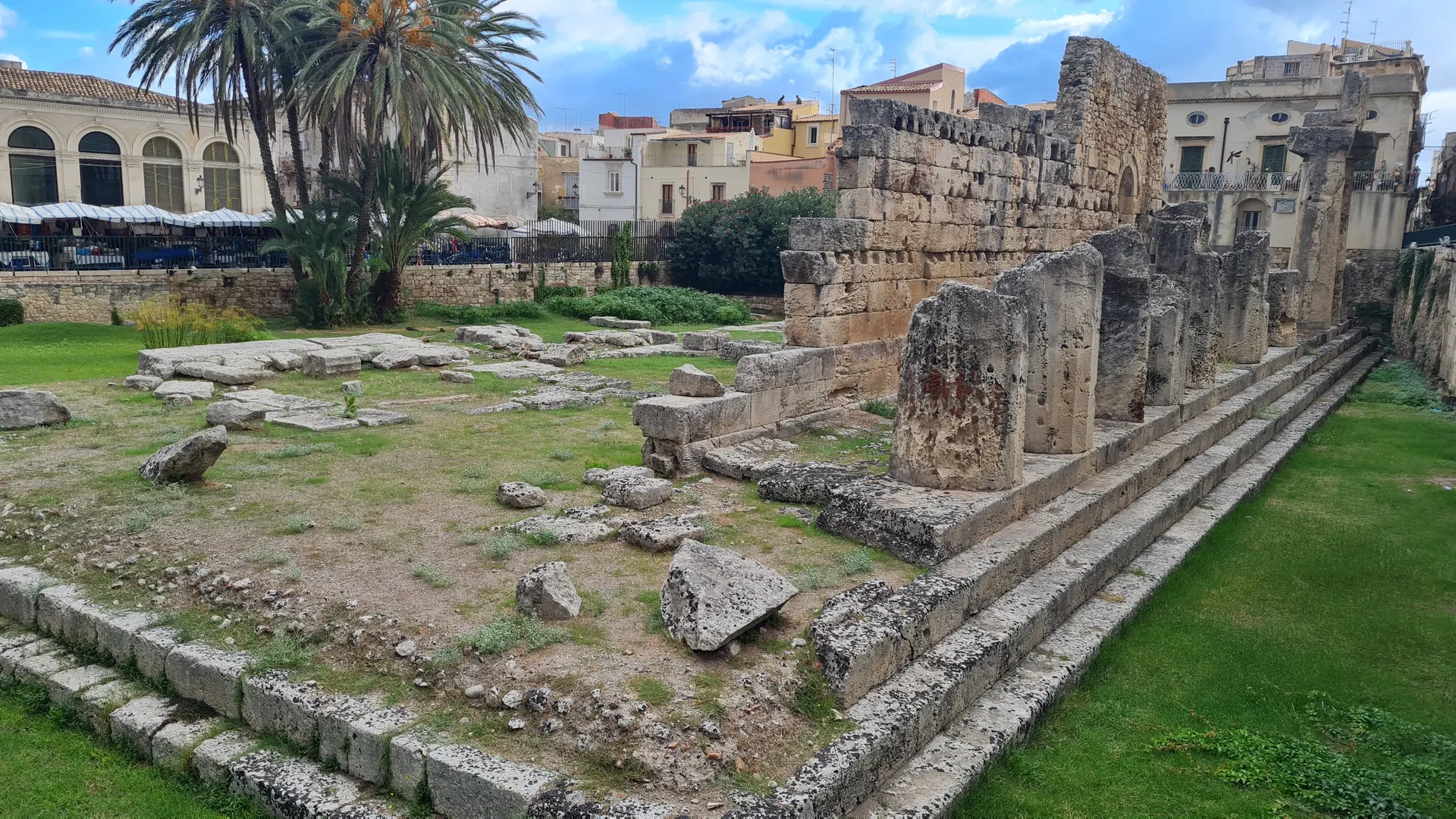
Image of Temple of Apollo, Syracuse. Image source · CC-BY-4.0
Visit essentials
A quick read before you go
- Duration
- 10-20 minutes for viewing the ruins.
- Etiquette
- The site is viewable but not accessible.
Overview
Corinthian colonists founded Syracuse around 734 BC on Ortygia, a teardrop island linked to Sicily by two bridges. Within a century and a half, it had become one of the Mediterranean's most powerful cities.
The Temple of Apollo, or Apollonion, rose around 580 BC, more than a century before the Parthenon. An archaic inscription on the eastern stylobate declares: Kleomenes, son of Knidieidas, made this temple for Apollo, and his colonnade is a beautiful work. It was the Western Greek world's first major peripteral temple built entirely of stone. Six-by-seventeen fluted columns display early Doric stoutness.
Inside were a pronaos, a three-aisled naos, and an adyton typical of Sicilian temples; its terracotta roof tiles were among Sicily's first.
In late antiquity, it became a Byzantine church with a new entrance cut through the front steps. Under Sicily's Arab emirate from the ninth to eleventh centuries, it was a mosque. The Normans reconsecrated it as the Church of the Saviour; in the sixteenth century it entered Spanish barracks, then disappeared within private houses. Rediscovered in the 1860s, it was excavated by Paolo Orsi between 1938 and 1942.
Today, two columns retain their original height amid cella-wall and stylobate fragments. Fenced but visible from Piazza Pancali, the oldest stone temple in Western Greece offers visitors entering Ortigia a first glimpse of Syracuse's sacred history.
Why this place is sacred
The Temple of Apollo achieves its thinness through layering. Stand before these ruins and you stand before 2,600 years of Mediterranean religious history compressed into a single site. The Greeks raised these columns for Apollo. The Byzantines turned them into a church. The Arabs converted the church into a mosque. The Normans reconverted the mosque to Christianity. Each transformation left physical traces that archaeologists have documented.
This is not the preservation of a single sacred tradition but the demonstration that sacred space outlasts the religions that define it. The ground remains holy while the names of the holy change. Whatever quality drew Syracusan colonists to worship Apollo here in the sixth century BC continued to draw Byzantine Christians, Muslim rulers, and Norman conquerors to the same stones.
The ruined state of the temple adds to its thin quality. The complete structures at Agrigento or Segesta invite admiration; the fragments at Syracuse invite imagination. From the two standing columns and the scattered remains, you must reconstruct in your mind what once stood here, the largest and most innovative temple of its era in the Western Greek world. This mental reconstruction is itself a form of participation in the sacred.
The location amplifies the experience. The temple stands at the entrance to Ortigia, where visitors have entered Syracuse's historic core for over 2,500 years. Behind you is modern Sicily; before you, through the ruins, lies the island where Archimedes calculated, where Plato taught, where Greek civilization reached one of its peaks. The temple is threshold as well as destination, the gate through which all who would understand Syracuse must pass.
Apollo was god of prophecy, of knowing what is hidden. At his temple in Delphi, pilgrims sought knowledge of the future. At his temple in Syracuse, the future has become past, visible in the layers of transformed stone.
The temple served the cult of Apollo, connecting Syracuse to its mother city Corinth and to the great sanctuary at Delphi. Apollo was protector of the city and guarantor of communal cohesion.
The transformation from Greek temple to Byzantine church to Islamic mosque to Norman church demonstrates sacred site continuity across three major religious traditions.
Experience and orientation
Cross the bridge to Ortigia and there it is, immediately to your left in Piazza Pancali: the oldest stone temple in the Western Greek world, reduced to ruins but still present, still marking the threshold of Syracuse's sacred landscape.
The temple is fenced, viewable but not accessible. This enforced distance creates a particular kind of encounter. You cannot walk among the columns as at Segesta or climb the platforms as at Selinunte. Instead, you stand outside and look in, as pilgrims have looked at sacred precincts throughout history.
Two columns remain at their original height, their fluted shafts displaying the characteristic stoutness of early Doric architecture. Portions of the cella walls are visible, along with sections of the stylobate. The remains are fragmentary but substantial enough to suggest the original scale: six columns by seventeen, filling the space now occupied by tourists, market vendors, and cafes.
Take time to circle the ruins as far as the modern streets allow. Notice the architectural fragments that preserve traces of different periods: the Byzantine entrance cut through the front steps, the modifications from successive transformations. The temple is a palimpsest, each layer partially visible through the ones above.
The surrounding piazza creates context. This is not a remote archaeological site but the living entrance to a living city. Markets are held here on weekday mornings. Restaurants and shops crowd the neighboring streets. The temple exists not in isolation but in dialogue with the continuous life of Syracuse, just as it has for two and a half millennia.
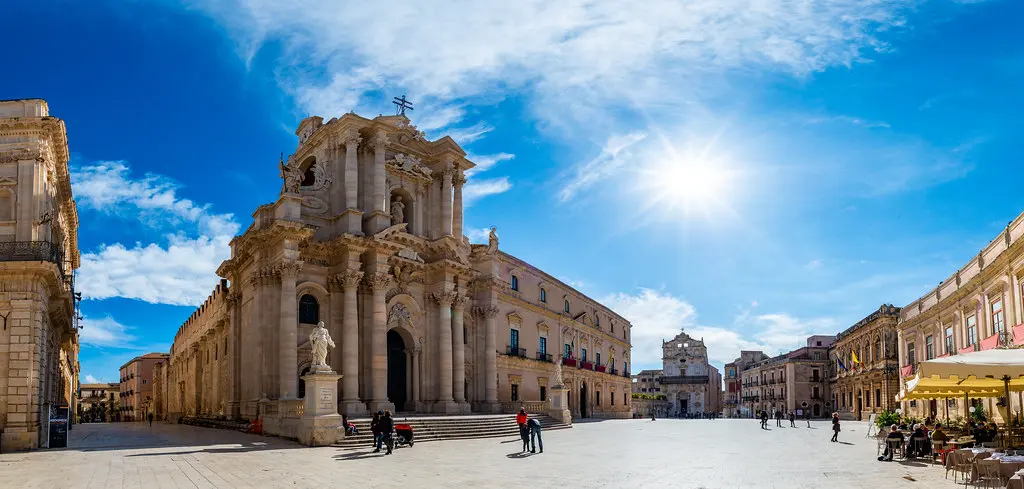
After viewing the temple, continue into Ortigia to see its transformation completed: the Cathedral of Syracuse, where the Temple of Athena became a church while its columns remained standing and visible. Together, the Temple of Apollo and the Duomo demonstrate what makes Syracuse unique: the preservation of Greek sacred architecture within the fabric of a modern Catholic city.
The temple is located in Piazza Pancali at the entrance to Ortigia, immediately visible when crossing the bridge from mainland Syracuse. The ruins are fenced but clearly visible from multiple angles around the piazza.
Context and lineage
Syracuse was founded around 734 BC by Corinthian colonists led by Archias. According to tradition, Archias consulted the oracle at Delphi before founding the colony, establishing a connection between Syracuse and Apollo from the city's very beginning. Within a few generations, Syracuse had grown wealthy and powerful, ready to build monuments that would proclaim its importance to the Mediterranean world.
The Temple of Apollo rose around 580 BC, the first major temple in the Western Greek world built entirely of stone. An inscription carved into the eastern stylobate celebrated this innovation: 'Kleomenes, son of Knidieidas, made this temple for Apollo, and his colonnade is a beautiful work.' The pride is palpable. This was something new, a technical and artistic achievement that set Syracuse apart from other colonies.
The temple served the cult of Apollo imported from Corinth. Apollo was god of prophecy, music, healing, and protection. As a deity closely associated with colonization, order, and civic identity, he was central to Syracuse's religious life. While the temple was not an oracle site like Delphi, it served as a locus for seeking divine approval in civic and military affairs.
For nearly a millennium, the temple functioned as a Greek sanctuary. Then late Roman persecution of paganism closed the temples. The Byzantine Christians who inherited the site transformed it into a church. The Arabs who conquered Sicily in the ninth century transformed the church into a mosque. The Normans who reconquered Sicily in the eleventh century transformed the mosque back into a church.
In the sixteenth century, Spanish military authorities incorporated the site into barracks. Private houses eventually swallowed the remains. Only in the 1860s, when the Spanish barracks were being demolished, did workers rediscover the ancient temple within. Paolo Orsi completed systematic excavation between 1938 and 1942, revealing the structure visible today.
From Greek worship of Apollo through Byzantine Christianity, Islamic worship, Norman Christianity, and Spanish military use to its current status as archaeological monument. No continuous religious tradition remains active at the site.
Kleomenes, son of Knidieidas
Temple maker
Paolo Orsi
Archaeologist
Traditions and practice
Greek worship of Apollo included animal sacrifice, processions, festivals, and consultation of the god for civic and military guidance. Musical performances honored Apollo's patronage of the arts. The temple served as the deity's dwelling place, with worship conducted primarily at outdoor altars.
No active religious practice takes place at the site. The ruins serve as an archaeological monument and tourist attraction. The fenced access prevents physical interaction with the stones.
Approach the temple as threshold rather than destination. Let it prepare you for the sacred sites deeper within Ortigia. Consider the layers of religious history visible in the remains. Visit at different times of day to see how light changes the stones. Continue to the Cathedral of Syracuse to see a Greek temple that remained standing through its transformation into a church.
Ancient Greek Religion / Cult of Apollo
HistoricalThe temple was dedicated to Apollo, god of prophecy, music, healing, and protection. As a deity closely associated with colonization and civic order, Apollo was central to Syracuse's religious identity and connected the colony to its Corinthian mother city.
Animal sacrifice, processions, festivals, musical performances, seeking divine guidance for civic and military decisions.
Byzantine Christianity
HistoricalAfter the closure of pagan temples, Byzantine Christians converted the structure into a church, modifying the entrance and interior. This transformation preserved the building while adapting it to Christian worship.
Eastern Christian liturgy adapted to the converted temple space.
Islam
HistoricalDuring the Emirate of Sicily (9th-11th centuries), the church became a mosque. This transformation reflects Sicily's incorporation into the Islamic world for over two centuries.
Islamic prayer and worship in the converted structure.
Perspectives and open questions
The Temple of Apollo can be understood as an architectural innovation, as a symbol of Syracuse's early power, as evidence of sacred site continuity across religious traditions, or as a meditation on the persistence of holy ground through cultural transformation.
Scholarly perspective
Architectural historians recognize the temple as a revolutionary achievement: the first major stone peripteral temple in the Western Greek world. The inscription naming Kleomenes provides rare evidence of early Greek attitudes toward architectural patronage and innovation. The temple's transformations document religious change in Sicily across two millennia.
Living and traditional perspectives
For those who honor Apollo, the temple represents one of the oldest sanctuaries of the god in the Western Mediterranean. Its innovative construction would have been understood as a gift to the deity and a demonstration of the colony's piety.
Alternative interpretations
The temple's transformation from Greek sanctuary to Byzantine church to Islamic mosque to Norman church suggests that sacred geography persists independent of the religions that define it. The ground remained holy while the gods changed names.
Open questions
The specific practices of Apollo worship at Syracuse are poorly documented. The exact circumstances of each religious transformation are not fully recorded. The original appearance of the temple interior can only be partially reconstructed.
Plan your visit
Access and arrival
Full range of accommodations throughout Syracuse. Staying on Ortigia provides easy access to the historic core.
Respectful visit
No specific requirements. Practical clothing for urban sightseeing.
Photography is permitted from public areas around the fenced ruins.
Not applicable. The site does not function as an active place of worship.
Do not climb fences or barriers. Do not attempt to remove any material from the site.
The ruins are fenced and not accessible. Viewing is from the exterior only. The surrounding piazza can be crowded and noisy; early morning offers more contemplative conditions.
Current practical details
Address
96100 Syracuse, Free municipal consortium of Syracuse, Italy
Phone
Hours
Hours, fees, and access can change — verify on the official source before you travel. Practical details last checked Jun 2026.
Location
Map loads as you approach this section.
Pilgrim reflections
A portrait of encounter, not a score
Pilgrims describe what they felt, how present they could become, and whether the place would shape a journey. There are no stars and no ranking of traditions.
No reviewed reflections yet
The first pilgrims can help describe the character of being here.
Share a reflection
Available after an account-backed “Been there.” Every reflection is reviewed before publication.
Nearby sacred places
Explore other sacred places in the region. Proximity does not establish access or travel time; check each place’s guidance.


References
Sources consulted for this page. Source categories describe the publication, not a guarantee that every claim is verified. Traditional accounts and outside interpretations may differ.
- 01Temple of Apollo (Syracuse) - WikipediaSource context
- 02Temple of Apollo - Italia.itSource context
- 03Discover the Temple of Apollo: Ancient Syracuse's GemSource context
- 04Temple of Apollo (Syracuse) - Madain ProjectSource context
- 05Temple of Apollo at Syracuse: a Pleiades place resourceSource context
- 06Temple of Apollo - Syracuse, SicilySource context
Share a photo
Help visitors recognize Temple of Apollo, Syracuse. Every submission is reviewed before publication.