The Giants' Tomb—The Ogre House
The Ogre's House rises from the Su Pranu plateau, where legends of giant banquets veil Bronze Age burial
Siddi, Sardinia, Italy

Plan this visit
Practical context before you go
30 minutes to 1 hour; longer if exploring plateau area.
Respect the ancient burial site through careful movement and contemplative behavior.
At a glance
- Coordinates
- 39.6861, 8.8711
- Type
- Giants' Tomb
- Suggested duration
- 30 minutes to 1 hour; longer if exploring plateau area.
Pilgrim tips
- No specific requirements. Sturdy shoes recommended for plateau terrain.
- Photography permitted.
- Unsupervised site on plateau terrain. Walking on uneven ground required.
Overview
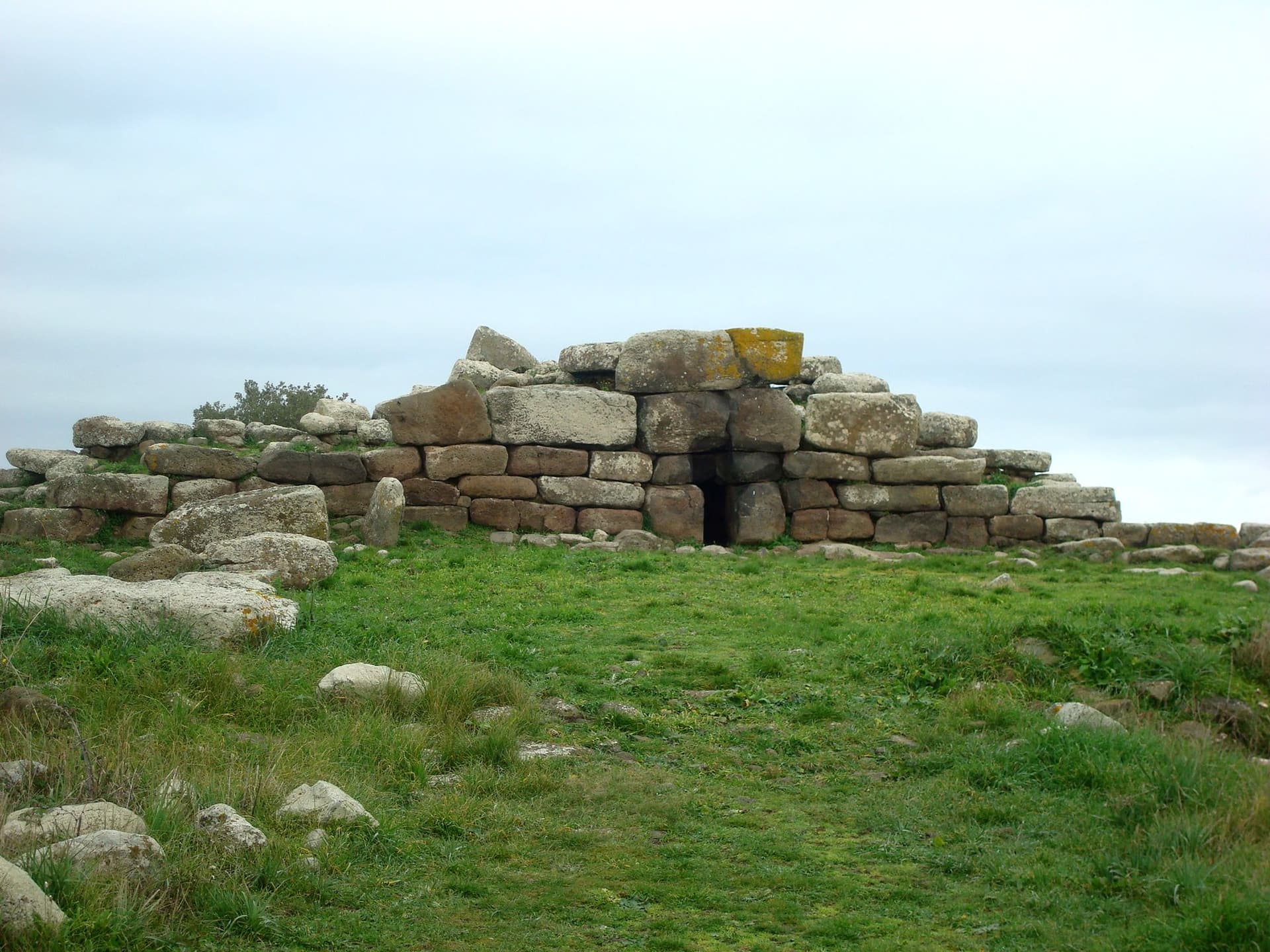
Sardinian legend tells of an ogre who feasted on victims in this stone house, their bones scattered within. Yet excavations have found no human remains—the paradox deepens the mystery of Sa Domu 'e S'Orcu. This Giants' Tomb, one of the best-preserved in Sardinia, stands on the basaltic plateau of Su Pranu, its bull's-horn exedra possibly dedicated to the God Thaurus. Evidence shows the site was sacred across millennia—Nuragic, Neo-Punic, Roman, even as late as the eighteenth century.
Sa Domu 'e S'Orcu—the Ogre's House—takes its name from Sardinian folklore that transformed ancient burial into monster legend. Local tradition held that a giant ogre dwelt here, feasting on human victims whose bones filled the tomb. Yet archaeological excavation revealed a paradox: despite clear evidence of burial use, no human bones have been recovered from this site.
The mystery deepens the fascination of one of Sardinia's best-preserved Giants' Tombs. Built during the Middle Bronze Age, sixteenth to fourteenth century BC, Sa Domu 'e S'Orcu presents exceptional architecture with its curved exedra forming bull's-horn arms around the central entrance. The form may connect to the cult of the God Thaurus (Bull), linking this burial site to broader Nuragic religious beliefs about strength, fertility, and divine power.
The tomb stands on the Su Pranu plateau, a basaltic highland rising above the surrounding landscape. This elevated position adds to the site's sacred character, setting the dead apart from ordinary terrain while keeping them visible to the living below.
Most remarkably, evidence shows that Sa Domu 'e S'Orcu retained significance across an extraordinary span of time. A bowl fragment with Neo-Punic writing indicates use during the Carthaginian period. Roman table ceramics show continued activity in Imperial times. Even Savoy coins from the eighteenth century have been recovered. For three thousand years, people continued coming to this place.
The post-World War II collapse of part of the main facade diminished but did not destroy the structure's power. What remains still impresses visitors who make the journey to the Su Pranu plateau—the ogre's house, the bull god's sanctuary, the tomb without bones that nonetheless served as sacred ground across millennia.
Context and lineage
The Giants' Tomb of Sa Domu 'e S'Orcu was built during the Middle Bronze Age, sixteenth to fourteenth century BC, by the Nuragic civilization of Sardinia. Its distinctive bull's-horn exedra may indicate dedication to the God Thaurus, connecting burial practice to broader religious beliefs about divine power and the cycle of life through death.
The site was selected for elevated plateau location—the Su Pranu giara—which set it apart from ordinary terrain and positioned the dead in sacred space. Excavations revealed ceramic vessels and offerings laid on beds of small pebbles, evidence of funerary practice despite the absence of human remains.
The mystery of the boneless tomb has never been resolved. The architecture clearly served burial function; grave goods were deposited with care; the form follows Giants' Tomb tradition precisely. Yet no bones have been recovered, creating a paradox that deepens the site's enigmatic quality.
Remarkably, evidence shows that Sa Domu 'e S'Orcu continued to draw visitors across three millennia. A bowl fragment with Neo-Punic writing indicates Carthaginian-era use. Roman table ceramics demonstrate Imperial period activity. Savoy coins from the eighteenth century prove ongoing significance long after the original religious framework had disappeared.
Sardinian folklore transformed burial site into ogre legend. The name 'Sa Domu 'e S'Orcu' means 'the ogre's house,' and local tradition held that a giant feasted on victims whose bones filled the tomb. The irony—that no bones exist—suggests the legend arose not from discovery but from the place's inexplicable power.
Built by Nuragic civilization (16th-14th century BC). Evidence of Neo-Punic, Roman, and 18th century use. Selected for UNESCO nomination as one of 31 representative Nuragic monuments.
The Nuragic Builders
Creators
Why this place is sacred
The thinness at Sa Domu 'e S'Orcu manifests through paradox. This is a burial site where no bones have been found—a tomb without remains that nonetheless drew sacred activity for over three thousand years. Something was present here that transcended the physical bodies the architecture was designed to hold.
The bull's-horn shape of the exedra connects burial to the cult of Thaurus, the divine bull of Nuragic religion. Bulls represented strength, fertility, and the cycle of life through death into new life. To be buried in a bull-shaped tomb was to be placed within the body of a god, transformed through divine power.
The elevated plateau location amplifies sacred dimension. Su Pranu rises above ordinary terrain, setting apart whatever happens upon it. The Nuragic builders chose this height deliberately, positioning their dead between earth and sky, visible to the living below while occupying territory that ordinary daily life did not claim.
The continuous use across millennia—Nuragic, Neo-Punic, Roman, eighteenth century—indicates that successive cultures recognized something powerful in this place. The Carthaginians who left the inscribed bowl fragment did not build their own sanctuary elsewhere; they came to the same location the Nuragic people had chosen a millennium earlier.
The folklore transformation of burial site into ogre's house represents another dimension of thinness. When the original meaning was lost, the place retained numinous power that required explanation. The legend of the bone-eating ogre preserved awareness that this was no ordinary location while offering framework for understanding its strangeness.
The paradox of the boneless tomb remains. Where did the bodies go? Did the ogre legend contain kernel of truth about disturbance? Did the Nuragic people practice secondary burial that removed remains to another location? The mystery persists, and with it the sense that Sa Domu 'e S'Orcu holds secrets that excavation has not fully revealed.
Built during Middle Bronze Age (16th-14th century BC) as collective burial site, possibly dedicated to the God Thaurus (Bull). The exedra and tomb body served funerary and possibly ongoing ritual functions.
Evidence of reuse during Neo-Punic period (inscribed bowl fragment), Roman period (table ceramics), and as late as 18th century (Savoy coins). Post-WWII collapse damaged facade. Selected for UNESCO nomination as one of 31 representative Nuragic monuments.
Traditions and practice
Nuragic burial practices with grave goods deposited on pebble beds. Possible connection to the cult of Thaurus (Bull God). Evidence of continued sacred use across Neo-Punic, Roman, and later periods.
Archaeological tourism and cultural heritage appreciation. Guided tours available through Cooperativa Villa Silli.
Approach the plateau with awareness that you are entering elevated sacred space. Spend time with the exedra, appreciating the bull's-horn form. Contemplate the mystery of the boneless tomb. Consider the folklore transformation from burial to ogre legend.
Nuragic Burial and Bull Cult
HistoricalSa Domu 'e S'Orcu may represent both Nuragic funerary traditions and the cult of the God Thaurus. The bull's-horn architecture connects burial to divine power, fertility, and the cycle of life through death.
Collective burial with grave goods on pebble beds. Bull's-horn architecture suggesting rituals connected to Thaurus cult. Evidence of continued sacred use across Neo-Punic, Roman, and later periods.
Experience and perspectives
The approach to Sa Domu 'e S'Orcu requires climbing to the Su Pranu plateau—a journey that prepares you for encountering something set apart from ordinary terrain. From Siddi, follow SP 44 toward Gonnostramatza, turning at the signpost onto a cement road that leads onto the giara.
The plateau landscape has its own character: basaltic flatness punctuated by wind-shaped vegetation, a terrain that feels ancient and somehow elevated not just in altitude but in atmosphere. The Giants' Tomb emerges as you approach, its bull's-horn exedra curving toward you like arms extended in welcome or warning.
First impression is preservation. Despite post-war collapse of part of the facade, Sa Domu 'e S'Orcu retains exceptional integrity. The stones of the exedra stand in place, the central entrance holds its form, the corridor extends into darkness that once held—what? The paradox of the boneless tomb begins to work on imagination.
Walk the curve of the exedra, appreciating the bull's-horn shape that may connect this burial to the cult of Thaurus. Touch the stone if you wish; feel the texture that hands touched three thousand years ago. The elevated plateau spreads around you, setting this place apart from the daily landscape below.
Spend time with the mystery. This was a burial site where no bodies have been found. This was an ogre's house in legend where a monster feasted on victims. This was a location that drew Neo-Punic, Roman, and even eighteenth-century visitors for reasons that transcended any single culture's understanding.
The guided tours through Cooperativa Villa Silli add historical context, but the site rewards contemplative solo exploration equally. The plateau's quiet and the tomb's enigma combine to create experience that lingers after departure.
From Siddi, take SP 44 toward Gonnostramatza. Turn right at 'Sa domu e s'orcu' sign. Follow cement road onto the giara (plateau). Unsupervised site with free access during daylight hours. Guided tours available through Cooperativa Villa Silli. Allow 30 minutes to 1 hour; longer if exploring plateau.
Sa Domu 'e S'Orcu can be understood as exceptional Nuragic funerary architecture, as evidence of the Bull God cult, as a mystery of absent remains, or as testimony to the power of place across three millennia.
Archaeologists recognize Sa Domu 'e S'Orcu as one of the finest Giants' Tomb examples, selected for UNESCO nomination. The multi-period evidence demonstrates extraordinary continuity of sacred use. The absence of human remains creates ongoing scholarly puzzle.
Sardinian folklore preserves the 'ogre's house' legend, maintaining popular awareness of the site's mysterious nature even as original meaning was lost.
The bull's-horn architecture attracts interest from those studying fertility cults and earth energy. The elevated plateau location suggests study of sacred landscapes.
Why no human bones have been found despite evidence of burial use remains unexplained. The precise relationship to the cult of Thaurus invites further research. The circumstances of post-WWII collapse require documentation.
Visit planning
Accommodation available in Siddi and surrounding towns.
Respect the ancient burial site through careful movement and contemplative behavior.
No specific requirements. Sturdy shoes recommended for plateau terrain.
Photography permitted.
Not appropriate at archaeological sites.
Respect the ancient structure. Do not enter burial chamber if restricted. Do not remove any materials.
Plan your visit
Address
SP44, 09020 Siddi VS, Italy
Hours
Hours, fees, and access can change — verify on the official source before you travel. Practical details last checked Jun 2026.
Nearby sacred places
Sacred places within a half-day’s reach. Pilgrims often visit them together: walk one, stay for the other.

References
Sources consulted when researching this page. Independent verification by readers is welcome.
- 01Sa Domu 'e S'Orcu Tomb of the Giants - IDESE — Italian Ministry of Culturehigh-reliability
- 02Giant's grave Sa Domu 'e s'Orku - Siddi - La Sardegna verso l'Unesco — La Sardegna verso l'Unescohigh-reliability
- 03Sa Dom'e s'Orku - Sardegna Turismo — Sardegna Turismohigh-reliability
- 04Historical places in Sardinia: Sa Domu e S'Orcu — All Tour Sardinia
- 05Giants' grave - Wikipedia — Wikipedia contributors
Key questions
What pilgrims usually ask
- Why is The Giants' Tomb—The Ogre House considered sacred?
- Explore the mystery of the boneless burial at Sa Domu 'e S'Orcu. One of Sardinia's best-preserved Giants' Tombs, with evidence of sacred use across three millen
- What should I wear at The Giants' Tomb—The Ogre House?
- No specific requirements. Sturdy shoes recommended for plateau terrain.
- Can I take photos at The Giants' Tomb—The Ogre House?
- Photography permitted.
- How long should I spend at The Giants' Tomb—The Ogre House?
- 30 minutes to 1 hour; longer if exploring plateau area.
- What offerings are appropriate at The Giants' Tomb—The Ogre House?
- Not appropriate at archaeological sites.
- What etiquette should visitors follow at The Giants' Tomb—The Ogre House?
- Respect the ancient burial site through careful movement and contemplative behavior.
- What is the history of The Giants' Tomb—The Ogre House?
- The Giants' Tomb of Sa Domu 'e S'Orcu was built during the Middle Bronze Age, sixteenth to fourteenth century BC, by the Nuragic civilization of Sardinia. Its distinctive bull's-horn exedra may indicate dedication to the God Thaurus, connecting burial practice to broader religious beliefs about divine power and the cycle of life through death. The site was selected for elevated plateau location—the Su Pranu giara—which set it apart from ordinary terrain and positioned the dead in sacred space. Excavations revealed ceramic vessels and offerings laid on beds of small pebbles, evidence of funerary practice despite the absence of human remains. The mystery of the boneless tomb has never been resolved. The architecture clearly served burial function; grave goods were deposited with care; the form follows Giants' Tomb tradition precisely. Yet no bones have been recovered, creating a paradox that deepens the site's enigmatic quality. Remarkably, evidence shows that Sa Domu 'e S'Orcu continued to draw visitors across three millennia. A bowl fragment with Neo-Punic writing indicates Carthaginian-era use. Roman table ceramics demonstrate Imperial period activity. Savoy coins from the eighteenth century prove ongoing significance long after the original religious framework had disappeared. Sardinian folklore transformed burial site into ogre legend. The name 'Sa Domu 'e S'Orcu' means 'the ogre's house,' and local tradition held that a giant feasted on victims whose bones filled the tomb. The irony—that no bones exist—suggests the legend arose not from discovery but from the place's inexplicable power.
- Who is associated with The Giants' Tomb—The Ogre House?
- The Nuragic Builders (Creators)