Vat Phou
A Khmer mountain temple where a linga-shaped peak and a sacred spring drew worship for over a thousand years
Understand sacred places, explore living traditions, and learn how to engage respectfully with Pilgrim Map.
Access has not been verified. Check current local guidance before planning a visit.
Nongsa, Champasak, Laos
Read the sources
Visit essentials
A quick read before you go
- Duration
- Two to three hours for the site plus the museum.
- Access
- Reached from Pakse or Champasak town in southern Laos; entry is through a modern site museum,…
Overview
Vat Phou rests on the lower slopes of a mountain early settlers called Lingaparvata, the linga mountain, after a summit rock formation read as a self-manifest emblem of Shiva. A ceremonial axis descends from peak to Mekong across rectangular ritual reservoirs, or barays, and a stone causeway, expressing Hindu cosmology: mountain as Mount Meru and river as cosmic ocean.
Ruined twin palaces and a hall once dedicated to Nandin, Shiva's bull mount, occupy the lower terraces. High among frangipani and Khmer carving, the sanctuary once used spring water to bathe a shrine linga. Sacred use is attested by the mid-fifth century, when an early king established a holy district protected by Shiva; most surviving monuments date to Angkorian rebuilding from the eleventh through thirteenth centuries.
As Khmer power waned and Lao Buddhists settled the region, the Hindu shrine was re-sacralized rather than abandoned. Buddha images fill the inner sanctuary, a Buddha footprint receives offerings, and the great annual festival fills the ruins with pilgrims. Often compared to a quieter, uncrowded Angkor, Vat Phou rewards a slow ascent into more than fifteen centuries of uninterrupted worship, where one faith lies visibly beneath another and the boundary between made and god-given grows hard to draw.
Why this place is sacred
What set this place apart, in the eyes of those who first worshipped here, was not anything human hands had made but two features of the land itself. The mountain above the sanctuary carries a natural rock formation read as a linga, the aniconic emblem of Shiva, so the peak was understood as the god's own abode rather than a site merely chosen for him.
This distinction matters for how the early worshippers understood the place: they did not consecrate ground and install a deity, they recognized a deity already present in the shape of the land.
Below the peak a perennial spring issues from the hillside, and its water was channeled to bathe the linga in the inner shrine, an act that made the everyday flow of the mountain into a continual rite, the god bathed not by occasional ceremony but by the unceasing gift of the spring itself.
The Mekong, glinting on the plain below, completed the picture: mountain as Mount Meru and home of Shiva, temple between, river as the cosmic ocean, all strung along one deliberate axis so that the geography itself preached the cosmology. To walk the axis was to read the order of the universe written across the land.
Travel and popular sources press this further, claiming solstitial or astronomical alignments in the axis, though specialist scholarship treats such precise orientation more cautiously, and a careful visitor holds the grander claims lightly. The deepest source of the site's weight, however, is simply duration. Worship has not lapsed here.
When the Khmer Shaivite cult faded, Lao Buddhism took up the same ground, so the place carries an unusual continuity, a sense that the sacred has been recognized at this exact spot across the rise and fall of kingdoms and the turning of one religion into another. Few places hold so visibly the evidence of devotion outlasting the particular forms it once took.
Experience and orientation
The visit unfolds as a gradual ascent. From the modern museum at the foot of the site, a long axis leads past the barays, the rectangular ritual reservoirs, and up between the ruined palaces toward the steep stairs that climb to the sanctuary. The lower levels offer little shade, which is why most visitors come early or in the soft light before sunset, when the heat eases and the carvings catch the angle of the sun.
Frangipani trees lean over the steps, dropping pale flowers onto the worn stone, and the higher one climbs the wider the view opens out across the plain to the river. The climb is steep enough to slow the body and quiet the mind, so that arrival at the top feels earned rather than merely reached.
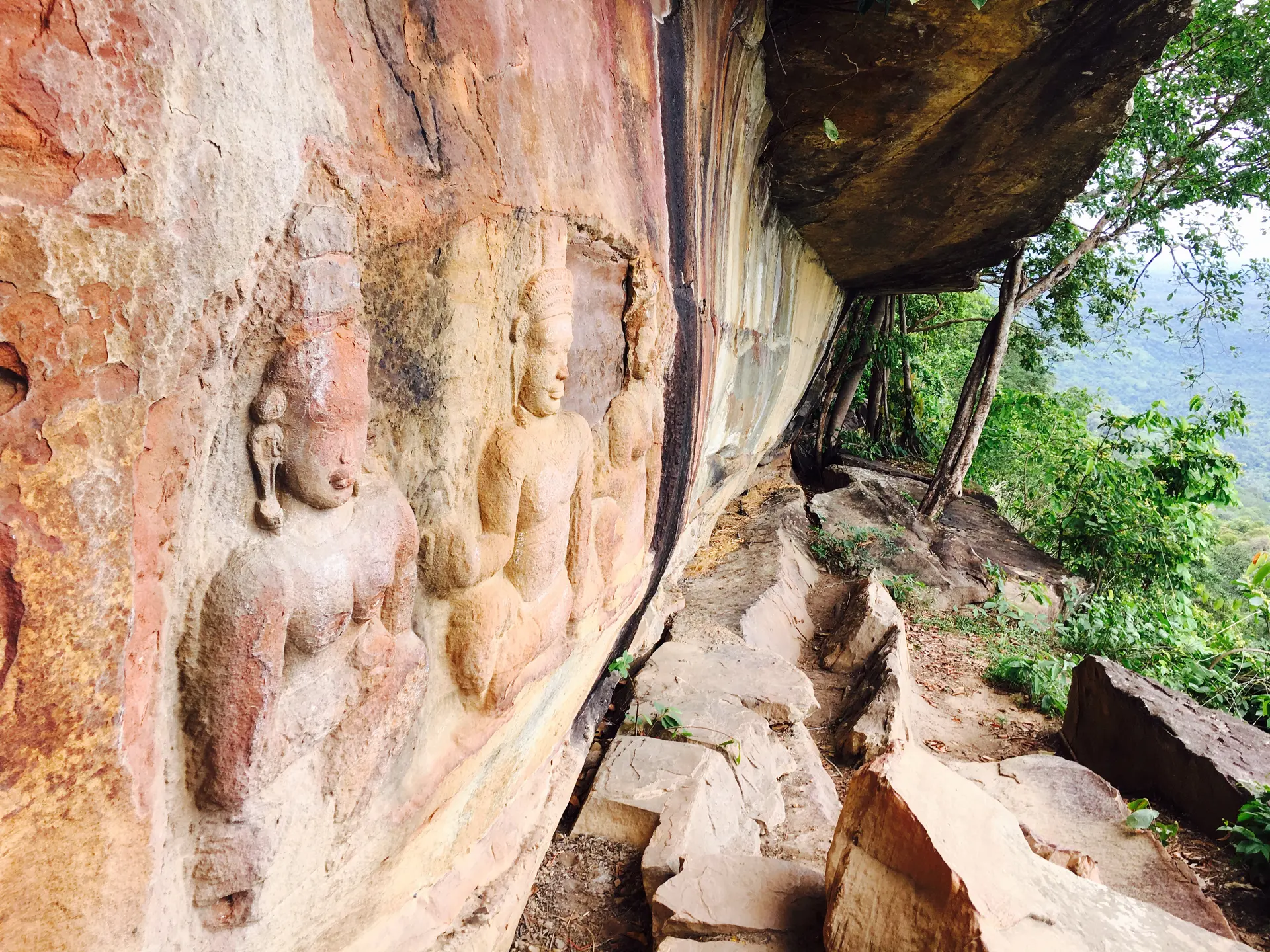
At the summit level the sanctuary holds intricate Khmer lintels, their carved deities and scrollwork still legible after a thousand years, alongside the Buddha images and footprint that mark its living devotion, and the sacred spring still issues from the hillside behind.
Near the summit a carved boulder known as the crocodile stone draws curiosity; its purpose is uncertain, and a speculative link to pre-Buddhist sacrifice rests on a single sixth-century Chinese text rather than firm evidence, so it is best met as an open question rather than a settled story.
Visitors frequently describe the place as a quieter, more contemplative counterpart to Angkor, where the absence of crowds lets the layering of the site register: Hindu beneath Buddhist, ruin beneath living shrine. The ascent, the spring, and the footprint together invite a reflection on continuity and impermanence that the setting makes almost unavoidable, and many find the unhurried, half-abandoned quality of the ruins more affecting than a more polished monument would be.
To pause at the spring, where the water still runs as it did when it bathed the linga, is to feel how little the essential gesture of the place has changed even as its gods have.
Entry is through the modern site museum at the base; a ceremonial axis runs from the barays up toward steep stairs leading to the hillside sanctuary, with the Mekong plain spread out below.
Context and lineage
The earliest firm trace of worship is the fifth-century inscription of King Devanika, recorded on the Vat Luong Kau stele and catalogued as K.365, which describes the establishment of a sacred district, identified with Shrestapura and likened to the Indian holy field of Kurukshetra, placed under the protection of Shiva manifest in Lingaparvata. The inscription marks the moment when an Indian model of sacred kingship and landscape was deliberately laid over this stretch of the Mekong.
A Cambodian foundation legend reaches further back, tracing royal origins to the union of the hermit Kambu Svayambhuva and the celestial nymph Mera, a gift of Shiva, whose lineage produced King Sreshthavarman, the namesake of Shrestapura associated with the site. Over the following centuries the shrine was rebuilt on a monumental scale by Angkorian Khmer rulers, giving Vat Phou most of the architecture visible today, including the twin palaces, the causeway, and the upper sanctuary.
As Khmer power receded and Lao settlers arrived from the north, the sanctuary was converted to Buddhist use by the thirteenth century, and it has been maintained as a Lao Buddhist site ever since, its Hindu fabric quietly repurposed rather than destroyed.
Begun as a Khmer Shaivite (Hindu) royal sanctuary, centered on the kingdom of Shrestapura linked to Chenla and later the Angkorian empire, and from the 13th century maintained as a Theravada Buddhist site by Lao communities.
King Devanika
Fifth-century ruler who established the sacred tirtha and holy district recorded in inscription K.365, the earliest attestation of worship at the site.
King Sreshthavarman
Legendary king of the Kambu-Mera lineage who gives his name to Shrestapura, the ancient settlement associated with Vat Phou.
Kambu Svayambhuva and Mera
The hermit and celestial nymph whose union, in Cambodian legend, founds the royal lineage tied to the site.
Traditions and practice
In the Khmer era the central rite was the ablution of the shrine linga with spring water channeled from the hillside, the daily renewal of the royal Shaivite cult that bound the king to Shiva. The act fused kingship and divinity: by tending the god's image the ruler affirmed his place in a cosmic order modeled on the Indian template of sacred sovereignty.
Pilgrimage to the sacred tirtha, the holy ford established by Devanika, drew worshippers to the protective presence of the god in the mountain, treating the site as one of those threshold places where the human and divine worlds meet and crossing is possible.
Living practice is Theravada Buddhist. Worshippers make merit, leave flowers and incense at the Buddha images and the Buddha footprint, and observe Makha Busa. Many Lao and Thai visitors also make offerings to the dvarapala, the guardian figure honored as King Kammatha, the mythical builder of the temple, so that an older sense of the place as the work and dwelling of a spirit-king persists alongside the Buddhist devotion.
The annual Boun Vat Phou, held around the full moon of the third lunar month coinciding with Makha Busa, is among the major Buddhist festivals of Laos, drawing monks from Laos, Thailand, and Cambodia and filling the ascent with pilgrims who climb to leave flowers and incense. Around the religious core the festival gathers processions, traditional music and dance, and games, and in past years has included elephant racing, so that solemn merit-making and communal celebration share the same days.
Climb at an unhurried pace, pausing at the spring and the footprint, and treat the ascent itself as the practice rather than a route to a viewpoint. Simple offerings of incense or flowers at the active shrines are welcome; the layering of Hindu and Buddhist devotion repays slow attention.
Shaivite Hinduism
HistoricalThe mountain Lingaparvata, crowned by a natural linga-shaped rock, was identified by early Indian-influenced settlers as the abode of Shiva. The sanctuary channeled spring water over a linga in the inner shrine, with the Mekong representing the cosmic ocean and Ganges and the mountain as Mount Meru, making the whole landscape an image of Hindu cosmology.
Ablution of the shrine linga with sacred spring water, the royal cult of Shiva, and tirtha pilgrimage to the sacred ford established by King Devanika.
Theravada Buddhism
ActiveAfter the decline of Khmer power and Lao settlement from the north, the site was converted to Buddhist use by the 13th century. The former Hindu sanctuary now houses Buddha images, and a Buddha footprint and ongoing offerings sustain living devotion. The annual Boun Vat Phou is among the major Buddhist festivals of Laos.
Merit-making, flower and incense offerings, observance of Makha Busa, and the pilgrim ascent of the temple stairs.
Lao folk veneration
ActiveThe dvarapala guardian figure is venerated as King Kammatha, the mythical builder of the temple, and most Lao and Thai visitors make offerings to it.
Offerings to the dvarapala spirit.
Perspectives and open questions
Vat Phou is read through several lenses at once: as a planned Hindu sacred landscape, as a living Buddhist site, and as a monument whose earliest layers and alignments remain debated.
Scholarly perspective
Scholars describe Vat Phou as a Khmer Shaivite temple complex whose sanctity derives from the Lingaparvata mountain and its sacred spring, with worship attested from at least the fifth century under Devanika and the surviving monuments largely belonging to the eleventh-to-thirteenth-century Angkorian rebuild, later adapted to Theravada Buddhism.
UNESCO inscribed it in 2001 as part of a planned sacred landscape expressing Hindu cosmology along a mountain-to-river axis of some ten kilometers, encompassing not only the temple but the associated ancient settlements of the Champasak cultural landscape.
Conservation has been a sustained international effort: Lao authorities have worked with UNESCO on the site since the late 1980s, and emergency stabilization of the deteriorating Nandin Hall was carried out with the Lerici Institute of Italy, reflecting the fragility of the sandstone and laterite structures on the unstable slope.
Living and traditional perspectives
Lao Buddhists regard the site as a protective, merit-rich place; the guardian figure is honored as the mythical builder-king Kammatha, and offerings to it remain a near-universal part of a Lao or Thai visit. In this living view the temple is less an antiquity to be studied than an active source of blessing, and the distant Hindu origins matter less than the present capacity of the place to receive prayer and confer merit.
Alternative interpretations
Popular and travel accounts emphasize the axial alignment of mountain, temple, and river as deliberate cosmological geometry, and some assert specific solstitial or astronomical orientation, a claim that specialist literature treats with more caution than these sources allow.
Open questions
The function of the so-called crocodile stone near the summit is uncertain; it has been speculatively linked, by way of a sixth-century Chinese text, to pre-Buddhist sacrifice, but this remains unproven. The precise sequence and dating of the earliest structures, the pre-Angkorian phases beneath the visible architecture, also remain debated.
Plan your visit
Access and arrival
Reached from Pakse or Champasak town in southern Laos; entry is through a modern site museum, open roughly 8:00 to 17:00 with the museum closing around 16:30. Foreigner entry is about 50,000-55,000 LAK, and guides are available in Lao, English, and French. Some upper-slope features require a climb.
Respectful visit
Dress modestly: women cover shoulders and knees, and men avoid tank-tops, though shorts are generally acceptable for men.
Generally permitted across the site; be respectful around worshippers and active shrines.
Flowers and incense are customary, especially at the dvarapala, the Buddha footprint, and the inner sanctuary.
Treat the inner shrine and active Buddhist images with respect, do not climb on the carvings, and stay on the paths along the upper slopes.
The inner sanctuary, the Buddha images, the footprint, and the dvarapala are active places of worship; keep offerings simple and behavior quiet, particularly during the festival when devotional activity is most intense.
Location
Map loads as you approach this section.
Pilgrim reflections
A portrait of encounter, not a score
Pilgrims describe what they felt, how present they could become, and whether the place would shape a journey. There are no stars and no ranking of traditions.
No reviewed reflections yet
The first pilgrims can help describe the character of being here.
Share a reflection
Available after an account-backed “Been there.” Every reflection is reviewed before publication.
Nearby sacred places
Explore other sacred places in the region. Proximity does not establish access or travel time; check each place’s guidance.


References
Sources consulted for this page. Source categories describe the publication, not a guarantee that every claim is verified. Traditional accounts and outside interpretations may differ.
- 01Vat Phou and Associated Ancient Settlements within the Champasak Cultural Landscape — UNESCO World Heritage CentreofficialInscribed 2001; defines the planned landscape expressing Hindu cosmology along a mountain-to-river axis over ~10 km.
- 02Vat Phou — Wikipedia contributorsencyclopediaCovers Lingaparvata, Shrestapura, Devanika inscription (K.365), Nandin hall, dvarapala, crocodile stone, Buddhist conversion.
- 03Wat Phou — New World EncyclopediaencyclopediaShiva dedication, linga bathed in spring water, 13th-century conversion to Buddhist monastery, continued Lao veneration.
- 04This ancient temple in Laos rivals Angkor Wat without the crowds — National GeographicnewsContext on significance and relationship to Angkorian Khmer civilization.
- 05Wat Phou - 10th Century Khmer temple in Laos — Renown TravelguideLingaparvata etymology, natural linga formation, mountain as home of Shiva, spring as Ganges.
- 06Wat Phou Festival (Wat Phou Champasak Festival) — Discover Laos TodayguideFestival held 15th day of waxing moon of 3rd lunar month, coinciding with Makha Busa.
- 07Wat Phu festival in January or February in Southern-Laos — luangprabang-laos.comguidePilgrims climb to leave flowers and incense; monks from Laos, Thailand, Cambodia attend; elephant racing, processions.
- 08Global Heritage Fund / Lerici Institute conservation at Vat Phou — Global Heritage Fund (reported)guideEmergency conservation of Nandin Hall via Lerici Institute (Italy) with Lao government; Lao-UNESCO projects from 1987.
- 09Vat Phou Champasak - Laos' Ancient UNESCO Temple — Laos InsiderguideOpening hours, entrance fee, dress code, museum, guide languages.
Photo gallery
3 curated photos
Share a photo
Help visitors recognize Vat Phou. Every submission is reviewed before publication.