Taranaki Maunga
A living ancestor now recognized in law as Te Kāhui Tupua, indivisible and legally its own person
Understand sacred places, explore living traditions, and learn how to engage respectfully with Pilgrim Map.
Access has not been verified. Check current local guidance before planning a visit.
Egmont National Park / Taranaki, Taranaki Region, Taranaki, New Zealand
Read the sources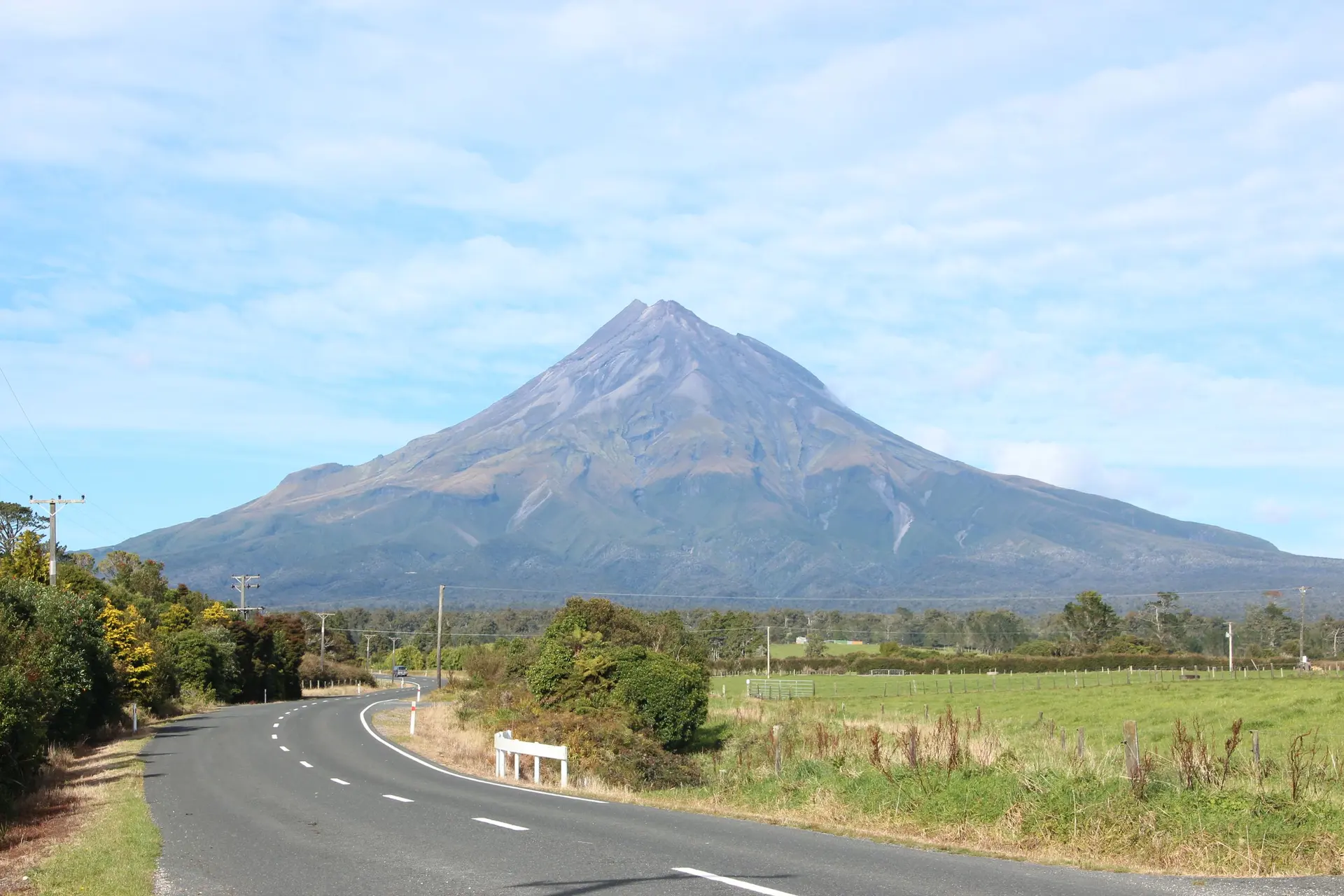
Visit essentials
A quick read before you go
- Duration
- The main summit route from North Egmont takes approximately nine hours round trip: one and a…
- Access
- Located within Egmont National Park, Te Papa-Kura-o-Taranaki, in the Taranaki region of New…
Overview
Taranaki Maunga stands alone on the western coast of New Zealand's North Island, its cone so symmetrical it is visible for great distances across the region it dominates. For Taranaki iwi, the mountain has always been understood as tupuna — a direct ancestor woven into whakapapa, a source of physical, cultural, and spiritual sustenance, and in traditional practice a final resting place.
That understanding, long held outside formal law, was given legal form in January 2025 when the Taranaki Maunga Collective Redress Act established Te Kāhui Tupua as a legal person: an indivisible living whole encompassing the mountain together with its neighboring peaks, Panitahi, Patuhā, Kaitake, and Pouākai. A new statutory body, Te Tōpuni Kōkōrangi, made up of four iwi-appointed and four Crown-appointed members, now speaks and acts on the entity's behalf.
This sits alongside the mountain's older identity as a demanding, symmetrical volcano within Egmont National Park, drawing climbers for a full-day summit ascent — and alongside its origin as a warrior in a battle of mountains, wounded and exiled to this coast. Few places ask a visitor to hold quite so many kinds of truth about the same rock at once.
Why this place is sacred
For Taranaki iwi, the maunga is not read as a symbol of ancestry; it is treated as an ancestor. This is the crucial distinction that separates Taranaki Maunga's thinness from a more familiar Western category of sacred mountain admired from a respectful distance.
Whakapapa binds the mountain into a genealogical line the same way it binds a person, and the mountain has, in traditional practice, served as a final resting place — a literal return to an ancestor rather than a metaphorical one. The 2025 legal personhood granted to Te Kāhui Tupua does not create this relationship; it recognizes one that Taranaki iwi describe as having always existed.
Lead Treaty negotiator Jamie Tuuta has put it directly: legal personhood 'recognised in law what the people of Taranaki have always known: our maunga are ancestors, they're not resources but they are living beings.' What makes the site's thinness distinctive is this collapse of the usual gap between physical landscape and spiritual personhood — a gap that in most traditions remains at least partly figurative.
Here it has been closed in formal legal terms as well as cosmological ones, so that visitors are asked to encounter the mountain not primarily as scenery to be climbed and photographed, but as a being with whom one stands in relationship, however briefly.
In Māori cosmological understanding, the mountain's original and ongoing purpose is to exist as a living ancestor — a source of physical sustenance, cultural identity, and in traditional practice a final resting place for Taranaki iwi, rather than a landform serving any single ceremonial function distinct from that ancestral relationship itself.
Colonial administration renamed the mountain 'Mount Egmont' and managed it as a conventional national park, a framing that persisted through most of the twentieth century alongside a documented 1.2 million acre Crown land confiscation from Taranaki iwi in the nineteenth century.
The 2025 Taranaki Maunga Collective Redress Act formally supersedes that colonial administrative framing, establishing Te Kāhui Tupua's legal personhood as part of the Treaty settlement process and following earlier New Zealand precedents — Te Urewera in 2014 and the Whanganui River/Te Awa Tupua in 2017 — in a still-developing pattern of indigenous legal personhood recognition.
Experience and orientation
Taranaki Maunga is visible from remarkable distances across its region, its cone rising in near-perfect symmetry above farmland and coastline in a way that makes it less a destination one travels toward and more a presence one lives alongside. Visitors who undertake the summit climb from North Egmont describe a demanding, technical, full-day undertaking — roughly nine hours round trip, crossing significant terrain and weather variability even in the more forgiving summer months.
The route itself moves through distinct registers: an initial stretch through alpine scrub and tussock to Tahurangi Lodge, then a longer, steeper haul over loose scoria and rock toward the crater rim, the symmetry that makes the mountain so recognizable from a distance dissolving underfoot into a much rougher, more demanding texture.
What distinguishes the experience from climbing conventions elsewhere is the protocol at the top: visitors are asked not to stand directly on the exact summit point, out of respect for its status as the mountain's most spiritually significant place.
Visitor guides consistently flag this as the detail that reframes the whole ascent — a reminder, at the moment of arrival, that the achievement being marked is not conquest of a peak but a brief and respectful presence on a living ancestor's most sacred point.
For Taranaki iwi members, the relationship described is not one of recreational achievement at all, but of ancestral connection and identity; for visitors from outside that whakapapa, the encounter with the summit protocol has, by several accounts, prompted a broader reconsideration of how one relates to land generally, even without a first-person account of a specific transformative moment recorded in the sources reviewed.
Descending, with the crater and its steep loose ground behind, the mountain's symmetry reasserts itself again at a distance — the same silhouette recognizable from the coast, now carrying, for anyone who has just stood near but not on its summit, a very different weight than it had that morning.
Approach via North Egmont, the main access point for the summit route within Egmont National Park; check in with the Department of Conservation visitor centre before setting out to confirm weather and track conditions, and leave a planned return time with someone aware of the itinerary given the terrain's real risk.
Context and lineage
According to Māori tradition, Taranaki once stood among the great mountains of the central North Island near what is now Lake Taupō, alongside Tongariro, Ngāuruhoe, and others. A battle broke out between Taranaki and Tongariro over the affections of the mountain Pihanga.
Defeated and wounded, Taranaki fled westward in the night, carving the gorges of the Whanganui River as he traveled and pausing long enough to form the Ngaere swamp, before the rising sun caught him and fixed him in his present location on the coast, his retreat blocked by the Pouākai Ranges.
The mountain's weather is read through this story to this day: clouds and rain gathering on its slopes are understood as Taranaki's ongoing grief for Pihanga, and striking light at sunset as the mountain displaying himself to her across the distance that now separates them.
That cosmological account sits alongside a documented and acknowledged historical injury: in the nineteenth century, the Crown confiscated roughly 1.2 million acres of land from Taranaki iwi, a wrong the 2025 Act itself names and formally addresses as part of the broader Treaty settlement in which Te Kāhui Tupua's legal personhood was established.
For much of the twentieth century the mountain was administered under the colonial name Mount Egmont and managed as a conventional national park, a framing the 2025 Act formally supersedes rather than merely supplements.
Guardianship and authority over the mountain now rests with Te Tōpuni Kōkōrangi, the eight-member statutory body established by the 2025 Act, composed of four members appointed by Taranaki iwi and four appointed by the Crown, acting and speaking on behalf of Te Kāhui Tupua as a legal person encompassing the mountain and its neighboring peaks Panitahi, Patuhā, Kaitake, and Pouākai as a single indivisible whole.
Jamie Tuuta
Lead Treaty negotiator for the Taranaki Maunga settlement
Led negotiations resulting in the Taranaki Maunga Collective Redress Act 2025, and has publicly framed the resulting legal personhood as recognition of an ancestral relationship Taranaki iwi have always held rather than a newly created one.
Traditions and practice
Specific pre-Treaty ceremonial practices historically conducted on the mountain by Taranaki iwi are not extensively documented in the English-language sources available for this research; deeper detail very likely exists within iwi-specific oral tradition not reached by this research pass, and this content does not claim to describe rituals that may exist only in that oral record.
The primary contemporary institutional practice is active participation in Te Tōpuni Kōkōrangi, the four-iwi, four-Crown-appointee statutory body that manages the practical implications of Te Kāhui Tupua's legal personhood. This is paired with the maintenance and promotion of tikanga-guided visitor protocols, chiefly the expectation that visitors do not stand on the exact summit point.
Visitors climbing the mountain are not expected to perform any specific ceremony, but can meet the mountain's ancestral status by observing the summit protocol scrupulously, treating the final approach to the peak with the same deliberateness they would bring to greeting an elder, and resisting the urge to stand at the highest point for a photograph.
Māori tupuna (ancestral mountain) cosmology
ActiveTaranaki iwi understand the mountain as a living ancestor woven into whakapapa rather than an inert natural resource, an understanding now given direct legal expression through Te Kāhui Tupua's 2025 personhood status.
Whakapapa-based relationship maintained through iwi guardianship, active participation in the Te Tōpuni Kōkōrangi governance body, and adherence to and promotion of tikanga-based visitor protocols, most notably the expectation not to stand on the summit.
Mountain-migration origin legend cycle
ActiveThe story of Taranaki's departure from the central North Island after his battle with Tongariro over Pihanga explains the region's geography — the Whanganui River gorges, the Ngaere swamp — in cosmological terms and remains an actively told part of Māori cultural heritage in the region.
Oral tradition and public retelling, including through official heritage and encyclopedia bodies; the legend is also referenced in ongoing weather-observation folklore, reading clouds and sunset light on the mountain as expressions of Taranaki's continuing grief and longing for Pihanga.
Perspectives and open questions
The mountain is read at once as a matter of settled Māori cosmological understanding, as a landmark case in New Zealand's developing law of indigenous legal personhood, and as a physically demanding alpine destination — three lenses that this content holds together rather than ranking.
Scholarly perspective
Legal scholars and commentators treat Taranaki Maunga's 2025 personhood as part of a broader, still-developing pattern of indigenous legal-personhood recognition in New Zealand, following Te Urewera in 2014 and the Whanganui River, or Te Awa Tupua, in 2017. Scholars generally regard this as a genuine legal innovation rather than a purely symbolic gesture, since Te Kāhui Tupua holds actual legal rights, powers, duties, and liabilities rather than a ceremonial designation alone.
International and domestic news coverage alike has treated the Act's acknowledgment of an 1.2 million acre nineteenth-century Crown land confiscation from Taranaki iwi as a substantive part of the settlement, not a preamble to it — the legal personhood and the redress for historical wrongdoing are presented in the legislation as two faces of a single act of recognition.
Living and traditional perspectives
Taranaki iwi describe the mountain not as a resource to be managed but as an ancestor with whom they hold an ongoing genealogical relationship. As lead Treaty negotiator Jamie Tuuta has stated, legal personhood 'recognised in law what the people of Taranaki have always known: our maunga are ancestors, they're not resources but they are living beings.' This is presented as the tradition's own longstanding understanding, formally confirmed rather than newly invented by the 2025 Act.
Alternative interpretations
No distinct New Age or alternative-spirituality interpretive literature specific to Taranaki Maunga was located in the sources gathered. International media coverage of the legal-personhood designation has occasionally framed it within broader popular discourse about nature's rights and animism more generally, though this is journalistic framing rather than a documented esoteric tradition specific to the mountain itself.
Open questions
The practical long-term implications of legal personhood for park management, visitor permitting, and any future legal disputes brought in the mountain's own name — over development, resource extraction, or environmental harm — remain genuinely open questions given how recent the law is.
The internal decision-making processes of Te Tōpuni Kōkōrangi beyond its basic four-iwi, four-Crown structure are likewise not fully detailed in sources reviewed, and specific pre-Treaty ceremonial practices on the mountain remain undocumented in the English-language record consulted here, likely held instead within iwi-specific oral tradition.
Plan your visit
Access and arrival
Located within Egmont National Park, Te Papa-Kura-o-Taranaki, in the Taranaki region of New Zealand's North Island. The main access point for the summit climb is North Egmont. Visitors should check in with the Department of Conservation visitor centre before climbing to discuss weather and track conditions, and set a planned return time with someone aware of their plans. Parking at North Egmont is limited through December 2026 due to visitor centre construction, and no alpine equipment rental is available locally.
No specific accommodation information for the immediate North Egmont area was located beyond the noted camping options at Stratford Plateau and Mangorei Road car parks; visitors should check current Department of Conservation guidance given the ongoing visitor centre construction affecting the North Egmont site through December 2026.
Respectful visit
No specific dress code is documented beyond standard alpine and mountaineering safety equipment appropriate to the season — this is a functional requirement driven by the mountain's real terrain and weather risk, not a devotional one.
No specific photography restriction is documented in official sources.
No offering practice is documented in available sources for this site.
Do not stand directly on the summit peak, out of respect for its status as the mountain's most spiritually significant point. Do not camp, cook, use the summit area as a toilet, or litter there. Freedom camping is not permitted at the North Egmont Road end, though alternative camping is available at the Stratford Plateau or Mangorei Road car parks.
Do not stand directly on the summit peak. The climb itself carries real physical risk — snow, ice, and avalanche conditions from roughly May through November or December require mountaineering skill and equipment, and even the more forgiving January-to-April season demands preparation and a realistic sense of the terrain's difficulty.
Location
Map loads as you approach this section.
Pilgrim reflections
A portrait of encounter, not a score
Pilgrims describe what they felt, how present they could become, and whether the place would shape a journey. There are no stars and no ranking of traditions.
No reviewed reflections yet
The first pilgrims can help describe the character of being here.
Share a reflection
Available after an account-backed “Been there.” Every reflection is reviewed before publication.
Nearby sacred places
Explore other sacred places in the region. Proximity does not establish access or travel time; check each place’s guidance.


References
Sources consulted for this page. Source categories describe the publication, not a guarantee that every claim is verified. Traditional accounts and outside interpretations may differ.
- 01Te Ture Whakatupua mō Te Kāhui Tupua 2025 / Taranaki Maunga Collective Redress Act 2025 — New Zealand ParliamentofficialPrimary legal text establishing Te Kāhui Tupua as a legal person; authoritative source for the exact legal mechanism and governance structure
- 02Taranaki Maunga becomes a legal person as treaty settlement passes into law — RNZ NewsofficialNew Zealand public broadcaster coverage of the January 2025 law passage, governance structure, and Treaty settlement context
- 03Taranaki Maunga bill: What creating 'legal personhood' means — 1News (TVNZ)officialExplains the practical and conceptual meaning of the legal personhood designation ahead of the bill's passage
- 04Te Kāhui Tupua: Taranaki Maunga bill passes into law — 1News (TVNZ)officialCoverage of the bill's passage including quotes from lead Treaty negotiator Jamie Tuuta
- 05Taranaki Maunga gains legal personhood status — Waatea News (Māori Radio Station)Source contextMāori-affiliated media source providing indigenous-community-facing coverage of the legal change
- 06Taranaki Maunga Summit Climb: Te Papa-Kura-o-Taranaki — New Zealand Department of Conservation (DOC)officialOfficial government conservation agency guidance on visitor etiquette, summit protocol, safety requirements, and access; primary source for practical/etiquette fields
- 07The journey of Taranaki Maunga — Te Ara: The Encyclopedia of New ZealandacademicNew Zealand government-run encyclopedia; authoritative retelling of the mountain-migration origin legend
- 08Battle of the mountains — Te Ara: The Encyclopedia of New ZealandacademicFurther detail on the Taranaki-Tongariro-Pihanga legend cycle and its role in explaining regional geography
- 09Taranaki Maunga Granted Legal Personhood — Te Pāti MāoriSource contextMāori political party statement on the significance of the legal change
- 10New Zealand mountain Taranaki Maunga has been granted personhood. Here's why that matters — CNNSource contextInternational news coverage explaining the significance to a general audience
- 11A New Zealand mountain is granted personhood, recognizing it as sacred for Māori — NPRSource contextInternational coverage with direct quotes on Māori cosmological understanding of the mountain as ancestor
- 12Mount Taranaki legend — Wikipedia contributorsacademicGeneral encyclopedia summary of the origin legend, cross-checked against Te Ara for accuracy
Share a photo
Help visitors recognize Taranaki Maunga. Every submission is reviewed before publication.