Sylhet; Shrine of Hazrat Shah Paran
Bangladesh's most visited shrine, where a saint who traveled a continent with a handful of earth found the soil that matched
Understand sacred places, explore living traditions, and learn how to engage respectfully with Pilgrim Map.
Access has not been verified. Check current local guidance before planning a visit.
Sylhet, Sylhet, Bangladesh
Read the sources
Visit essentials
A quick read before you go
- Duration
- 1 to 2 hours.
- Access
- Central Sylhet, Dargah Mahalla neighbourhood.
Overview
The Dargah of Hazrat Shah Jalal occupies a hillock called Dargah Tila in the Dargah Mahalla neighbourhood of Sylhet, forming the largest religious compound in Bangladesh and the country's most visited pilgrimage site. Shah Jalal — born around 1271, raised in Mecca, a Hafiz who achieved spiritual perfection after thirty years of study and meditation — arrived in Sylhet in 1303 with 360 companions and a mission that was simultaneously military and mystical.
His uncle Syed Ahmad Kabir had given him a handful of earth and told him to travel east until he found soil that matched its colour and texture. Shah Jalal journeyed across the subcontinent, meeting Sufi scholars along the way, including Nizamuddin Auliya in Delhi, who gifted him a pair of pigeons. At Sylhet, the earth matched. Shah Jalal stayed.
The dargah that grew around his tomb has been described by historian Syed Mahmudul Hasan as the religious centre of Sylhet. The current shrine structure dates to 1678, built under Farhad Khan, though an inscription from 1505 attests to earlier construction. Ibn Battuta, the great medieval traveler, visited Shah Jalal in 1345, recording his encounter with a saint whose reputation had spread across the Islamic world.
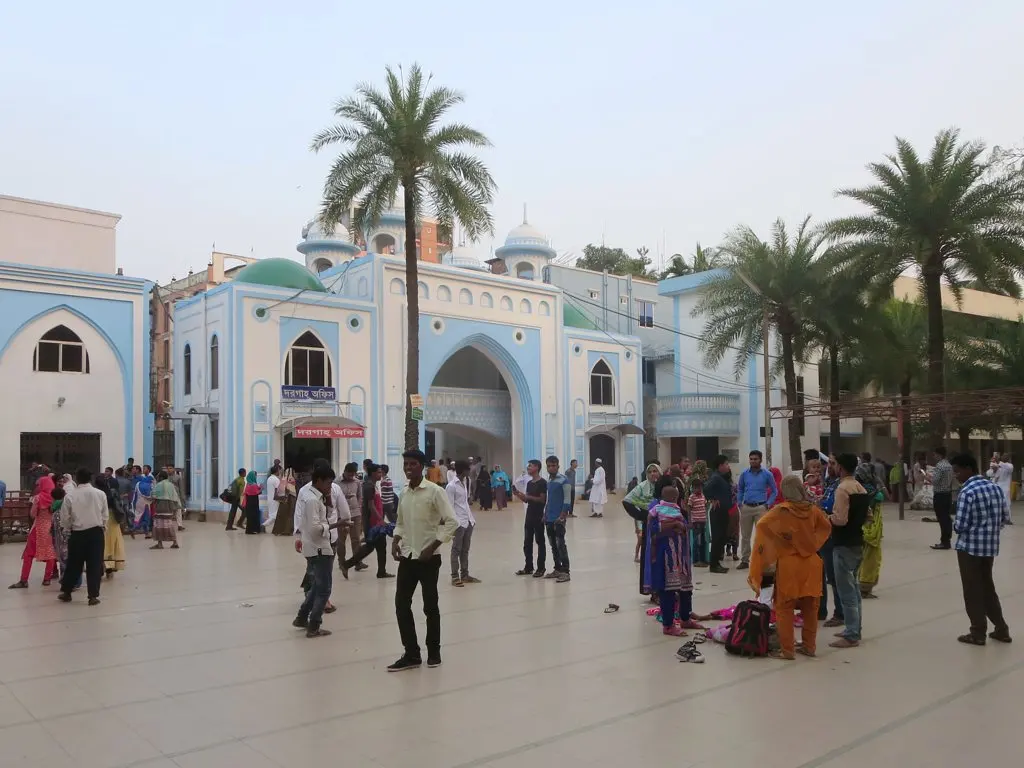
Today, the compound holds the tomb, a mosque, a pond with sacred catfish, and the descendants of Nizamuddin Auliya's pigeons — white birds that move through the courtyard with the unhurried confidence of creatures who have been at home for seven centuries. Both Muslims and Hindus make pilgrimage here.
The daily flow of thousands creates an atmosphere of collective devotion that is less an event than a permanent condition — a place where the seeking that Shah Jalal enacted across a continent has become a stillness that draws the seekers to itself.
Why this place is sacred
Shah Jalal carried earth from Mecca across an entire subcontinent, comparing it to the soil at each stopping point, and did not find a match until Sylhet. This is a story about searching — about the idea that the right place exists and that the seeker will know it by a physical sign. The earth matches. The journey ends. The teaching begins.
Seven centuries of continuous pilgrimage have saturated this hillock with devotional energy. Thousands arrive daily. The tomb has been enclosed in structures built and rebuilt over the centuries, each generation adding its own layer to the saint's physical memorial. The atmosphere is not historical but present-tense: people are praying now, seeking blessings now, feeding the catfish now.
The sacred pigeons introduce another temporal dimension. These white birds are held to be descendants of the pair that Nizamuddin Auliya gifted to Shah Jalal in Delhi — a living link across seven centuries to one of the most venerated Sufi saints of the medieval period. The catfish in the shrine's pond carry their own tradition. The non-human sacred coexists with the human here, adding biological continuity to the devotional.
The interfaith dimension deepens the thinness. Both Muslims and Hindus visit, pray, and make offerings. The shrine's sanctity transcends sectarian boundaries — a quality that Shah Jalal himself may have embodied, given the syncretistic traditions of medieval Bengal's Sufi culture.
Shah Jalal established his spiritual center in Sylhet after the 1303 conquest, recognizing the place where his handful of earth found its match.
From a 14th-century Sufi establishment through multiple constructions (1505 inscription, 1678 current structure) to the most visited shrine in Bangladesh. The annual Urs, the interfaith pilgrimage tradition, and the national recognition of Shah Jalal (Dhaka's international airport bears his name) mark the shrine's evolution into a national institution.
Experience and orientation
Approach through the streets of Sylhet's Dargah Mahalla, where the shrine's proximity shapes the entire neighbourhood. The hillock rises gently, and the compound opens into a space that is at once crowded and contemplative — thousands of people moving through with purpose, each one carrying their own prayer.
The tomb is the gravitational center. Enclosed in the 17th-century structure, it draws pilgrims who press close, offer chadar and flowers, murmur supplications, and seek the baraka of a saint whose reputation extends across the Islamic world. The atmosphere is intense without being oppressive — the collective devotion creates a field that individual visitors enter and are shaped by.
The sacred pigeons move through the courtyard with an authority that is entirely their own. White and unhurried, they are treated with the reverence owed to living connections to Nizamuddin Auliya's blessing. The catfish in the shrine's pond are fed by devotees, their dark shapes surfacing to receive offerings in a gesture that echoes the turtle-feeding at Bayazid Bostami's shrine in Chittagong.
The compound's mosque accommodates the regular prayer schedule, and the call to prayer from the dargah adds another layer to the sonic environment. During the annual Urs, the already-intense atmosphere reaches its peak, with tens of thousands gathering for collective devotion, qawwali music, and communal meals.
The experience is not quiet. It is not orderly. It is alive.
Allow 1 to 2 hours. Approach the tomb with respect and patience. Watch the pigeons. Feed the catfish. Listen to whatever music or chanting is occurring. Let the collective atmosphere work on you rather than trying to find individual quiet.
Context and lineage
Raised by his uncle Syed Ahmad Kabir in Mecca, Shah Jalal became a Hafiz and achieved Kamaliyat after thirty years. His uncle gave him a handful of earth and sent him eastward with instructions to settle where the soil matched. In Delhi, he received pigeons from Nizamuddin Auliya. In 1303, at Sylhet, the earth matched. He stayed, taught, and was visited by Ibn Battuta in 1345.
He died around 1346-1347, and his burial place became the object of veneration that it remains today.
The shrine connects to the Sufi networks of medieval South Asia, including the Naqshbandi lineage and the Chishti tradition (through the Nizamuddin Auliya connection). It represents the establishment of institutional Sufism in the Sylhet region.
Hazrat Shah Jalal
The most venerated Sufi saint in Bangladesh. Hafiz, spiritual master, and credited with bringing Islam to the Sylhet region.
Nizamuddin Auliya
Delhi-based Sufi saint who gifted Shah Jalal the sacred pigeons, connecting the Sylhet shrine to the broader Chishti Sufi network
Ibn Battuta
Medieval traveler who visited Shah Jalal in 1345, providing external historical confirmation of the saint's reputation
Traditions and practice
Prayer at the tomb, offering of chadar and flowers, supplication for blessings. Feeding the catfish. Collective zikr. The Urs draws tens of thousands for music, prayer, and communal meals.
The shrine receives thousands daily from across Bangladesh and India. Both Muslims and Hindus visit. The dargah functions as a permanent pilgrimage site rather than a seasonal one.
Visit the tomb with quiet respect. Feed the catfish. Watch the sacred pigeons. If possible, time your visit for a Friday for larger congregational prayers, or for the Urs for the most concentrated atmosphere.
Sufi Islam
ActiveThe most visited shrine in Bangladesh. Shah Jalal is the most venerated Sufi saint in the country, credited with bringing Islam to the Sylhet region.
Daily pilgrimage by thousands. Tomb veneration, catfish feeding, collective zikr, annual Urs. Interfaith visitation by both Muslims and Hindus.
Perspectives and open questions
Shah Jalal's dargah invites reflection on what it means to search — to carry earth across a continent until the ground beneath your feet confirms that the journey is over.
Scholarly perspective
The dargah is recognized as the most important Sufi shrine in Bangladesh. The 1505 and 1678 inscriptions provide historical anchoring. Ibn Battuta's 1345 visit offers external confirmation. The interfaith visitation tradition is noted as significant South Asian religious syncretism.
Living and traditional perspectives
For the faithful, Shah Jalal's baraka continues to flow from his tomb. The saint who achieved Kamaliyat after thirty years of spiritual perfection remains available to all who seek his intercession, seven centuries after his earthly life.
Alternative interpretations
The story of the matching soil suggests that sacred places are not created but recognized — that the seeker's task is not to build a shrine but to find the place where the earth itself confirms the sacred. The pigeons connect this site to a network of Sufi baraka that spans the subcontinent.
Open questions
Shah Jalal's exact origins — Turkestan or Yemen. The nature of the soil-matching miracle. Why both Muslims and Hindus recognize this particular site's sanctity.
Plan your visit
Access and arrival
Central Sylhet, Dargah Mahalla neighbourhood. Accessible by rickshaw or CNG from anywhere in Sylhet. Osmani International Airport serves Sylhet.
Hotels throughout Sylhet. Budget options near the dargah.
Respectful visit
Modest dress required. Women should cover their heads. Remove shoes before entering the shrine building.
May be restricted near the tomb. Courtyard photography generally permitted.
Chadar (cloth), flowers, and sweets are traditional. Food for the catfish is available.
Remove shoes at the shrine | Cover head | Maintain respect near the tomb | Do not disturb the sacred pigeons | Follow shrine attendants' guidance
The shrine is very crowded, especially during the Urs. Maintain awareness of personal belongings. The intensity of the devotional atmosphere may be overwhelming for some visitors.
Current practical details
Address
Shah Paran Road, Hazrat Shah Paran, Bangladesh
Hours
Hours, fees, and access can change — verify on the official source before you travel. Practical details last checked Jun 2026.
Location
Map loads as you approach this section.
Pilgrim reflections
A portrait of encounter, not a score
Pilgrims describe what they felt, how present they could become, and whether the place would shape a journey. There are no stars and no ranking of traditions.
No reviewed reflections yet
The first pilgrims can help describe the character of being here.
Share a reflection
Available after an account-backed “Been there.” Every reflection is reviewed before publication.
Nearby sacred places
Explore other sacred places in the region. Proximity does not establish access or travel time; check each place’s guidance.


References
Sources consulted for this page. Source categories describe the publication, not a guarantee that every claim is verified. Traditional accounts and outside interpretations may differ.
- 01Shah Paran - Wikipedia — Wikipedia contributorsencyclopediaOverview of biography and shrine
- 02Shah Paran - Grokipedia — GrokipediaencyclopediaBiographical details and khanqah information
- 03Tomb of Hazrat Shah Paran - Offroad Bangladesh — Offroad BangladeshguideVisitor information and practical details
- 04Hazrat Shah Paran - Londoni — Londoni.coacademicCultural and religious context
- 05Beyond Fear: Sufism and shrines of Sylhet - New Age — New Age BangladeshnewsContext on Sufi shrine culture in Sylhet
- 06Hazrat Shah Paran Mazar Sharif - Rexby — RexbyguidePersonal account of shrine visit
Share a photo
Help visitors recognize Sylhet; Shrine of Hazrat Shah Paran. Every submission is reviewed before publication.