Stone 'O Quoybune
A solitary standing stone that walks to drink from the loch when the year turns
Understand sacred places, explore living traditions, and learn how to engage respectfully with Pilgrim Map.
Access has not been verified. Check current local guidance before planning a visit.
Birsay, Scotland, United Kingdom
Read the sources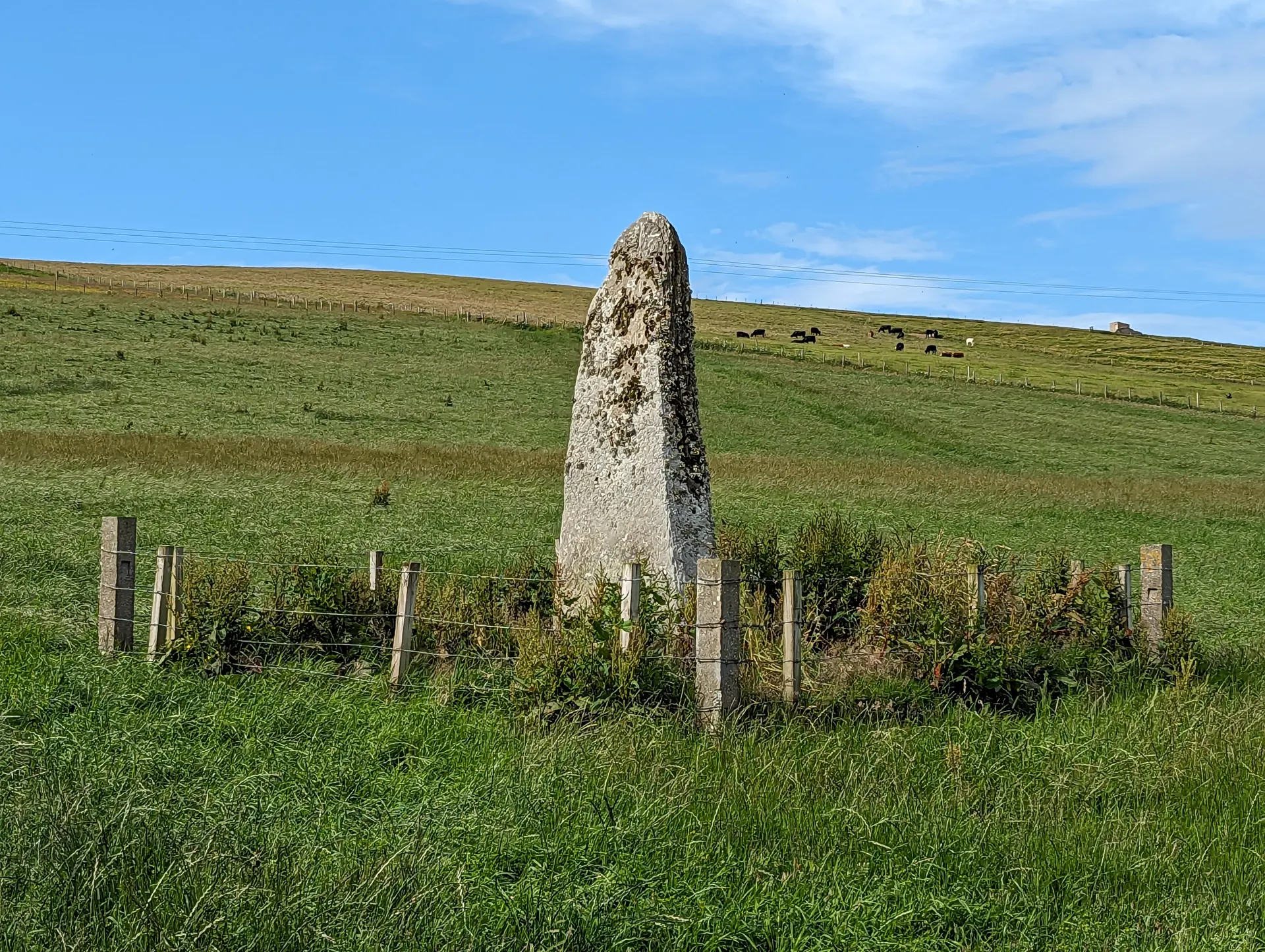
Image of Stone 'O Quoybune. Image source · CC-BY-SA-4.0
Visit essentials
A quick read before you go
- Duration
- 15-30 minutes at the stone itself.
- Etiquette
- Approach with awareness that the stone stands on private land.
Overview
In northwest Mainland Orkney, where farmland meets Loch of Boardhouse, a roadside field holds a solitary Devonian flagstone. The Stone 'O Quoybune, or Wheebin Standing Stone, has stood here approximately four thousand years. Three and a half metres tall and a metre and a half wide at its base, it tapers gradually toward its summit and bears a deep crevice from middle to summit, weathered by millennia of wind, rain, and frost.
Unlike the southern ceremonial complexes at Stenness and Brodgar, it has no ring, henge, or visible companion. Communities whose names and languages are lost quarried, transported, and raised it around 2000 BC, in the late Neolithic or early Bronze Age. Such monumental labor indicates a purpose important enough to command many hands.
The Loch of Boardhouse lies two hundred and seventy-four metres east. That may be coincidence, but Orcadian folklore understands the Stane o' Quoybune among the islands' petrified beings rather than as inert rock. Each Hogmanay, tradition says, it walks to the loch, lowers its head to drink cold water, and returns. Anyone witnessing the journey is warned they will not live to see another year's end.
Historic Environment Scotland scheduled the nationally important ancient monument in 1937. No formal excavation has tested the secrets beneath its turf.
Why this place is sacred
What makes a place thin is sometimes the absence of explanation rather than its abundance. The Stone 'O Quoybune has no interpretation panel, no visitor centre, no excavation report detailing what lies beneath. It stands in a field next to a road, and if you did not know to look for it, you might drive past without pausing. This unadorned quality is itself a form of power. The stone does not perform. It simply stands.
Four thousand years of Orkney weather have worked on the flagstone slab. The deep crevice that splits the upper portion of the stone is the record of that encounter between stone and sky, a wound that took millennia to open. The weathering gives the stone a quality that polished granite or sheltered marble cannot possess: it looks like something that has endured suffering.
The narrowing of the stone from base to summit, combined with the crevice, creates a form that is almost figurative, almost a body.
Perhaps this is why the folklore insists the stone is alive. The walking stone legend, shared with the Watch Stone at Stenness and the Yetnasteen on Rousay, treats these monoliths not as memorials or markers but as beings temporarily frozen in stone. The turning of the year releases them. For one night, they return to their essential nature, walking to water to drink.
The prohibition against watching suggests that the boundary between stone and life is sacred, a transformation that must occur unseen.
The Loch of Boardhouse lies close enough that on a still day the stone might see its own reflection in the water. Whether the people who raised the stone four thousand years ago intended this relationship with the loch cannot be known. But the landscape creates the connection regardless, and the folklore honours it.
Erected in the late Neolithic or early Bronze Age period, around 2000 BC. Solitary standing stones in Orkney are understood to have served ritual or ceremonial purposes, marking places of significance in the landscape. The precise nature of the ceremonies conducted at the Stone 'O Quoybune is unknown, as no excavation has taken place.
The stone has remained in its original position for approximately four thousand years. It was folded into Orcadian folklore traditions, acquiring the identity of a petrified giant and the walking stone legend associated with Hogmanay. Historic Environment Scotland scheduled the site as an ancient monument in 1937 (reference SM1414), with the scheduling last amended in 2003 to include a larger protective area. The stone stands on private farmland but is visible from the A967 road.
Experience and orientation
The stone does not announce itself from a distance. Driving the A967 through the parish of Birsay, you pass through farmland that lies open to the sky. The Loch of Boardhouse stretches to the east, and the land undulates gently without dramatic features. Then a tall, narrow shape appears beside the road, standing in a field of grass.
Park where you can safely and walk toward the stone. It stands on private land, so move with awareness and respect. As you approach, the scale becomes apparent. Three and a half metres is taller than it sounds when the object is a single slab of weathered flagstone set against the open Orkney sky. The stone is wider at the base and narrows as it rises, creating a form that draws the eye upward.
The deep crevice that splits the upper face is the feature that arrests attention. It looks as though the stone has been struck by something, or as though it is slowly opening.
Stand beside it. Place your palm against the flagstone if you wish. It will be cold, and the surface will be rough with weathering. Look east toward the Loch of Boardhouse, less than three hundred metres away. On a winter evening, consider the legend: that this stone will walk to that water when midnight strikes on Hogmanay.
Consider what it means that generations of Orcadians have told this story to each other, investing the stone with a life that the eye cannot detect but the imagination refuses to deny.
The wind will be present. Orkney is seldom still. The sound of it against the stone is part of the experience, a continuous voice that the stone has heard for four thousand years.
The stone stands beside the A967 road in the parish of Birsay, approximately 1.5 km southeast of Birsay village. It is 274 metres from the western edge of the Loch of Boardhouse. The Brough of Birsay lies approximately 2 km to the northwest.
Context and lineage
No written record survives from the period of the stone's erection, and no archaeological excavation has been conducted at the site. What is known must be read from the stone itself and from the landscape it inhabits.
Around 2000 BC, communities living on Mainland Orkney selected a slab of Devonian flagstone and raised it upright in a field near the Loch of Boardhouse. This was an era of monumental construction across Orkney. The great stone circles at Stenness and Brodgar, the chambered tomb at Maeshowe, and the settlement at Skara Brae were all part of the same broad cultural world, though the Stone 'O Quoybune stands apart from these better-known sites in both geography and form.
It is a solitary marker, not a communal gathering place.
Why this particular location was chosen is unknown. The proximity to the loch may have been deliberate, connecting the stone to water in a relationship whose meaning the erectors understood but did not write down. What they left instead was the stone itself, an act of communication in a medium designed to outlast the communicators.
Centuries later, Norse-influenced Orcadian culture wove the stone into a different kind of narrative. The monolith became a petrified giant, held in stone by enchantment, freed for one night each year to walk to the loch and drink. This transformation from ritual marker to folkloric being represents not a loss of meaning but a translation, the stone's significance adapted to the imagination of each culture that encountered it.
No continuous tradition survives from the communities who erected the stone. The Orcadian folklore tradition of the walking stone represents a later cultural layer, likely influenced by Norse settlement and medieval storytelling traditions. The stone's scheduled monument status reflects its recognition by modern heritage institutions as a site of national archaeological importance.
Traditions and practice
The original ritual or ceremonial practices associated with the stone are unknown. Standing stones in Orkney are broadly understood to have served as focal points for communal gathering, territorial marking, or astronomical observation, though none of these functions has been confirmed for this particular stone.
The Hogmanay walking stone tradition, while not a ritual performed at the stone, represents a form of cultural observance in which the stone itself is the active participant and human beings are instructed to remain at a distance.
Visitors come to the stone for contemplative experience, photography, and engagement with Orkney's prehistoric landscape. The stone is often visited as part of a wider tour of Orcadian standing stones and archaeological sites. No formal ceremonies or gatherings take place at the site.
Stand with the stone for longer than you planned. Allow the wind to settle into your awareness. Look toward the Loch of Boardhouse and consider the distance the stone is said to walk each year. Touch the flagstone if you feel moved to do so. Notice the crevice and the weathering, the four thousand years of erosion made visible. If you visit near Hogmanay, carry the legend with you and consider what it means to believe a stone can walk.
Late Neolithic / Early Bronze Age Monumental Tradition
HistoricalThe stone was erected around 2000 BC as part of the broader monumental landscape of Orkney, during a period when communities across the islands were constructing stone circles, chambered tombs, and solitary standing stones. These monuments served ritual and ceremonial purposes that defined the social and spiritual life of their communities.
Erection of monolithic standing stones at chosen locations in the landscape. Precise ritual practices at solitary stones are not well documented archaeologically.
Orcadian Walking Stone Folklore
HistoricalThe Stone 'O Quoybune is one of three principal standing stones in Orkney associated with the Hogmanay walking stone legend. This folklore tradition treats standing stones as petrified giants temporarily released from enchantment at the turning of the year. The tradition reveals a persistent animistic perception of the Orcadian landscape that survived the islands' conversion to Christianity and continues to inform local culture.
Oral transmission of the walking stone narratives. Avoidance of standing stones on Hogmanay night. Cultural acknowledgement of the stones as beings rather than objects.
Perspectives and open questions
The Stone 'O Quoybune can be understood as a prehistoric ritual monument, as a solitary survivor of a now-invisible ceremonial landscape, as a focus of living folklore, or as an encounter with four thousand years of weathering made tangible in a single slab of stone.
Scholarly perspective
Archaeologists classify the stone as a late Neolithic or early Bronze Age solitary standing stone, erected around 2000 BC. Historic Environment Scotland considers it of national importance as an example of a standing stone with potential to provide information about the religious or ritual life of past societies. The absence of excavation means that subsurface features, if any exist, remain unrecorded.
The stone's relationship to other monuments in the parish of Birsay and to the Loch of Boardhouse has not been systematically investigated. Orkney's standing stones are broadly understood as components of a monumental landscape that served multiple functions including territorial marking, ritual gathering, and astronomical observation.
Living and traditional perspectives
Orcadian folklore understands the stone as a petrified giant that walks to the Loch of Boardhouse each Hogmanay to drink. This legend belongs to a wider tradition shared with the Watch Stone at Stenness and the Yetnasteen on Rousay. The prohibition against witnessing the stone's journey functions as a cultural boundary, marking the stone as a place and a being deserving of distance and respect at liminal times.
Alternative interpretations
Some visitors and writers interested in earth energies and sacred landscapes note the stone's relationship to water and its position within the broader Orcadian monumental landscape. The walking stone legend has attracted interest from those who explore animistic perceptions of landscape, understanding the folklore as a surviving trace of an older worldview in which stones, water, and the turning of the year participate in a living relationship.
Open questions
Whether the stone was originally part of a larger monument complex or has always stood alone remains unknown. No excavation has been conducted, so the presence or absence of subsurface features such as pits, cists, or satellite stones cannot be confirmed. The exact quarry source of the flagstone slab has not been identified. The origin of the walking stone legend, and whether it preserves any genuine memory of the stone's original ritual purpose, is an open question.
Plan your visit
Access and arrival
Accommodation available in the Birsay area and surrounding parishes. Full range of services in Kirkwall, approximately 25 km east.
Respectful visit
Outdoor clothing suitable for exposed Orkney conditions. Waterproofs essential year-round. Warm layers even in summer. Sturdy footwear for walking across farmland, which may be muddy or uneven.
Permitted. The stone photographs well in late afternoon light when the western sun illuminates the crevice and the weathered surface.
Do not leave offerings, coins, or objects at the stone. It is a scheduled monument.
Scheduled ancient monument: disturbance prohibited. Private farmland: approach with respect. No metal detecting.
The stone stands on private farmland. Approach with respect for the landowner and any livestock present. It is a scheduled ancient monument and must not be disturbed, marked, or altered in any way.
Current practical details
Address
Birsay, Orkney KW17 2NB, UK
Hours
Hours, fees, and access can change — verify on the official source before you travel. Practical details last checked Jun 2026.
Location
Map loads as you approach this section.
Pilgrim reflections
A portrait of encounter, not a score
Pilgrims describe what they felt, how present they could become, and whether the place would shape a journey. There are no stars and no ranking of traditions.
No reviewed reflections yet
The first pilgrims can help describe the character of being here.
Share a reflection
Available after an account-backed “Been there.” Every reflection is reviewed before publication.
Nearby sacred places
Explore other sacred places in the region. Proximity does not establish access or travel time; check each place’s guidance.


References
Sources consulted for this page. Source categories describe the publication, not a guarantee that every claim is verified. Traditional accounts and outside interpretations may differ.
- 01Wheebin standing stone (SM1414) — Historic Environment ScotlandofficialOfficial scheduled monument designation record with archaeological significance statement
- 02Wheebin standing stone — WikipediaencyclopediaWell-referenced encyclopedia article with dimensions, coordinates, and folklore
- 03Stone 'O Quoybune Standing Stone (Menhir) — The Megalithic PortalofficialSpecialist megalith database with visitor photographs, coordinates, and community observations
- 04Wheebin (Standing Stone / Menhir) — The Modern AntiquarianofficialCommunity-contributed site record with visitor descriptions
- 05Quoybune Standing Stone — Saints and StonesacademicDetailed journey description and folklore context from specialist standing stones site
- 06Stone of Quoybune — British FolkloreSource contextFolklore and legend associated with the stone, including the 1884 documented account
- 07Wheebin standing stone, West Mainland, Orkney Islands — Ancient Monuments UKofficialScheduled monument listing with location and scheduling details
- 08Wheebin Standing Stone or Stane o' Quoybune — Jo and Steve Turner / GeographSource contextGeolocated photograph confirming present condition of the stone
Share a photo
Help visitors recognize Stone 'O Quoybune. Every submission is reviewed before publication.