Statue-menhir of Tavera
A Bronze Age face in fine granite — Corsica's most expressive statue-menhir, still called 'A Santa' by the shepherds who knew her
Understand sacred places, explore living traditions, and learn how to engage respectfully with Pilgrim Map.
Access has not been verified. Check current local guidance before planning a visit.
Corse-du-Sud, France
Read the sources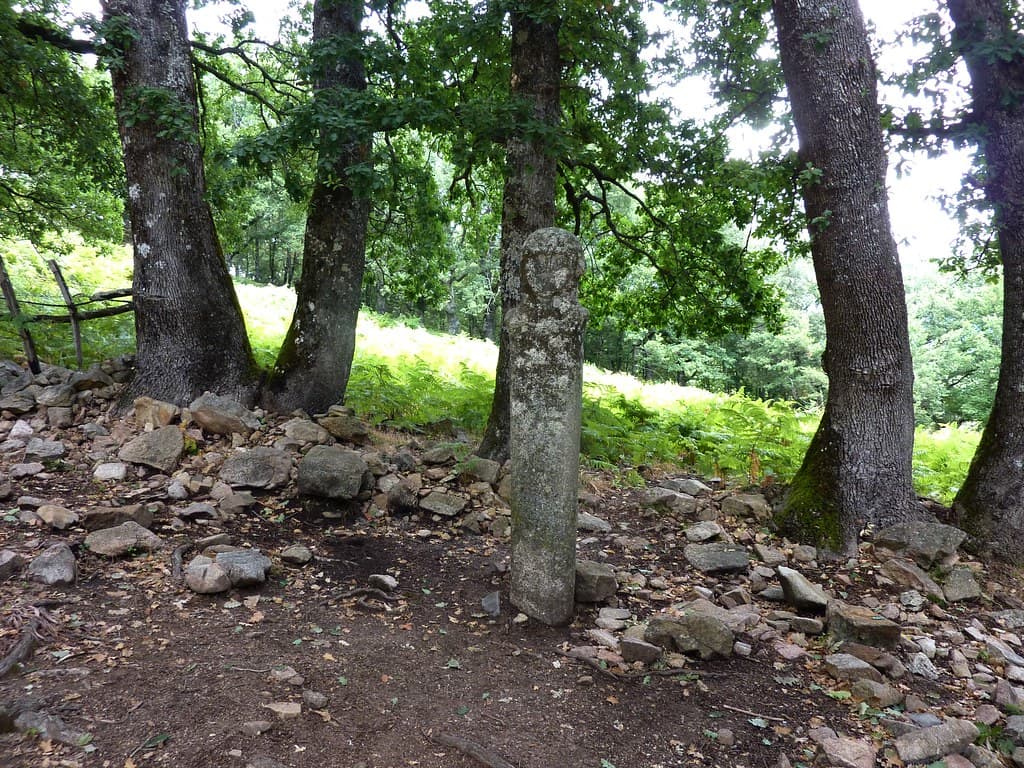
Image of Statue-menhir of Tavera. Image source
Visit essentials
A quick read before you go
- Duration
- 1–2 hours for the menhir visit alone; 3–4 hours if combined with the medieval casteddi trail and…
- Access
- Located 2 km west of Tavera village along the RT20 (territorial road 20) in Corse-du-Sud.
Overview
On a mountain pass above the Gravone valley in central Corsica, a face carved from granite has watched the valley for thousands of years — and then lay face-down in the ground, forgotten, until a geologist found it in 1961. The Tavera statue-menhir is 2.42 metres tall, cut from a monolith of fine-grained granite whose source Pierre Lamotte traced to outcrops approximately five kilometres downstream near Ucciani and Vero.
It was carried, worked, and erected by Late Neolithic or Early Bronze Age people of the Gravona valley, perhaps 4,000 years ago.
The figure is carved in the round with a degree of anatomical specificity that sets it apart from most of Corsica's approximately eighty known statue-menhirs. The head is rounded. The ears project slightly in salient relief. The nose rises from the face as a separate sculptural element — a block of stone shaped to read as a nose at any distance.
The eyes are rendered as hollows, set close together, giving the face an expression that many visitors describe as unsettling: too human, too attentive, too present for something so ancient. The mouth is indicated by a short horizontal engraving — a closed line, suggesting neither smile nor grimace.
Gravone valley shepherds called the figure 'A Santa' — the saint — and believed it made grass grow lush for good pasture. Whether this reflects continuity from the Bronze Age or a later human response to an expressive stone face remains unresolved.
Why this place is sacred
Corsica's statue-menhirs are unique in the Mediterranean world. While standing stones exist across prehistoric Europe, the Corsican tradition produced something rarer: anthropomorphic figures — faces, bodies, identities suggested in stone — that occupied specific landscape points and carried specific cultural meanings for the communities that erected them. The Tavera menhir is among the finest of these figures, and it is among the ones whose meaning most clearly survived into historical time.
The name 'A Santa' — the saint — was given by Corsican shepherds who knew the figure in the twentieth century. They believed the statue had the virtue of making grass grow. This is a fertility attribution: sacred power tied to the productivity of the land, mediated through a stone figure on a pass. The attribution is pre-Christian in structure, however late in time it was observed.
It echoes the original purpose of these Bronze Age anthropomorphic standing stones — not merely territorial markers or ancestor effigies, but mediating presences between the human community and the forces that governed the land's generosity.
When Lamotte found the figure in 1961, it was lying face-down in the soil, partly buried. The deliberate burial of statue-menhirs at Filitosa and other Corsican sites is associated with the Torrean Bronze Age culture that superseded the statue-menhir tradition around 1500 BC. Whether the Tavera menhir was overthrown in cultural conflict, buried in reverence, or fell to unknown causes is not established.
The fact that the shepherds who later worked this mountain pass called the figure 'A Santa' suggests that whatever broke the formal continuity of the Bronze Age sacred tradition at this site, the sense of sacred presence — the felt significance of this particular stone face — was never entirely extinguished.
Standing before the re-erected figure today, looking at its closed eyes and engraved mouth, the quality of that persistence is available to experience directly.
Anthropomorphic standing stone erected at a significant landscape point on the Col de Tagliafarro — possibly as a territorial or cosmological marker, an ancestor figure, a fertility-conferring sacred presence, or a boundary between zones of the inhabited landscape. The specific function is unresolved.
Late Neolithic / early Bronze Age erection (c. 2nd millennium BC) → use and veneration by Bronze Age Gravone valley community → overthrow or burial (date unknown; possibly Torrean cultural transition c.
1500 BC) → centuries or millennia face-down in the soil → informal folk recognition by Corsican shepherds as 'A Santa' (date range unknown) → discovery by Pierre Lamotte (1961) → publication in Bulletin de la Société Préhistorique Française (1963) → classification as French Historic Monument (2010) → re-erection at discovery site → current heritage site with explanatory panel.
Experience and orientation
The trailhead for the Tavera statue-menhir is approximately one kilometre west of the D127/RT20 junction on the territorial road 20, about two kilometres from Tavera village in Corse-du-Sud. The walk takes approximately forty minutes from the trailhead. The terrain is that of the Corsican interior mountain passes — maquis scrub, granite outcrops, the clarity of altitude above the valley.
The Col de Tagliafarro where the menhir stands is a natural threshold: a pass between the high interior and the lower Gravone valley, the kind of topographic point that prehistoric communities across the Mediterranean chose for boundary markers, sacred figures, and territorial statements. When the menhir comes into view — its 2.42-metre height substantial against the mountain backdrop — the first impression is of verticality. A single human-height figure standing upright in a horizontal landscape.
Approach slowly. Resist the temptation to go directly to the front. Circle the menhir first, observing it from all sides. Lamotte's description in the 1963 paper noted that the modelling gives the figure 'a well-proportioned silhouette' — the carving is not merely a face on a flat slab but a figure worked in three dimensions, the stone thinned at the shoulders and neck, the head given a rounded form that reads as a head from any angle.
Then face the menhir directly. The eyes are hollows — not cut deeply but pressed inward, giving the face shadow-defined sockets. They are set closely together, which creates an expression more intense than widely-spaced eyes would suggest. The nose is in relief — a distinct sculptural element raised above the plane of the face. The mouth is a horizontal engraving below the nose: short, closed, neither smiling nor frowning.
The ears, Lamotte noted, are rendered as 'two salient reliefs' — slight projections from the side of the head that read as ears without being naturalistic.
The granite has texture. The surface has been shaped rather than smoothed — you can see where the Bronze Age sculptor worked the stone. The quality of attention the face receives from any visitor who stands before it long enough is a useful index of what the figure does: it generates a kind of reciprocal looking. The Bronze Age sculptor created something that looks back.
The interpretive panel at the site provides dating and context. The Voile de la Mariée waterfall is two kilometres east, visible from certain points on the approach. The medieval casteddi accessible on an extension of the same trail add a different historical layer for those who want to extend the walk.
Access via the RT20, approximately 20 km northeast of Ajaccio. Trailhead 1 km west of the D127/RT20 junction; 40-minute walk to the menhir. Explanatory panel on site. Free access. Parking on the roadside. Walking footwear recommended.
Context and lineage
In the late Neolithic or early Bronze Age — archaeologists date the Tavera figure to the second millennium BC — a community living in the Gravone valley of central Corsica quarried a monolith of fine-grained granite from outcrops five kilometres downstream, carried it to the Col de Tagliafarro at approximately 425 metres altitude, and carved it into a human figure.
The granite was shaped into a body with rounded head, projecting ears, a nose in relief, hollow eyes, and an engraved mouth. Then it was erected at the mountain pass — standing upright, facing a direction we no longer know with certainty, present in the landscape as a named sacred figure.
At some subsequent point — possibly during the Torrean Bronze Age cultural transition around 1500 BC, possibly at a different time for different reasons — the figure was laid face-down and partly buried. It remained there for an indeterminate length of time.
When Corsican shepherds working the pass encountered the menhir (at a date before 1961), they recognized it not as an archaeological artifact but as a sacred figure, naming it 'A Santa' and attributing to it the power to make grass grow for good pasture. Pierre Lamotte, conducting a geological and archaeological survey of the Gravona valley in 1961, found the figure and published its first formal description in 1963.
Late Neolithic / early Bronze Age (c. 2nd millennium BC) → overthrow or burial (date unknown) → folk recognition as 'A Santa' by Corsican shepherds → discovery by Pierre Lamotte (1961) → academic publication (1963) → classification as French Historic Monument (2010) → re-erection and heritage site.
Traditions and practice
The erection of statue-menhirs at significant landscape points in Bronze Age Corsica implies veneration of the figure as a mediating presence — between the living community and the forces governing land, animals, and seasonal cycles. The specific veneration practices are not documented.
The folk attribution of 'A Santa' — the saint who makes grass grow — represents either a survival or a reinvention of this mediating function: the stone figure understood as conferring the virtue of good pasture on the surrounding land. Shepherds acknowledged this figure informally; no organized ritual is described.
The site functions as a heritage attraction with an explanatory panel. No organized ceremony or religious practice.
Walk to the menhir without looking at images of it beforehand if possible. The encounter with a Bronze Age sculptor's rendering of a human face is more immediate when the face is not already familiar. Approach from below on the trail, which means approaching the figure from the valley side — the same direction a Gravone valley inhabitant would have approached it 4,000 years ago.
Before looking at the face, look at the figure's overall posture and proportion. Lamotte described the modelling as creating 'a well-proportioned silhouette' — the figure reads as a body, not just a head on a slab. Note the line of the shoulders, the narrowing toward the neck, the rounded form of the head.
Then approach close enough to examine the face. Spend time with each element: the ears in their slight salient relief, the closely set hollow eyes, the nose as a separate sculptural block, the engraved horizontal line of the mouth. Try to determine what expression, if any, the face conveys. Different light conditions change the answer — morning light and afternoon light create different shadow configurations in the hollows of the eyes.
If you are visiting with knowledge of the shepherd tradition of calling this figure 'A Santa', stand back to a distance from which the figure is seen as a whole against the mountain pass and the valley behind it. Imagine a shepherd encountering this stone face on a working day on this pass and recognizing it as a saint — not from religious instruction but from the direct recognition that this face, here, in this landscape, was something.
The granite has been here for 4,000 years. The impulse to recognize sacred presence in it has not entirely passed.
Corsican Statue-Menhir Tradition
HistoricalThe Tavera menhir is one of the most anatomically detailed and best-preserved examples of Corsica's Bronze Age statue-menhir tradition. These anthropomorphic standing stones are unique to Corsica and represent a sophisticated sculptural tradition from the late Neolithic and early Bronze Age. The Tavera example is noted as among the most refined on the island for the quality of its modelling.
Erection and veneration of anthropomorphic standing stones at significant landscape points; possibly associated with territorial marking, ancestor veneration, or cosmological and fertility-related sacred functions.
Local Folk Veneration
HistoricalLocal shepherds called the figure 'A Santa' (the saint) and believed it possessed the virtue of making grass grow lush for good pastures. This residual sacred attribution — linking the prehistoric statue to fertility of the land — was still known within living memory at the time of the 1961 discovery.
Informal veneration; no documented organized ritual. The sacred attribution appears to have been transmitted among shepherds working the Col de Tagliafarro area.
Perspectives and open questions
The Tavera menhir is interpreted through archaeology, folk sacred tradition, and the broader scholarly debate about the function of Corsica's statue-menhir tradition — whether territorial, funerary, ancestral, or cosmological.
Scholarly perspective
The Tavera statue-menhir is one of the finest examples of Corsica's Bronze Age anthropomorphic standing stone tradition. First described by Pierre Lamotte in a 1963 paper in the Bulletin de la Société Préhistorique Française, it is dated to the late Neolithic or early Bronze Age (c. 2nd millennium BC). Its exceptional anatomical detail — nose in relief, hollow eyes, engraved mouth, modelled ears — sets it apart from most other Corsican menhirs. Classified as a historic monument in 2010 (PA2A000008).
Post-2014 excavations on a nearby spur identified a perched settlement with occupation from the Middle Bronze Age through the Second Iron Age, contextualizing the menhir within a long-inhabited sacred landscape.
Living and traditional perspectives
The shepherd attribution of 'A Santa' (the saint) and the belief that the figure made grass grow lush for good pastures represents an indigenous Corsican folk sacred tradition documented at the time of the 1961 discovery. This is a residual pre-Christian sacred attribution that survived into the modern era — a persistence of the sense of sacred presence attached to this specific stone figure across an unknown number of generations between the Bronze Age and the twentieth century.
Alternative interpretations
Some researchers interpret Corsican statue-menhirs as territorial ancestor markers or as mediating figures between the living and the dead — positioned at landscape boundaries, passes, and sightlines to define and protect community territory. The female-coded facial features of the Tavera figure — discussed in the context of broader Mediterranean prehistoric anthropomorphic sacred tradition — have been tentatively associated with a female sacred principle, though this remains speculative.
The figure's overthrow and burial, paralleled at Filitosa and other sites, has been linked to the cultural disruption brought by the Torrean Bronze Age people who succeeded the statue-menhir tradition.
Open questions
The identity of the figure — deity, ancestor, territorial guardian, or cosmological marker — is unresolved. The original orientation of the erected stone, whether it faced a specific landscape feature or astronomical direction, is unknown. The reason for the face-down burial — cultural conflict, deliberate ritual deposition, or simple collapse — is not established.
The date of burial and the length of time the figure lay hidden before the shepherds' folk attribution suggest a complex history of alternating visibility and concealment.
Plan your visit
Access and arrival
Located 2 km west of Tavera village along the RT20 (territorial road 20) in Corse-du-Sud. Parking on the roadside. Trailhead 1 km west of the D127/RT20 junction; approximately 40-minute walk to the menhir. Explanatory panel on site. Free access. Nearest town is Tavera; Ajaccio is approximately 20 km southeast.
Ajaccio (approximately 20 km southeast) has the full range of accommodation options. Tavera village has no formal accommodation; rural gîtes may be available in the Gravone valley.
Respectful visit
No dress code; walking footwear recommended for the trail approach.
Permitted.
Not applicable.
Do not touch or lean on the statue; conservation concerns regarding surface deterioration have been noted. The figure is a classified French historic monument (PA2A000008).
Conservation concerns have been reported in local press regarding some deterioration of the statue. Do not touch or lean on the figure; physical contact accelerates weathering. The statue is a classified French historic monument.
Location
Map loads as you approach this section.
Pilgrim reflections
A portrait of encounter, not a score
Pilgrims describe what they felt, how present they could become, and whether the place would shape a journey. There are no stars and no ranking of traditions.
No reviewed reflections yet
The first pilgrims can help describe the character of being here.
Share a reflection
Available after an account-backed “Been there.” Every reflection is reviewed before publication.
Nearby sacred places
Explore other sacred places in the region. Proximity does not establish access or travel time; check each place’s guidance.


References
Sources consulted for this page. Source categories describe the publication, not a guarantee that every claim is verified. Traditional accounts and outside interpretations may differ.
- 01Statue-menhir de Tavera — Plateforme Ouverte du Patrimoine (PA2A000008)officialFrench Ministry of Culture official heritage record with classification data
- 02La statue-menhir de Tavera (Corse) — Pierre LamotteacademicOriginal discovery publication in the Bulletin de la Société Préhistorique Française (1963) — primary scholarly source with full physical description
- 03The menhir of Tavera — Office Intercommunal de tourisme du Celavu-PrunelliofficialOfficial tourism office description with access and visitor information
- 04Statue-menhir de Tavera — patrimoine-corse-3d.corsicaofficial3D digital heritage documentation project record
- 05Corsica: 'The Island Of Statue-Menhirs' - Where Humans Lived At Least 7,000 BCSource contextPopular overview contextualizing Tavera within Corsica's broader menhir tradition
- 06Site préhistorique de Tavera: état de délabrement inquiétant de la statue-menhirSource contextNews article on conservation concerns about the statue's deteriorating condition
- 07Tavera statue-menhir Sculptured Stone — The Megalithic PortalSource contextMegalithic Portal site record for the Tavera statue-menhir
- 08Rencontrez la mystérieuse statue-menhir de Tavera, en Corse-du-SudguideRegional travel guide description with visitor information
- 09La Statue-Menhir de Tavera et i casteddi — Corse-randos.comguideHiking guide combining the menhir visit with nearby medieval casteddi
- 10Tavera – statue menhir et casteddi – La Corse à petits pasguideWalking guide with trail details and visitor information
Share a photo
Help visitors recognize Statue-menhir of Tavera. Every submission is reviewed before publication.