Monument torréen de Foce
A lone Bronze Age tower in the Taravo uplands, its circular chamber still intact after three millennia
Understand sacred places, explore living traditions, and learn how to engage respectfully with Pilgrim Map.
Access has not been verified. Check current local guidance before planning a visit.
Corse-du-Sud, France
Read the sources
Visit essentials
A quick read before you go
- Duration
- 1–2 hours including the approach walk and time inside the chamber.
- Access
- Located near Col de Foce via the D757 road in the commune of Argiusta-Moriccio (20140),…
Overview
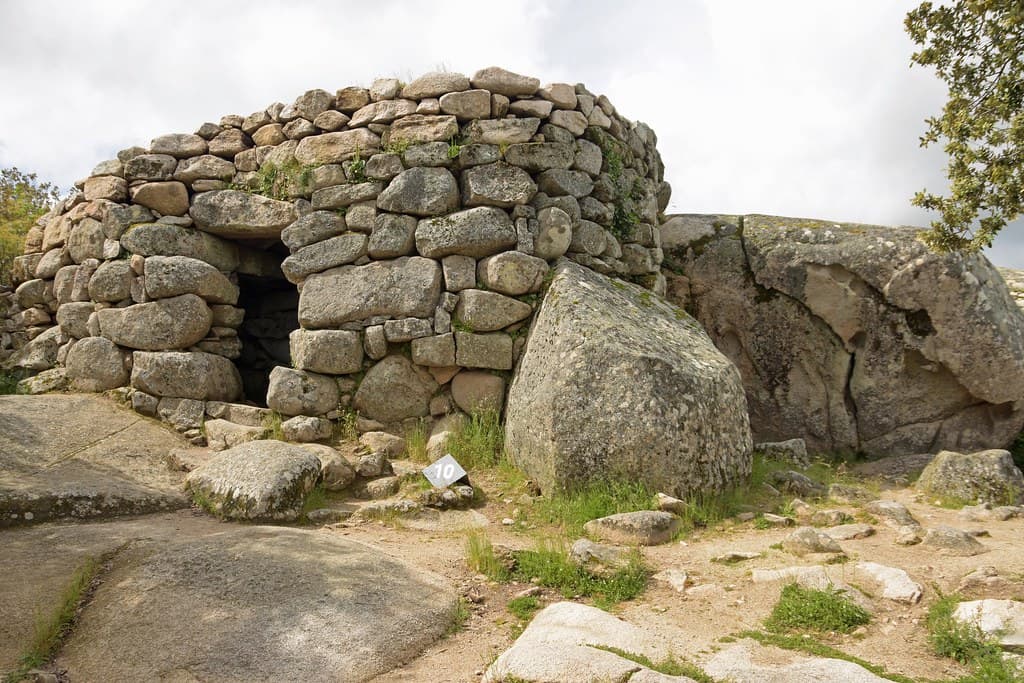
At a col above Corsica's Taravo valley, a Bronze Age tower stands alone. The Monument torréen de Foce is a torra, the defining monument of the Torrean civilization that inhabited southern Corsica between roughly 1500 and 800 BC. Unlike sites combining a torre with a cyclopean village enclosure, Foce is an isolated circular structure of dry-stone cyclopean masonry, approximately 18 metres across its base. It originally rose around 15 metres on two floors; only the lower three metres survive.
Its south-southwest entrance crosses a narrow passage into a sub-trapezoidal central chamber. Three blind recesses open at different angles through the wall thickness, creating spaces apart from the common interior; a ramp once reached the second floor. Roger Grosjean first excavated Foce in autumn 1957, and INRAP conducted a more systematic campaign in 2001. Neither resolved the recesses' function or determined whether the torre served ceremony, defense, storage, or all three.
Remote and elevated, Foce commands an interior Corsican landscape that has not substantially changed. The tower predates every surviving written record of Corsica by more than a thousand years.
Why this place is sacred
The architecture of the Foce torra encodes a question that has occupied archaeologists since its first excavation: what were those three blind chambers for? Structurally, they are set within the wall thickness at the three corner angles of the sub-trapezoidal interior, each accessible from the central chamber, none providing passage further into the wall. Their configuration is orderly enough to suggest design intent rather than structural necessity.
Across the Torrean world, early torre constructions are interpreted as primarily cultic in origin — sacred monuments that later accrued defensive and domestic functions as Torrean society evolved. The Foce torra's three recesses fit this interpretive frame: spaces within the sacred space, distinguished from the common interior by their enclosure, their reduced light, their physical separateness.
Whether they received offerings, served as stations for specific ceremonial roles, or functioned in ways that have no modern analogue, the evidence does not fully say.
The isolation of the Foce monument adds another dimension. Unlike sites such as Cucuruzzu or Tappa, where the torre was the focal point of a larger walled community, Foce appears as a standalone structure in a natural landscape. This may indicate that the site functioned as a dedicated sacred space — a place people came to rather than lived beside — or it may reflect only differential preservation of associated structures.
The question remains productive: a solitary sacred tower in a valley, its three inner chambers waiting, for three thousand years, for an answer.
Cultic and possibly defensive use — early Torrean torre monuments are interpreted as primarily ceremonial, later acquiring combined sacred and protective functions. Location at a col with commanding views supports a territorial or cosmological role.
Bronze Age construction (second half of 2nd millennium BC) → use and eventual abandonment; excavated by Roger Grosjean (1957) and INRAP (2001); classified as a French Historic Monument (decree of 16 April 2021); now a protected heritage site accessible to visitors.
Experience and orientation
The road to Foce via the D757 through Argiusta-Moriccio climbs through the Corsican interior. The site appears in open countryside near the col: a rounded stone mass lower than its original height, but still reading unmistakably as an intentional built form. At ground level, the surviving walls are approximately three metres high — enough to contain and define interior space without completely enclosing the sky.
The entrance is the key threshold. It is narrow and low enough that an adult must duck or turn slightly to enter — the passage itself is a preparation, a physical compression before the chamber opens. Inside, let the eyes adjust before moving. The central space is sub-trapezoidal — not a perfect circle but close, with the three recessed chambers opening at intervals around the wall. Move toward each alcove in turn. Stand within one.
Notice the degree of enclosure, the reduced sound from outside, the change in light quality. These are small architectural differences, but they are sufficient to distinguish one zone of interior experience from another.
The ramp is visible on the wall, beginning its curve upward toward the vanished upper floor. It creates a vertical axis in what might otherwise read as a purely horizontal space — a reminder that the full experience of the torra once included height, a view from above, a perspective no longer available.
Outside, circle the tower and attend to its setting: the Taravo valley below, the surrounding ridgeline, the sky above a structure that was built to endure beneath it.
Access from Argiusta-Moriccio via the D757 road; the site is in open countryside near the Col de Foce. No formal admission or hours. Allow 1–2 hours including the approach walk. Sturdy footwear appropriate for countryside terrain.
Context and lineage
The Foce torra was built by the Torrean Bronze Age population of southern Corsica during the second half of the second millennium BC — a culture that constructed circular dry-stone towers across the island's interior and southern coasts, architecturally related to the nuraghe-building traditions of Sardinia. No founding mythology specific to Foce is recorded.
The torre was a type rather than a unique conception: the Torrean world produced these structures at intervals across the landscape, each following the same architectural constants — circular plan, dry-stone cyclopean masonry, central chamber distributing to recessed side chambers, ramp to upper floor — while varying the specifics of size and setting.
Why a standalone torra at this particular col above the Taravo valley, rather than as part of a larger settlement complex, is not established. The location's altitude and commanding views are consistent with a deliberately chosen sacred or territorial position.
Bronze Age Torrean construction (c. 1500–800 BC) → abandonment → Grosjean excavation (1957) → INRAP excavation (2001) → classification as French Historic Monument (2021).
Traditions and practice
Excavation evidence suggests possible votive deposits or ceremonial gatherings within the torre structure. The three blind side chambers set within the wall thickness are architecturally consistent with spaces designed for specific ritual functions — placement of offerings, priestly stations, or ceremonially distinguished interior zones. No specific sequence of rites is documented.
No contemporary religious or ceremonial practices. The site is visited as a protected heritage site.
Approach the torra from a distance first, taking in its profile against the valley and sky before reaching the entrance. The scale transition from exterior to interior is an important part of the experience: the tower reads as substantial from outside, but the interior is intimate. Use the threshold moment — the low entrance passage — as a deliberate pause. Inside, move to each of the three alcoves in turn rather than sweeping the space with a glance.
Each alcove offers a slightly different quality of enclosure and light. Take time at the ramp to think about the vanished upper floor — what it would have meant to ascend to a high vantage point within a sacred tower, looking out over the Taravo valley. Consider returning to the entrance and experiencing the contrast of interior darkness and exterior light deliberately before leaving.
Torrean Bronze Age Culture
HistoricalThe Foce monument is a well-preserved 'torra' — the defining monument type of the Bronze Age Torrean civilization of Corsica. Scholars debate whether torras primarily served defensive, ceremonial, or mixed functions. Excavations suggest possible offering deposits consistent with ritual use.
Presumed ceremonial use of the circular central chamber; three blind side chambers in the wall thickness may have held offerings or served priestly functions.
Perspectives and open questions
The Foce torra is interpreted archaeologically as a monument-type within Torrean civilization; its specific ritual or social function and its relationship to the wider Torrean landscape remain active scholarly questions.
Scholarly perspective
The Monument torréen de Foce is one of the best-preserved standalone torra structures in Corsica. First excavated by Roger Grosjean in 1957 and again by INRAP in 2001, it represents canonical Torrean architecture with clear parallels to Sardinian nuraghi. Scholars acknowledge the likely dual ceremonial and defensive function while noting the absence of clear evidence for a distinct priestly caste. The site was classified as a French Historic Monument in April 2021 (PA2A000044).
Living and traditional perspectives
No surviving Corsican oral tradition is specifically tied to the Foce torra.
Alternative interpretations
The Torrean civilization's possible connection to the Sea Peoples or Shardana warriors from Eastern Mediterranean Bronze Age contexts has attracted popular speculation, partly because the visual similarity of torri and nuraghi suggests a wider network of culturally related Bronze Age seafarers. This speculation remains outside scholarly consensus.
Open questions
The precise ritual or religious function of the three blind wall chambers; whether the standalone character of the Foce torre indicates a primarily sacred (rather than domestic-defensive) purpose; the reason for its eventual abandonment; and whether any funerary use accompanied its ceremonial function are all unresolved questions.
Plan your visit
Access and arrival
Located near Col de Foce via the D757 road in the commune of Argiusta-Moriccio (20140), Corse-du-Sud. The site is in open countryside near the road. No formal admission. A hiking trail approach is also described on Visorando. Occasional guided visits are organized by local heritage associations.
The nearest accommodation hubs are Propriano (approximately 25 km south) and Ajaccio (approximately 50 km north). Rural gîtes are available in the Taravo valley.
Respectful visit
No dress code; sturdy footwear appropriate for the countryside approach path.
Permitted.
Not applicable.
Do not disturb or lean on the stone structure; do not remove any stone or archaeological material.
The site is a classified French historic monument; do not disturb the stone structure or remove any material. Respect the protected heritage status.
Location
Map loads as you approach this section.
Pilgrim reflections
A portrait of encounter, not a score
Pilgrims describe what they felt, how present they could become, and whether the place would shape a journey. There are no stars and no ranking of traditions.
No reviewed reflections yet
The first pilgrims can help describe the character of being here.
Share a reflection
Available after an account-backed “Been there.” Every reflection is reviewed before publication.
Nearby sacred places
Explore other sacred places in the region. Proximity does not establish access or travel time; check each place’s guidance.


References
Sources consulted for this page. Source categories describe the publication, not a guarantee that every claim is verified. Traditional accounts and outside interpretations may differ.
- 01Monument torréen de Foce — Plateforme Ouverte du PatrimoineofficialFrench Ministry of Culture official protected monument record (PA2A000044)
- 02Monument torréen de Foce — WikipédiaencyclopediaFrench Wikipedia article with structural details and excavation history
- 03Torra di Foce Monument Torréen - Arghjusta MuricciuofficialOfficial commune website describing the monument
- 04Torra de Foce - patrimoine-corse-3d.corsicaofficial3D heritage documentation project for Corsican monuments
- 05Torrean civilization - WikipediaencyclopediaCultural and architectural context for Torrean monuments
- 06The Torrean Site of Focè - Archaeological site, Argiusta-MoriccioguidePetit Futé travel guide entry
- 07Préhistoire / Monument torréen de Foce / 2A - Argiusta-MoriccioguideCorsican heritage tourism atlas
- 08Monument torréen de Foce - WikidataencyclopediaStructured data entry with location and heritage classification
Share a photo
Help visitors recognize Monument torréen de Foce. Every submission is reviewed before publication.