St. Vitus Cathedral
Where Czech faith, sovereignty, and identity converge beneath Gothic spires rising from Prague Castle
Understand sacred places, explore living traditions, and learn how to engage respectfully with Pilgrim Map.
Access has not been verified. Check current local guidance before planning a visit.
Prague, Prague, Czechia
Read the sources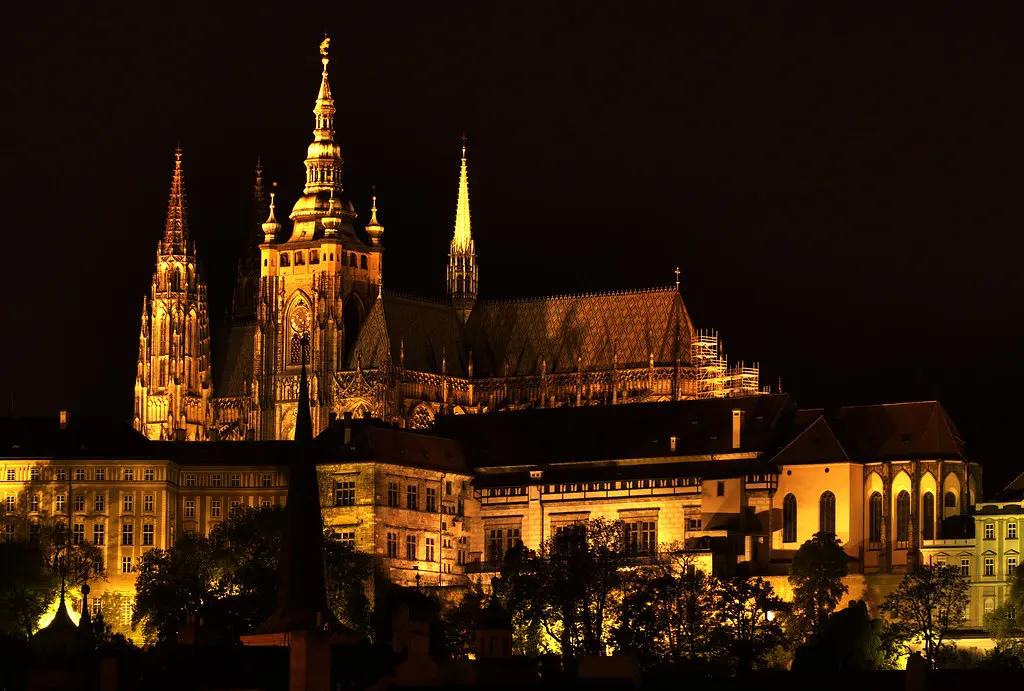
Image of St. Vitus Cathedral. Image source
Visit essentials
A quick read before you go
- Duration
- Allow 1-2 hours for a meaningful visit to the cathedral interior.
- Etiquette
- As an active Catholic cathedral, St.
Overview
Some buildings hold a nation's soul; St. Vitus Cathedral is one. Its Gothic towers have watched over Prague from the castle heights for nearly seven centuries, but its story began in 925 CE, when Prince Wenceslaus built a small rotunda for a relic of St. Vitus. A decade later his brother murdered him, and Wenceslaus became the site's holiest presence. His tomb remains Czech Catholicism's spiritual center.
Nearly six hundred years of construction joined French Gothic arches, Peter Parler's innovative vaulting, centuries of interruption, and a final campaign completed only in 1929. This was not failure but devotion across generations, a stone testament to how Czechs have understood themselves in relation to the sacred.
The cathedral still serves as it has for a millennium: seat of the Archbishop of Prague, mother church of Czech Catholicism, resting place of saints and sovereigns, and guardian of crown jewels symbolizing national continuity. It remains an active place of worship where candles burn, Masses echo, and something of Wenceslaus's intention persists.
Why this place is sacred
The sacredness of St. Vitus Cathedral is layered like the city it watches over.
At the foundation lies a relic. Around 925 CE, Prince Wenceslaus received a bone from the arm of St. Vitus as a gift from the Saxon Emperor Henry I. He built a rotunda to house it, establishing the site's consecration. But this first layer was soon overshadowed by something more powerful: Wenceslaus himself.
Murdered by his brother Boleslav in 935, Wenceslaus was brought to the rotunda he had built. Within years, miracles were reported at his grave. Within decades, he was venerated as a saint. Within centuries, he had become the eternal patron of the Czech lands, a figure whose significance transcends religious devotion to embody national identity itself.
Charles IV understood this when he commissioned the Gothic cathedral in 1344. He intended more than a church. He was building a coronation sanctuary, a royal crypt, a treasury for sacred relics, and a pilgrimage shrine centered on Wenceslaus. The Crown of St. Wenceslas, created for Charles's coronation in 1346, was dedicated to the saint and declared his eternal property, merely loaned to living rulers. Seven keys guard the Crown Chamber, held by seven representatives of state, church, and city.
This accumulation of sacred significance is not merely historical. The Archbishop of Prague still presides from this cathedral. Masses still rise toward Parler's vaults. Pilgrims still come to venerate Wenceslaus. The weight of continuous devotion across a millennium presses down through these stones, and visitors who enter receptively often sense it without being told.
The original rotunda of 925 CE served a single purpose: to house the relic of St. Vitus. But when Wenceslaus was buried there, the site's purpose expanded to include pilgrimage and veneration. The Romanesque basilica that followed served as the seat of the Prague bishopric from 973.
When Charles IV commissioned the Gothic cathedral in 1344, he deliberately layered multiple functions: coronation church for Bohemian monarchs, royal crypt, treasury for the kingdom's most precious relics, and pilgrimage destination for those seeking the intercession of Czech patron saints.
The cathedral's six-century construction is itself a story of devotion through adversity. Matthias of Arras laid the foundations in French High Gothic style, but died in 1352 with only the choir begun. Peter Parler continued, introducing innovations that would influence Gothic architecture across Central Europe. The Hussite Wars interrupted work in 1419. Habsburg rule brought new phases of construction.
But it was only in the 19th century that a Union for Completion formed with the explicit goal of finishing what had been started five hundred years earlier.
The cathedral's completion on September 28, 1929, was not accidental timing. That date marks St. Wenceslas Day, and 1929 was the millennium of his martyrdom. The new Czechoslovak Republic, barely a decade old, chose to mark its independence by completing the cathedral that symbolized Czech continuity through centuries of foreign rule. Past and present fused in that consecration.
Experience and orientation
The first impression is scale. St. Vitus Cathedral is vast in a way that photographs cannot convey, its Gothic vaults soaring thirty-three meters above the nave. The space does what Gothic space was designed to do: redirect attention upward, making the visitor feel simultaneously small and lifted.
Light enters through windows that span eight centuries of craft. The oldest are medieval; the most celebrated is Alphonse Mucha's 1930 Art Nouveau creation, depicting Saints Cyril and Methodius in a palette of blues and reds that transforms throughout the day. When morning sun strikes the rose window above the entrance, the nave fills with colored luminescence. The effect is not decoration but atmosphere, light made tangible.
Deeper in the cathedral, St. Wenceslas Chapel awaits. Visitors cannot enter, only approach the entrance and look within. The chapel walls are encrusted with semi-precious stones, over 1,300 of them, glinting in candlelight above gilded paintings of Christ's Passion. At the center lies the tomb of Wenceslaus himself, the Good King Wenceslas of the English carol, who has watched over Bohemia for more than a thousand years.
Something shifts in visitors who stand at that threshold. The crowds seem to quiet. Cameras lower. There is a sense of approaching not just history but presence. Whether this reflects the accumulated prayers of centuries or something more, the effect is consistent enough to note.
The Royal Crypt offers a different encounter. Descending below the cathedral, visitors find the remains of Charles IV, the emperor who commissioned this Gothic masterwork, along with other Bohemian rulers. The proximity to those whose vision shaped the building creates a peculiar intimacy across time.
Those who climb the 287 steps of the Great South Tower emerge into panoramic views of Prague, the red roofs spreading below. But the ascent itself has meaning. The narrow spiral, the effort required, the gradual revelation of the city as one rises: this is pilgrimage in miniature.
St. Vitus Cathedral rewards those who arrive early and linger. The front portion is free to enter, accessible to anyone who enters Prague Castle. This alone offers an encounter with the nave's immensity and the rose window's light. But the cathedral reveals more to those who purchase a castle ticket and venture into the choir, the chapels, the Royal Crypt.
Consider timing your visit to avoid the crowds that peak between eleven and two. Early morning light through the east windows creates a particular atmosphere. Late afternoon offers quieter spaces and different angles of illumination. If possible, return more than once: the cathedral shows different faces at different hours.
Those seeking spiritual engagement might attend a Sunday Mass, entering without a ticket during services. The liturgy in Czech may be unfamiliar, but the rhythm of worship in this space connects visitors to what the cathedral was built for. During services, the building becomes what it has always been: not monument but living church.
Context and lineage
The story begins with a gift between rulers. Around 925 CE, the Saxon Emperor Henry I the Fowler sent Prince Wenceslaus of Bohemia a precious relic: a bone from the arm of St. Vitus, an early Christian martyr. Wenceslaus, a Christian ruler in a land still converting, built a small round church to house this holy object. That rotunda, modest in scale, established the site's consecration.
Ten years later, Wenceslaus was dead, murdered by his brother Boleslav in a political struggle. His body was brought to the rotunda he had built. Almost immediately, reports of miracles began to circulate. Wenceslaus the prince became St. Wenceslaus the patron, and the rotunda became a pilgrimage destination.
The site grew with the Czech nation. After the Prague bishopric was established in 973, the rotunda was replaced by a Romanesque basilica. When Charles IV elevated Prague to an archbishopric in 1344, he commissioned something grander still: a Gothic cathedral to rival those of France, to house the crown jewels, to serve as the coronation church, and to glorify the cult of St. Wenceslaus at the heart of Bohemian identity.
The lineage of St. Vitus Cathedral is inseparable from Czech history itself. The site has been the seat of the Prague diocese since 973, elevated to archdiocese in 1344. Bohemian kings were crowned here; their remains rest in the Royal Crypt. The crown jewels have been stored here since the 14th century.
Through the Hussite Wars, the Thirty Years' War, Habsburg rule, Nazi occupation, and communist suppression, the cathedral has endured. When Czechoslovakia gained independence in 1918, completing the cathedral became a national priority. When the Velvet Revolution restored democracy in 1989, it was in the shadow of these spires. When Vaclav Havel died in 2011, his state funeral was held within these walls.
The Archbishops of Prague continue to preside from this cathedral. Mass continues to be celebrated. The lineage is unbroken.
St. Wenceslaus
saint
Duke of Bohemia (c. 907-935), murdered by his brother and venerated as a martyr almost immediately afterward. He became the patron saint of the Czech lands, a symbol of national identity that transcends religious affiliation. His tomb in St. Wenceslas Chapel is the cathedral's spiritual center.
St. Vitus
saint
Early Christian martyr whose relic inspired the cathedral's founding. Though overshadowed by Wenceslaus in Czech devotion, his presence established the site's original consecration.
St. Adalbert
saint
Second Bishop of Prague, martyred in 997 while attempting to convert the Prussians. The cathedral's full name honors him alongside Vitus and Wenceslaus as the three patron saints it shelters.
Charles IV
historical
King of Bohemia and Holy Roman Emperor (1316-1378). He elevated Prague to an archbishopric and commissioned the Gothic cathedral, understanding it as both religious sanctuary and political statement. His remains rest in the Royal Crypt.
Peter Parler
historical
Master builder who took over construction in 1353 at age twenty-three. His innovative net vaulting and sculptural approach to Gothic architecture influenced building across Central Europe. He designed St. Wenceslas Chapel and worked on the cathedral until his death in 1399.
Traditions and practice
For nearly a millennium, the central practice at this site has been the veneration of St. Wenceslaus. Pilgrims have come to pray at his tomb, seeking his intercession and connecting with the patron saint of the Czech lands. Coronation ceremonies for Bohemian monarchs represented another layer of traditional practice, with rulers receiving the Crown of St. Wenceslas in ceremonies that united political authority with sacred sanction.
The liturgical calendar has always structured the cathedral's rhythm. Feast days for the three patron saints, the great celebrations of Christmas and Easter, Masses for the dead in the Royal Crypt: these practices have continued through centuries of political change.
The cathedral maintains its role as an active parish church. Sunday Masses are celebrated in Czech, open to all who wish to attend. During services, the cathedral functions as it was designed to, and visitors enter without entrance fees as worshipers rather than tourists.
Feast day celebrations continue to mark the liturgical year. St. Wenceslas Day on September 28 is both a religious feast and a Czech national holiday, drawing special observances. St. Vitus Day on June 15 and St. Adalbert Day on April 23 are also celebrated. Christmas and Easter bring liturgical celebrations that transform the cathedral into a space of active worship rather than passive observation.
State ceremonies continue to take place here. The funeral of Vaclav Havel in 2011 demonstrated that the cathedral remains the appropriate setting for honoring those who have shaped the nation.
For those seeking spiritual engagement rather than mere tourism, consider these approaches.
Attend a Mass. The Sunday liturgy in Czech may be unfamiliar in language but recognizable in structure. Standing among worshipers, participating in the rhythm of the service, connects you to what this building has meant for a thousand years. During services, you enter without a ticket; you enter as a guest at worship.
Approach St. Wenceslas Chapel in silence. You cannot enter, but you can stand at the threshold and look upon the tomb. Consider who Wenceslaus was: a young ruler who chose to live his faith openly, murdered for his convictions, venerated ever since. What might you ask of such a figure?
Light a candle. This simple act of prayer is available to anyone. Let the flame carry whatever intention brought you here.
Visit during a feast day if possible. St. Wenceslas Day on September 28 offers the opportunity to experience the cathedral not as monument but as living center of Czech spiritual identity.
Roman Catholicism
ActiveSt. Vitus Cathedral is the seat of the Archbishop of Prague and the most important Roman Catholic church in the Czech Republic. Since the 10th century, it has been the center of Czech Catholicism, holding the tombs of the three patron saints for whom it is named: Vitus, Wenceslaus, and Adalbert. The cult of St. Wenceslaus, centered on his chapel and tomb within the cathedral, represents the spiritual heart of Czech Catholic identity.
Regular Mass services are held throughout the week, with Sunday liturgy as the primary gathering. Feast day celebrations mark the calendar, particularly St. Wenceslas Day on September 28, St. Vitus Day on June 15, and St. Adalbert Day on April 23. The cathedral hosts archiepiscopal ceremonies, ordinations, and state funerals for significant national figures. Pilgrims come to venerate at St. Wenceslas's tomb and light candles at various altars and chapels.
Czech National Identity
ActiveBeyond its religious role, St. Vitus Cathedral functions as a symbol of Czech statehood and national continuity. It served as the coronation church for Bohemian kings and houses the Czech crown jewels, including the Crown of St. Wenceslas. The cathedral's completion in 1929, marking both the millennium of St. Wenceslaus and the first decade of Czechoslovak independence, fused sacred and national significance. St. Wenceslas himself has become a figure of national as much as religious identity.
The Czech crown jewels are housed in the Crown Chamber, protected by seven locks whose keys are held by representatives of state, church, and city. The jewels are displayed only on rare occasions, approximately every five years, emphasizing their sacred trust rather than their material value. National commemorations and state ceremonies continue to take place in the cathedral, acknowledging its role in Czech identity regardless of religious affiliation.
Perspectives and open questions
St. Vitus Cathedral invites multiple readings. Art historians see a masterwork of Gothic architecture; historians see the story of Czech statehood in stone; believers see an active sanctuary where saints intercede; seekers of all kinds find something that defies easy categorization. These perspectives need not compete.
Scholarly perspective
Art historians recognize St. Vitus Cathedral as a significant monument in the development of Gothic architecture. The building represents a unique synthesis: the French High Gothic of Matthias of Arras, who designed the choir and eastern portions, and the innovative 'Sondergotik' or Special Gothic of Peter Parler, who introduced net vaulting and a more sculptural approach. Parler's innovations at Prague influenced Gothic development across Central Europe and may have reached England.
The cathedral's protracted construction, spanning nearly six centuries, makes it a kind of encyclopedia of Gothic and neo-Gothic techniques. Architectural historians study how different eras approached the challenge of completing a unified design while working in evolving styles.
Historians emphasize the cathedral's role as a statement of Bohemian royal power, particularly under Charles IV. By building a cathedral to rival those of France, by housing coronation regalia and royal tombs, by centering the cult of St. Wenceslaus here, Charles deliberately constructed a monument that fused sacred and political authority.
Living and traditional perspectives
For Czech Catholics, St. Vitus Cathedral is the mother church of their faith in this land, the seat of the Archbishop, and the resting place of their patron saints. The presence of St. Wenceslaus is not merely historical but spiritually active. Pilgrims come seeking his intercession, approaching his tomb as one approaches a living presence capable of hearing and responding.
The cathedral represents the continuity of Czech Catholic faith through centuries of disruption: the Hussite Wars, the Reformation, the Counter-Reformation, communist suppression. That the cathedral was completed only in 1929, and that Mass continues to be celebrated here today, testifies to a faith that outlasts political systems.
From this perspective, the building is not monument but living church. Its significance lies not in what it was but in what it is: a place where the sacred is accessed through worship, sacrament, and the communion of saints.
Alternative interpretations
Some esoteric interpretations focus on the sacred geometry of the cathedral and its placement within Prague's landscape. The seven locks securing the Crown Chamber carry numerological significance for some seekers. The legend that anyone who wrongfully wears the Crown of St. Wenceslas will die within a year, said to have been fulfilled by Nazi Reichsprotektor Reinhard Heydrich, suggests to some a protective power that transcends conventional explanation.
Prague itself is often described in alternative literature as a city of occult significance, and St. Vitus Cathedral, as its spiritual heart, is sometimes framed as a nexus of mystical forces. These interpretations lack historical or scholarly support but reflect genuine attempts to articulate something visitors sense in this space.
Open questions
Mysteries remain. The exact extent of Peter Parler's innovations versus his knowledge of earlier developments, possibly including English Gothic, remains debated among architectural historians. The precise ceremonies that would have taken place here in medieval times can only be partly reconstructed.
The nature of sacredness itself resists definitive explanation. Why do visitors consistently report a sense of presence in St. Wenceslas Chapel? Why does this building move people who arrive without religious belief? Whether this reflects psychology, accumulated human intention, something inherent in the space, or something beyond current vocabulary, the phenomenon is consistent enough to take seriously even when we cannot explain it.
Plan your visit
Access and arrival
Prague offers accommodation at every price point within easy reach of the castle. For those seeking to experience the cathedral's atmosphere at multiple hours, staying in Hradcany or Mala Strana provides closest access. The city's excellent public transport makes most central locations convenient.
Respectful visit
Modest dress is expected. Shoulders and knees should be covered. This is not merely tradition but respect for an active place of worship. Those arriving in clothing deemed inappropriate may be asked to cover up or refused entry to certain areas.
Photography without flash is permitted in most areas of the cathedral. Some restrictions may apply in St. Wenceslas Chapel. During services, photography is prohibited. Tripods and professional equipment require advance permission. Drones are not permitted within Prague Castle grounds.
Votive candles are available for purchase, offering a traditional form of prayer and remembrance. Donations for cathedral maintenance are welcomed. There is no expectation of offering, but contribution supports the preservation of this irreplaceable space.
Security screening is required at Prague Castle entrance. St. Wenceslas Chapel may be viewed from the entrance but not entered. The Crown Chamber is closed to the public except during rare exhibitions. Large bags should be stored outside the cathedral. Food and drink are not permitted inside.
During religious services, the cathedral is a place of worship first. Visitors should maintain silence, refrain from photography, and position themselves so as not to disturb those who have come to pray. Flash photography is prohibited. Moving around during services is inappropriate.
St. Wenceslas Chapel cannot be entered by visitors. The Crown Chamber is opened only approximately every five years for special exhibitions. Accept these boundaries as part of how sacred spaces protect their most significant contents.
Current practical details
Address
III. nádvoří 48/2, 119 01 Praha 1-Hradčany, Czechia
Phone
Hours
Hours, fees, and access can change — verify on the official source before you travel. Practical details last checked Jun 2026.
Location
Map loads as you approach this section.
Pilgrim reflections
A portrait of encounter, not a score
Pilgrims describe what they felt, how present they could become, and whether the place would shape a journey. There are no stars and no ranking of traditions.
No reviewed reflections yet
The first pilgrims can help describe the character of being here.
Share a reflection
Available after an account-backed “Been there.” Every reflection is reviewed before publication.
Nearby sacred places
Explore other sacred places in the region. Proximity does not establish access or travel time; check each place’s guidance.


References
Sources consulted for this page. Source categories describe the publication, not a guarantee that every claim is verified. Traditional accounts and outside interpretations may differ.
- 01St. Vitus Cathedral - WikipediaencyclopediaPrimary encyclopedic source with comprehensive historical and architectural information
- 02St. Vitus Cathedral - Prague Castle for visitorsofficialOfficial Prague Castle website with authoritative information
- 03Prague Castle - Cathedral of St Vitus | Prague City TourismSource contextOfficial Prague tourism portal
- 04Saint Vitus's Cathedral | BritannicaencyclopediaEncyclopedic overview
- 05Peter Parler - WikipediaencyclopediaBiographical and architectural information on master builder
- 06Crown of Saint Wenceslas - WikipediaencyclopediaCrown jewels documentation
- 07Stained-glass Window designed by Mucha at St. Vitus Cathedral | Mucha FoundationspiritualOfficial Mucha Foundation documentation
- 08Opening hours - Prague Castle for visitorsofficialOfficial opening hours
- 09St Vitus Cathedral: Prague's Iconic Gothic Masterpiece - Story of PragueguideDetailed historical narrative
- 10St. Vitus Cathedral at Prague Castle | Visitor Information & HistoryguideVisitor practical information
- 11St Wenceslas Chapel | Prague.netguideChapel details and crown jewels access
- 12The Creative Adventurer - St. Vitus Cathedral's Stained GlassguideDetailed stained glass window guide
- 13Prague, Czech Republic: Saint Vitus Cathedral - The Catholic Travel GuidespiritualCatholic pilgrimage perspective
Share a photo
Help visitors recognize St. Vitus Cathedral. Every submission is reviewed before publication.