Neolithic circular enclosure of Goseck, Germany
A seven-thousand-year-old ring of timber and ditch whose gates frame the midwinter sun
Understand sacred places, explore living traditions, and learn how to engage respectfully with Pilgrim Map.
Access has not been verified. Check current local guidance before planning a visit.
Markröhlitz, Saxony-Anhalt, Germany
Read the sources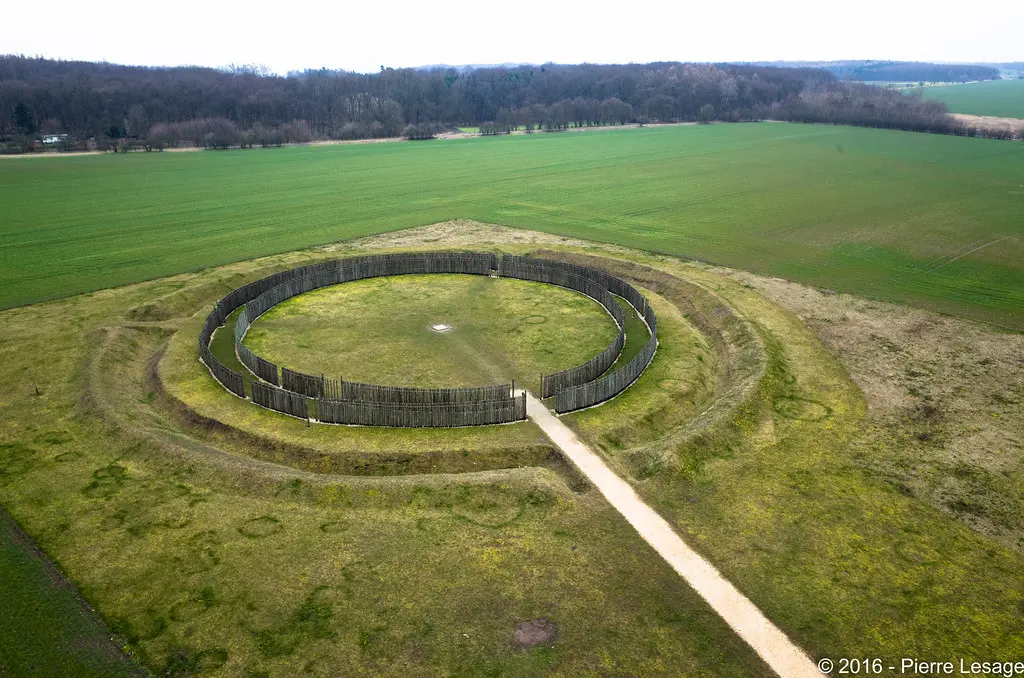
Image of Neolithic circular enclosure of Goseck, Germany. Image source
Visit essentials
A quick read before you go
- Duration
- 30 to 60 minutes at the circle; add time for the information centre and other Himmelswege stops.
- Access
- On farmland at Goseck, Burgenlandkreis, Saxony-Anhalt, between Naumburg and Weissenfels; best…
Overview
On open farmland between Naumburg and Weissenfels stands a reconstructed ring roughly seventy-five metres across, marked by a circular ditch and concentric timber palisades. Raised in 2005 from 1,675 oak posts, it follows a structure built around 4900 BC by some of central Europe's earliest farming communities, during the transition between the Linear Pottery and Stroke-ornamented ware cultures.
Two gates frame the winter-solstice sunrise and sunset, making Goseck the oldest known solar observatory and a gathering place ordered around the agricultural year. Excavation in 2002 found fires, animal and human bones, and a headless skeleton; whether these remains reflect burial or sacrifice is unresolved.
The gate span echoes an angle later marked on the Nebra Sky Disc, found about twenty-five kilometres away and dating from more than three millennia after Goseck's abandonment, suggesting regional continuity in sky observation rather than a direct link. Discovered by aerial photography in 1991, the reconstruction reopened at the winter solstice in 2005 and is now a station on the Himmelswege, the Sky Paths heritage route.
No origin myth or living descendant tradition survives; archaeology, the structure, and the returning sun carry its meaning.
Why this place is sacred
Goseck's resonance comes from precision across enormous time. Stand at the center of the reconstructed ring and the gates resolve into instruments: openings cut to catch the sun at the turning of the year, built by people seven thousand years gone whose names and beliefs are lost. The open farmland setting is quiet and exposed, with little to distract from the geometry of ditch, palisade, and sky.
There is no shrine to enter and no rite to follow, only the structure and the seasonal light it was made to frame. The thinness here is archaeological and astronomical: a felt connection not to a continuing cult but to the ancient and recurring human urge to track the sun and order time around its return.
Experience and orientation
The site is an open-air reconstruction that visitors can enter freely at any hour. Walking into the ring of oak posts, you can stand at the center and grasp how the southeastern and southwestern gates frame the winter-solstice sunrise and sunset; the summer-solstice alignments are also marked. The setting is flat, quiet farmland between Naumburg and Weissenfels, with wide skies that suit the structure's purpose.
Midwinter visits are especially evocative, when the gates and the low sun line up as they were designed to do. The information centre at nearby Schloss Goseck provides interpretation and context within the wider Himmelswege route. To experience Goseck well is to come on a clear day, ideally near a solstice, and let the alignment do its work.
Allow 30 to 60 minutes at the circle, more for the information centre and other Himmelswege stops. The site is fully exposed; dress for open farmland and weather. The circle is freely accessible at all hours.
Context and lineage
No origin myth survives. The structure is interpreted from its architecture and finds: its solstice-aligned gates suggest a community that ritualized the sun's return at midwinter and used the enclosure to order a seasonal, agricultural calendar. The roughly hundred-degree span between its solstice gates corresponds to an angle later marked on the Nebra Sky Disc, found about twenty-five kilometres away and dated around 1600 BC, hinting at a long regional tradition of sky observation rather than a direct link.
Middle Neolithic Central European circular-enclosure (Kreisgrabenanlage) tradition; no descendant indigenous tradition survives.
Middle Neolithic farming communities
Builders
Otto Braasch
Aerial archaeologist
University of Halle-Wittenberg excavation team
Excavators
State Museum of Prehistory, Halle
Custodian and interpreter
Reconstruction team (2005)
Builders of the replica
Traditions and practice
In the Neolithic the enclosure hosted solar observation tied to a seasonal calendar and gatherings with fires, feasting, and offerings; deposits of human and animal remains suggest burial ritual or sacrifice, though which is unresolved.
Heritage interpretation and guided tours, with informal modern observance of the winter solstice when the reconstructed gates align with the sun.
Walk to the center of the ring and orient yourself to the solstice gates; if possible, time a visit to a solstice to see the alignment. Read the interpretation at Schloss Goseck and consider the site as part of the wider Himmelswege sky-watching landscape.
Middle Neolithic Central European circular-enclosure culture
HistoricalOne of the oldest and best-known of the Central European Kreisgrabenanlagen and arguably the world's oldest known solar observatory, built by early farming communities of the Linear Pottery / Stroke-ornamented ware transition.
Solar observation tied to a seasonal and agricultural calendar; gatherings with feasting, fires, and offerings; possible burial or sacrificial ritual indicated by deposited remains.
Perspectives and open questions
Goseck is interpreted as the oldest known solar observatory, understood through archaeology rather than any surviving tradition, and embraced by some as a sacred solar temple.
Scholarly perspective
Scholars describe a Middle Neolithic (c. 4900 BC) circular enclosure whose deliberately placed gates align to the winter-solstice sunrise and sunset, widely regarded as the oldest known solar observatory and a ritual gathering place, one of many Central European Kreisgrabenanlagen.
Living and traditional perspectives
No descendant indigenous tradition survives; the meaning of the site is reconstructed from archaeology.
Alternative interpretations
Popular and neo-pagan accounts frame Goseck as a sacred solar temple and link it to the Nebra Sky Disc as part of an ancient astronomical 'sky religion.'
Open questions
The exact rituals, the meaning of the deposited human and animal remains, whether burial or sacrifice, and the precise relationship to other enclosures and to the Nebra Disc remain open questions. The end-of-use date is given variously as around 4700 or 4600 BC.
Plan your visit
Access and arrival
On farmland at Goseck, Burgenlandkreis, Saxony-Anhalt, between Naumburg and Weissenfels; best reached by car. A station on the Himmelswege route. Check the State Museum of Prehistory or Himmelswege for current details before visiting.
Respectful visit
No dress code; dress for open, exposed farmland and weather.
Photography is freely permitted.
There is no sanctioned offering tradition; do not leave items or light fires at the reconstruction.
Respect the reconstructed palisade and signage; do not climb on or damage the structure.
There is no sanctioned offering tradition; do not leave items or light fires at the reconstruction, and respect the palisade and signage.
Current practical details
Address
Pflaumenweg, 06667 Goseck, Germany
Phone
Hours
Hours, fees, and access can change — verify on the official source before you travel. Practical details last checked Jun 2026.
Location
Map loads as you approach this section.
Pilgrim reflections
A portrait of encounter, not a score
Pilgrims describe what they felt, how present they could become, and whether the place would shape a journey. There are no stars and no ranking of traditions.
No reviewed reflections yet
The first pilgrims can help describe the character of being here.
Share a reflection
Available after an account-backed “Been there.” Every reflection is reviewed before publication.
Nearby sacred places
Explore other sacred places in the region. Proximity does not establish access or travel time; check each place’s guidance.

Naumburg Cathedral
Naumburg (Saale), Naumburg (Saale), Saxony-Anhalt, Germany
6.3 km away

Old Synagogue Erfurt
Erfurt, Erfurt, Thuringia, Germany
63.2 km away

Collegiate Church of St Servatius, Quedlinburg
Quedlinburg, Quedlinburg, Saxony-Anhalt, Germany
82.5 km away

Ring Sanctuary of Pömmelte
Pömmelte (Barby), Pömmelte (Barby), Saxony-Anhalt, Germany
89.0 km away
References
Sources consulted for this page. Source categories describe the publication, not a guarantee that every claim is verified. Traditional accounts and outside interpretations may differ.
- 01Goseck Circle — Wikipedia — Wikipedia contributorsacademicConfirms c. 4900 BC construction, 75 m diameter, palisade rings with solstice-aligned gates, 1991 aerial discovery, 2002 excavation, 2005 reconstruction, Linear Pottery/Stroke-ornamented ware context, and Himmelswege route.
- 02Solar Observatory Goseck — Himmelswege (Sky Paths) — Landesmuseum für Vorgeschichte Halle / HimmelswegeofficialOfficial state-museum route site; confirms reconstruction, interpretation, visitor access, and the Sky Paths network linking Goseck, Nebra, Halle, Langeneichstadt and Pommelte.
- 03Himmelswege (Sky Paths) — State Museum of Prehistory — Landesmuseum für Vorgeschichte, Halle (Saale)officialState heritage authority describing the Sky Paths network and Goseck's place within it.
- 04Solar Circle — Archaeology Magazine — Archaeological Institute of America (Archaeology Magazine archive)academicPeer-adjacent archaeological reporting on the solar-observatory interpretation and the winter-solstice alignment.
- 05Goseck Circle: The Oldest Known Solar Observatory — Ancient OriginsSource contextConfirms winter-solstice gate alignments, ritual remains (fires, animal/human bones, headless skeleton), and the ~100-degree gate span echoing the Nebra Sky Disc angle.
- 06Discover The Partially Reconstructed Goseck Circle — The TravelSource contextConfirms 2005 reconstruction (1,675 oak posts, opened on the 21 Dec winter solstice) and visitor access.
Share a photo
Help visitors recognize Neolithic circular enclosure of Goseck, Germany. Every submission is reviewed before publication.