St Nonna’s Church, Altarnun
Where a Celtic saint's altar named a village and her memory persists in moorland stone
Altarnun, England, United Kingdom
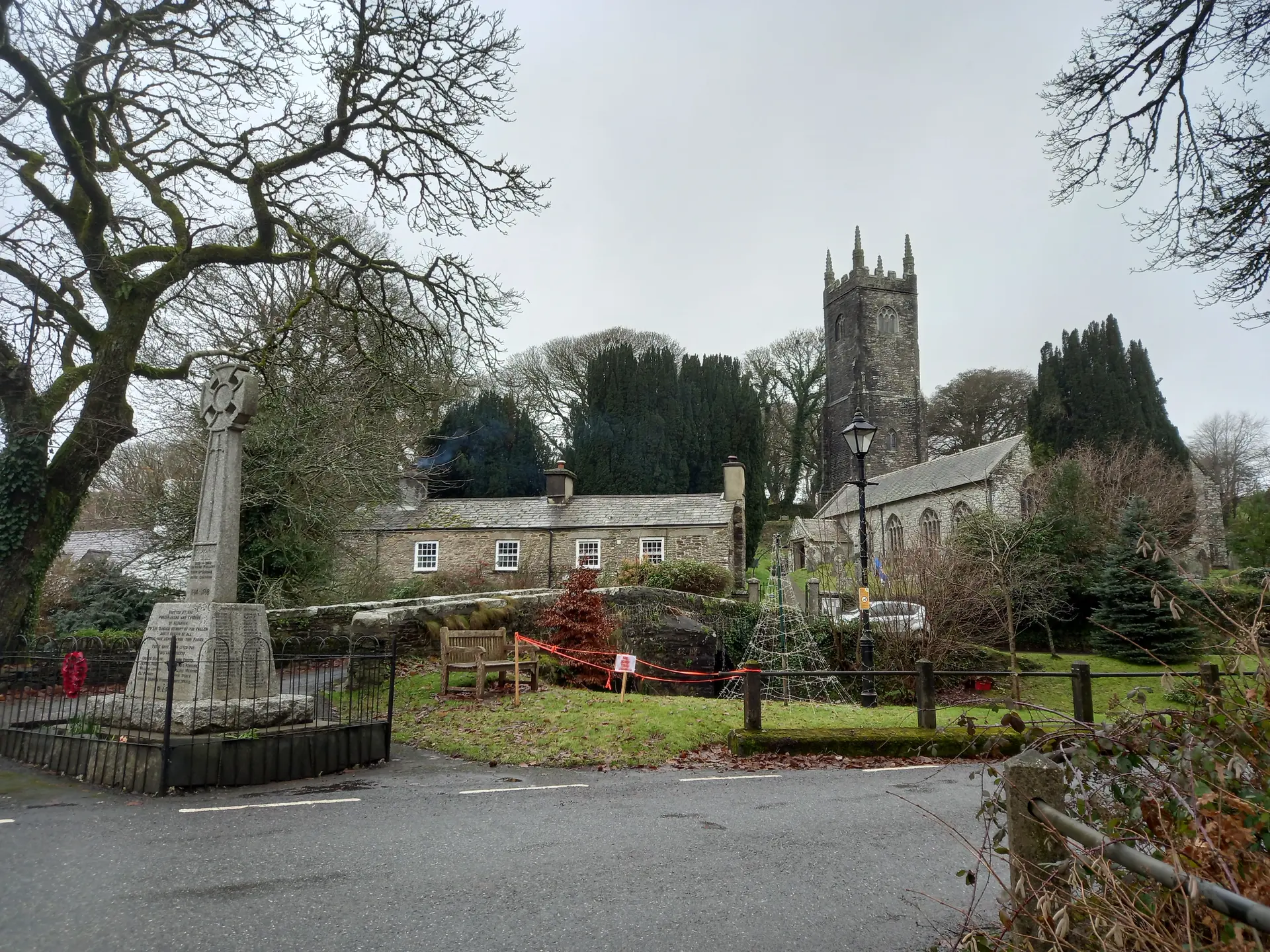
Image of St Nonna’s Church, Altarnun. Image source · CC-BY-SA-2.0
Visit essentials
Before you go
- Address
- Altarnun, Launceston PL15 7SJ, UK
- Duration
- Allow 1-2 hours to fully appreciate the church, including detailed examination of all 79 bench…
- Etiquette
- St Nonna's Church is an active place of worship that welcomes visitors.
Overview
Altarnun's name carries its founder forward: the altar of Non recalls a 6th-century woman who paused here while traveling from Wales to Brittany. St Nonna was the mother of St David, Wales's patron saint. Tradition says she founded a prayer community around a stone altar that gave the settlement its name. The later church became Bodmin Moor's spiritual center, its 109-foot tower visible for miles.
The present building is mainly 15th-century Perpendicular Gothic, with earlier traces including a Norman font whose carved faces have watched baptisms for nine hundred years. Its greatest treasures are 79 oak bench ends carved by Robert Daye in the early 16th century. Biblical scenes share the wood with Cornish life—a bagpiper, fiddler, jester, and man in the stocks—binding sacred and vernacular.
Worship continues as it has since Nonna's time. The congregation inherits a tradition older than the building, offering depth to those seeking Celtic Christianity, medieval craft, or a place where time moves differently.
Why this place is sacred
The thinness of this place accumulates in layers. First comes the founder herself. Saint Nonna traveled from Wales through Cornwall on her way to Brittany, part of that remarkable movement of Celtic saints in the 6th century who carried Christianity across the sea roads of the Atlantic edge. She was not simply passing through—she stopped, she established, she left her altar. The place took her name and has held it for fifteen hundred years.
Then comes the continuity. From that 6th-century founding to this morning's prayers, worship has not ceased at Altarnun. The forms have changed—Celtic to Norman to medieval to Reformed to Anglican—but the impulse remains the same: this is a place where people come to address what is larger than themselves. Few sites in Britain can claim such unbroken tenure of sacred purpose.
The building itself contributes its own weight. The tower rises 109 feet, one of the tallest in Cornwall, designed to be seen across miles of moorland—a reminder to the scattered communities of Bodmin that they were not alone, that something anchored the center. The masons who fitted these granite blocks, the carvers who shaped the font's mysterious faces, the hands of Robert Daye moving across oak—all left intention embedded in material.
Outside the church, approximately 300 meters below the vicarage, St Nonna's Well continues to flow. Here the practice of bowsening once took place—immersing those suffering from mental illness in cold water before bringing them to the church for prayers. Whether or not such treatment helped anyone, the well represents something important: the Celtic Christian integration of natural sacred spaces into Christian practice, the understanding that holiness might bubble up from the earth itself.
The moorland contributes too. Bodmin Moor is wild, liminal territory—not wilderness exactly, but not tamed either. The church stands at the edge of this landscape, mediating between the domestic and the vast. Visitors often note a quality of exposure here, of being at the threshold of something that resists human ordering.
St Nonna established her prayer community here around 527 CE, using a stone altar that would give the settlement its name. In Celtic Christian understanding, such a place was not simply a location for worship but a node in a network of sacred sites stretching from Wales to Brittany, connected by the journeys of holy men and women who carried the faith along the sea roads.
The site served this mobile Celtic Christianity before becoming the more settled parish center it would remain through the medieval period and beyond.
The original 6th-century church, whatever its form, gave way to a Norman building in the early 12th century. The font from this period survives—a square stone basin with carved faces at the corners, originally painted, still bearing traces of its medieval colors. The 14th and 15th centuries saw substantial rebuilding in the Perpendicular Gothic style that dominates today, including the great tower that earned the church its reputation as the Cathedral of the Moor.
The early 16th century brought Robert Daye, a carver whose 79 bench ends represent one of the finest surviving sets of Tudor church woodwork in England. His depictions blend the sacred and the everyday in ways that illuminate how medieval Cornish Christians understood their faith—not separate from daily life but woven through it.
The Reformation brought destruction as well as continuity. St Nonna's relics, once venerated here, were destroyed. The stone altar that gave Altarnun its name disappeared. Yet worship continued, adapting to each new dispensation. The 19th century saw restoration of the medieval rood screen. The 20th century brought the clearing and restoration of the holy well. Today the church serves both parish and pilgrims, the latest chapter in a story still being written.
Experience and orientation
The first impression is often scale. This is no humble village chapel but a substantial building, its tower commanding the valley, its proportions generous. The name Cathedral of the Moor feels apt when you stand before it. That such a church should serve what remains a small village speaks to different expectations of sacred architecture—or perhaps to a deeper understanding of what worship requires.
Inside, the bench ends command attention. Robert Daye carved with both skill and personality, signing his work and leaving images that range from the formally devotional to the irreverently human. A bagpiper plays on one end, a jester capers on another. Sheep appear alongside saints. A man sits in the stocks. These are not generic biblical illustrations but specific, situated imaginings—the sacred filtered through Cornish experience.
Spending time with them, moving from one to another, becomes a meditation on how faith was once embedded in the whole of life.
The Norman font deserves similar attention. Nine hundred years of baptisms have worn its surface smooth. The carved faces at its corners—bearded, somewhat mysterious, wreathed in serpents and rosettes—resist easy interpretation. Traces of original paint survive, suggesting the medieval interior was far more colorful than what remains. Standing before this font, you join a congregation that stretches back through all the generations who brought their children here.
Outside, the churchyard holds a Celtic cross that may date to St Nonna's own time, though the evidence remains contested. Whether 6th century or later, it provides a focus for contemplation of the site's deepest roots. The walk to the holy well, across fields to a spot below the vicarage, offers time to reflect on the historical practices that took place there—the cold immersions, the prayers for healing, the hope that affliction might be lifted.
The moorland itself becomes part of the experience. On clear days, the sense of space is immense. On days when mist moves across Bodmin, the church feels like a refuge, a place of shelter within something vast and indifferent. Both moods belong to the site's full character.
St Nonna's Church rewards those who arrive with time to spare. The bench ends alone deserve an hour of attention—all 79 of them, each worth examining. Bring a guidebook or use your phone to identify scenes, but also allow yourself to simply look, to notice what catches your attention without knowing why.
Consider attending a service if your visit falls on the first or third Sunday of the month. Worship here is not performance but practice, the congregation continuing what others have done at this spot for nearly fifteen centuries. Participating, even as an observer, adds a dimension unavailable to heritage tourism alone.
The walk to the holy well should not be skipped. It is brief—perhaps ten minutes each way—but it connects the church to the broader landscape of Celtic sacred geography. At the well itself, there is little to see and much to sense: the spring emerging from the earth, the history of hope and suffering associated with its waters.
If you seek deeper engagement, return at different times. Morning light enters the church differently than afternoon. The feeling of the place shifts between seasons. Those who treat St Nonna's as a destination for repeated visits, rather than a single stop, report the richest experiences.
Context and lineage
According to tradition, Saint Nonna was born into nobility in Pembrokeshire, Wales. She became a nun at Ty Gwyn, but her life was marked by violence—she was violated by Sanctus, King of Ceredigion, and the child conceived from this trauma was David, who would become the patron saint of Wales.
The circumstances of David's birth were said to be attended by miracle: a great storm prevented anyone from approaching Nonna during her labor, yet the place where she lay was bathed in divine light. Her pain was so intense that her fingers left marks in a rock, and the stone itself split in sympathy.
Around 527 CE, Nonna left Wales and traveled through Cornwall on her way to Brittany, where she would end her days and where her shrine at Dirinon remains a place of pilgrimage. In Cornwall, she established a prayer community at the place now called Altarnun—the altar of Non. The stone altar she used for worship gave the settlement its enduring name, a linguistic fossil preserving her presence across fifteen centuries.
The church that grew from Nonna's founding served as the spiritual center for the scattered communities of Bodmin Moor. Its tower, at 109 feet one of the tallest in Cornwall, was designed to be visible across the wild landscape—a beacon calling the dispersed faithful to gather.
From Nonna's Celtic community to the Norman builders who left their font, from the medieval masons who raised the tower to Robert Daye shaping his bench ends, from the reformers who destroyed Nonna's relics to the restorers who cleared her well—each generation has added to and subtracted from the inheritance.
The church remains part of the Diocese of Truro within the Church of England, serving the parish of Altarnon with Bolventor. Services continue on the first and third Sundays of each month, maintaining the worship that has not ceased at this site since the 6th century. Contemporary visitors join a lineage that connects back through all these generations to Nonna herself, kneeling at her altar in the Cornish dawn.
Saint Nonna
founder
Welsh saint of the 6th century, mother of St David. She established the original prayer community at Altarnun and is commemorated in the church's dedication. Her feast day is March 3.
Saint David
associated_figure
Patron saint of Wales and son of St Nonna. His fame gave additional significance to his mother's foundations, including Altarnun.
Robert Daye
craftsman
Carver responsible for the church's 79 bench ends, created between approximately 1521 and 1532. He signed his work with the name 'Robart Daye maker of this work', one of the few documented Tudor church carvers in Cornwall. Scholarly analysis suggests he may have been from Somerset rather than a local man.
Traditions and practice
In the centuries before the Reformation, pilgrims came to Altarnun to venerate St Nonna's relics and pray at her altar. The stone that gave the village its name was an object of devotion, a tangible connection to the saint who had founded the community.
The holy well served a particular function that strikes modern sensibilities as harsh: the treatment of mental illness through bowsening. Richard Carew documented this practice in his Survey of Cornwall in 1602. The afflicted person was thrown backward into the cold water repeatedly until their struggles ceased, then carried to the church for mass. If the treatment restored their senses, they were released; if not, the process was repeated.
Whether this practice helped anyone—whether the cold shock or the prayers or simply the community's attention provided relief—remains unknowable. What is clear is that people came to St Nonna's in their desperation, seeking healing that might flow from both water and word.
Regular worship services take place on the first and third Sundays of each month at 4pm. The church continues to serve the community for baptisms, weddings, and funerals, maintaining its function as a parish church. Visitors are welcome for private prayer and contemplation during daylight hours when the church is open.
The holy well, restored in the 20th century after years of neglect, can be visited via a footpath from the church. No formal ceremonies take place there today, but some visitors come to sit quietly by the spring, reflecting on its history and what it represents about the relationship between sacred places and natural waters.
For visitors seeking more than architectural appreciation, consider these approaches. Spend time with individual bench ends rather than rushing through them all. Choose five or six that draw your attention and sit with them, noticing what the carver saw fit to place in a sacred space. The blend of biblical and vernacular—saint and bagpiper, devotion and humor—reveals something about how faith once permeated ordinary life.
If time allows, attend a Sunday service. The congregation is small, the worship simple, but you will be participating in something that has occurred at this site for nearly fifteen centuries. The experience differs fundamentally from visiting an empty building.
Walk to the holy well even if there is little to see there. The act of walking to a healing spring, of standing where afflicted people once came in hope, creates its own connection. Let the site's difficult history be present—the practice of bowsening was desperate medicine, but desperation is part of what humans bring to sacred places.
Before leaving, pause at the Norman font. Touch it if you feel moved to do so, with clean hands and gentle pressure. Nine hundred years of baptisms have sanctified this stone. Consider what it means for a community to bring generation after generation to the same vessel.
Celtic Christianity
HistoricalSt Nonna established her prayer community at Altarnun around 527 CE as part of the broader movement of Celtic saints who carried Christianity through Cornwall and beyond. As the mother of St David, patron saint of Wales, she holds particular significance in the Celtic Christian tradition. Her relics were venerated at Altarnun until the Reformation, when they were destroyed. The village name itself preserves her memory, derived from 'the altar of Non.'
Historical practices included veneration of St Nonna's altar and relics, pilgrimage to the site, and use of the holy well for baptism and healing. The bowsening tradition—immersing mentally ill patients in the cold water of the well before bringing them to the church for prayers—represented the Celtic Christian integration of sacred waters into healing practice.
Anglican Christianity
ActiveSt Nonna's remains an active parish church within the Church of England's Diocese of Truro, continuing the Christian worship that has occurred at this site since the 6th century. The church serves the local community while welcoming visitors and pilgrims who come to experience its historic significance.
Regular worship services take place on the first and third Sundays of each month at 4pm. The church continues to host baptisms, weddings, and funerals for the parish. Private prayer and contemplation are welcome during visiting hours. The rhythm of Anglican worship maintains continuity with the centuries of Christian practice at this site.
Holy Well Healing Tradition
HistoricalSt Nonna's Well, located approximately 300 meters from the church, was historically renowned for the practice of bowsening—a treatment for madness documented by Richard Carew in 1602. The well represents the broader phenomenon of holy wells throughout Celtic lands, where sacred waters were believed to carry healing properties.
The bowsening practice involved repeatedly immersing the afflicted person in the cold water until their struggling ceased, then carrying them to the church for mass. If they recovered their senses, they were released; if not, the treatment was repeated. The well water was also used for baptisms, connecting the healing properties of the water to the sacrament of initiation.
Perspectives and open questions
St Nonna's Church invites interpretation from multiple angles: the architectural historian's appreciation of its Grade I listed features, the devotional historian's interest in Celtic Christianity and medieval parish life, and the seeker's encounter with a place where the past feels unusually present. Each perspective illuminates something genuine; none exhausts the site's significance.
Scholarly perspective
Architectural historians recognize St Nonna's as one of the finest medieval parish churches in Cornwall, meriting its Grade I listed status. The 15th-century Perpendicular Gothic building preserves exceptional features: the 12th-century Norman font with its carved faces and serpent motifs, the 15th-century rood screen among the best in Cornwall, and most notably the 79 bench end carvings attributed to Robert Daye.
Scholarly analysis of the bench ends has established a probable date range of 1521-1532 through comparison with contemporary documents and other works. The carver signed his work, allowing attribution, though his precise identity remains uncertain—some evidence suggests he may have been from Somerset rather than a local man. The tower at 109 feet represents a significant medieval construction achievement and remains one of the tallest in Cornwall.
The site's connection to St Nonna places it within the broader context of Celtic Christianity's spread through Cornwall. The village name Altarnun (altar of Non) preserves linguistic evidence of the saint's presence, though the exact nature and appearance of the original 6th-century foundation cannot be archaeologically verified.
Living and traditional perspectives
Within Celtic Christian tradition, St Nonna's Church represents a living connection to the Age of Saints. Saint Nonna was among those holy men and women who carried Christianity along the sea roads connecting Wales, Cornwall, and Brittany in the 6th century. Her journey through Cornwall, pausing to establish a community at Altarnun before continuing to her final settlement in Brittany, exemplifies how the faith spread through personal presence and place-making rather than institutional decree.
The holy well represents the Celtic Christian integration of pre-existing sacred water sites into Christian practice. Natural springs were understood as places where blessing might emerge from the earth itself—a theology of creation's goodness that Celtic Christianity emphasized. The bowsening practice, however harsh it appears to modern understanding, emerged from genuine belief that affliction might be addressed through the combination of natural elements and prayer.
For contemporary Christians in the Celtic tradition, St Nonna's offers pilgrimage connection to these roots—a place where one of the mother-saints of Celtic Christianity established her altar and where worship has continued, unbroken, ever since.
Alternative interpretations
Some visitors are drawn to St Nonna's Church through interest in the network of Celtic saints' sites that crisscross Cornwall and the broader Celtic world. These sites are sometimes understood as nodes on spiritual pathways, places where centuries of devotion have created accumulated presence.
The holy well attracts those interested in sacred waters and their healing properties. While the bowsening practice has long ceased, some contemporary visitors approach the well as a place of energetic significance, where the emergence of water from earth marks a threshold between worlds.
The moorland setting contributes to these interpretations. Bodmin Moor has attracted attention from those who see landscape as spiritually significant—the wild spaces, the ancient stone formations, the sense of being at the edge of ordinary terrain. St Nonna's Church, standing between village and moor, can be understood as mediating between the domestic and the vast, the cultivated and the wild.
Open questions
Genuine uncertainties persist about St Nonna's Church. The exact appearance and structure of the original 6th-century church built by St Nonna remain archaeologically unverified. The stone altar that gave Altarnun its name has been lost since the Reformation, and its original appearance is unknown. The Celtic cross in the churchyard is attributed to the 6th century by some sources, but others suggest later dates—the evidence does not permit certainty.
The precise identity and biography of Robert Daye, the bench end carver, remain partially obscure despite scholarly investigation. Whether he was local or from Somerset, whether he worked alone or with assistants, and the full range of his output beyond Altarnun are questions without definitive answers.
The effectiveness of the bowsening practice—whether it helped anyone, through cold shock, through community attention, through faith, or not at all—cannot be determined from historical distance. The practice speaks to human desperation in the face of mental affliction and the hope that sacred places might offer healing, but its outcomes are lost to history.
Plan your visit
Access and arrival
Limited accommodation is available in Altarnun village itself. Jamaica Inn at Bolventor, approximately 4 miles away, offers overnight stays and is associated with Daphne du Maurier's novel of the same name. Launceston (7 miles) and Bodmin have more extensive options. Various holiday cottages and bed-and-breakfasts are scattered across Bodmin Moor.
Respectful visit
No formal dress code applies for visiting, though modest attire is appreciated. If attending a service, dress as you would for any church occasion—neat and respectful, if not necessarily formal. The building can be cool even in summer; bring a layer.
Photography is generally permitted for personal use. Be mindful of others seeking quiet contemplation; the sound of camera shutters can be intrusive in an otherwise silent space. Flash photography should be used carefully around the historic furnishings. During services, photography is not appropriate.
Donations for the upkeep of this Grade I listed building are welcomed. A donation box is typically available in the church. For those who have found meaning here, contributing to the church's maintenance continues the work of preservation that has kept this site open for fifteen centuries.
The holy well is on private land accessible via public footpath. Stay on the path and do not disturb the landowner's property. Within the church, do not move furnishings, light candles unless candle lighting is provided for, or leave objects as offerings.
Be respectful of any services or private prayers in progress. The church is an active place of worship, not a museum, and visitors should remember that the space serves a community that extends beyond tourism.
The holy well is on private land. While accessible via public footpath, visitors should respect the landowner's property and not stray from the path. The well itself requires no special behavior beyond the general reverence appropriate to a site with a long history of human hope and suffering.
Current practical details
Address
Altarnun, Launceston PL15 7SJ, UK
Phone
Hours
Hours, fees, and access can change — verify on the official source before you travel. Practical details last checked Jun 2026.
Location
Map loads as you approach this section.
Pilgrim reflections
A portrait of encounter, not a score
Pilgrims describe what they felt, how present they could become, and whether the place would shape a journey. There are no stars and no ranking of traditions.
No reviewed reflections yet
The first pilgrims can help describe the character of being here.
Share a reflection
Available after an account-backed “Been there.” Every reflection is reviewed before publication.
Nearby sacred places
Explore other sacred places in the region. Proximity does not establish access or travel time; check each place’s guidance.

References
Sources consulted for this page. Source categories describe the publication, not a guarantee that every claim is verified. Traditional accounts and outside interpretations may differ.
- 01CHURCH OF ST NONNA - Historic England — Historic EnglandofficialOfficial Grade I listing information
- 02Altarnun St Nonna - National Churches Trust — National Churches TrustofficialDetailed architectural and historical information
- 03Altarnon, Church of St Nonna - Cornwall Historic Churches Trust — Cornwall Historic Churches TrustofficialComprehensive parish history
- 04Altarnon: St Nonna with Bolventor - A Church Near You — Church of EnglandSource contextOfficial Church of England parish information
- 05Dating the Altarnun Bench Ends - Tudor Bench Ends of the West Country — Tudor Bench Ends ProjectacademicScholarly analysis of Robert Daye and the bench end carvings
- 06A Potted History - Altarnun Parish Council — Altarnun Parish CouncilSource contextLocal parish historical information
- 07Who is St Non? - St Davids Cathedral — St Davids CathedralSource contextWelsh perspective on St Nonna's life and significance
- 08St Nonna's Church, Altarnun - Wikipedia — Wikipedia contributorsencyclopediaGeneral overview with historical and architectural details
- 09Altarnun, Cornwall, St Nonna's Church - Historic Cornwall Guide — Britain ExpressguideTourist-oriented information with historical context
- 10Saint Non - Wikipedia — Wikipedia contributorsencyclopediaComprehensive information about St Nonna's life and legend
- 11St Nonna's holy well, Altarnun, Cornwall - Celtic Glory — Celtic GloryspiritualInformation about the holy well and Celtic Christian significance
- 12St Nonna's Well & a 17th century Cure for Madness - The Cornish Bird — The Cornish BirdblogDetailed account of the bowsening tradition
- 13Altarnun Holy Well - Mysterious Britain & Ireland — Mysterious Britain & IrelandguideInformation on the holy well and folklore
Share a photo
Help visitors recognize St Nonna’s Church, Altarnun. Every submission is reviewed before publication.