St Nicholas Church - Mavrovo
A church that refuses to disappear, rising from the waters like faith itself
Understand sacred places, explore living traditions, and learn how to engage respectfully with Pilgrim Map.
Access has not been verified. Check current local guidance before planning a visit.
Makedonski Brod, Makedonski Brod, North Macedonia
Read the sources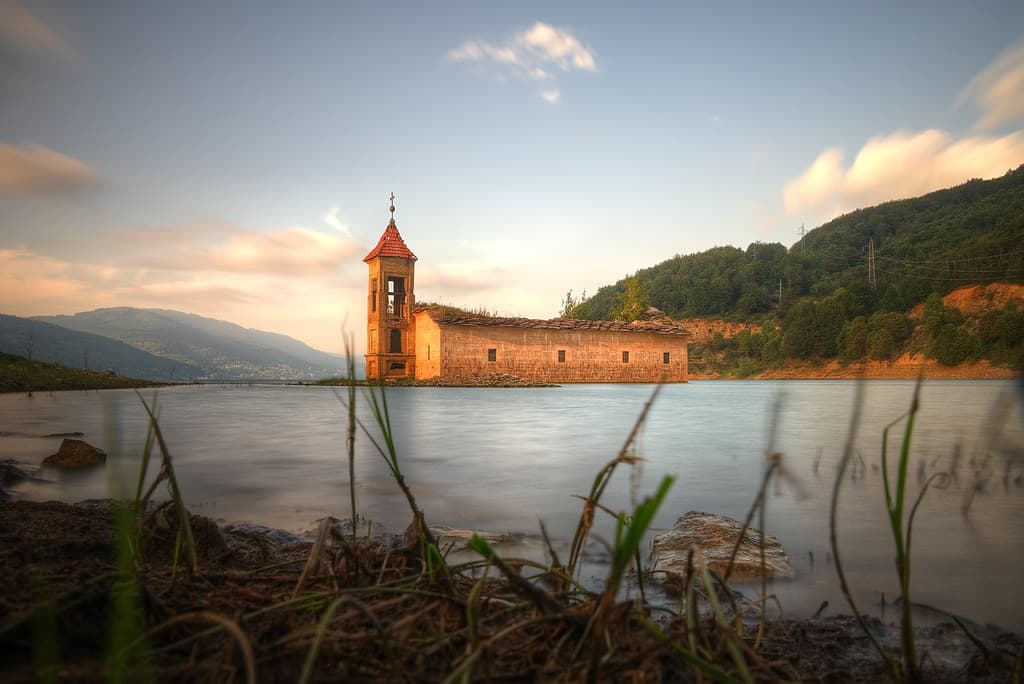
Image of St Nicholas Church - Mavrovo. Image source
Visit essentials
A quick read before you go
- Duration
- A contemplative visit typically takes 30 minutes to an hour.
- Etiquette
- No formal protocols govern the abandoned church, but respectful behavior befitting a sacred site…
Overview
When Yugoslavia's communist government dammed the Mavrovo River in the early 1950s, the reservoir drowned Mavrovo village—homes, fields, and memory—and its 19th-century St. Nicholas Church. Every other structure crumbled underwater, but the church's walls and bell tower endured. Local believers said the saint and God's power would not let it disappear.
During increasingly frequent low-water droughts, the church returns: exposed altar, roofless nave, cracked floors and weeds where villagers worshipped. Visitors report profound stillness; some light candles beside surviving votive stands, while others contemplate why this structure alone survived and keeps returning.
A new St. Nicholas Church built nearby in 1996 continues what the water interrupted. Pilgrims still seek the half-drowned original, suspended between water and land, abandoned village and continuing faith—rising and falling without disappearing.
Why this place is sacred
The Celtic term 'thin place' describes locations where the boundary between the ordinary and the sacred feels permeable. St. Nicholas Church embodies this liminality physically. It is neither fully submerged nor fully exposed, neither active church nor complete ruin, neither forgotten nor restored. It occupies the space between.
This threshold quality intensifies what visitors report experiencing within its walls. The roofless interior—collapsed from decades of flooding—opens directly to the sky. Weather enters the nave. Light falls where icons once hung. The stone altar remains, weathered but present, with a solitary image of St. Nicholas still visible in the remnants of the iconostasis. Two stands for votive candles wait before it, as if the church still expects its congregation.
The church's very survival defies easy explanation. When the reservoir filled in 1953, it destroyed every other building in Mavrovo village. Wooden homes, stone structures, the entire fabric of village life dissolved underwater. Only St. Nicholas remained standing—marble and granite walls somehow resisting what collapsed everything around them. Engineers might point to construction quality. Believers point elsewhere.
The cyclical emergence adds another layer. During droughts, the church rises from the water like something returning from the underworld. For Orthodox Christians, the resurrection symbolism is unavoidable. Each re-emergence feels like Easter enacted in stone—the dead refusing to stay buried, the sacred refusing to stay submerged.
Perhaps most significantly, the church stands witness to profound collective trauma. A whole village was displaced, their sacred center drowned in the name of industrial progress. The church's persistence becomes a kind of resistance—a refusal to let that erasure be complete.
St. Nicholas Church was built between 1850 and 1857 as the main parish church of Mavrovo village. Constructed by master builders from the Reka region of Western Macedonia in the tradition of the Debar Art School, it featured a three-nave design with a five-sided apse and bell tower. The marble altar and throne icons painted by Dicho Zograf—one of the finest 19th-century iconographers in the Balkans—made it a significant regional example of Orthodox sacred art.
For nearly a century, villagers gathered here for baptisms, weddings, funerals, and the rhythms of the Orthodox liturgical year.
The church's transformation from parish center to submerged ruin to pilgrimage site spans seven decades. When dam construction began in 1947, the village's fate was sealed. By 1952, as waters began to rise, the community salvaged what they could—the iconostasis, icons, religious books, and liturgical objects were transferred to another small St. Nicholas church nearby, called the Roman Church. In 1953, the church went under.
For decades, the submerged church was primarily a curiosity—visible only when water levels dropped. But climate change has shifted this pattern. Since 2019, persistent droughts have kept the church above water consistently, transforming it from occasional apparition to permanent presence. This accessibility has intensified its status as a pilgrimage destination.
Meanwhile, the construction of a new St. Nicholas Church (Mavrovo Monastery) just meters away in 1996 created an interesting duality: an active Orthodox church continuing the tradition, and the ruined original serving a different kind of spiritual function—not worship in the formal sense, but encounter, witness, and the sort of meaning-making that emerges at places marked by loss and persistence.
Experience and orientation
The approach sets the tone. Descending thirty-three steps from the road toward the lakebed, visitors cross ground that was once village and then lake bottom. The church waits—exposed walls, absent roof, the bell tower still reaching upward as if nothing had changed.
Inside, the experience diverges sharply from typical ruin tourism. Visitors speak of 'profound stillness' and feeling 'wholly set apart from the land around it.' The absence of a roof means weather becomes part of the encounter—sun falling directly on the altar, wind moving through where walls once supported icons. The floor shows 'dips and swells caused by years of flooding,' making the physical damage visceral and present.
One visitor described spending an hour inside 'attempting to communicate with something beyond himself.' Another noted the meditative quality that emerged simply from sitting within the damaged walls. These are not accounts of dramatic visions or mystical phenomena, but something quieter—a quality of attention that the space seems to demand and support.
The visual impact also plays a role. The juxtaposition of sacred architecture and water damage produces something visitors find difficult to name. A church that has been drowned repeatedly yet remains standing. An altar still marked by a solitary icon of the saint. Votive candle stands waiting before it, as if services might resume any moment. The image is both elegiac and somehow hopeful.
Those who come seeking transformation often report finding it in unexpected forms—not revelation but reflection, not answers but a deepened capacity to sit with questions.
St. Nicholas Church rewards presence over agenda. Those who rush through see a ruin; those who stay begin to sense something else.
Consider arriving without a planned duration. Bring water and sun protection—there is no shade—but let the visit unfold at its own pace. Enter through where doors once hung and simply stand for a moment in the nave. Let your eyes adjust to what is here: the weathered altar, the remnants of the iconostasis, the weeds growing through broken floors, the sky where the roof used to be.
If lighting a candle feels meaningful, you can—the votive stands remain. If sitting in silence feels more appropriate, do that instead. The church does not require any particular practice. It seems to ask only that visitors notice where they are, and what has happened here, and what persists despite it.
The question the church poses is not complicated: what survives? What rises again? These are questions that belong to Orthodox theology, but also to anyone who has lost something and wonders what remains.
Context and lineage
The church emerged from a flourishing of Orthodox art and architecture in 19th-century Macedonia. The Debar Art School, centered in the region's monastic communities, produced some of the finest religious painters in the Balkans. When Mavrovo village commissioned its new parish church around 1850, they engaged master builders from the Reka region who worked in this tradition.
The highlight of the church was its iconostasis and throne icons, painted by Dicho Zograf in 1855. Zograf—full name Dimitar Krstev Dichov—was among the most celebrated iconographers of his era, whose work can be found in churches and monasteries throughout Macedonia, Bulgaria, and Serbia. His icons for St. Nicholas Church represented regional mastery at its peak.
The church was completed in 1857 and served the village for the next ninety-six years—christening children, blessing marriages, burying the dead, marking the liturgical seasons that structured village life. It was not a famous church, not a pilgrimage destination. It was simply the sacred center of an ordinary mountain community.
The church's spiritual lineage connects to the broader tradition of Macedonian Orthodox Christianity, itself part of the Eastern Orthodox communion. The Macedonian Orthodox Church has a complex history—declared autocephalous (self-governing) in 1967 but not fully recognized by other Orthodox churches until recently.
The physical lineage of sacred objects from the original St. Nicholas Church continues nearby. Before the flooding, the community transferred the iconostasis, icons, crosses, and liturgy books to the Roman Church—a smaller historic St. Nicholas church in the area. These items, including Dicho Zograf's icons, survive there today. The new Mavrovo Monastery church, built in 1996 meters from the submerged original, continues Orthodox worship in the area.
The submerged church itself now serves a different function in this lineage—not as active worship space but as witness, memorial, and site of pilgrimage. It has become, in a sense, its own tradition.
St. Nicholas
patron_saint
One of the most venerated saints in Orthodox Christianity, Nicholas of Myra is associated with miracles, protection, and generosity. His patronage of the church takes on particular resonance given the structure's apparent miraculous survival.
Dicho Zograf
historical
Master iconographer (1819-1872) who painted the church's throne icons and iconostasis in 1855. Considered one of the finest 19th-century religious painters in the Balkans. His works from this church were saved before flooding and remain in the nearby Roman Church.
Traditions and practice
When the church was active (1857-1952), it followed the rhythms of Orthodox liturgical life. The Divine Liturgy would have been celebrated regularly, with particular significance on the Feast of St. Nicholas (December 6 in the Western calendar, December 19 in the Eastern Orthodox calendar). Baptisms, weddings, and funerals marked the community's passages. Candle lighting, veneration of icons, and reception of communion structured personal devotion.
The icons painted by Dicho Zograf—particularly the throne icons of Christ and the Theotokos—would have been central to worship, venerated by the faithful who kissed them and prayed before them. The iconostasis separated nave from sanctuary, mediating between congregation and altar in the traditional Orthodox arrangement.
At the submerged church today, practice is informal and self-directed. Many visitors light votive candles at the stands that remain before the altar—a continuity with Orthodox tradition that requires no formal structure. Some stand or kneel in prayer. Others simply sit in silence, allowing the space to work on them without specific religious intention.
The nearby Mavrovo Monastery offers formal Orthodox worship for those seeking it. Built in 1996, this new St. Nicholas Church maintains active services and monastic life. Visitors can attend Divine Liturgy here and then walk to the submerged original—experiencing both the living tradition and its haunted remnant.
For those coming to the submerged church with spiritual intention rather than mere curiosity, consider these approaches:
Arrive without hurry. The church has waited decades between visitors; it will wait for you to be ready. Descend the steps slowly. Notice the transition from road to lakebed to sacred ground.
Once inside the roofless nave, stand still before moving further. Let your eyes and your breathing adjust. Notice the altar, the remnant of the iconostasis, the solitary icon of St. Nicholas. Notice also the damage—the collapsed roof, the uneven floor, the weeds. Both are part of what this place is.
If you wish to light a candle, do so at the votive stands. Orthodox tradition holds that candles represent prayers continuing after we leave. Here, that symbolism extends: the church itself has continued after everyone left.
Then simply stay. Sit or stand as feels appropriate. There is nothing you need to do. The church's gift is the space it holds—for grief, for wonder, for questions about what persists.
Eastern Orthodox Christianity
HistoricalSt. Nicholas Church served as the main parish church for Mavrovo village from 1857 until its submersion in 1953, marking nearly a century of Orthodox worship, sacraments, and community life. The church was dedicated to St. Nicholas (Sveti Nikola), one of the most venerated saints in Orthodox Christianity. Its iconostasis and throne icons, painted by the master iconographer Dicho Zograf in 1855, represented the finest work of the Debar Art School and elevated the church to regional significance.
When active, the church followed standard Orthodox liturgical practice: celebration of the Divine Liturgy, the seven sacraments, the festal cycle marking Christ's life and the saints' commemorations. The Feast of St. Nicholas would have been the church's patronal feast, celebrated with particular solemnity. Before flooding, the community removed the iconostasis, icons, religious books, and liturgical objects, transferring them to the nearby Roman Church where they remain today.
Contemporary Pilgrimage
ActiveDespite being deconsecrated and abandoned, St. Nicholas Church has become an informal pilgrimage destination attracting visitors who seek spiritual encounter alongside or instead of tourism. The church's unusual status—its survival, its emergence from water, its liminal quality—draws seekers who find meaning in places marked by persistence and transformation.
Visitors engage through contemplative presence rather than formal ritual. Practices include lighting candles at the votive stands that remain before the altar, personal prayer or meditation within the roofless nave, photography as a form of witness, and simply sitting with the questions the church poses. No organized services or ceremonies take place, but the space supports individual spiritual practice.
Perspectives and open questions
St. Nicholas Church invites interpretation from multiple angles—architectural history, communist-era displacement studies, Orthodox theology, and contemporary spiritual seeking. Each perspective illuminates part of the site's significance while no single framework captures the whole. The church holds its mysteries lightly, offering itself to whatever questions visitors bring.
Scholarly perspective
From a heritage studies perspective, St. Nicholas Church represents a documented case of built heritage affected by mid-20th century infrastructure development—specifically, the hydroelectric dam programs pursued under Yugoslav industrialization policies. Similar stories of flooded villages and submerged churches exist throughout Eastern Europe, though few have achieved the visibility of Mavrovo.
The church itself is notable for its icons by Dicho Zograf, a major figure in Balkan religious art whose work is studied for its synthesis of Byzantine traditions with 19th-century influences. The preservation of these icons through transfer before flooding represents successful heritage salvage; their current location in the Roman Church maintains continuity with their original context.
Archaeologists and structural engineers have expressed interest in understanding how the church alone remained standing when surrounding structures collapsed. No formal study has been published, but the use of marble and granite in construction likely contributed to the structural resilience.
Living and traditional perspectives
For Orthodox believers, the church's survival carries clear theological meaning. Local tradition holds that 'the saint and God's power will not allow the church to completely disappear in the waters of Mavrovo Lake.' This interpretation places the site within the Orthodox understanding of saints as active intercessors and sacred spaces as permanently consecrated—unable to be unmade by human action.
The church's cyclical emergence from the waters resonates with resurrection theology. Each time it rises, it enacts in stone what Orthodox Christianity proclaims about death: that it does not have the final word. Some believers frame the site explicitly as miraculous evidence of divine protection.
The Macedonian Orthodox Church, while not formally designating the site as miraculous, has maintained the tradition nearby through the construction of the new Mavrovo Monastery. The continuity of St. Nicholas veneration—same saint, same location, new structure—suggests the church sees sacred significance persisting at this place.
Alternative interpretations
Contemporary spiritual seekers, many without Orthodox affiliation, experience the site as what some call a 'thin place'—a location where the boundary between ordinary and sacred feels permeable. The church's liminal quality—neither submerged nor emerged, neither active nor completely abandoned—creates what visitors describe as a space 'wholly set apart' from ordinary reality.
Some interpret the site through the lens of trauma and collective memory, understanding its power as emerging from the forced displacement of the village and the church's role as witness to that erasure. On this reading, the site's significance is psychological and communal rather than supernatural—though no less real for that.
New Age frameworks occasionally appear in visitor accounts, with references to the church's 'energy' or its function as a 'portal.' These interpretations are not historically grounded but may reflect genuine experiences visitors struggle to articulate in other language.
Open questions
Several genuine mysteries surround the site. Why did the church alone survive when every other structure in the flooded village collapsed? Structural engineering hypotheses exist but no definitive study has been conducted. The question remains technically open.
What was lost underwater remains largely undocumented. Village records, personal effects, the material fabric of an entire community's life—all went beneath the water. The church's survival makes visible what otherwise would be completely invisible: a whole village erased in the name of progress.
Climate change adds uncertainty to the site's future. Will ongoing drought permanently expose the church, requiring conservation intervention? Would permanent exposure change its character—its meaning deriving partly from its cyclical submersion and emergence? These questions remain open.
Plan your visit
Access and arrival
Mavrovo village offers several accommodation options ranging from the historic Radika Hotel to smaller guesthouses. The area is a ski destination in winter, so hotel availability exists year-round. For those seeking a spiritual retreat context, the region lacks dedicated centers, but the nearby Saint Jovan Bigorski Monastery may offer pilgrim accommodations—inquire directly.
Respectful visit
No formal dress code applies to the abandoned church. However, modest, practical attire shows respect for the sacred context. The approach crosses potentially muddy lakebed, so appropriate footwear is advisable. Sun protection is essential as there is no shade inside the roofless structure.
Photography is permitted and the site is highly photogenic—particularly the juxtaposition of ruined church against lake and mountain backdrop. Drone photography may be possible but check local regulations. Be mindful of other visitors seeking contemplative space; avoid extended photo sessions that monopolize the altar area or disrupt others.
Visitors may light candles at the votive stands that remain before the altar. This is the most appropriate form of offering. Do not leave other objects, which would constitute litter at an unmanaged site.
Access depends entirely on water levels—check conditions before visiting. When the church is accessible, there are no formal restrictions on entry. Physical caution is required inside due to damaged flooring. Do not climb on walls or structures. Do not remove any materials from the site.
The church structure, while standing, has suffered significant damage from decades of submersion. The floor is uneven, with 'dips and swells' from flooding. Exercise physical caution when moving about the interior.
Do not remove any stones, artifacts, or materials from the site. What remains belongs here—and to the community whose church this was.
While the church is deconsecrated and abandoned, it remains a place of spiritual significance for many. Behavior that would be disrespectful in an active church—loud talking, disruptive photography, dismissive commentary—is equally inappropriate here.
Location
Map loads as you approach this section.
Pilgrim reflections
A portrait of encounter, not a score
Pilgrims describe what they felt, how present they could become, and whether the place would shape a journey. There are no stars and no ranking of traditions.
No reviewed reflections yet
The first pilgrims can help describe the character of being here.
Share a reflection
Available after an account-backed “Been there.” Every reflection is reviewed before publication.
Nearby sacred places
Explore other sacred places in the region. Proximity does not establish access or travel time; check each place’s guidance.

Zrze Monastery
Zrze, Zrze, Dolneni Municipality, Pelagonia Region, North Macedonia
11.1 km away

Treskavec Monastery
Near Prilep, Near Prilep, Pelagonia Region, North Macedonia
30.5 km away

Marko's Monastery
Markova Sušica, Markova Sušica, Studeničani Municipality, Skopje Region, North Macedonia
44.3 km away

Monastery of Saint Andrew, Matka
Matka Canyon, Matka Canyon, Skopje, North Macedonia
48.2 km away
References
Sources consulted for this page. Source categories describe the publication, not a guarantee that every claim is verified. Traditional accounts and outside interpretations may differ.
- 01St Nicholas Church, Mavrovo - Wikipedia — Wikipedia contributorsofficialComprehensive article with detailed historical information and citations
- 02St Nicholas Church - Mavrovo — Atlas ObscuraguideWell-researched travel article with current condition details
- 03The Sunken Church at Mavrovo — Owen Clarke / Dead Foot CollectiveguideFirst-hand visitor account with spiritual reflections and detailed observations
- 04The Submerged Church of St. Nikola in Mavrovo — Macedonian CuisinespiritualLocal perspective with cultural context
- 05Crkva Sveti Nikola - Mavrovo — St. Nicholas CenterspiritualDedicated St. Nicholas research organization with detailed church information
- 06St. Nicholas Summer, Mavrovo — ReligianaspiritualReligious heritage database entry
- 07Dičo Zograf - Wikipedia — Wikipedia contributorsofficialBiographical information on the iconographer
- 08Mavrovo Lake - Wikipedia — Wikipedia contributorsofficialInformation on reservoir construction and hydroelectric system
- 09Sveti Jovan Bigorski Monastery - Lonely Planet — Lonely PlanetguideInformation on nearby sacred sites in Mavrovo National Park
- 10Old Mavrovo Church - TripAdvisor Reviews — Various visitorsguideVisitor reviews and practical information
Share a photo
Help visitors recognize St Nicholas Church - Mavrovo. Every submission is reviewed before publication.