St. Katharina, Langenzersdorf
Seven centuries of worship beneath a Black Madonna brought from Einsiedeln
Understand sacred places, explore living traditions, and learn how to engage respectfully with Pilgrim Map.
Access has not been verified. Check current local guidance before planning a visit.
Langenzersdorf, Lower Austria, Austria
Read the sources
Visit essentials
A quick read before you go
- Duration
- A contemplative visit of 30-60 minutes allows adequate time to appreciate the architecture,…
- Etiquette
- St.
Overview
Some churches announce themselves; St. Katharina does not. In Langenzersdorf, a Lower Austrian market town eight miles north of Vienna, it has quietly gathered prayer for seven hundred years.
Early Gothic bones remain beneath Baroque additions from centuries of renovation. Fire, flood, and earthquake each required repair. A mid-18th-century pulpit bears intricate carvings, while paintings of Augustinian saints line the walls and attest to the long connection with Klosterneuburg Abbey. A large canvas attributed to Annibale Carracci, acquired from the Liechtenstein Collection after Austrian nobility's fall, depicts St. Catherine before the Madonna and Child.
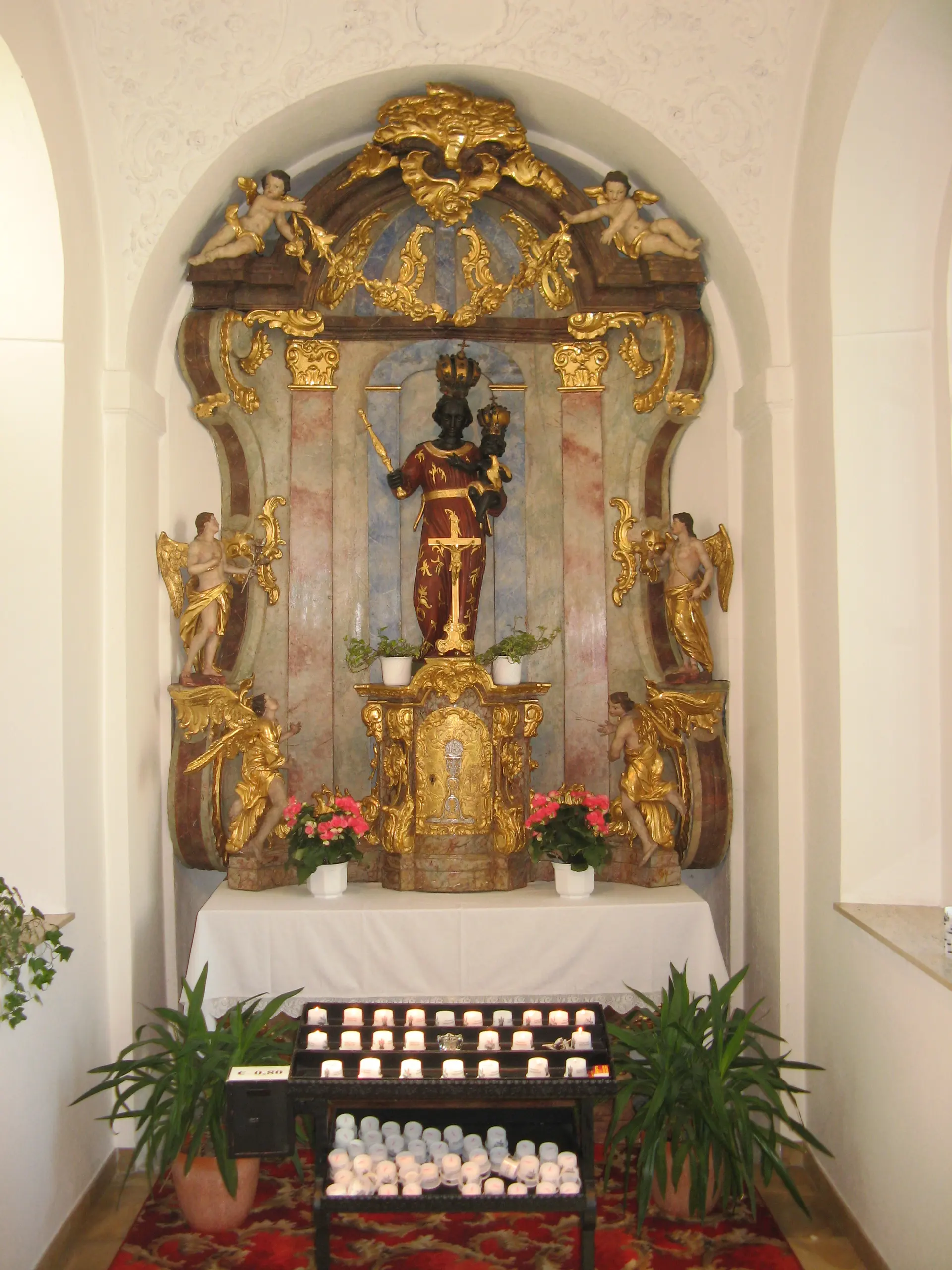
Many visitors are drawn to a small Black Madonna installed in 1708, a copy of Einsiedeln's famous Swiss statue. The dark-faced Virgin holds the Child with her original's inscrutable gaze, carrying that pilgrimage shrine into this parish and linking it to one of Europe's deepest Marian currents.
Mass and sacraments still mark local lives. St. Katharina is a living church, not a museum: accumulated centuries of intention meet ongoing faith.
Sites inside
Why this place is sacred
What makes a place thin is rarely dramatic. Sometimes it is simply the weight of years, the accumulated residue of countless ordinary prayers offered in the same space, generation after generation.
St. Katharina has held such prayers since 1326, when it was elevated from chapel to parish church. Before that, the site already served Christian worship, first documented in 1323. In 1403, the parish was incorporated into Klosterneuburg Abbey, bringing Augustinian influence that persists today. For over six hundred years, this partnership has shaped the spiritual character of the place.
The church has been tested. In 1683, fire required extensive renovation. In 1709, flood waters demanded more repair. In 1749, an earthquake shook the foundations, necessitating yet another restoration. Through each crisis, the community rebuilt, adding new elements while preserving what could be saved. The result is a palimpsest of devotion visible in the architecture itself: Gothic bones, Baroque skin, Rococo and Classicist ornament layered across the centuries.
The Black Madonna arrived in 1708, a year before the flood. Her installation represented the spread of Counter-Reformation Marian piety from the great pilgrimage center of Einsiedeln across Central Europe. Each copy carried something of the original's accumulated veneration, seeding new centers of devotion in parish churches like this one. The dark-faced Virgin has watched over this community now for more than three centuries, receiving the prayers of those who stand before her.
Visitors often describe the church as unexpectedly rich. The carved pulpit from the mid-18th century rewards close attention. The 1766 paintings of Augustinian saints connect this parish to the monastic tradition that has shaped it. The Carracci-attributed St. Catherine, acquired in 1926 from the dispersed Liechtenstein Collection, adds a thread linking this village church to the great currents of European art and the reshaping of aristocratic holdings after World War I.
These layers accumulate not through grand intention but through the slow accretion of care, crisis, and response. The church is thin because it has been loved continuously for seven centuries.
St. Katharina was established as the parish church for the village of Langenzersdorf in 1326, serving the spiritual needs of an agricultural community in the Vienna basin. Its incorporation into Klosterneuburg Abbey in 1403 brought it under Augustinian care, adding a monastic dimension to its parochial function. The church was designed to hold the rhythms of Catholic life: baptism, confirmation, marriage, funeral, and the daily and seasonal cycles of the Mass.
The church has evolved through necessity rather than ambition. Each disaster required renovation; each renovation added new beauty. The Gothic structure received Baroque overlays in the late 17th and early 18th centuries. The Black Madonna's arrival in 1708 introduced a devotional focus that continues today. The tower, damaged by fire in 1817, was rebuilt with a new baroque-style dome during the 1901-1902 general renovation.
The acquisition of the Carracci painting in 1926 represents a late addition, connecting the church to the redistribution of art following the collapse of the Habsburg nobility. Throughout these changes, the essential function has remained constant: holding the prayers of the community, marking the passages of lives, maintaining continuity with tradition.
Experience and orientation
Entering St. Katharina, you may not immediately recognize what you have found. The exterior suggests a typical Lower Austrian parish church, distinguished but not exceptional. The interior tells a different story.
Light falls through windows onto centuries of accumulated devotion. The eye travels first to the carved pulpit, its mid-18th century craftsmanship evident in every detail. The paintings of Augustinian saints from 1766 line the walls, their presence recalling the six centuries of connection to Klosterneuburg Abbey. Then, perhaps, attention settles on the large canvas of St. Catherine before the Madonna and Child, its attribution to Carracci lending weight to its already considerable beauty.
But many visitors find themselves drawn to the Black Madonna. The dark-faced Virgin holds the Child with the same mysterious expression found at Einsiedeln, her gaze neither welcoming nor forbidding but simply present. Those who know the original recognize something of its quality here; those who do not may sense that this statue carries more than its immediate form suggests.
The church rewards slowness. Rush through it and you see a pretty parish church. Sit in its pews, let your eyes adjust to its light and your mind to its quiet, and layers begin to reveal themselves. The Gothic structure beneath the Baroque surface. The repairs that mark fire, flood, and earthquake. The choices made across centuries about what to preserve, what to add, what to let go.
Some visitors report a quality of stillness unusual for a church this accessible from Vienna. Whether this reflects the accumulated prayer of seven centuries, the presence of the Black Madonna, or simply the opportunity for quiet contemplation, the experience is consistent enough to note.
St. Katharina invites you to slow down. Enter not as a tourist checking a box but as someone seeking a moment of stillness. Allow your eyes to adjust to the interior light. Notice the pulpit, the paintings, the architecture before looking for the Black Madonna.
When you find her, sit with her presence. You need not pray in any formal sense. Simply notice what arises in the presence of a statue that has received devotion for more than three centuries, connected to an original that has gathered prayers for far longer.
If mass is being celebrated, remain at the back or outside unless you are participating. The church exists first for its community; your visit is secondary to that primary purpose. Between services, the space opens to anyone seeking quiet.
Context and lineage
The church emerged from the medieval Christian landscape of the Vienna basin, where parish churches served agricultural communities under the spiritual authority of nearby monasteries. Klosterneuburg Abbey, founded by the Babenberg duke Leopold III in the early 12th century, held influence over surrounding parishes. When St. Katharina was incorporated into the abbey in 1403, it joined a network of parishes shaped by Augustinian spirituality.
The dedication to St. Catherine of Alexandria reflects the medieval veneration of this 4th-century martyr, revered for her wisdom and her legendary debate with pagan philosophers. Her feast day, November 25, would have been a significant moment in the parish calendar, connecting this village to the broader community of those who honored her intercession.
The Black Madonna arrived in 1708, during the Counter-Reformation period when copies of miraculous images spread from major pilgrimage centers to parish churches throughout Catholic Europe. Einsiedeln, in Switzerland, was among the most important of these centers, its Black Madonna drawing pilgrims since the Middle Ages. By installing a copy in St. Katharina, the parish claimed a share of that devotional current, offering local parishioners access to Marian devotion rooted in one of Europe's great shrines.
The spiritual lineage of St. Katharina runs through Klosterneuburg Abbey, which has overseen the parish since 1403. Klosterneuburg itself was founded by Leopold III and houses Augustinian Canons Regular, whose spirituality has shaped the character of parishes under their care. The connection brings the parish into a chain of tradition extending through six centuries of Austrian Catholicism.
The Black Madonna adds a parallel lineage: devotion to the dark-faced Virgin connects St. Katharina to Einsiedeln, and through Einsiedeln to the broader phenomenon of Black Madonna veneration across Catholic Europe. This tradition carries associations with ancient mother goddess worship, though such interpretations remain contested by scholars and traditional practitioners alike.
St. Catherine of Alexandria
patron_saint
The 4th-century Christian martyr to whom the church is dedicated. According to hagiography, she was a learned woman of noble birth who converted to Christianity and debated pagan philosophers, leading to her execution. She is a patron saint of philosophers, students, and unmarried women.
Black Madonna of Einsiedeln
devotional_focus
The original statue at Einsiedeln Abbey in Switzerland has been a focus of pilgrimage since the Middle Ages. The copy installed at St. Katharina in 1708 extends this devotional tradition into the local parish, connecting Langenzersdorf to one of Europe's major Marian shrines.
Annibale Carracci
attributed_artist
The major Baroque painter to whom the large painting of St. Catherine before the Madonna and Child is attributed. The work was acquired from the Liechtenstein Collection in 1926, representing the redistribution of aristocratic art holdings after World War I.
Traditions and practice
The parish follows the Roman Catholic liturgical calendar, marking Sundays, holy days of obligation, and the feasts of saints throughout the year. The feast of St. Catherine of Alexandria on November 25 holds particular significance as the patronal festival. Major Marian feasts offer occasions for special devotion before the Black Madonna, connecting local observance to the broader Catholic tradition of honoring Mary.
The Augustinian influence from Klosterneuburg Abbey adds distinctive elements to the parish's spiritual character, visible in the 1766 paintings of Augustinian saints and in the connection to a monastic tradition emphasizing community life, liturgical prayer, and pastoral care.
The parish continues active sacramental life, offering mass, baptism, confirmation, marriage, and funeral rites to the community of Langenzersdorf. As part of the Archdiocese of Vienna, it participates in diocesan initiatives and maintains connection to the broader Catholic church.
Marian devotion before the Black Madonna remains a living practice. Visitors may light candles, offer prayers, or simply sit in the presence of the statue. The devotion requires no particular knowledge or preparation; it is available to anyone who enters with sincere intention.
If you visit St. Katharina seeking spiritual engagement rather than architectural tourism, consider these approaches.
Before entering, pause at the threshold. Acknowledge that you are entering a space that has held prayer for seven centuries. This simple recognition can shift the quality of attention you bring inside.
Once within, allow time for your eyes and heart to adjust. Find a seat in the nave and simply be present. Notice what draws your attention without forcing an agenda.
When you are ready, approach the Black Madonna. You need not be Catholic to stand before her. Whatever your tradition or lack of one, you can offer silence, attention, or a question you are carrying. The practice is simpler than it may seem: you show up, you pay attention, you see what arises.
If you wish to participate in mass, check the parish website or posted schedules. Arriving during a service when you do not intend to participate may disrupt the community gathering.
Roman Catholicism
ActiveSt. Katharina has served as the Catholic parish church of Langenzersdorf since 1326, maintaining the full cycle of liturgical and sacramental life. Its incorporation into Klosterneuburg Abbey in 1403 brought Augustinian influence that has shaped the parish for six centuries. The church remains an active part of the Archdiocese of Vienna, serving the spiritual needs of the local Catholic community.
The parish celebrates regular masses, administers the sacraments, and observes the Catholic liturgical calendar including the feast of its patron St. Catherine of Alexandria on November 25. Personal prayer, particularly before the Black Madonna, complements communal worship.
Black Madonna Devotion
ActiveThe installation of a Black Madonna copy in 1708 connected this parish church to the great pilgrimage tradition of Einsiedeln, Switzerland, one of Europe's most important Marian shrines. Black Madonna devotion represents a distinctive strand within Catholic Marian piety, often associated with the most ancient and miraculous images of the Virgin.
Devotion before the Black Madonna follows standard Catholic Marian practice: prayer, candle lighting, and contemplation before the image. The statue serves as a focus for those seeking Mary's intercession, connecting their prayers to the accumulated devotion of the Einsiedeln tradition.
Perspectives and open questions
St. Katharina can be understood through multiple lenses: as an example of Austrian parish church architecture evolving through centuries, as a node in the network of Black Madonna devotion spreading from Einsiedeln, or as a living community of faith continuing practices that stretch back to 1326. Each perspective illuminates different aspects of the church's significance.
Scholarly perspective
The church exemplifies the architectural evolution of Austrian parish churches from medieval foundations through Baroque transformation. Scholars of Habsburg religious culture note the typical pattern visible here: a medieval parish incorporated into a monastery (Klosterneuburg Abbey), receiving Baroque embellishment during the Counter-Reformation, and accumulating artistic treasures through various channels including the dispersal of aristocratic collections.
The Black Madonna copy represents a documented phenomenon: the spread of miraculous images from major pilgrimage centers to local parishes throughout Catholic Europe during the 17th and 18th centuries. Each copy extended the devotional reach of the original, creating a network of sites connected through shared iconography and spiritual association.
The Carracci attribution raises questions typical of art historical study. The painting's provenance from the Liechtenstein Collection is established; its attribution to Carracci is traditional but not definitively verified. Its presence in a parish church after the collapse of aristocratic holdings illustrates the redistribution of cultural wealth following World War I.
Living and traditional perspectives
From within Catholic tradition, St. Katharina represents the continuity of faith across centuries. The parish has maintained sacramental life since 1326, marking the births, marriages, and deaths of generations of Langenzersdorf residents. This unbroken chain of liturgical practice connects current parishioners to those who prayed in the same space seven hundred years ago.
The Black Madonna holds particular significance for those who approach her with Marian devotion. Catholic teaching understands Mary as intercessor, able to bring prayers before her Son. The Black Madonna of Einsiedeln has received such prayers since the Middle Ages; her copies extend this intercessory presence to local communities who cannot make the pilgrimage to Switzerland.
Alternative interpretations
Some who encounter Black Madonnas find in them echoes of pre-Christian goddess worship, understanding the dark-faced Virgin as carrying forward an archetype older than Christianity itself. The color of these statues, often attributed to candle smoke but sometimes unexplained, invites speculation about origins in Isis worship or other ancient traditions.
These interpretations are not endorsed by the Catholic Church and lack scholarly consensus. They represent one way contemporary seekers make meaning of religious imagery, finding in traditional forms dimensions that the tradition itself may not recognize.
Open questions
The acquisition of the Carracci painting from the Liechtenstein Collection in 1926 represents an interesting case whose full story remains unclear. Why this painting came to this particular parish church, what negotiations surrounded the transfer, and how the parish afforded such an acquisition are questions the historical record does not fully answer.
More broadly, what happened in this church across seven centuries of worship, crisis, and renewal leaves much unknown. The prayers offered before the Black Madonna, the transformations experienced by those who entered, the ways the community responded to fire, flood, and earthquake beyond the physical rebuilding recorded in documents remain beyond historical recovery.
Plan your visit
Access and arrival
Most visitors will stay in Vienna, which offers lodging at all price points and provides easy train access to Langenzersdorf. Those wishing to stay in Langenzersdorf itself will find limited options; the town is residential rather than touristic. Vienna provides far more choices and allows visits to multiple sites in the region.
Respectful visit
Modest attire appropriate for a Catholic church is expected. Cover shoulders and knees. Hats should be removed by men upon entering. No specific dress code is enforced, but dressing thoughtfully shows respect for the community whose space you are entering.
Photography is generally permitted but should be practiced with discretion. Avoid flash, which can damage artwork and disturb other visitors. Do not photograph during mass or other services. Consider whether your photography enhances or detracts from the contemplative atmosphere.
Candle lighting is a traditional Catholic devotional practice available to all visitors. A small donation typically accompanies the lighting. Beyond this, no offerings are expected from visitors, though donations to support the church's maintenance are welcomed.
Avoid visiting during mass unless you intend to participate. Check service schedules in advance or be prepared to wait. The church may occasionally close for private ceremonies such as weddings or funerals. Behavior disruptive to the atmosphere of worship or contemplation is inappropriate.
This is an active parish church where local Catholics come to worship. Their practice takes precedence over your visit. Avoid treating the church as a museum while services are in progress. Flash photography during mass is inappropriate. Conversation should be quiet or reserved for outside.
The Black Madonna is a devotional object, not an art piece. Approach her with respect for those who pray before her as an act of genuine devotion.
Current practical details
Address
Obere Kirchengasse 6, 2103 Langenzersdorf, Austria
Phone
Hours
Hours, fees, and access can change — verify on the official source before you travel. Practical details last checked Jun 2026.
Location
Map loads as you approach this section.
Pilgrim reflections
A portrait of encounter, not a score
Pilgrims describe what they felt, how present they could become, and whether the place would shape a journey. There are no stars and no ranking of traditions.
No reviewed reflections yet
The first pilgrims can help describe the character of being here.
Share a reflection
Available after an account-backed “Been there.” Every reflection is reviewed before publication.
Nearby sacred places
Explore other sacred places in the region. Proximity does not establish access or travel time; check each place’s guidance.
Black Madonna of Langenzersdorf
Langenzersdorf, Lower Austria, Austria
0.0 km away

Klosterneuburg Abbey
Klosterneuburg, Klosterneuburg, Lower Austria, Austria
2.6 km away
Black Madonna of Kaltenleutgeben
Kaltenleutgeben, Lower Austria, Austria
24.6 km away
Parish Church of Saint James, Kaltenleutgeben
Kaltenleutgeben, Lower Austria, Austria
24.6 km away
References
Sources consulted for this page. Source categories describe the publication, not a guarantee that every claim is verified. Traditional accounts and outside interpretations may differ.
- 01St. Katharina (Langenzersdorf) — Wikipedia (German)encyclopediaDetailed German Wikipedia article about the church
- 02Langenzersdorf — Lower Austria TourismofficialOfficial tourism information describing the church as an 'architectural jewel'
- 03Pfarre Langenzersdorf - St. Katharina — Parish of LangenzersdorfofficialOfficial parish website
- 04Pfarre Langenzersdorf-St. Katharina — Archdiocese of ViennaofficialOfficial archdiocese listing
- 05Austria Black Madonnas Index — Interfaith Mary PageSource contextConfirms Black Madonna of Einsiedeln copy installed 1708
- 06Kath. Pfarrkirche St. Katharina Reviews — TripAdvisorSource contextVisitor reviews and general information
Share a photo
Help visitors recognize St. Katharina, Langenzersdorf. Every submission is reviewed before publication.