Black Madonna of Langenzersdorf
InsideSt. Katharina, Langenzersdorf
A Black Madonna bringing Einsiedeln's thousand-year devotion to the Vienna lowlands
Understand sacred places, explore living traditions, and learn how to engage respectfully with Pilgrim Map.
Access has not been verified. Check current local guidance before planning a visit.
Langenzersdorf, Lower Austria, Austria
Read the sources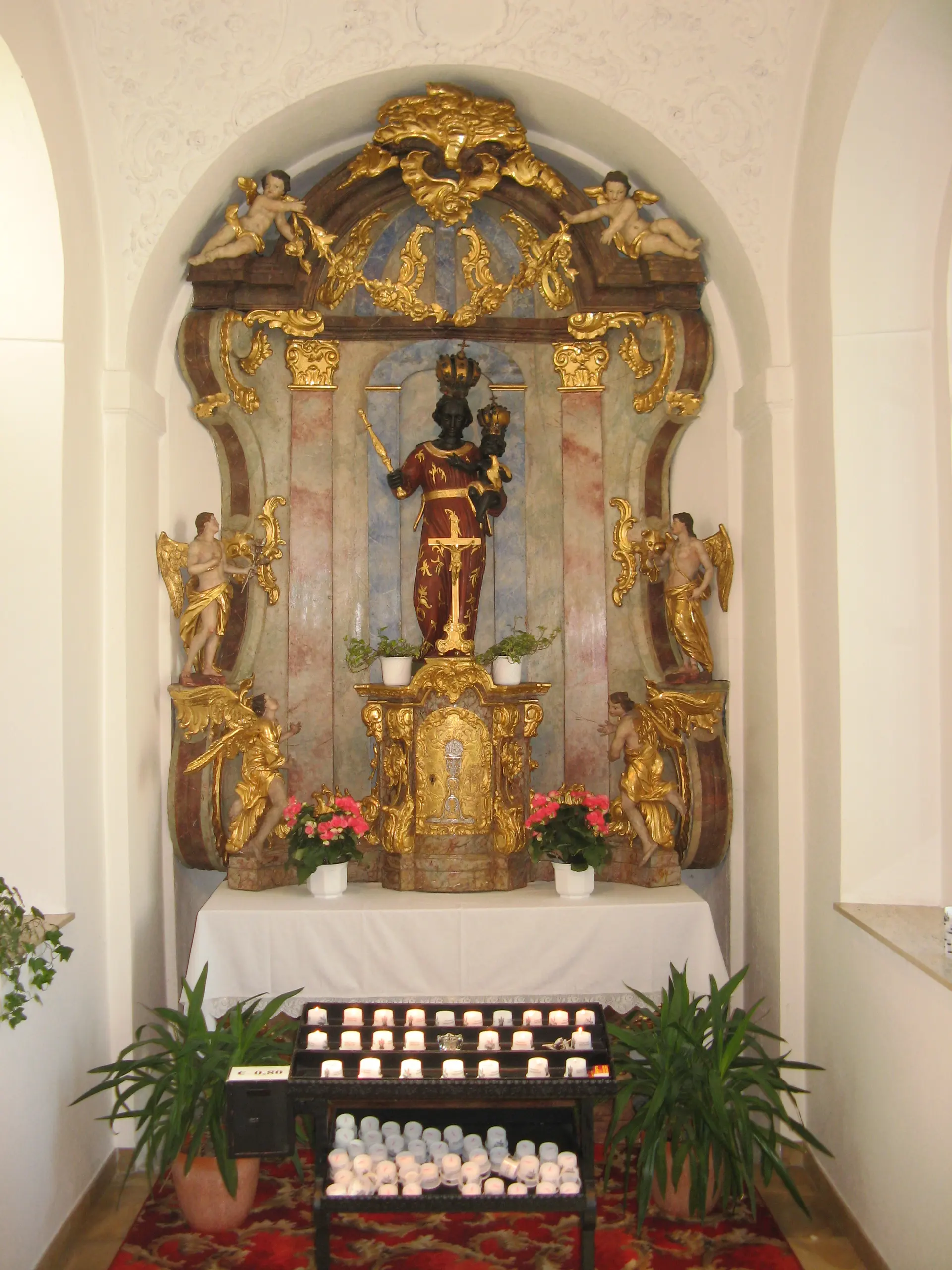
Visit essentials
A quick read before you go
- Duration
- 20-40 minutes for a focused devotional visit.
- Access
- St.
Overview
Installed at St. Katharina in 1708, the Black Madonna of Langenzersdorf is a copy of the celebrated original at Switzerland's Einsiedeln Abbey, brought into the Vienna region during Habsburg Austria's Counter-Reformation Marian devotion. Three centuries of local prayer have made it more than a replica. At Einsiedeln, candle smoke darkened the Virgin's face; when restorers proposed flesh tones in 1799, the faithful refused, making the darkness itself part of its sacred identity.
The Langenzersdorf copy carries that mystery as a dark-faced mother and child within ordinary parish life.
Why this place is sacred
Black Madonnas occupy a distinctive place in Catholic devotion. More than 10% of European shrines featuring dark-faced Virgins stand on sites known to have been centers of worship in pre-Christian times. Whether this reflects continuity with older traditions or coincidence, these images attract a particular quality of devotion—often associated with healing, deep transformation, and encounter with the feminine divine in her more mysterious aspect.
The original at Einsiedeln carries over a millennium of such devotion. Saint Meinrad established his hermitage in the Swiss forests in 835, and according to tradition, the chapel that eventually rose on that site was consecrated by Christ himself in 948—a miracle confirmed by papal bull. The Madonna that pilgrims venerate today was carved around 1466, inheriting the accumulated sanctity of that ground.
By installing a copy in Langenzersdorf, the parish participated in this tradition, creating a local point of access to a devotion most parishioners would never reach in person. The statue became, in a sense, an embassy of Einsiedeln's spiritual presence in the Vienna lowlands.
Three centuries of village prayer have followed. Whatever one believes about the transmission of sacred power through copies, the continuity of devotion here is real. Generation after generation has knelt before this image, bringing their griefs and hopes. That weight of attention has its own significance.
The installation of this Black Madonna in 1708 served the Counter-Reformation strategy of strengthening Catholic identity through Marian devotion. Copies of famous Black Madonnas spread throughout Habsburg territories during the 17th and 18th centuries, functioning as proxies that allowed local communities to participate in major pilgrimage cults without traveling to distant originals.
From Counter-Reformation instrument to village devotion, the Black Madonna of Langenzersdorf has quietly persisted through the transformations of Austrian history—imperial decline, world wars, secularization. The parish church continues its daily rhythms, and the statue remains, available to anyone who enters seeking the presence of the dark-faced Virgin.
Experience and orientation
St. Katharina is not a famous destination. It is a parish church doing what parish churches do—holding mass, marking baptisms and funerals, offering quiet space between services to anyone who enters.
This ordinariness is part of what the Black Madonna offers. Unlike the grand pilgrimage sites where Marian devotion can feel like theater, here devotion happens in the key of daily life. The space holds whatever you bring to it. An elderly woman lighting a candle before the image, a visitor pausing on a day trip from Vienna, the parish priest preparing for evening mass—these ordinary presences create the texture of a living sacred site.
Those familiar with the Einsiedeln tradition may find themselves moved by the connection, aware that this small statue carries a lineage stretching back a thousand years. Those encountering Black Madonnas for the first time may notice something about the dark face itself—a gravity, a refusal of prettiness, a presence that meets rather than merely blesses.
The experience deepens for those who come with genuine seeking rather than curiosity alone. A question held, a burden carried, an intention offered in silence before the image—these create the conditions for encounter.
Approach this as you would approach a friend's home rather than a tourist attraction. The church welcomes visitors, but it exists for its community. Notice the rhythm of parish life around you. Let your visit be quiet, attentive, unhurried. If prayer is natural to you, pray. If contemplation is more your mode, contemplate. The image will meet you where you are.
Context and lineage
The story begins not in Austria but in the Swiss forests of the 9th century. In 835, a nobleman named Meinrad withdrew from the world to become a hermit. Abbess Hildegarde of Zurich gave him a statue of Mary as companion. For 26 years he lived in solitude, his only companions two crows—until 861, when bandits murdered him for imagined treasure. According to tradition, the crows followed the killers to Zurich, circling and shrieking until justice was served.
A monastery grew on the site of Meinrad's hermitage. On September 14, 948, Bishop Conrad of Constance arrived to consecrate the chapel. According to the account confirmed by papal bull, Conrad had a vision of Christ himself approaching the altar to perform the consecration. This 'Divine Consecration' has been commemorated annually ever since, and Einsiedeln became one of Europe's great pilgrimage centers, drawing some 800,000 pilgrims each year even today.
The current Black Madonna at Einsiedeln, carved around 1466 from linden wood, inherited all this accumulated sanctity. And in 1708, unknown hands created a copy for a parish church in the Vienna lowlands—St. Katharina in Langenzersdorf—bringing this thousand-year devotion to a new home.
The Langenzersdorf Black Madonna represents a branch of the Einsiedeln devotional lineage transplanted to Austria during the height of Counter-Reformation Marian piety. Similar copies spread throughout the Habsburg territories, each becoming a local center of devotion. This particular copy has witnessed three centuries of Austrian parish life, its significance accumulated through the quiet faithfulness of generations.
Saint Meinrad
founder
The 9th-century hermit whose solitary devotion founded the tradition at Einsiedeln. His murder in 861 and the legend of the avenging crows became part of the pilgrimage site's sacred history.
The Black Madonna of Einsiedeln
sacred image
The original image of which the Langenzersdorf statue is a copy. Carved around 1466, blackened by centuries of candle smoke, and deliberately kept dark when restoration was attempted.
Traditions and practice
The original Einsiedeln Madonna is dressed in elaborate satin and sequined robes that change throughout the liturgical year—a tradition begun in the early 17th century. Devotees donate these vestments, and the changing colors mark the rhythm of sacred time. Whether the Langenzersdorf copy follows this practice in full is unclear, though such traditions often travel with copies.
Marian devotion continues as part of regular parish life. The faithful pray before the Black Madonna, light candles, and bring their intentions to the dark-faced Virgin as generations before them have done. Major Marian feast days—particularly the Assumption on August 15 and the Nativity of Mary on September 8—likely see heightened devotion.
If you come seeking more than a brief viewing, consider timing your visit to allow for extended silence before the image. Sit rather than stand. Let the initial impulse to photograph pass. Notice what arises when you simply remain in the presence of this dark-faced mother and child. If candle-lighting is meaningful to you, this is a traditional way to mark intentions in Catholic devotion.
Roman Catholicism - Marian Devotion
ActiveThis Black Madonna represents the spread of the famous Einsiedeln cult throughout the German-speaking Catholic world. By installing a copy in 1708, the parish of Langenzersdorf brought this thousand-year tradition to the Vienna region, allowing local Catholics to venerate an image connected to one of Europe's holiest Marian shrines.
Marian devotion in the form of prayer before the statue, candle lighting, contemplation of the mysteries of Mary, and participation in devotions on major Marian feast days. The faithful bring their intentions to the dark-faced Virgin as they have for three centuries.
Black Madonna Tradition
ActiveBlack Madonnas hold a distinctive place in Catholic devotion across Europe, often associated with miraculous healing, transformation, and encounter with the divine feminine in her mysterious aspect. The darkness of these images—whether from age, soot, or intentional design—has generated centuries of theological and folk interpretation.
Veneration, pilgrimage, and contemplation of the mystery embodied in the dark-faced Virgin. Those drawn to Black Madonnas often report a particular quality of encounter, a gravity and depth they distinguish from other Marian images.
Perspectives and open questions
The Black Madonna of Langenzersdorf can be understood through multiple frameworks: as an instrument of Counter-Reformation devotional strategy, as a living link to one of Europe's great pilgrimage traditions, or as an instance of the mysterious Black Madonna phenomenon that spans the continent. Each perspective illuminates something different.
Scholarly perspective
The spread of Black Madonna copies throughout Habsburg territories during the 17th and 18th centuries served clear religious-political purposes. Counter-Reformation strategy sought to strengthen Catholic identity through intensified Marian devotion, creating bulwarks against Protestantism. These copies functioned as proxies, allowing local communities to participate in major pilgrimage cults without travel to distant originals. The Langenzersdorf installation fits this pattern precisely.
Living and traditional perspectives
Within Catholic Marian devotion, the copy is understood as a genuine point of access to the graces associated with the original. The prayers offered before this image participate in the same devotional stream that has flowed through Einsiedeln for a millennium. The statue is not merely a representation but a presence—the Virgin making herself available to the faithful of this place.
Alternative interpretations
Some scholars connect Black Madonna veneration to pre-Christian goddess worship. Mary Lee Nolan noted that many Black Virgin shrines occupy sites of earlier sacred significance. Some interpreters see in these dark-faced images a continuation of worship of Isis, Diana of Ephesus, Cybele, or Celtic goddesses—the divine feminine in her chthonic aspect, absorbed but not erased by Christianity.
Open questions
The spiritual significance attached to the blackness of these images remains debated. When the Einsiedeln Madonna was restored in 1799, the restorer found the face 'thoroughly black' from centuries of lamp smoke. Yet when he proposed painting it flesh-colored, the people refused. The darkness had become sacred—but why? Whether the blackness evokes earth, night, the mystery of the divine feminine, or something the faithful cannot articulate, it holds power that resists explanation.
Plan your visit
Access and arrival
St. Katharina Church is located in Langenzersdorf, Lower Austria. From Vienna, the train from Wien Mitte takes approximately 23 minutes. The church is accessible from the Langenzersdorf station.
Most visitors will be based in Vienna, where lodging at all price points is abundant. Langenzersdorf itself is a commuter town rather than a tourist destination, but its proximity to Vienna makes a day visit straightforward.
Respectful visit
Modest attire appropriate for a Catholic church. Shoulders and knees covered. Remove hats upon entering.
Generally permitted with discretion. Avoid flash. Do not photograph during services or when doing so would disturb those in prayer. Consider whether photography is truly necessary, or whether presence without documentation might be more appropriate.
Candle lighting is the traditional form of offering in Catholic devotion. Monetary offerings support the parish's ongoing work.
Respect ongoing services and private prayer. Check mass schedules to avoid disrupting worship.
Current practical details
Address
Obere Kirchengasse 6, 2103 Langenzersdorf, Austria
Phone
Hours, fees, and access can change — verify on the official source before you travel. Practical details last checked Jun 2026.
Location
Map loads as you approach this section.
Pilgrim reflections
A portrait of encounter, not a score
Pilgrims describe what they felt, how present they could become, and whether the place would shape a journey. There are no stars and no ranking of traditions.
No reviewed reflections yet
The first pilgrims can help describe the character of being here.
Share a reflection
Available after an account-backed “Been there.” Every reflection is reviewed before publication.
Nearby sacred places
Explore other sacred places in the region. Proximity does not establish access or travel time; check each place’s guidance.

St. Katharina, Langenzersdorf
Langenzersdorf, Lower Austria, Austria
0.0 km away

Klosterneuburg Abbey
Klosterneuburg, Klosterneuburg, Lower Austria, Austria
2.6 km away
Black Madonna of Kaltenleutgeben
Kaltenleutgeben, Lower Austria, Austria
24.6 km away
Parish Church of Saint James, Kaltenleutgeben
Kaltenleutgeben, Lower Austria, Austria
24.6 km away
References
Sources consulted for this page. Source categories describe the publication, not a guarantee that every claim is verified. Traditional accounts and outside interpretations may differ.
- 01Liste Schwarzer Madonnen — German WikipediaencyclopediaGerman Wikipedia list of Black Madonnas in Central Europe
- 02The Madonna of Einsiedeln — The Frick CollectionSource contextContext about the original Einsiedeln Black Madonna
- 03Einsiedeln Black Madonna — University of Dayton International Marian Research InstituteacademicAcademic source on Einsiedeln Black Madonna
- 04Austria Black Madonnas Index — Interfaith Mary PageSource contextPrimary source confirming the statue is a copy of Einsiedeln Black Madonna installed 1708
- 05Einsiedeln - World Pilgrimage Guide — Sacred Sites by Martin GraySource contextContext about Einsiedeln pilgrimage tradition
Share a photo
Help visitors recognize Black Madonna of Langenzersdorf. Every submission is reviewed before publication.