Black Madonna of Kaltenleutgeben
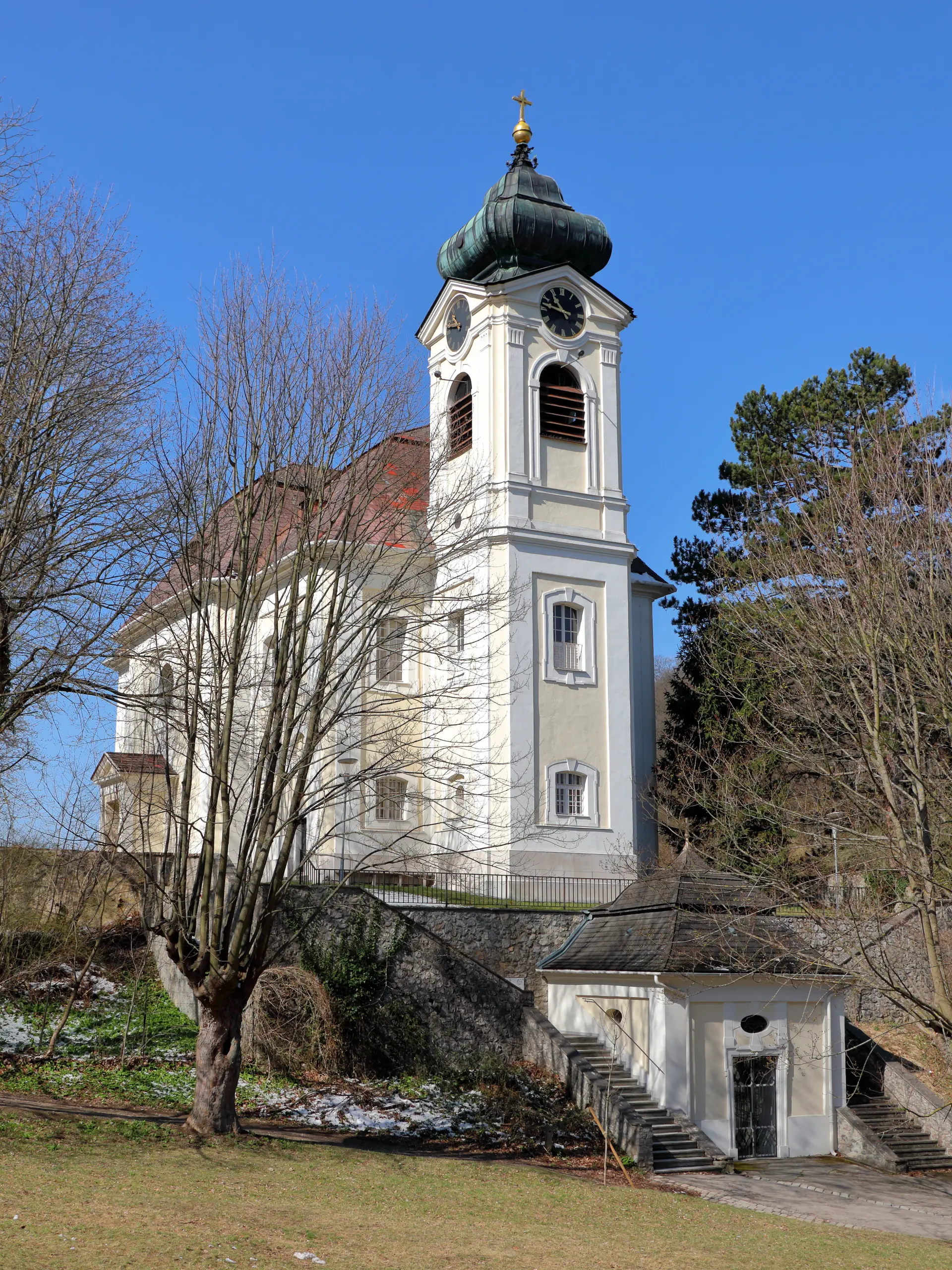
InsideParish Church of Saint James, Kaltenleutgeben
A Black Madonna who traveled from Bavaria to this Vienna Woods parish, carrying transferred grace
Understand sacred places, explore living traditions, and learn how to engage respectfully with Pilgrim Map.
Access has not been verified. Check current local guidance before planning a visit.
Kaltenleutgeben, Lower Austria, Austria
Visit essentials
A quick read before you go
- Duration
- A contemplative visit takes 30 minutes to an hour.
- Etiquette
- Standard Catholic church etiquette applies.
Overview
On the high altar of a baroque church in a spa village at the Vienna Woods' edge, a small Black Madonna wears colored vestments that change with the liturgical seasons. Pilgrims have come since 1712, including from Vienna during plague years. The parish chronicle says an Altotting hermit carved her as a copy of Bavaria's more famous image and deliberately touched it to the original to transfer its spiritual power.
Within Catholic devotion, where physical objects can mediate spiritual reality, the copy became a conduit. It arrived at St. James parish in 1707 after the hermit's gravely ill relative recovered in Vienna through the Madonna's intercession and he instructed his mother to donate it to a countryside church dedicated to St. James. Viennese master builder Jakob Oeckhl financed the present church about two decades later after a vow made at his son's birth.
Window light, gilding, contemplative proportions, and an unusual tower attached outside the altar area shape its intimate interior. Kaltenleutgeben's curative waters and Vienna Woods setting join physical healing, spiritual restoration, and respite beneath the Madonna's turning seasonal colors.
Why this place is sacred
In Catholic understanding, sacred images are not merely representations. They function as points of contact with the holy. The Black Madonna of Altotting is one of the most venerated Marian images in the German-speaking world, drawing pilgrims for over five centuries. The Kaltenleutgeben statue carries that significance through a specific act of transmission: the hermit who carved her touched his work to the original.
This practice presupposes that sacred power can be transferred through physical contact, that copies can become genuine conduits rather than mere reproductions. The parish chronicle of 1766 records the hermit's intention explicitly: to absorb the grace, energy, and blessings of the mother statue. Whether one accepts this framework or not, the practice establishes the Kaltenleutgeben Madonna as more than a decorative image. She is understood to function.
The church itself contributes to the site's quality. Baroque architecture was designed with specific intentions: to elevate the worshipper's attention toward the transcendent, to create spaces where the divine might be encountered. The proportions, the play of light, the positioning of the altar all serve this purpose. Jakob Oeckhl built not just a structure but a container for devotion.
Then there are the centuries of accumulated prayer. Since 1712, people have come here specifically seeking something. During plague epidemics, when death was an intimate companion, they came in groups from Vienna and surrounding parishes. Emperor Joseph II banned the pilgrimages in the late 18th century and confiscated the votive offerings, but the devotion did not disappear. It went underground, continued in private, and has now resurfaced with the annual pilgrimage revived in 2004.
The spa town context adds another dimension. Kaltenleutgeben has been a place where people come for restoration, where the curative properties of the water drew those seeking healing. The Black Madonna sits within this larger geography of seeking. Physical and spiritual healing are not, in this landscape, entirely separate pursuits.
The church was built as a pilgrimage destination for the Black Madonna, who had already begun drawing devotees by the time construction started. Oeckhl's vow upon his son's birth connected personal gratitude with public devotion. The result was a building designed to house something sacred and to facilitate the encounter between pilgrims and the image they sought.
The site's history traces the arc of Catholic devotion in Austria. The enthusiastic pilgrimages of the 18th century met the Enlightenment reforms of Joseph II, who saw popular devotion as superstition to be curtailed. The votive offerings, evidence of answered prayers, were taken away. The pilgrimages were banned. But the Madonna remained on her altar, and private devotion continued.
The 19th century brought sporadic revivals, and the 20th saw the church continue as an active parish. The formal revival of the annual pilgrimage in 2004 marks a recovery of something that had been suppressed but never entirely lost. Today, the church functions both as ordinary parish and as pilgrimage destination, holding both identities together as sacred sites often must.
Experience and orientation
The church is not large. This is part of its gift. Unlike the famous pilgrimage sites that draw crowds by the thousands, Kaltenleutgeben offers the possibility of quiet encounter. You might be alone with the Madonna, or nearly so.
The baroque interior works as it was designed to work. Light enters through windows placed with intention. The proportions draw the eye forward and upward. The high altar holds the Black Madonna in her current vestment, whatever color the liturgical season requires. She is not dramatically lit or theatrically presented. She simply presides.
The town of Kaltenleutgeben was known for its healing waters. People came here to take the cure, to rest, to recover from whatever had depleted them. The church sits within this context. Visitors often describe a particular quality of peace, a sense that restoration is the purpose of this place and always has been.
The unusual architectural feature, the tower attached to the outside of the altar area, gives the interior a distinctive character. The space feels complete unto itself, designed for what happens within rather than for external display. Those who sit in the pews and let the silence settle often report a quality of being held, of permission to simply be present without agenda.
The setting matters too. The Vienna Woods provide a buffer between the village and the city. The green hills, the quality of light, the absence of urban urgency all contribute to what visitors experience. The church exists within a landscape, and that landscape is part of the encounter.
Approach this church as you might approach a meeting with someone whose counsel matters. Arrive without hurry. Let the door close behind you and stand for a moment before proceeding. The Madonna is not going anywhere.
If you have come from Vienna, you have already crossed a threshold. The spa town is not the city, and the church is not the street. Notice the transition. Let each boundary you cross mark a deepening of attention.
You need not be Catholic to sit before a Black Madonna. You need not hold any particular belief. What is required is only the willingness to be present, to let the accumulated centuries of devotion do whatever they will do in you. Bring a question if you have one. Or bring nothing at all. The baroque interior was designed to receive whoever enters.
Context and lineage
The parish chronicle of 1766 preserves the account. A holy hermit living in Altotting, home of the most famous Black Madonna in the German-speaking world, carved a faithful copy of the venerated image. Before completing his work, he touched the copy to the original, intending to transfer its sacred power.
Later, when a relative in Vienna fell gravely ill, the hermit traveled with his statue and prayed to the Virgin Mary. The sick person recovered. Before returning to Bavaria, the hermit gave the statue to his mother with specific instructions: she should donate it to a church dedicated to St. James somewhere in the countryside.
The parish records show the statue arrived in 1707. Kaltenleutgeben's parish church, dedicated to St. James, fit the hermit's requirements precisely. Within five years, pilgrims began coming. The devotion grew strong enough that Jakob Oeckhl, a prominent Viennese architect, built a new baroque church specifically to house the Madonna and accommodate her devotees.
Oeckhl's motivation was personal as well as pious. Upon the birth of his son, he made a vow, and the church was its fulfillment. The building that resulted, completed around 1729, stands today as both his gift and his prayer made material.
The site belongs to the broader tradition of Black Madonna veneration in Europe, which includes famous images at Altotting, Mariazell, Einsiedeln, and Czestochowa. These dark-faced Madonnas carry particular significance in Catholic devotion, often associated with miraculous healings and special protection.
Kaltenleutgeben's Madonna specifically derives from Altotting, Bavaria, the most important Marian shrine in Germany. The chain of transmission through touch creates a direct connection between the two images. Pilgrims to Kaltenleutgeben participate, in a sense, in the Altotting devotion without traveling to Bavaria.
The church also sits on the traditional pilgrimage route from Perchtoldsdorf to Mariazell, Austria's most famous Marian pilgrimage site. The Madonna of Kaltenleutgeben thus occupies a place within a larger landscape of sacred travel, a waystation on longer journeys.
The Black Madonna of Kaltenleutgeben
sacred image
A copy of the Altotting Black Madonna, believed to carry transferred grace through physical contact with the original. She is dressed in vestments that change according to the liturgical calendar, like the Madonna of Mariazell.
Jakob Oeckhl
historical
Viennese master builder and architect (c.1670-1754) who financed and constructed the current baroque church after a vow made upon his son's birth. His work gave the Madonna a fitting home.
The Virgin Mary
deity
The Mother of God, venerated in Catholic tradition as intercessor and source of grace. The Black Madonna tradition represents one form of Marian devotion.
Traditions and practice
Historical pilgrimages began in 1712, drawing groups from Vienna and surrounding parishes. During plague epidemics, when death was everywhere, pilgrims came seeking the Madonna's protection and intercession. The devotion involved not just private prayer but communal procession, the gathering of believers moving through landscape toward a sacred goal.
These pilgrimages were popular enough to attract imperial notice. Emperor Joseph II, implementing Enlightenment reforms that viewed popular Catholic devotion with suspicion, elevated the pilgrimage church to parish status, confiscated the votive offerings that testified to answered prayers, and banned the pilgrimages themselves. The suppression was effective at the public level but could not eliminate private devotion.
The annual local pilgrimage revived in 2004 marks a recovery of communal practice. The exact form varies, but it reconnects the parish with its identity as a pilgrimage destination, not merely an ordinary church. Regular Catholic services continue throughout the year.
The practice of dressing the Madonna in different colored mantles according to the liturgical season maintains a living relationship with the image. She is not a museum piece but an active participant in the church's life, her appearance changing as the sacred calendar unfolds.
Visitors who come outside of formal services can pray before the Madonna, light candles, and sit in the pews as long as they wish. The church remains accessible for personal devotion.
Enter with reverence, regardless of your background. Take a seat in the pews and let your attention settle. The baroque interior was designed to facilitate this settling.
Approach the high altar when you feel ready. The Madonna is there, in whatever vestment the season requires. You might offer a prayer, an intention, a question. Catholic tradition holds that Mary intercedes for those who ask. You might simply sit in her presence and notice what arises.
Lighting a candle is a traditional practice, a way of leaving something of yourself behind when you go. If you choose to do this, let the gesture be meaningful rather than automatic.
If your visit coincides with a mass, consider staying. You need not receive communion to participate in Catholic worship. Your presence is itself a form of prayer.
Roman Catholicism
ActiveThe church houses a venerated copy of the Black Madonna of Altotting, one of the most important Marian pilgrimage images in the German-speaking Catholic world. The Kaltenleutgeben copy is believed to carry the grace of the original through physical contact at its creation, making it a genuine conduit for Marian intercession rather than merely a representation.
Marian devotion centers on prayer before the Black Madonna, seeking her intercession with her son. The parish celebrates regular masses and sacraments. Since 2004, an annual local pilgrimage has been revived, reconnecting the church with its identity as a pilgrimage destination. The Madonna's vestments change according to the liturgical calendar, marking the passage of the church year.
Black Madonna Veneration
ActivePart of the broader European tradition of Black Madonna devotion, the Kaltenleutgeben statue represents the transmission of sacred power across distance and time. Like the Mariazell Madonna in Austria and the Czestochowa Madonna in Poland, she belongs to a family of dark-faced Madonnas who have attracted intense devotion for centuries.
The changing of the Madonna's vestments according to church seasons maintains a living relationship with the image. She is dressed in colored mantles that reflect the liturgical calendar, just as the Mariazell Madonna is dressed. This practice treats the image not as static object but as participant in the ongoing life of the church.
Perspectives and open questions
The Black Madonna of Kaltenleutgeben invites interpretation from multiple angles. Scholarly analysis situates her within the broader phenomenon of Marian devotion and Black Madonna veneration in Catholic Europe. Traditional Catholic understanding takes the transmission of grace through touch as a genuine spiritual reality. Alternative perspectives explore the meaning of Black Madonnas across cultures. Each lens reveals something the others might miss.
Scholarly perspective
The tradition of copying venerated images and transmitting their power through physical contact was widespread in medieval and early modern Catholic Europe. Scholars understand this practice within a sacramental worldview where physical objects can genuinely mediate spiritual realities. The Kaltenleutgeben Madonna exemplifies this transmission: a copy intentionally made to carry the grace of the Altotting original.
The Black Madonna phenomenon itself has generated considerable scholarly attention. The darkness of these images has been attributed to aging of materials, candle soot, and sometimes deliberate artistic choice. Whether the darkening was accidental or intentional, the spiritual significance attached to it is a historical fact. Black Madonnas throughout Europe have attracted particular devotion, often associated with miraculous healings and protection during crisis.
The architecture deserves attention as well. Baroque churches were designed according to Counter-Reformation principles that sought to engage the senses and emotions of worshippers. Oeckhl's building, with its intimate proportions and careful handling of light, represents this tradition applied to a village pilgrimage church.
Living and traditional perspectives
In Catholic understanding, Mary functions as intercessor between believers and her son Jesus Christ. Devotion to Mary, including veneration of her images, is a central feature of Catholic piety. The Black Madonna of Kaltenleutgeben is understood to be genuinely present through her image, receptive to prayer, capable of intercession.
The practice of touching copies to originals makes sense within this framework. If sacred images genuinely mediate the presence of the holy, then proximity and contact can transfer that mediation. The Kaltenleutgeben Madonna carries the grace of Altotting not merely symbolically but really. Pilgrims who pray before her are understood to be praying before an image that participates in the power of the Bavarian original.
The 1766 chronicle's account of the hermit's intention, and the subsequent healing of his relative, establishes a foundation of miraculous efficacy. The statue did not merely arrive as an artwork but came with evidence of the Virgin's response to devotion.
Alternative interpretations
Some researchers connect Black Madonnas to pre-Christian goddess worship, seeing in them a continuation of earth-mother traditions beneath a Christian surface. The darkness of these images is sometimes interpreted as representing the fertile earth, the hidden feminine divine, or esoteric wisdom that official religion does not acknowledge.
Others emphasize the psychological power of these images, suggesting that the dark faces create an opening for projection and encounter that lighter images do not. The Black Madonna becomes a screen onto which devotees can project their deepest needs, and from which they can receive comfort.
These interpretations are not endorsed by Catholic teaching but reflect genuine attempts to understand why Black Madonnas have attracted such powerful devotion across centuries and cultures.
Open questions
The precise reason why certain images became venerated as Black Madonnas remains unclear. In some cases the darkness clearly resulted from candle soot and aging. In others, the darkness appears to have been original or intentionally enhanced. Why darkness should carry such spiritual weight is a question that admits no definitive answer.
The specific details of the hermit who carved the Kaltenleutgeben Madonna are lost. We have the parish chronicle's account but not his name, his monastery, or his fate after returning to Bavaria. The statue carries a story, but parts of that story have been absorbed into silence.
What happened to the votive offerings that Joseph II confiscated remains unknown. These testimonies to answered prayers, accumulated over decades, were taken as evidence of superstition. Whether they were destroyed, sold, or archived somewhere awaits discovery.
Plan your visit
Access and arrival
Kaltenleutgeben has limited accommodations as a small spa village. Vienna offers extensive options within 30 minutes. Those wishing to extend their stay in the Vienna Woods can find guesthouses and hotels in surrounding towns. The proximity to Vienna makes day visits entirely practical.
Respectful visit
Dress modestly, as befits a Catholic church. Shoulders and knees should be covered. This is not about rules but about the kind of attention that is appropriate in sacred space. Dress as though meeting someone worthy of respect.
Generally permitted, but use natural light and avoid flash. Do not photograph worshippers without their permission. Extended photo sessions disrupt the atmosphere that makes the space meaningful. Document briefly and return to presence.
Candles may be lit as is customary in Catholic churches. A small monetary donation in the offering box acknowledges that the church's upkeep depends on the community's support. Physical offerings are not traditional at this site.
Avoid visiting during mass unless you intend to participate or observe quietly. The times may vary, so check in advance if your schedule is constrained. Maintain quiet and reverent behavior throughout your visit.
This is an active parish church where regular worship takes place. Check mass times to avoid disrupting services. If you arrive during mass, remain quiet and respectful, positioning yourself at the back if you do not wish to participate.
The Madonna is publicly displayed and may be photographed, but use discretion. Flash photography and extended photo sessions are inappropriate in a sacred space. Approach documentation as secondary to encounter.
Location
Map loads as you approach this section.
Pilgrim reflections
A portrait of encounter, not a score
Pilgrims describe what they felt, how present they could become, and whether the place would shape a journey. There are no stars and no ranking of traditions.
No reviewed reflections yet
The first pilgrims can help describe the character of being here.
Share a reflection
Available after an account-backed “Been there.” Every reflection is reviewed before publication.
Nearby sacred places
Explore other sacred places in the region. Proximity does not establish access or travel time; check each place’s guidance.
Parish Church of Saint James, Kaltenleutgeben
Kaltenleutgeben, Lower Austria, Austria
0.0 km away

Heiligenkreuz Abbey
Heiligenkreuz, Heiligenkreuz, Lower Austria, Austria
8.4 km away

Basilica Klein-Mariazell
Altenmarkt an der Triesting, Altenmarkt an der Triesting, Lower Austria, Austria
18.8 km away

Klosterneuburg Abbey
Klosterneuburg, Klosterneuburg, Lower Austria, Austria
23.3 km away
Photo gallery
3 curated photos
Share a photo
Help visitors recognize Black Madonna of Kaltenleutgeben. Every submission is reviewed before publication.