Basilica of Maria Loretto in Burgenland
Where a Black Madonna survived fire and siege to become northern Burgenland's heart of pilgrimage
Understand sacred places, explore living traditions, and learn how to engage respectfully with Pilgrim Map.
Access has not been verified. Check current local guidance before planning a visit.
Loretto, Burgenland, Austria
Read the sources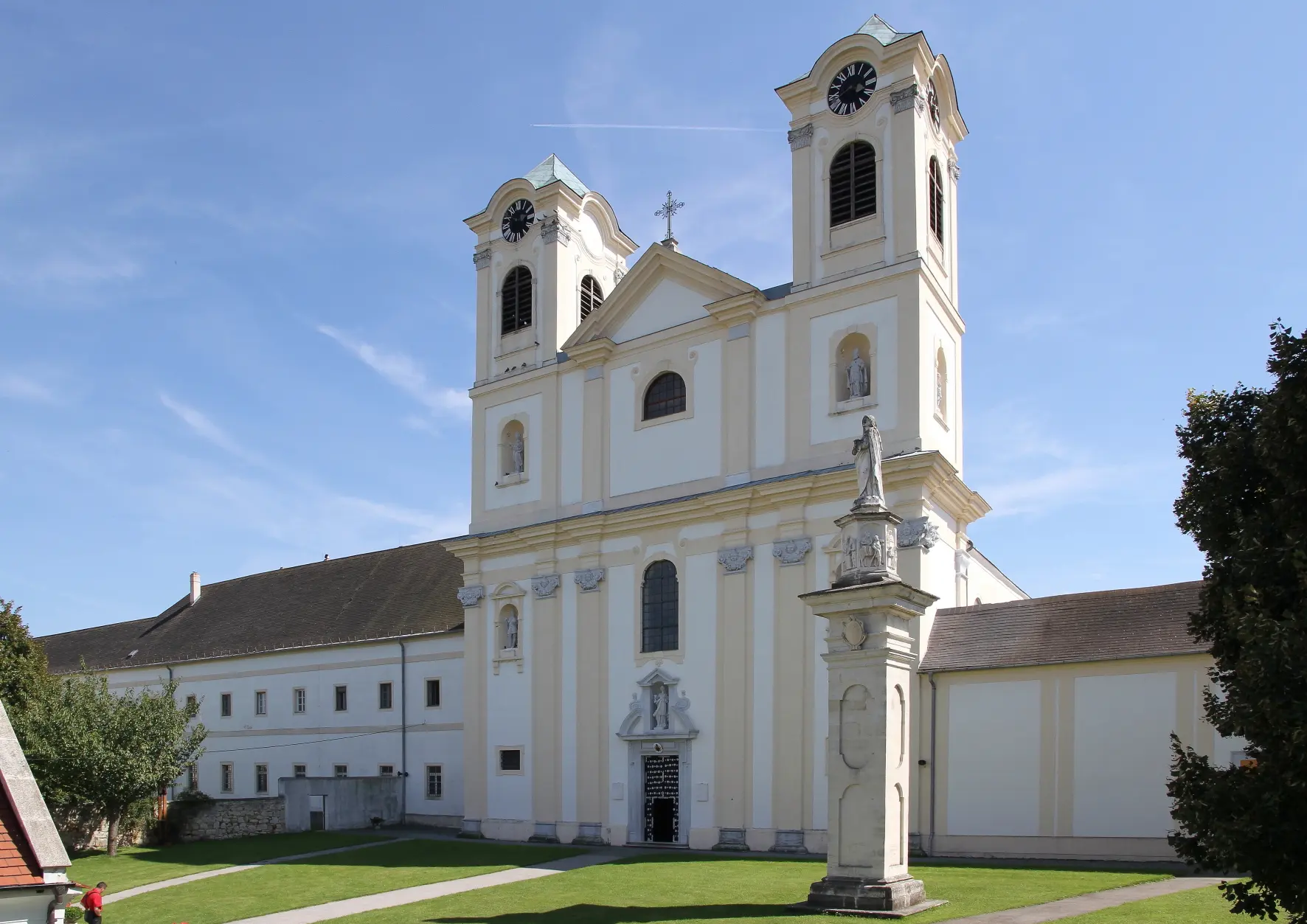
Visit essentials
A quick read before you go
- Duration
- A meaningful visit requires forty-five minutes to one and a half hours, allowing time for the…
- Etiquette
- As an active pilgrimage basilica, Maria Loretto expects respectful behavior appropriate to a…
Overview
Loretto began sacred. In 1644, a feudal lord returned from Italy's Loreto shrine and commissioned a replica Black Madonna with a chapel to house her. An entire village grew to serve pilgrims seeking her protection; Loretto exists because of the pilgrimage, not the reverse.
During the 1683 Turkish siege, invaders burned the church at four corners, razed the monastery, and destroyed the Servite brothers' work. The Black Madonna, carried to Forchtenstein Castle for safekeeping, returned to a community determined to rebuild.
The resulting baroque basilica surrounds pilgrims with frescoes and stucco, while its hushed, intimate Grace Chapel draws inward. Both spaces centre the dark-faced Madonna who has watched over the land for nearly four centuries. In 1997, Rome elevated the church to Basilica minor, formally recognizing what local faithful already knew: something here persists and remains worth the journey.
Sites inside
Why this place is sacred
The Loreto devotion reaches back to one of Christianity's most persistent traditions. In the Italian town of Loreto stands what Catholic teaching holds to be the Holy House itself, the dwelling where Mary received the Annunciation and where Jesus spent his childhood. According to tradition, angels transported this house from Nazareth to protect it from destruction. The shrine became one of Europe's greatest pilgrimage destinations.
When Rudolf von Stotzingen visited Loreto in 1644 and commissioned a replica of its Black Madonna for his Austrian lands, he was not merely building a local shrine. He was creating a branch of a devotion that connected his corner of Burgenland to the heart of Marian Christianity. The chapel he built, and the monastery that followed, became a node in a vast web of pilgrimage.
But history gave Loretto something the Italian original could not claim. A fire destroyed the statue in the Loreto sanctuary, and what stands there now is a later replacement. The Burgenland Black Madonna, crafted in 1644, now ranks among the oldest surviving copies, predating what is currently venerated at the source. The replica has become, in a sense, more original than the original.
The Turkish siege of 1683 added another layer. When the Ottoman army marched toward Vienna, passing through Burgenland, the Madonna was rushed to Forchtenstein Castle for protection. The church burned. The monastery fell. Yet the statue returned to a community that rebuilt around her. That survival became part of her meaning.
During the plague epidemic of 1713, pilgrims surged to Loretto seeking protection and healing. What they found, whether grace or placebo or something between, was enough to establish the site permanently in the regional imagination. The plague passed. The pilgrimage continued.
In 2016, renovation workers discovered a three-hundred-year-old statue of Mary buried beneath the altar of the Grace Chapel. Her head had been cut off during the Turkish destruction; her Christ Child was missing. Yet she had been wrapped in sand and hidden, preserving her original colors for centuries. She is wound within wound, survival within survival. The thinness at Loretto is not mystical abstraction but material fact: things endure here that should not have endured.
Rudolf von Stotzingen built the first Loreto Chapel in 1644 as an act of personal devotion following his transformative visit to the Italian shrine. Within four years, Servite friars came to tend the chapel. By 1651, Count Franz Nadasdy had laid the foundation stone for a much larger church with an attached monastery. The project was explicitly designed as a pilgrimage center: a place where the faithful could encounter the Holy House tradition without traveling to Italy.
The entire village that grew around the site existed to support this purpose.
The destruction of 1683 was total. Turkish forces set fire to the church at four separate points, leaving ruins where the Servite monastery had stood. But the community rebuilt, completing the reconsecration in 1707 and the full basilica by 1720. The plague of 1713 brought waves of new pilgrims, expanding the site's reputation beyond local devotion.
The Servites returned to the monastery in 1926, serving until 1956. Through changes of religious order and political regime, through two world wars and Austria's shifting borders, the pilgrimage continued. In 1997, Pope John Paul II elevated the church to Basilica minor, placing it among the Catholic world's specially honored sanctuaries.
Today, approximately one hundred thousand pilgrims visit annually. For a village of five hundred people, this represents a two-hundred-fold multiplication of presence at pilgrimage peaks. The site has moved from local shrine to regional center to internationally recognized basilica, but the core remains unchanged: a Black Madonna in her Grace Chapel, and the faithful who come seeking her gaze.
Experience and orientation
The basilica announces itself through scale. Northern Burgenland is not a landscape of grand gestures, and the church rises against its surroundings with unmistakable presence. Inside, baroque ambition unfolds across every surface: frescoes covering the vaulted ceiling, stucco work framing windows and altars, a high altar of considerable splendor. The effect is meant to overwhelm, and it does. Some visitors find themselves speechless not from devotion but from sensory saturation.
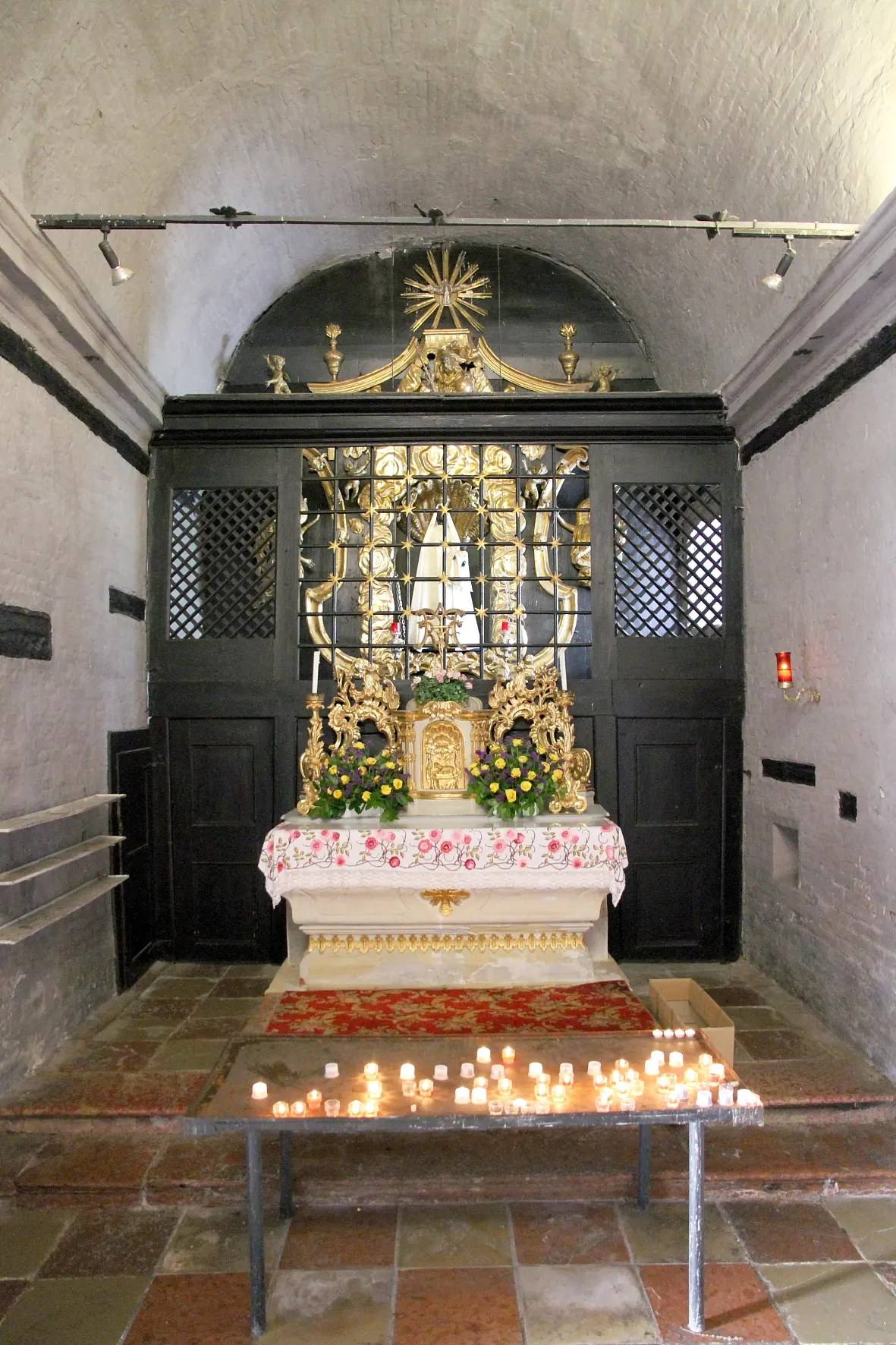
The Grace Chapel offers something entirely different. Separated from the main church, smaller and more concentrated, it holds the Black Madonna who is the reason for everything else. The transition from basilica to chapel enacts a kind of stripping away. The grandeur falls behind. What remains is a dark-faced mother and child, surrounded by the prayers of four centuries.
Visitors consistently report a quality of stillness in this space that differs from mere architectural quiet. The word protection appears repeatedly in accounts, perhaps unsurprising for a Madonna who survived what should have destroyed her. Those who come during life difficulties often describe feeling, for the first time in weeks or months, that something is holding them.
Whether this is the accumulated weight of centuries of prayer, psychological response to the chapel's intimacy, or something beyond either explanation, the pattern is consistent.
The Madonna's darkness carries its own resonance. Black Madonnas throughout Europe evoke interpretations ranging from the practical (candle smoke, aging varnish) to the theological (reference to the Song of Songs' dark and comely beloved) to the esoteric (earth goddess, hidden feminine divine). In the Grace Chapel, lit by candles, the dark face seems to absorb light rather than reflect it. She does not perform holiness. She is simply there, as she has been there since 1644, watching.
Consider arriving during the relative quiet of a weekday morning, when the pilgrimage crowds have thinned. Begin in the main basilica; let its grandeur do its work. Then move to the Grace Chapel. The architectural descent is deliberate. You are meant to shed layers between one space and the other.
In the chapel, sit before the Madonna. You need not pray in any formal sense. You need not believe anything in particular about her power or presence. But consider bringing whatever weighs on you, not to demand intervention but to place it somewhere. The faithful have been placing their burdens here since 1644. Some things persist because they serve a purpose.
The monastery cloister, if accessible, offers space for walking contemplation after the intensity of the chapel. The contrast between interior encounter and exterior air is worth experiencing slowly.
Context and lineage
The story begins in 1431 with a modest Johannes Chapel on this land, likely destroyed during the Turkish invasion of 1529. When Rudolf von Stotzingen, feudal lord of Hornstein, traveled to Italy and visited the Loreto shrine, he returned transformed. In 1644 he commissioned a replica of the Black Madonna and built a Loreto Chapel near Stotzing to house her.
Word spread quickly. The Servite Order, dedicated to serving Mary, arrived in 1648 to tend the growing pilgrimage. By 1651, Count Franz Nadasdy was laying the foundation stone for a grander church with an attached monastery. On July 2, 1659, the church was solemnly consecrated in the presence of a Cardinal, Hungarian high nobility, and twenty thousand faithful. An entire village had emerged to support what one man's devotion had begun.
The Ottoman siege of 1683 should have ended everything. The main Turkish army set out on July 7; by July 13, Loretto was burning at four separate points. Church and monastery collapsed into ruin. But the Black Madonna had been carried to Forchtenstein Castle six days earlier. She watched from safety as her home was destroyed.
The community rebuilt. On May 24, 1707, the reconstructed church was reconsecrated. By 1720, the basilica we see today was complete. When the plague of 1713 struck, pilgrims flooded to Loretto seeking the Madonna's protection. Whatever they found there, enough of them survived to establish the site permanently as a place of refuge and healing.
The Servite Order arrived in 1648, within four years of the chapel's founding. They served the growing pilgrimage through its first flourishing and its near-destruction. After the 1683 devastation, the community rebuilt under their guidance, completing the work by 1720.
The Servites returned to the monastery from 1926 to 1956, a period spanning Austria's annexation, World War II, and postwar occupation. Today, diocesan clergy serve the basilica, maintaining the pilgrimage that continues unbroken.
The site's evolution from private chapel to regional center to internationally recognized basilica reflects both the persistence of Marian devotion and the site's genuine capacity to draw pilgrims. The 1997 elevation to Basilica minor placed Maria Loretto among the Catholic world's specially honored churches, a formal recognition of what had been evident for centuries.
Rudolf von Stotzingen
founder
Feudal lord of Hornstein who, after visiting the Loreto shrine in Italy in 1644, commissioned the Black Madonna replica and built the original Loreto Chapel. His act of personal devotion created the pilgrimage that would generate an entire village.
Count Franz Nadasdy
patron
Hungarian noble who laid the foundation stone for the expanded church and monastery in 1651, transforming a small chapel into a major pilgrimage site. His patronage enabled the grandeur that still characterizes the basilica.
The Black Madonna
sacred object
The 1644 replica of the Loreto Madonna, now one of the oldest surviving copies of the image. Saved during the 1683 Turkish destruction, she is the center of the pilgrimage and resides in the Grace Chapel.
Servite Order
custodians
The Order of Servants of Mary, who began serving the chapel in 1648 and returned in 1926-1956. Their charism of Marian devotion shaped the site's spiritual character.
Traditions and practice
Traditional Catholic practices at Maria Loretto center on Marian devotion within the framework established by the Loreto tradition. Pilgrims came seeking the Madonna's intercession for protection, healing, and guidance. During the 1713 plague, many sought specifically medical protection, placing their physical welfare in her care.
The structure of pilgrimage follows familiar Catholic patterns: the journey itself as spiritual act, arrival at the site, prayer before the sacred image, participation in mass, perhaps lighting candles or making offerings, departure transformed. The Grace Chapel serves as the focal point where this encounter intensifies.
Regular masses take place in the basilica; check local schedules for current times. Pilgrimage services occur throughout the liturgical year, with particular intensity around Marian feast days. Approximately one hundred thousand pilgrims visit annually, creating a rhythm of devotion that pulses through the site.
Visitors may light candles, write prayer intentions, and sit in contemplation before the Black Madonna. The Grace Chapel is small enough that presence there feels intimate even when others share the space. Many visitors report that the transition from the grand basilica to the focused chapel enacts a kind of spiritual narrowing, bringing them from spectacle to encounter.
Enter through the main basilica first. Let the baroque grandeur work on you as it was designed to do. Then move to the Grace Chapel. Sit before the Black Madonna. You need not pray formally if formal prayer does not suit you. Simply be present with whatever you have brought.
If you are carrying something heavy, a decision or a loss or a fear, consider placing it before her. Not demanding intervention, but acknowledging that you have reached a place where others have placed heavy things for nearly four centuries. Something about that accumulation has meaning.
Before leaving, walk the monastery grounds if accessible. The shift from interior intensity to exterior space is worth experiencing deliberately. Consider returning a second time if your visit allows. What is noticed on a second encounter often differs from the first.
Roman Catholicism
ActiveThe Basilica Maria Loretto is the most important Marian pilgrimage center in northern Burgenland, receiving approximately one hundred thousand pilgrims annually. It was elevated to Basilica minor by Pope John Paul II in 1997, placing it among the Catholic world's specially honored sanctuaries. The village of Loretto itself was built in the 17th century to support the monastery and pilgrimage site, making it one of the few Austrian villages named after a devotional tradition.
Regular Catholic masses, pilgrimage services, Marian devotions, veneration of the Black Madonna in the Grace Chapel, feast day celebrations. The liturgical calendar shapes the site's rhythm, with particular intensity around Marian feasts.
Loreto Devotion
ActiveThe pilgrimage site replicates the Holy House of Loreto in Italy, traditionally believed to be the dwelling where Mary received the Annunciation. Remarkably, the Italian original's statue was destroyed in a fire, making the 1644 Loretto Burgenland Black Madonna one of the oldest surviving copies, predating the current Italian replacement.
Veneration of the Black Madonna, pilgrimage, prayer for protection. Historically, the site was sought particularly during times of danger: plague, war, personal crisis. The practice connects local devotion to the broader European network of Loreto shrines.
Perspectives and open questions
The Basilica Maria Loretto invites interpretation from multiple angles. Historians see a Counter-Reformation pilgrimage site exemplifying Marian devotion in Habsburg territories. Catholic faithful encounter a living sanctuary where the Black Madonna continues to intercede. Those drawn to Black Madonna traditions find layers of meaning in the dark-faced image. Each perspective illuminates something genuine; none exhausts the site's significance.
Scholarly perspective
Historical consensus views Maria Loretto as a product of Counter-Reformation Marian devotion spreading from Italy through Habsburg lands. The creation of an entire village to support a monastery and pilgrimage site demonstrates the economic and social power of 17th-century Catholic devotional movements. The site's survival through Ottoman destruction and subsequent flourishing during the 1713 plague illustrates how sacred sites adapt to historical trauma, often emerging strengthened.
The 1644 Black Madonna now holds additional historical interest as one of the oldest surviving replicas of the Loreto image, predating the current Italian replacement. The 2016 discovery of the desecrated statue beneath the altar provides material evidence of the 1683 destruction and the community's determination to protect sacred objects even when unable to save them intact.
Living and traditional perspectives
For Catholic faithful, Maria Loretto is a place of active Marian devotion within the Loreto tradition. The Black Madonna is not historical artifact but living intercessor. The site's survival through Turkish destruction and its role as refuge during plague are not merely historical facts but evidence of Mary's protection over those who seek her.
The Grace Chapel is the heart of this understanding: a space where the faithful can bring their concerns to the Mother of God and trust in her intercession. The baroque splendor of the main basilica expresses the community's devotion, but the intimate chapel is where encounter happens.
Alternative interpretations
Black Madonna traditions have generated interpretive frameworks beyond mainstream Catholic understanding. Some see in these dark-faced images a preservation of pre-Christian goddess veneration within Catholic devotion. The darkness is connected to earth symbolism, the hidden feminine divine, aspects of the sacred that mainstream Christianity has underemphasized.
These interpretations are not endorsed by Church teaching, but they point toward something visitors often sense: that the Black Madonna carries resonance beyond conventional Marian imagery. Her darkness seems to absorb rather than reflect, to receive rather than project. Whatever theological framework one brings, the phenomenological experience of presence before her differs from encounter with lighter-faced Madonnas.
Open questions
The 2016 discovery raises questions about what else might remain hidden. The desecrated statue, wrapped in protective sand beneath the altar, survived three centuries. Its original colors preserved, its wounds from 1683 still visible, it suggests the possibility of other objects buried during the destruction and never recovered.
The specific devotional practices of the early pilgrimage are only partially documented. What exactly brought twenty thousand faithful to the 1659 consecration? What experiences during the 1713 plague established the site's reputation for protection? The historical record tells us outcomes but not the texture of encounter.
Plan your visit
Access and arrival
Limited accommodations exist in Loretto itself; most visitors stay in nearby Eisenstadt or make day trips from Vienna. The small village scale means the pilgrimage infrastructure is concentrated at the basilica rather than spread through town.
Respectful visit
Modest attire appropriate for a Catholic basilica. Shoulders and knees should be covered. This is not enforced with the strictness of some Italian churches, but respect for the space is appreciated.
Generally permitted in the basilica with discretion. Flash should be avoided. In the Grace Chapel, photography should be minimal or avoided entirely, particularly when others are present at prayer. The priority is encounter, not documentation.
Candles may be purchased and lit as offerings. Prayer intention books are typically available. These are the appropriate channels for offerings; leaving objects at the altar or around the Madonna is not customary.
The site is open to all visitors. Maintain reverent silence in the Grace Chapel. During masses and pilgrimage services, participate appropriately or wait outside until the service concludes.
This is an active pilgrimage site. Visitors during mass or pilgrimage services should maintain appropriate reverence. The Grace Chapel in particular is a devotional space, not a museum exhibit. Photography may be permitted but should be practiced with discretion, particularly when others are at prayer.
Current practical details
Address
Hauptpl. 22, 2443 Loretto, Austria
Phone
Hours, fees, and access can change — verify on the official source before you travel. Practical details last checked Jun 2026.
Location
Map loads as you approach this section.
Pilgrim reflections
A portrait of encounter, not a score
Pilgrims describe what they felt, how present they could become, and whether the place would shape a journey. There are no stars and no ranking of traditions.
No reviewed reflections yet
The first pilgrims can help describe the character of being here.
Share a reflection
Available after an account-backed “Been there.” Every reflection is reviewed before publication.
Nearby sacred places
Explore other sacred places in the region. Proximity does not establish access or travel time; check each place’s guidance.
Black Madonna of Loretto Burgenland
Loretto, Burgenland, Austria
0.0 km away
Black Madonna of Kaltenleutgeben
Kaltenleutgeben, Lower Austria, Austria
32.5 km away
Parish Church of Saint James, Kaltenleutgeben
Kaltenleutgeben, Lower Austria, Austria
32.5 km away

Heiligenkreuz Abbey
Heiligenkreuz, Heiligenkreuz, Lower Austria, Austria
32.6 km away
References
Sources consulted for this page. Source categories describe the publication, not a guarantee that every claim is verified. Traditional accounts and outside interpretations may differ.
- 01Basilika and church of pilgrimage Maria Loretto — Burgenland TourismofficialOfficial regional tourism site
- 02Basilika Maria Loretto im Burgenland — Wikipedia (German)encyclopediaDetailed German Wikipedia article
- 03Basilika Maria Loretto, Loretto, Burgenland, Austria — GCatholic.orgSource contextOfficial Catholic church database
- 04Black Madonna in Loretto, Burgenland, Austria — Interfaith Mary PageSource contextComprehensive Black Madonna reference site
- 05Maria Loretto Basilica in Burgenland — Second.wikiencyclopediaHistorical details about founding
- 06Loretto — Best of BurgenlandSource contextRegional tourism information
Share a photo
Help visitors recognize Basilica of Maria Loretto in Burgenland. Every submission is reviewed before publication.