St. Cybi’s Church
Where Roman walls became the enclosure for Celtic Christianity on the edge of Wales
Holyhead, Wales, United Kingdom
Visit essentials
Before you go
- Access
- St Cybi's Church is located on Market Square in central Holyhead.
- Address
- Stanley St, Holyhead LL65 1HG, UK
- Duration
- Allow 30 minutes to an hour for the church and churchyard.
- Etiquette
- St Cybi's is an active place of worship.
Overview
Something in the human instinct for the sacred prefers to build upon what came before. When St Cybi arrived at this headland in 540 AD, the Roman fort that would become his home had stood abandoned for perhaps a century. The legions were gone, but their walls remained, three-sided and facing the sea, built to protect a landing place that no longer needed military protection.
King Maelgwn Gwynedd gave Cybi the fort. What the Romans had built for war became the enclosure for a monastery. The transition was not merely practical but theological: Christian sanctity filling the shell of imperial power, the cross rising where standards had stood.
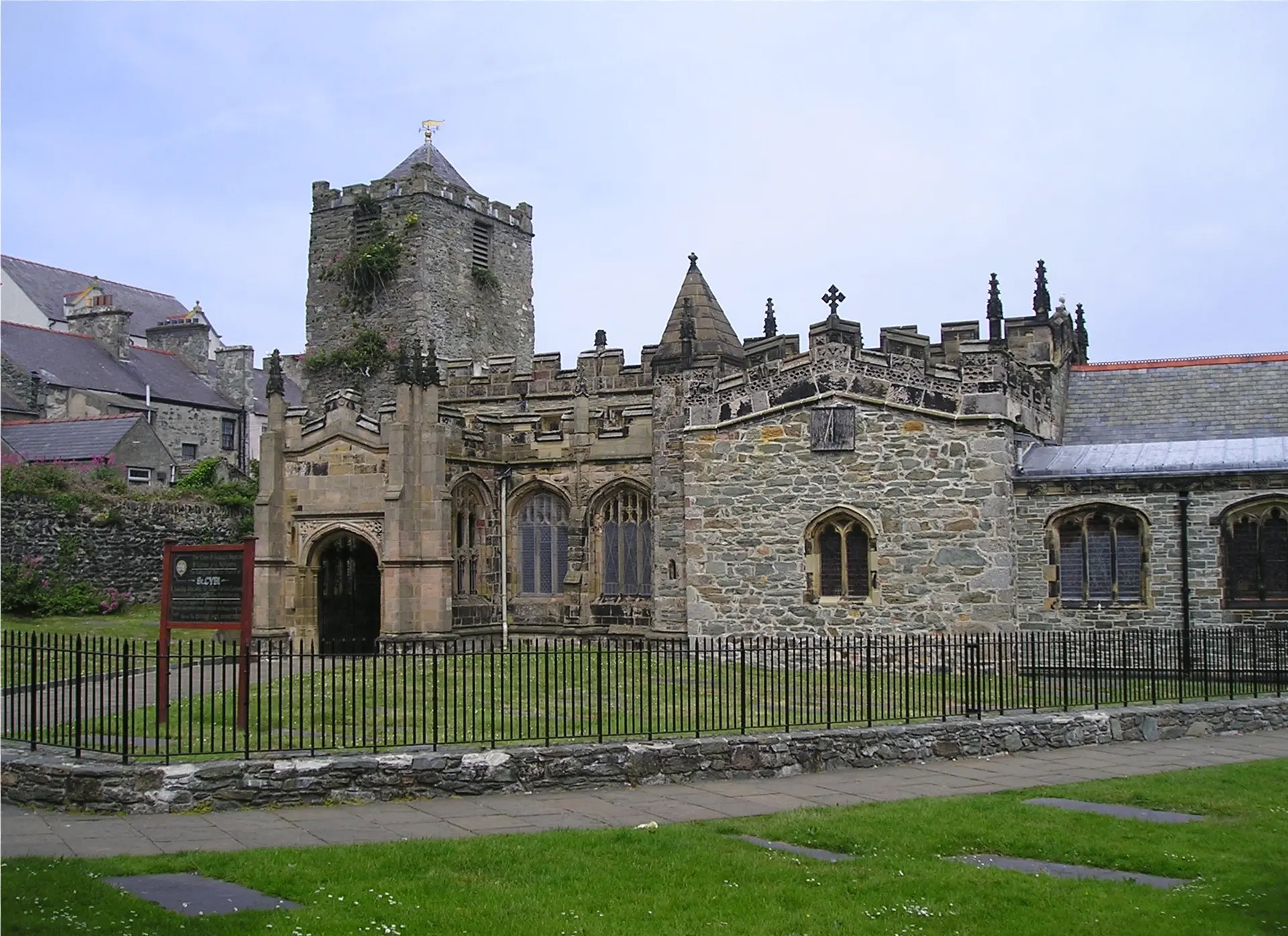
Fifteen centuries later, the arrangement persists. You enter the churchyard through the Roman walls, walking ground that Roman soldiers walked, approaching a church that holds the memory of a Celtic saint. The current building dates primarily from the late fifteenth century, but the site's significance reaches back through Cybi to Rome and beyond. A small chapel within the enclosure, Eglwys y Bedd, may mark where Cybi himself was first buried.
Holyhead has become a ferry port, a transit point between Wales and Ireland. The church waits amid the traffic, offering what it has always offered: continuity, depth, a reminder that some purposes outlast the passing of empires.
Why this place is sacred
The thin place quality here differs from wild wells or remote mountain shrines. This is civilizational thinness, the kind that accumulates when layer builds upon layer without erasure. The Roman walls do not contradict the Christian church; they contain it, as though the fort's defensive purpose transformed but did not disappear.
Cybi was a wandering saint, born in Cornwall, trained in the monastic life, traveling in search of the place where he was called to settle. Arriving at Holyhead in 540, he found the abandoned fort and recognized in it something that suited his purpose. The king's gift formalized what Cybi already knew: this place was ready for its next use.
The transition from fort to monastery was not unique in the post-Roman world, but few examples survive so clearly. At St Cybi's, the Roman walls still stand to significant height, forming the churchyard boundary, their construction visible and distinct from the medieval church they surround. You can touch stones that Roman hands laid in the fourth century, then turn and touch carved wood from the fifteenth. The continuity is tactile.
Eglwys y Bedd, the small chapel within the enclosure, adds another dimension. Its name means Church of the Grave, and tradition holds it marks Cybi's original burial place. If so, the saint lies within the fort he sanctified, his remains adding another layer to what the place holds.
The Romans built Caer Gybi as a coastal fortification, one of a series protecting Britain's western approaches. Its unusual three-sided design, open to the sea, suggests it defended a landing place rather than a land route. The fort dates to the fourth century, near the end of Roman Britain, and was likely abandoned when the legions withdrew in 410 AD. For perhaps a century, the walls stood empty before Cybi arrived.
Cybi's monastery flourished through the early medieval period, part of the network of Celtic Christian foundations that connected Wales to Ireland, Cornwall, and Brittany. The present church dates primarily to 1480-1520, rebuilt on a grander scale to reflect the importance of Cybi's cult. During the Civil War, Cromwell's forces raised the tower as a lookout post, adding military purpose to sacred space once more. George Gilbert Scott restored the church in 1877-79, preserving its medieval character.
Today, St Cybi's serves as an active parish church within the Church in Wales, maintaining fifteen centuries of continuous worship on this site.
Experience and orientation
The approach shapes the experience. Holyhead is a working port town, ferries coming and going to Ireland, traffic moving through on its way elsewhere. The church sits in this transit, reached through an archway from Market Square. Pass through that arch and the world shifts. The Roman walls rise around you, and the noise of the town recedes.
The churchyard has the quality of enclosure that ancient walls provide: a sense of being held, protected, set apart. The walls are not decoration but structure, massive stones that have stood for seventeen centuries. Walking the perimeter, you trace the outline of the Roman fort, understanding through your feet what maps can only approximate.
The church interior offers its own layer of encounter. Medieval carvings, Victorian restoration, and ongoing worship combine without contradiction. Services continue here as they have since Cybi's time, and the building holds that continuity in ways that empty ruins cannot. This is not a museum but a church, and the difference matters.
Eglwys y Bedd, the small chapel that may mark Cybi's grave, invites particular attention. Its simplicity contrasts with the main church, recalling the early monastic settlement that Cybi founded. Those who take time here often report a quality of stillness distinct from the rest of the enclosure.
Enter through the archway from Market Square and pause to take in the Roman walls before approaching the church. Walk the perimeter of the churchyard first, letting your hand touch the ancient stonework if you wish. Notice where Roman construction gives way to medieval repair and later addition.
Inside the church, find the medieval carvings and give them time. They reward close attention. If Eglwys y Bedd is accessible, spend time there; its simplicity offers something different from the main church.
Consider the journey that brought you here. For centuries, this was the point where travelers between Wales and Ireland passed. The church has witnessed countless comings and goings. What are you passing through?
Context and lineage
Cybi was born in Cornwall around 480 AD, into a family connected to local nobility. He chose religious life early, traveling to study and practice the monastic disciplines that characterized Celtic Christianity. His journeys took him through Wales, where he founded or influenced several churches before arriving at Holyhead.
The abandoned Roman fort presented both practical advantage and symbolic opportunity. Its walls offered protection; its Roman origin offered a stage for demonstrating that Christianity had succeeded where empire had failed. King Maelgwn Gwynedd, a powerful but controversial ruler, granted Cybi the fort for his monastery, perhaps seeking the saint's prayers or the prestige of patronizing a holy man.
Cybi died in 554 AD and was likely buried first at Eglwys y Bedd before his relics were translated to a more prominent shrine. That shrine was lost when Henry IV's forces raided the church during a Welsh uprising, carrying away whatever treasures remained. The church continued without the relics, its sanctity rooted in place rather than object.
St Cybi's monastery continued through the early medieval period, contributing to the Christian culture of Wales. The Viking raids of the ninth and tenth centuries disrupted many Celtic foundations, but the site persisted. The present church, built 1480-1520, reflects the late medieval investment in sacred architecture that preceded the Reformation. Post-Reformation, the church continued as a Protestant parish, maintaining worship within the ancient enclosure.
Today, St Cybi's is part of the Church in Wales, the Anglican communion's Welsh branch, continuing the tradition of Christian worship that Cybi initiated nearly fifteen centuries ago.
St Cybi
founder
A Cornish-born Celtic saint who founded his monastery at Holyhead in 540 AD. Cousin of St David, patron of Wales, Cybi represents the network of Celtic saints who established Christianity across the Celtic lands. His feast day is November 8.
King Maelgwn Gwynedd
patron
The sixth-century king who gave Cybi the Roman fort for his monastery. Maelgwn is remembered as both powerful and controversial, praised by some sources and condemned by others. His patronage of Cybi suggests his desire for the church's blessing.
St David
associated_saint
Patron saint of Wales and Cybi's cousin. The connection between these two saints links Holyhead to the broader network of Celtic foundations that shaped Welsh Christianity.
Traditions and practice
Cybi's monastery would have followed the patterns of Celtic Christian practice: daily offices of prayer, communal work, study of scripture, and hospitality to travelers. The monastic community likely maintained prayers at the canonical hours, the rhythm of worship that structured medieval religious life.
Medieval pilgrims came to venerate Cybi's relics and seek his intercession. The loss of the relics during Henry IV's reign ended this formal pilgrimage, but the church continued to attract those who honored the saint's memory.
The church holds regular services according to the Church in Wales calendar. Sunday worship, along with occasional weekday services and special celebrations, continues the tradition of prayer on this site. Visitors not attending services are welcome during opening hours to explore the church and contemplate the layers of history it holds.
The churchyard, enclosed by Roman walls, is accessible during daylight hours regardless of whether the church is open. Walking the perimeter, touching the ancient stones, and sitting in the enclosure are practices available to any visitor.
If possible, attend a service. The experience of worship in a fifteen-century-old tradition, within a Roman enclosure, offers something that tourism alone cannot provide. Even if the liturgy is unfamiliar, the accumulated weight of prayer in this place is palpable.
If visiting outside service times, begin at the Roman walls. Let your hand touch the stonework. Then approach the church slowly, noticing the transition from Roman to medieval construction. Inside, find the medieval carvings and give them attention. Before leaving, spend time at Eglwys y Bedd if accessible.
Consider what continuity means to you. This place has held human intention through the fall of Rome, the coming of the saints, the Reformation, the modern age. What persists through your own life's changes?
Celtic Christianity
ActiveSt Cybi was one of the great Celtic saints of the sixth century, cousin to St David and part of the network of holy men and women who established Christianity across the Celtic lands. His foundation at Holyhead represents the Celtic church's capacity to sanctify existing structures, transforming Roman military infrastructure into monastic enclosure. The tradition of Celtic Christianity continues to inform Welsh Christian identity.
The original monastic community would have followed daily offices of prayer, communal work, and hospitality. Contemporary practice includes regular Church in Wales services, pilgrimage visits to the site, and the observance of St Cybi's feast day on November 8.
Anglican/Church in Wales
ActiveFollowing the Reformation, St Cybi's continued as a parish church within the reformed tradition, eventually becoming part of the Church in Wales when Wales was disestablished in 1920. The church maintains the Protestant inheritance of Welsh Christianity while honoring its pre-Reformation roots. The building serves as the primary worship space for Holyhead's Anglican community.
Regular Sunday worship, occasional weekday services, baptisms, weddings, funerals, and holy day observances according to the Church in Wales calendar. The church also welcomes visitors seeking to explore its historical and spiritual significance.
Perspectives and open questions
St Cybi's Church invites interpretation from multiple angles: as an archaeological site preserving rare Roman military architecture, as a monument to Celtic Christianity's sanctification of Roman infrastructure, and as an active parish maintaining fifteen centuries of worship. Each perspective reveals genuine significance.
Scholarly perspective
Archaeological and architectural historians recognize St Cybi's for the exceptional survival of its Roman fort walls. Caer Gybi is one of few Roman landing-place forts surviving in Europe, its three-sided design reflecting its coastal defensive purpose. The church itself preserves significant late medieval architecture, including carved woodwork and stonework from the 1480-1520 rebuilding. The site demonstrates the transition from Roman to post-Roman to medieval Britain with unusual clarity, a palimpsest readable in stone.
Living and traditional perspectives
For those who hold the tradition of Celtic Christianity, St Cybi's represents the sanctification of imperial power for sacred purpose. Cybi, like many Celtic saints, took what the world offered and transformed it. The Roman walls became the enclosure for prayer; the military installation became a monastery. This pattern, repeated across post-Roman Britain, represents Christianity's capacity to redeem rather than merely reject. The church continues this work, maintaining the tradition Cybi began.
Alternative interpretations
Some visitors understand the site through the lens of ley lines or sacred geometry, noting the transition from military to sacred use as evidence of the location's inherent power. The continuity of human intention focused on this spot for seventeen centuries invites such interpretation, even if the specific frameworks lack historical support. The consistency of reports about the place's atmosphere suggests something worth attending to, whatever vocabulary one uses to describe it.
Open questions
Genuine mysteries remain. What happened to Cybi's shrine when Henry IV's forces raided the church? What was the nature of any pre-Roman sacred use of this headland? How did the transition from fort to monastery actually unfold, and how long did the walls stand empty before Cybi arrived? The historical record is silent on many details, leaving space for imagination to fill what documents cannot reach.
Plan your visit
Access and arrival
St Cybi's Church is located on Market Square in central Holyhead. Enter through the archway from the square. Holyhead is the terminus of the North Wales Main Line, with trains from Bangor and beyond. Irish Ferries and Stena Line operate from Holyhead Port to Dublin. By road, Holyhead is reached via the A55, crossing Anglesey on the Britannia Bridge.
Holyhead offers a range of accommodations from budget to mid-range hotels, serving ferry passengers and visitors to Anglesey. For a wider selection, Bangor (30 minutes by train) or Beaumaris on Anglesey's east coast provide alternatives.
Respectful visit
Dress modestly, as appropriate for a church. Bare shoulders or very casual beachwear would be inappropriate, particularly during services.
Photography is permitted in the church and churchyard, but use discretion. Do not photograph during services without explicit permission. Flash photography may be restricted inside the church. The Roman walls and exterior are freely photographable.
Donations to support the church's maintenance are welcome. A donation box is typically available inside. No offerings of objects are expected or traditional.
Check opening hours before visiting. The church may be closed for private events or maintenance. Climbing on the Roman walls is prohibited. Service times take priority; be prepared to adjust your visit accordingly.
The church has limited opening hours; check before visiting. Services take priority over tourism, so be prepared to wait or return if worship is underway. The Roman walls, while sturdy, are ancient structures; do not climb on them. Eglwys y Bedd may not always be accessible; inquire locally about access.
Current practical details
Address
Stanley St, Holyhead LL65 1HG, UK
Phone
Hours, fees, and access can change — verify on the official source before you travel. Practical details last checked Jun 2026.
Location
Map loads as you approach this section.
Pilgrim reflections
A portrait of encounter, not a score
Pilgrims describe what they felt, how present they could become, and whether the place would shape a journey. There are no stars and no ranking of traditions.
No reviewed reflections yet
The first pilgrims can help describe the character of being here.
Share a reflection
Available after an account-backed “Been there.” Every reflection is reviewed before publication.
Nearby sacred places
Explore other sacred places in the region. Proximity does not establish access or travel time; check each place’s guidance.
References
Sources consulted for this page. Source categories describe the publication, not a guarantee that every claim is verified. Traditional accounts and outside interpretations may differ.
- 01St Cybi's Church, Holyhead / Caergybi — British Pilgrimage TrustguidePilgrimage organization
- 02St Cybi's Church — WikipediaencyclopediaEncyclopedia entry
- 03Holyhead, St Cybi's Church — Britain ExpressSource contextHeritage tourism
- 04St Cybi's Church, Holyhead — History PointsofficialWelsh heritage information
Share a photo
Help visitors recognize St. Cybi’s Church. Every submission is reviewed before publication.