Penrhos Feiliw standing stones
A rare matched pair of Bronze Age standing stones on Anglesey's sacred isle
Holyhead, Wales, United Kingdom
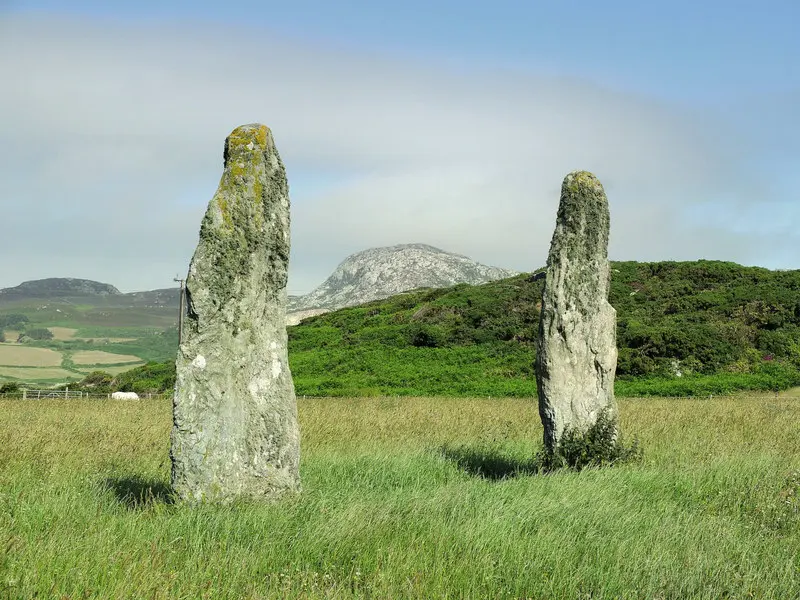
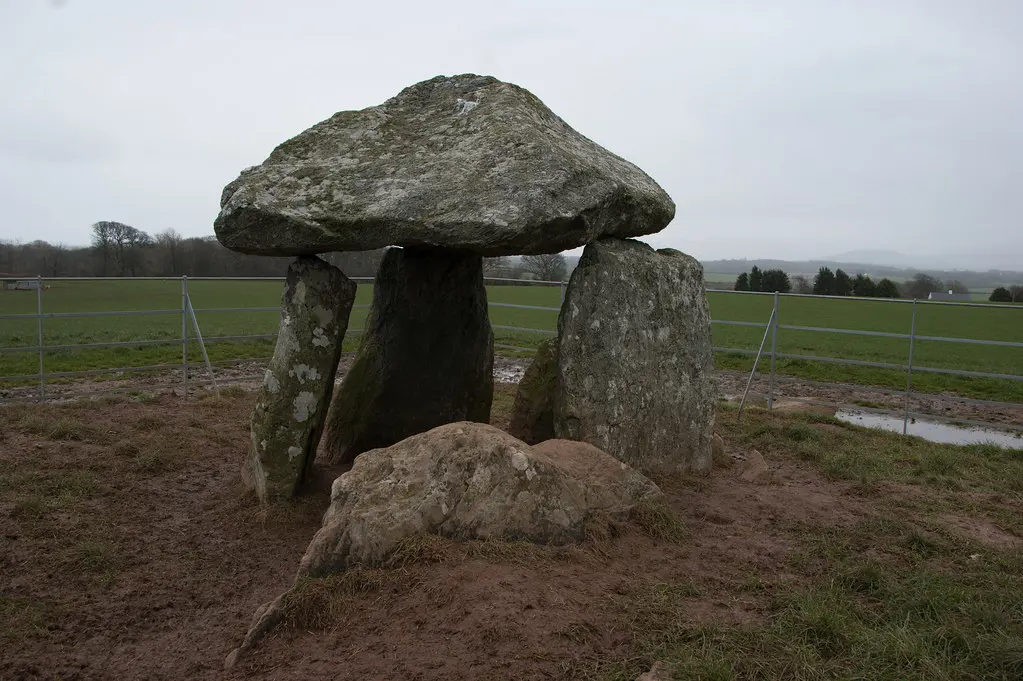
Image of Penrhos Feiliw standing stones. Image source · CC-BY-SA-2.0
Visit essentials
Before you go
- Access
- Located behind Plas Meilw farmhouse, reached by minor road from Trearddur Bay.
- Address
- Trearddur Bay, Holyhead LL65 2LU, UK
- Duration
- Twenty to thirty minutes at the stones.
- Etiquette
- Standard heritage site protocols apply.
Overview
The Penrhos Feilw Standing Stones present a puzzle found nowhere else on Anglesey. Two local-stone pillars, nearly identical in height, width, and profile, stand three meters apart in a natural saddle between low hills. Their careful matching suggests deliberate intent, though its meaning has not survived the four millennia since they were raised.
Where Holy Island's western hills drop toward the sea, the stones overlook Holyhead Mountain and, on clear days, Snowdonia's distant peaks. Archaeological evidence cannot determine whether Bronze Age builders intentionally aligned them with these landmarks or had unrelated purposes.
Tradition says a stone cist once found between the pillars held bones, spear heads, and arrow heads. If true, it suggests funerary significance, though the cist has vanished. The matched pair remains in a landscape containing over 120 prehistoric monuments and recognized as significant for at least five thousand years.
Why this place is sacred
What distinguishes Penrhos Feilw from other standing stone sites is the deliberate matching. Elsewhere, paired stones typically differ in size, shape, or orientation, often interpreted as representing dualities, perhaps male and female, or complementary aspects of a cosmology we cannot reconstruct. Here, the stones appear designed to mirror each other. This raises questions without providing answers.
Visitors often remark on the quality of light at the site. The western position on Holy Island means long evening shadows and views into sunset. The saddle position creates a sense of threshold, standing between the hills rather than on them. Some describe feeling observed, as if the matched stones were gatekeepers marking passage.
The broader landscape adds weight to individual experience. Anglesey holds one of the highest concentrations of prehistoric monuments in Britain, over 120 sites recorded. Holy Island, the smaller island to which Penrhos Feilw belongs, includes Holyhead Mountain's hut circles and multiple burial chambers. The Bronze Age peoples who raised these stones were not working in isolation but contributing to a landscape already marked as significant across generations.
The traditional account of a cist burial between the stones, if accurate, suggests the site held funerary significance. Finding bones alongside weapons implies a person of importance, buried with markers of status or power. This individual has vanished, the cist has vanished, but the stones that may have marked their grave remain.
Archaeological interpretation suggests the stones may have marked a burial site, based on traditional accounts of a cist found between them. The unusual matching of the pair suggests symbolic significance beyond mere funerary marking. The alignment north-northeast by south-southwest may relate to astronomical events, though this remains speculative.
No direct continuity connects Bronze Age practice with subsequent traditions. The stones became part of the estate of Plas Meilw Farm and are now under the care of Cadw, the Welsh heritage agency. They remain accessible to visitors seeking connection with Anglesey's prehistoric landscape.
Experience and orientation
Reaching Penrhos Feilw requires navigating narrow roads southwest of Holyhead. The journey itself provides context, passing through a landscape where prehistoric and modern exist in close proximity. Approaching the farmhouse, the stones become visible, two dark pillars rising from the saddle between hills.
At closer range, the matching becomes apparent. Each stone is roughly three meters high, a meter wide at the base, and remarkably thin in profile, perhaps twenty centimeters. They lean very slightly, different angles for each, accumulated adjustment over four millennia. Standing between them, you occupy the space where tradition places the vanished cist burial.
The view from the stones extends in multiple directions. Holyhead Mountain's distinctive profile rises to the north. On clear days, Snowdonia's peaks mark the eastern horizon. The sea lies west, beyond the intervening hills. Whether these sightlines mattered to the builders, or whether the saddle position served purposes unrelated to views, remains unknown.
The quality of encounter here differs from busier heritage sites. There are no interpretation panels, no marked path, no facilities. The stones simply stand as they have stood, requiring visitors to bring their own frameworks for understanding. This absence of explanation can be unsettling or liberating, depending on disposition.
Bring context with you, since the site offers none. Learn about Anglesey's prehistoric landscape before visiting. Note that the site is under Cadw care, making access straightforward. Allow time to sit with the stones rather than simply photographing them.
Context and lineage
No founding narrative survives for Penrhos Feilw. What archaeology reveals is that during the Early Bronze Age, someone or some community selected these two remarkably similar stones, transported them to this saddle, and raised them in alignment. The effort required suggests communal intention and resources.
The traditional account of a cist burial provides the closest thing to an origin story. Bones and weapons found between the stones would suggest a significant individual, perhaps a leader or warrior, commemorated through monument building. Without the physical evidence of the cist, this tradition cannot be verified but represents how later communities understood the site.
Penrhos Feilw belongs to the Bronze Age tradition of standing stone pairs found across Britain and Ireland. Such monuments typically date between 2500 and 1500 BCE. Unlike most paired stones, which differ in size or shape, the matching at Penrhos Feilw appears deliberate. Whether this reflects a regional variation, a specific symbolic purpose, or individual builder choice cannot be determined.
Traditions and practice
Original practices cannot be determined. If the cist burial tradition is accurate, the site may have served funerary commemoration. The alignment and position may relate to astronomical observation or sightline marking. What specific ceremonies, if any, took place here remains unknown.
Visitors today come primarily from archaeological or historical interest. Some may engage in personal contemplation or meditation. There is no organized practice associated with the site.
Approach the site with patience, allowing the narrow roads and rural setting to slow your pace before arrival. Once at the stones, take time to observe from multiple angles. Stand between the stones and notice the views in each direction. Consider what matching two stones so precisely might have meant to those who did so.
Bronze Age Religion
HistoricalThe stones represent Early Bronze Age monument building on Anglesey, part of a densely populated sacred landscape with over 120 prehistoric sites.
Original practices cannot be reconstructed. Possible functions include funerary commemoration, territorial marking, and ceremonial gathering. The unusual matching suggests symbolic significance beyond mere function.
Perspectives and open questions
The unusual matching of these stones has generated various interpretations, from archaeological functionalism to symbolic readings. None can be definitively verified.
Scholarly perspective
Archaeologists recognize Penrhos Feilw as nationally important within the corpus of Bronze Age standing stones. The unusual matching of the pair has prompted various interpretations. Some suggest the stones marked a significant burial, supported by traditional accounts of the cist. Others propose astronomical alignment toward Holyhead Mountain or Snowdonia. The site may have served as a territorial marker or gathering point.
What seems clear is that the matching was deliberate and meaningful within a system of thought we cannot fully reconstruct.
Living and traditional perspectives
No Welsh tradition preserves memory of the stones' original purpose. The account of a cist burial represents the closest approach to traditional knowledge, though this cannot be verified archaeologically. Local understanding frames the stones as part of Anglesey's rich prehistoric heritage without claiming to explain their meaning.
Alternative interpretations
Some contemporary visitors interpret the stones as marking energy lines or cosmic alignments. The position in a saddle between hills, with views to significant mountains, supports such readings for those inclined to them. These interpretations are not supported by mainstream scholarship.
Open questions
The central mystery remains the matching itself. Why create two nearly identical stones? What did the pairing symbolize? Was the cist burial original to the monument or added later? These questions resist definitive answers.
Plan your visit
Access and arrival
Located behind Plas Meilw farmhouse, reached by minor road from Trearddur Bay. Free admission under Cadw. Limited parking. Not wheelchair accessible due to uneven terrain.
Holyhead offers range of accommodations. Trearddur Bay has holiday cottages and a hotel.
Respectful visit
No specific requirements. The approach can be uneven, so sturdy footwear is recommended.
Photographs are welcome. The thin profile of the stones makes them most dramatic when photographed from the side.
Leaving offerings is not traditional at this site.
Do not climb on stones. Do not dig or excavate. Do not disturb adjacent farm property.
The stones are a protected monument. Do not climb on them or attempt to excavate around them. Respect the adjacent farm property.
Current practical details
Address
Trearddur Bay, Holyhead LL65 2LU, UK
Hours, fees, and access can change — verify on the official source before you travel. Practical details last checked Jun 2026.
Location
Map loads as you approach this section.
Pilgrim reflections
A portrait of encounter, not a score
Pilgrims describe what they felt, how present they could become, and whether the place would shape a journey. There are no stars and no ranking of traditions.
No reviewed reflections yet
The first pilgrims can help describe the character of being here.
Share a reflection
Available after an account-backed “Been there.” Every reflection is reviewed before publication.
Nearby sacred places
Explore other sacred places in the region. Proximity does not establish access or travel time; check each place’s guidance.
References
Sources consulted for this page. Source categories describe the publication, not a guarantee that every claim is verified. Traditional accounts and outside interpretations may differ.
- 01Penrhos Feilw Standing Stones — CadwofficialOfficial Welsh heritage agency
- 02Penrhos-Feilw Standing Stones — The Megalithic PortalofficialComprehensive archaeological database
- 03Penrhos Feilw Standing Stones — WikipediaencyclopediaGeneral encyclopedia entry
Photo gallery
2 curated photos
Share a photo
Help visitors recognize Penrhos Feiliw standing stones. Every submission is reviewed before publication.