Son Real Necropolis
A Talayotic burial ground facing the sea in Mallorca
Understand sacred places, explore living traditions, and learn how to engage respectfully with Pilgrim Map.
Access has not been verified. Check current local guidance before planning a visit.
Santa Margalida, Balearic Islands, Spain
Read the sources
Visit essentials
A quick read before you go
- Duration
- Not precisely documented.
- Access
- On foot only, via a coastal path from Can Picafort or Son Bauló beach — there is no direct…
Overview
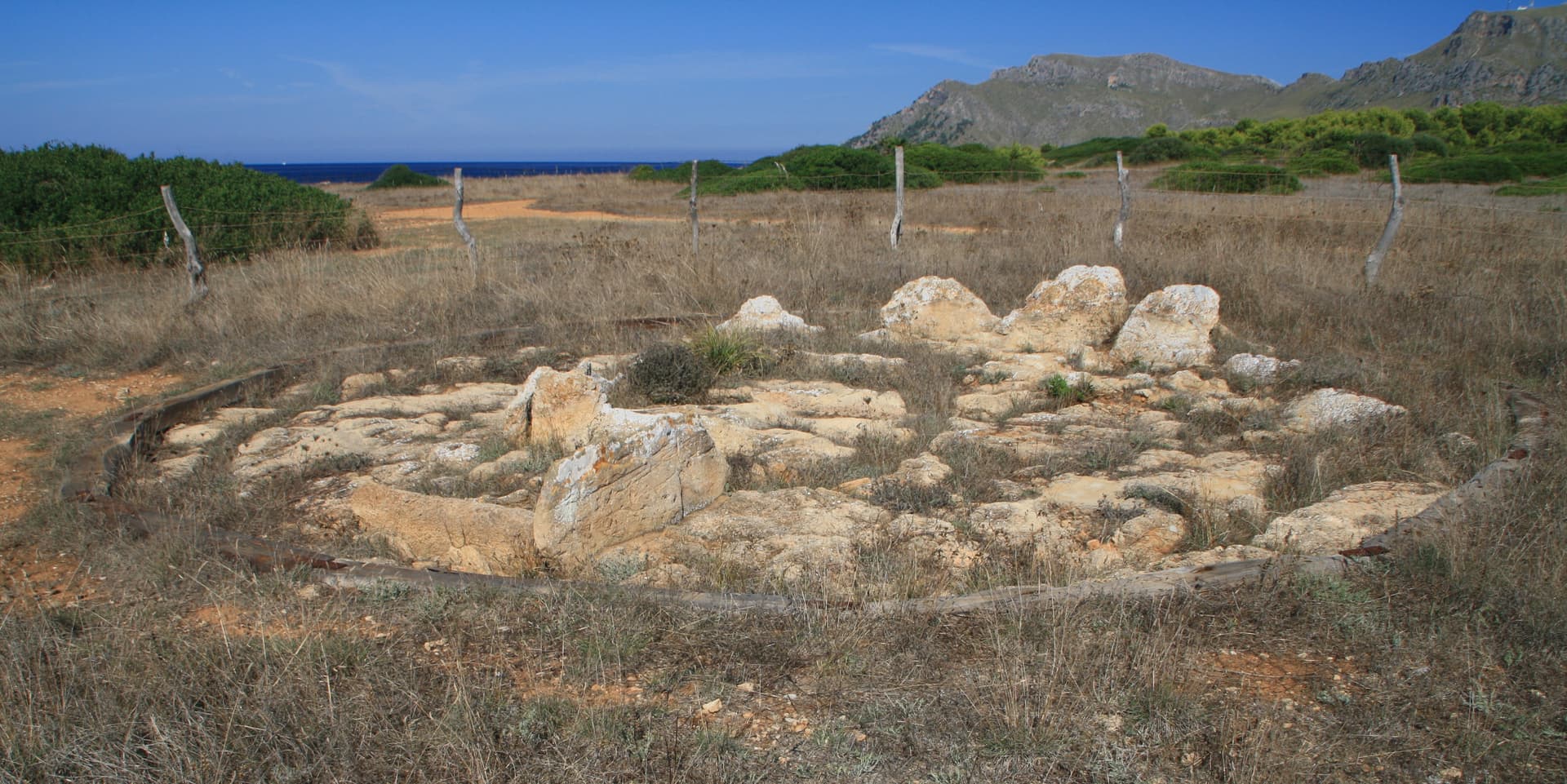
Son Real Necropolis occupies a narrow, wind-exposed spit on Mallorca's northern coast, facing the smaller island tomb-site of Illa dels Porros offshore. From roughly the 7th to 2nd centuries BC, the Balearic Islands' indigenous Talayotic culture buried its dead in varied tombs: some round and simple, others miniature echoes of talayot towers and boat-shaped navetas.
Popular guides sometimes call it the “Phoenician Cemetery,” an early, loose attribution. Decades of excavation and academic study instead place its origin and primary use with Talayotic culture, continuing into the Roman period. Rediscovered and excavated in two long 20th-century phases, Son Real is now a protected public estate. Its low stone chambers, open to sky and sea wind, offer one of the clearest surviving pictures of how a prehistoric Mediterranean society marked its dead.
Why this place is sacred
Son Real does not carry an origin myth or a devotional history in the way a shrine or temple might; its significance is archaeological rather than legendary. What draws attention is the density and variety of what survives above ground: tombs shaped as small circles, as rectangles echoing the towers called talayots, and as elongated hulls recalling the naveta form found elsewhere in the Balearics.
Grave goods recovered from the tombs — jewelry, iron weapons, everyday tools, and animal remains — point to a community that marked social rank in death as much as in life, though the exact logic connecting tomb shape to status is understood only in broad strokes and remains a live question for researchers.
The site's exposure to sea, wind, and light, combined with the visible cluster of so many burial forms in one place, is what visitors and guides most often describe as giving Son Real its charged, contemplative atmosphere.
A burial ground for the Talayotic community of this stretch of Mallorca's northern coast, reserved by the evidence of its grave goods primarily for higher-status individuals.
Used from roughly the 7th century BC through the Post-Talayotic period, with some later activity attributed to the Roman era; rediscovered in the mid-20th century and excavated in two phases (the 1950s–60s and again from the late 1990s into the 2010s), after which the site passed into public, government-protected ownership.
Experience and orientation
Most visitors do not drive up to Son Real; they walk to it, along a coastal path from Can Picafort or Son Bauló beach that takes roughly twenty to thirty minutes. That approach matters: the necropolis is not staged behind a gate but is met on foot, with the Mediterranean visible for most of the walk and the offshore silhouette of Illa dels Porros gradually resolving into a shape of its own.
Once among the tombs, the low stone walls sit at knee or waist height, open to the air rather than sealed underground, so the site reads less as a hidden crypt and more as an open field of markers. Moving slowly between the round, rectangular, and boat-shaped forms lets their differences register — a deliberate variety that is easy to miss in photographs but immediate on foot.
The wind off the bay and the relative flatness of the headland give the place an exposed, unshielded quality; there is little shade and little sound beyond the sea, which visitors consistently note as part of what makes the site feel contemplative rather than merely historical.
Best approached slowly and on foot from the coastal path, treating the walk itself as part of the encounter rather than an obstacle before it.
Context and lineage
No foundation legend survives for Son Real; its history is reconstructed entirely from excavation. The necropolis was established by the Talayotic culture of the Balearic Islands, likely beginning around the 7th century BC, and continued to receive burials through the Post-Talayotic period, with some evidence suggesting activity persisting into the Roman era. It was rediscovered in the mid-20th century and excavated in two distinct campaigns before its 2002 acquisition by the Balearic Islands Government as a protected public estate.
Part of the broader Talayotic funerary tradition of the Balearic Islands, sharing its tomb typology (talayot-imitating and naveta-shaped burials) with other sites of the culture, and forming a single documented funerary landscape together with the neighboring necropolis on Illa dels Porros.
Traditions and practice
What is known of Talayotic funerary practice comes entirely from what the tombs and their contents preserve: burial accompanied by jewelry, iron weapons, tools, and animal remains, and construction in forms that deliberately echoed the culture's major monuments. No textual account of the accompanying rites has survived.
No ceremonial or ritual practice continues at the site. Its present life is as a managed archaeological and educational site, with an on-site interpretation centre and archaeological museum offering context for what visitors see among the tombs.
Walk the tomb field slowly rather than moving quickly between forms. Pause at a round tomb, then a rectangular one, then a boat-shaped naveta tomb, and notice how each holds the body of the site's evidence differently — this comparison, done in person rather than through a single photograph, is closer to how the site is meant to be read.
Talayotic Culture
HistoricalSon Real is one of the most extensive surviving funerary complexes of the Talayotic (Balearic Iron Age) culture, used mainly to bury higher-status members of the community between roughly the 7th and 2nd centuries BC, in tombs that reproduce in miniature the culture's characteristic talayot towers and naveta forms.
Individual and collective inhumation, with grave goods including jewelry, iron weapons, everyday tools, and animal remains; tombs built in round, rectangular (talayot-imitating), and boat-shaped (naveta-style) forms.
Archaeological and Heritage Conservation Stewardship
ActiveSince its mid-20th-century rediscovery, Son Real has been the subject of two major excavation campaigns and ongoing academic study; since 2002 it has been managed by the Govern de les Illes Balears as a protected public estate and Natural Area of Special Interest, with an on-site interpretation centre and museum sustaining public engagement with the site.
Excavation, academic publication, site conservation, and public interpretation through the on-site museum and guided educational access.
Perspectives and open questions
Son Real is read almost entirely through an archaeological lens, but even within that lens its evidence leaves real questions open.
Scholarly perspective
Academic work — most substantially a Ministerio de Cultura monograph and a doctoral thesis treating Son Real and Illa dels Porros together — attributes the necropolis to the indigenous Talayotic culture, with origins around the 7th century BC and continued use through the Post-Talayotic period and into the Roman era. This scholarship treats the two necropolises as a single funerary system rather than isolated sites.
Living and traditional perspectives
There is no continuous indigenous or religious community carrying forward Talayotic tradition today; the culture left no descendant tradition-bearers, so there is no living traditional perspective to set alongside the scholarly one.
Open questions
The precise counts of tombs and burials are inconsistently reported — figures across sources range from roughly 109 to 130 tombs and from around 300 to over 400 burials — so any number should be read as approximate. More substantively, the social logic connecting a given tomb's shape (round, talayot-imitating, or boat-shaped naveta) to the status of the person buried within it is understood only in general terms and remains an open question in the scholarship.
Plan your visit
Access and arrival
On foot only, via a coastal path from Can Picafort or Son Bauló beach — there is no direct vehicle access to the necropolis itself. On-site facilities reported include a reception, interpretation centre, archaeological museum, public toilets, a shelter, and bike rental.
No information on mobile phone signal at the site was available at time of writing; visitors relying on connectivity should not assume reliable coverage and can check with the Can Picafort or Santa Margalida tourist information office in advance. No keyholder or advance booking is required for standard visits; group or special visits should confirm current arrangements with the Ajuntament de Santa Margalida.
Respectful visit
No documented dress requirement. Practical footwear is advisable for the coastal walking path.
No photography restriction was found in available sources; photography appears to be permitted as at other open, publicly managed heritage sites, though visitors should photograph with the same restraint appropriate to a burial ground.
Not applicable — no tradition of leaving offerings is documented at this site.
Stay on marked paths and avoid entering or touching the tomb structures directly; no source specified a formal rule beyond this, but the shallow, unenclosed nature of the tombs makes such care especially important for their preservation.
Treat the ground as a burial site rather than a ruin to climb on; the tombs are shallow, exposed, and vulnerable to wear.
Location
Map loads as you approach this section.
Pilgrim reflections
A portrait of encounter, not a score
Pilgrims describe what they felt, how present they could become, and whether the place would shape a journey. There are no stars and no ranking of traditions.
No reviewed reflections yet
The first pilgrims can help describe the character of being here.
Share a reflection
Available after an account-backed “Been there.” Every reflection is reviewed before publication.
Nearby sacred places
Explore other sacred places in the region. Proximity does not establish access or travel time; check each place’s guidance.


References
Sources consulted for this page. Source categories describe the publication, not a guarantee that every claim is verified. Traditional accounts and outside interpretations may differ.
- 01La necrópolis de "Son Real" y la "Illa dels Porros", Mallorca — Ministerio de Cultura (Spain), publications libraryofficialOfficial Spanish Ministry of Culture archaeological monograph treating Son Real and Illa dels Porros as a joint funerary complex.
- 02Las necrópolis de la edad del hierro de Son Real y s'Illa des Porros (Santa Margalida, Mallorca). Estudio arqueológico y análisis social — Dialnet (doctoral thesis record)academicDoctoral-level archaeological and social analysis of both necropolises as a single Iron Age funerary area.
- 03La Necròpolis Talaiòtica de S'Illot des Porros — ResearchGate (academic publication)academicConfirms Talayotic attribution and describes collective rock-cut tombs on the adjacent islet, explicitly linked to Son Real.
- 04Espacios naturales protegidos - Finca pública de Son Real — Govern de les Illes Balears (CAIB)officialOfficial Balearic government page confirming acquisition of the Son Real estate in 2002 and its designation as a Natural Area of Special Interest.
- 05Necrópolis Punta dels Fenicis. Son Real (Mallorca) — Illes Balears official tourism boardofficialOfficial regional tourism board description of the site's location, dating range, and tomb typology.
- 06Illot des Porros — Wikipedia contributorsacademicConfirms the islet's Talayotic necropolis, its proximity (~65m offshore) to Son Real, and their shared archaeological study.
- 07Son Real Necropolis, Balearic Isles (Mallorca / Majorca) — The Megalithic PortalSource contextMegalith-focused site database entry providing coordinate data and tomb-type descriptions (navetas, miniature talayots).
- 08Necropolis of Son Real in Santa Margalida — Atlas ObscuraSource contextDescribes site chronology (7th century BC through Roman era), boat-shaped and horseshoe tombs, and 2002 government acquisition.
- 09Son Real Archaeological Site, Santa Margalida — SeeMallorca.comSource contextTravel-guide description of dating range and tomb/skeleton counts (used with hedged language due to source disagreement).
- 10Son Real (beach and archaeological ruins) — +Mallorca MagazineSource contextRegional culture magazine covering site history, excavation phases (1957-1969 and 1998-2019), and grave goods.
Share a photo
Help visitors recognize Son Real Necropolis. Every submission is reviewed before publication.