Siega Verde Archaeological Site
Ice Age animal engravings on open river rock in Salamanca
Understand sacred places, explore living traditions, and learn how to engage respectfully with Pilgrim Map.
Access has not been verified. Check current local guidance before planning a visit.
Castillejo de Martín Viejo, Salamanca, Spain
Read the sources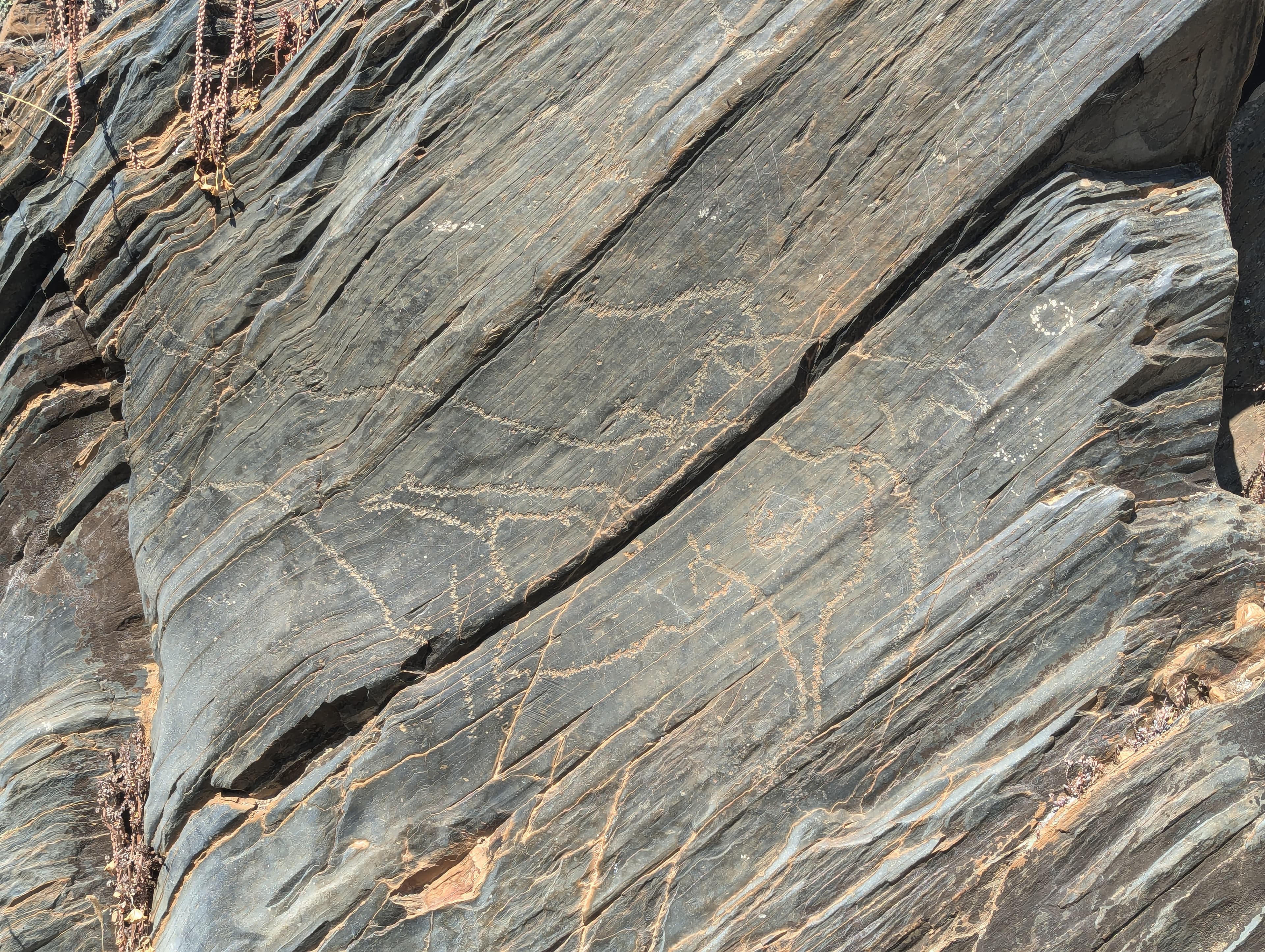
Image of Siega Verde Archaeological Site. Image source
Visit essentials
A quick read before you go
- Duration
- Guided visits typically run either about 30 minutes (a shorter circuit of roughly five panels)…
- Access
- The rock-art panels are accessible only via advance-booked guided visit, arranged through the…
Overview
Siega Verde is an open-air gallery of Upper Palaeolithic engravings cut into schist outcrops along the Águeda river in western Spain, close to the Portuguese border. Horses, aurochs, deer, ibex, and the occasional woolly rhinoceros or human figure appear across dozens of rock faces spread along roughly three kilometers of riverbank.
Discovered by archaeologists in the late 1980s, the site forced a revision of a long-held assumption that Palaeolithic image-making belonged only to deep cave interiors; here, the same hunting-era hands worked in daylight, on stone shaped by the river itself. Siega Verde was added in 2010 to the UNESCO World Heritage listing already held by Portugal's Côa Valley, forming a single transboundary inscription recognizing the largest known concentration of open-air Ice Age rock art in Europe.
There is no continuous devotional or ceremonial tradition attached to the site — no one has worshipped here in living memory, and no oral history explains what the images meant to the people who made them. What draws visitors instead is something plainer and, for many, no less affecting: unmediated contact with the earliest known human mark-making in the region, still visible on the rock where it was made, in a landscape that has changed remarkably little since.
Why this place is sacred
Sources disagree on exactly how many engravings survive here — figures range from roughly 440 to 645 individual carvings across either 91 or 94 catalogued panels, depending on which academic or institutional count is used, and the discrepancy remains unresolved rather than a simple rounding difference.
What is not disputed is the scale of time involved: the earliest figures are generally placed in the Gravettian, around 20,000 to 22,000 years ago, with work continuing through the Solutrean and Magdalenian to perhaps 10,000 years ago or later. The engravings sit on natural, river-worn schist faces oriented north-south, exposed to weather rather than sealed in a cave chamber, which is part of what distinguishes Siega Verde from Cantabrian sites like Altamira.
Visibility itself is contingent and fleeting — many of the finer lines only resolve under low, raking sunlight at particular hours, so a panel that looks blank at midday can reveal a horse's head by early evening. That dependence on light and shadow, on the river's mood, and on a guide's timing gives the site a quality some visitors describe as provisional or half-hidden, as if the images were never meant to be permanently legible, only intermittently so.
Archaeologists infer that the engravings served some combination of territorial marking, hunting-related symbolism, or group identity signaling among Upper Palaeolithic hunter-gatherer bands moving through the Águeda-Douro river system, but no textual or oral tradition survives to confirm intent, and researchers are careful to describe this as informed inference rather than established fact.
The site's function has shifted entirely from whatever role it held for its original makers to a scientific and heritage-tourism role today: since its cataloguing began in the late 1980s, Siega Verde has moved from an obscure riverside inventory find to a jointly Spanish-Portuguese UNESCO World Heritage property, managed through guided visits, 3D conservation scanning, and cross-border academic research rather than any form of ongoing use.
Experience and orientation
Visits begin at an interpretation center — the aula arqueológica — before a guide leads a small group, typically no more than eight people, along a footpath tracing the Águeda's bank. The terrain is uneven and can be damp, so the walk itself has a quality of minor expedition rather than museum stroll. At each stop, the guide angles attention toward a rock face that, without explanation, might read as unremarkable weathered stone.
Then, with the light adjusted or a flashlight held obliquely, the incised outline of a horse's neck or an auroch's horn resolves out of the surface. Visitors consistently describe this moment of emergence — the image appearing rather than simply being pointed to — as the most memorable part of the visit, sharper in effect than seeing the same motif reproduced in a museum case.
The valley itself is quiet and largely undeveloped, and the absence of glass, barriers, or artificial lighting (during standard visits) keeps the encounter close to outdoor and unmediated. Night visits and themed formats, including theatrical and escape-room-style tours, are also offered for those wanting a different register of engagement, though the standard daytime walk remains the most common way to see the panels.
Expect a walking visit of roughly thirty minutes to an hour on the trail itself, book ahead through the official visitor center, and treat the experience as observational rather than participatory — there is nothing to do at Siega Verde beyond looking closely and following the guide.
Context and lineage
The rock art was created by Upper Palaeolithic hunter-gatherer groups inhabiting the Águeda and Douro river basins, working across a long span from the Gravettian (roughly 20,000-22,000 years ago) through the Solutrean and Magdalenian.
The site's modern discovery is itself a point of disagreement in the sources: it is most consistently dated to 1988, when archaeologists Manuel Santonja and Rosario Pérez identified the engravings during a provincial archaeological inventory of Salamanca province, reportedly after a tip from local resident Ángel Hervalejo — though at least one source attributes the find to 1989 and credits Santonja alone.
The 1988 date, with both Santonja and Pérez named, is the more frequently cited version in academic literature, but the discrepancy has not been resolved across sources and is presented here as such rather than settled.
Siega Verde has no living lineage of practitioners or tradition-bearers; its intellectual lineage runs instead through the archaeologists and conservation scientists — Spanish and Portuguese heritage authorities, University of Alcalá and University of Vigo researchers, and the Centro de Conservación y Restauración de Castilla y León — who have studied and stewarded it since the late 1980s, working in coordination with counterparts at the sister site in Portugal's Côa Valley.
Traditions and practice
No ceremonial or ritual practice is documented at the site among its Upper Palaeolithic makers beyond the inferred, unproven possibility that the engraving itself carried symbolic or territorial function for those who created it.
Present-day engagement with Siega Verde is entirely interpretive: guided walking tours along the riverside trail, ongoing scientific documentation and 3D-scanning conservation monitoring by regional heritage authorities, and academic research connecting the site to the broader open-air rock-art tradition shared with Portugal's Côa Valley across the border.
Move at the guide's pace rather than your own — much of what there is to see only appears when the light or angle is right, so lingering at a panel a beat longer than feels necessary is often rewarded.
Pay attention to the river itself: its level and recent flooding history shape both what is currently accessible and what has already been lost to erosion, which grounds the visit in an ongoing, physical process rather than a fixed museum display.
Upper Palaeolithic (Gravettian–Magdalenian) open-air rock-art tradition
HistoricalSiega Verde preserves one of the largest known concentrations of open-air Palaeolithic rock engravings in Europe, part of the transboundary UNESCO listing shared with Portugal's Côa Valley. The engravings — predominantly horses, aurochs, deer, goats, bison, reindeer, and woolly rhinoceros, with rarer human or abstract figures — are believed by archaeologists to reflect symbolic, territorial, or ritual practices of Upper Palaeolithic hunter-gatherer groups, though their precise original meaning is not definitively established.
Fine-line and pecked engraving of animal figures directly onto exposed schist river-worn rock faces; possible original chromatic treatment, since traces of red ochre plus yellow and manganese pigment on some figures suggest certain engravings may once have been painted; a distinctive local stylistic technique of superimposing two or three animal heads on a single body to suggest movement, noted by researchers as unusual relative to contemporaneous Cantabrian cave art.
Archaeological and scholarly research tradition
ActiveSince the 1988 discovery, Siega Verde has been the subject of a continuous, active program of academic study — chronological analysis, stylistic comparison with Cantabrian cave art, and cross-border research coordinated with Portugal's Côa Valley team — that continues to shape scholarly understanding of Ice Age art in Iberia.
Field survey and cataloguing of panels, comparative stylistic and chronological analysis, 3D-scanning documentation to monitor rock-surface cracking and movement risk, and published academic synthesis by researchers including de Balbín Behrmann and Alcolea González.
Heritage-tourism and guided-interpretation tradition
ActivePublic access to Siega Verde exists entirely within a managed heritage-tourism framework established after UNESCO inscription, structured around guide-led education rather than open or independent visitation.
Small-group guided walking tours along a fixed riverside route, standard and night-visit formats, themed formats including theatrical and escape-room-style tours, and interpretation-center exhibits explaining the site's archaeology to visitors.
Perspectives and open questions
Siega Verde is read almost entirely through an archaeological lens, since no surviving oral or textual tradition offers an alternative account of its meaning; the interpretive debate that exists is scholarly, not devotional.
Scholarly perspective
Archaeologists regard Siega Verde, together with Portugal's Côa Valley, as decisive evidence that Upper Palaeolithic peoples in Iberia produced open-air rock art and not only art sealed within cave interiors, overturning an earlier paradigm that associated Ice Age image-making almost exclusively with sites like Altamira or Lascaux.
Stylistic features — including the superimposition of two or three animal heads on a single body to suggest movement, distinct from techniques seen in Cantabrian cave art of the same period — place the bulk of the work in the Gravettian through Magdalenian, with possible continuity toward the Final Glacial or early Holocene.
The joint discovery of Siega Verde and Foz Côa is credited with reshaping scholarly understanding of how widely, and in what settings, Ice Age communities across the Iberian Peninsula made images.
Open questions
The engravings' original function — territorial marking, hunting-related ritual, group-identity signaling, or some combination — remains genuinely unresolved and cannot be settled from physical evidence alone. Whether the figures were originally painted in red ochre, yellow, or manganese-black pigment, as trace findings on some panels suggest, or whether that coloration is incidental or later, is likewise unconfirmed.
And because erosion, river action, and possibly undiscovered panels may mean the current catalogue represents only part of what once existed, even the scale of the original ensemble is not fully known.
Plan your visit
Access and arrival
The rock-art panels are accessible only via advance-booked guided visit, arranged through the official visitor center at siegaverde.es (contact: visitas@siegaverde.es, +34 653 78 10 71); independent, unguided access is not permitted. The site sits off the DSA-470 road near Villar de la Yegua and Castillejo de Martín Viejo, roughly 15 km downstream from Ciudad Rodrigo in Salamanca province.
No reliable mobile-signal information for the riverside trail itself was available at time of writing; visitors relying on connectivity for emergencies should confirm current signal coverage and note that Ciudad Rodrigo, roughly 15 km away, is the nearest town with dependable phone service and road access.
No published seasonal closure calendar with specific dates was found in research; sources indicate the site generally operates Wednesday through Sunday for most of the year with some seasonal and weekend-only variation, and restricts or closes access in adverse weather — check siegaverde.es or the Junta de Castilla y León heritage portal directly for current opening days before travel.
No specific on-site accommodation information was available at time of writing; visitors typically base themselves in Ciudad Rodrigo, the nearest town with lodging, and check current options directly with local tourism resources or the Junta de Castilla y León before travel.
Respectful visit
No formal dress code applies; sturdy, closed footwear suitable for an uneven, sometimes damp riverside trail is strongly advised.
Personal photography is generally permitted during guided visits, but visitors should follow the guide's instructions in the moment, since flash or close-contact photography near fragile surfaces may be restricted at the guide's discretion; no single published photography policy was found in research.
Touching the engraved rock surfaces is not permitted under any circumstance, since the visits are structured specifically to prevent direct contact and protect weathered rock art. Independent or unguided access to the panels is prohibited — all visits must be booked and led by an official guide. Metal-tipped hiking poles are not allowed on the trail, and pets, smoking, and eating are prohibited during the guided visit, though water is generally permitted.
Group sizes are capped, commonly around eight people per tour, to limit foot traffic on the fragile terrain.
A working conservation site on exposed, fragile rock, not a controlled museum environment — footing on the riverside trail can be uneven and damp, and visit availability is genuinely contingent on river conditions and weather, so treat any booked time as provisional until confirmed close to your visit.
Location
Map loads as you approach this section.
Pilgrim reflections
A portrait of encounter, not a score
Pilgrims describe what they felt, how present they could become, and whether the place would shape a journey. There are no stars and no ranking of traditions.
No reviewed reflections yet
The first pilgrims can help describe the character of being here.
Share a reflection
Available after an account-backed “Been there.” Every reflection is reviewed before publication.
Nearby sacred places
Explore other sacred places in the region. Proximity does not establish access or travel time; check each place’s guidance.


References
Sources consulted for this page. Source categories describe the publication, not a guarantee that every claim is verified. Traditional accounts and outside interpretations may differ.
- 01Prehistoric Rock Art Sites in the Côa Valley and Siega Verde — UNESCO World Heritage Centre — UNESCO World Heritage CentreofficialOfficial World Heritage listing page; confirms transboundary status, 1998 Côa inscription, 2010 Siega Verde extension. Full text could not be fetched directly (403 error) but listing ID and status confirmed via multiple secondary sources referencing it.
- 02Prehistoric Rock Art Sites in the Côa Valley and Siega Verde — Wikipedia — Wikipedia contributorsacademicConfirms discovery in 1988 by M. Santonja and R. Pérez, supervision by R. de Balbín Behrman, 94 panels/~645 carvings over ~3 km along the Águeda, dating 20,000-12,000 years ago, 2010 UNESCO extension.
- 03Siega Verde — Wikipedia — Wikipedia contributorsacademicAlternate/dedicated article; states 91 panels, ~450 figurative images, Solutrean-Magdalenian (18,000-12,000 BC), coordinates 40°41'51"N 6°39'40"W, discovery attributed to Manuel Santonja Gómez.
- 04Archaeological Area of Siega Verde — PRAT/CARP (Prehistoric Rock Art Trails Europe project)academicEU heritage-trail academic-adjacent project page on Siega Verde; cross-references de Balbín Behrmann research.
- 05Siega Verde archaeological site in Castillejo de Martín Viejo — spain.info (Spain's official tourism board, Turespaña)officialOfficial Spanish tourism board page; confirms Castillejo de Martín Viejo/Villar de la Yegua/Villar de Argañán tri-municipality span, 440+ engravings, 2010 UNESCO status alongside Portugal's Vale do Côa.
- 06Siega Verde — Castilla y León Patrimonio de la Humanidad — Junta de Castilla y León (regional government heritage portal)officialRegional government heritage page; details guided-visit-only access (max 8 people), 30-min/60-min tour options, sun-angle-dependent visibility scheduling (e.g., Peñascosa panel morning visibility issues), Águeda flood/erosion/humidity as principal conservation threat, 3D scanning conservation program.
- 07Siega Verde. Zona arqueológica. Patrimonio Mundial — Fundación Siega Verde / official site managementofficialOfficial visitor-facing site; confirms interpretation center (aula arqueológica), guided-only visits including night tours, online ticketing, contact details (visitas@siegaverde.es, +34 653 78 10 71), themed visits (theatrical, escape-room, motorcycle tours).
- 08Tecnología 3D para conservar el arte rupestre de Siega Verde — DiCYT (Agencia de noticias de ciencia y tecnología, Castilla y León)academicScience-news coverage of 3D-scanning conservation monitoring project tracking rock-surface cracking and movement risk from river action.
- 09Investigación y difusión del arte rupestre. Yacimiento de Siega Verde — Junta de Castilla y León, Patrimonio CulturalofficialOfficial regional cultural heritage authority page on the 2010-2011 Spain-Portugal cross-border cooperation research, documentation, and dissemination program; references Centro de Conservación y Restauración de Castilla y León studies including University of Vigo lichen-impact research.
- 10Siega Verde synthèse (J. Alcolea & R. de Balbín, 2007) — José Javier Alcolea González and Rodrigo de Balbín BehrmannacademicPeer-adjacent academic synthesis by the site's principal excavators/researchers on content, chronology, and significance of the open-air engravings.
- 11Siega Verde and the open-air rock art of the northern Iberian Peninsula (Spain) — Comptes Rendus Palevol (Scientific Publications of the Muséum national d'Histoire naturelle, Paris)academicPeer-reviewed academic journal article situating Siega Verde within the broader open-air Palaeolithic rock art phenomenon of the northern Iberian Peninsula.
- 12Siega Verde Site • World Heritage Site — Camping Arribes del Duero (local tourism operator)Source contextThird-party visitor guide; notes spring/autumn as ideal seasons, riverside trail terrain requiring appropriate footwear, prohibitions on metal-tipped poles/pets/smoking/eating during tours, nearby Ciudad Rodrigo and Arribes del Duero Natural Park.
Share a photo
Help visitors recognize Siega Verde Archaeological Site. Every submission is reviewed before publication.