Shrine of the Queen of Peace at Medjugorje, Medjugorje
A Herzegovinian village where millions have come seeking peace and left changed
Understand sacred places, explore living traditions, and learn how to engage respectfully with Pilgrim Map.
Access has not been verified. Check current local guidance before planning a visit.
Međugorje, Herzegovina-Neretva, Bosnia and Herzegovina
Read the sources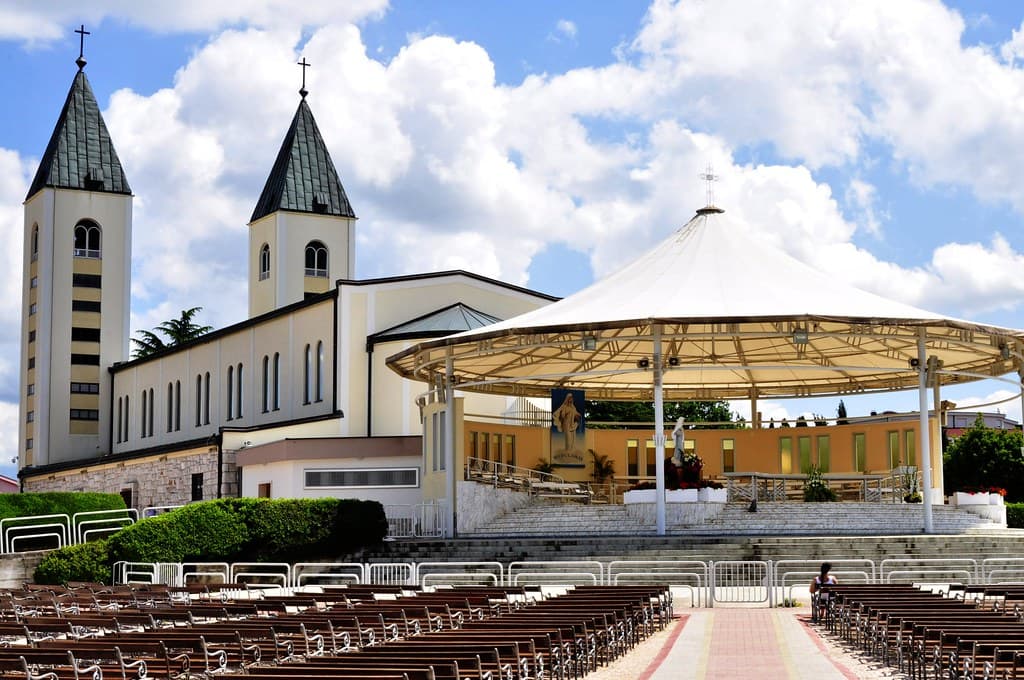
Image of Shrine of the Queen of Peace at Medjugorje, Medjugorje. Image source
Visit essentials
A quick read before you go
- Duration
- Most organized pilgrimages allow five to seven days, and this is well-considered.
- Access
- Medjugorje has no airport.
Overview
Something happens to people in Medjugorje. They arrive as tourists and return as pilgrims. They come out of curiosity and find themselves on their knees. This has been true for more than four decades, across cultures and languages and levels of belief, and it shows no sign of slowing.
The story begins simply enough. On a June evening in 1981, two teenage girls saw a luminous figure on a hillside above their village. By the following day, four more young people had joined them. The figure identified herself as the Blessed Virgin Mary, the Queen of Peace, and began delivering messages that have continued, in one form or another, ever since.
The Vatican has studied Medjugorje for decades and arrived at a careful position: the spiritual fruits are genuine and abundant, the devotion is authorized, but the supernatural origin of the apparitions remains neither confirmed nor denied. This is, in a sense, the honest stance. What happens at Medjugorje resists neat categorization. The confessions are real. The conversions are documented. The vocations are counted.
The peace that pilgrims describe upon entering the village is reported with a consistency that demands attention, regardless of one's framework for explaining it.
Medjugorje does not ask you to believe before you arrive. It asks only that you come.
Why this place is sacred
Thin places, in the Celtic understanding, are locations where the distance between the human and the divine narrows to almost nothing. Medjugorje fits the description, but not in the way most thin places do. There is no ancient stone circle, no geological wonder, no five-thousand-year accumulation of ritual. The village itself is unremarkable — a cluster of stone houses in the dry hills of Herzegovina, surrounded by tobacco fields and vineyards. The parish church, St.
James, is a functional twentieth-century structure, not a cathedral.
What creates the thinness here is something else entirely. It is the accumulated weight of forty-three years of unbroken daily prayer. It is the fact that every evening, hundreds or thousands of people gather for a program of devotion that lasts hours — rosary, Mass, adoration, healing prayer — and have done so without interruption since the early 1980s, through war, through skepticism, through the slow grinding of institutional investigation.
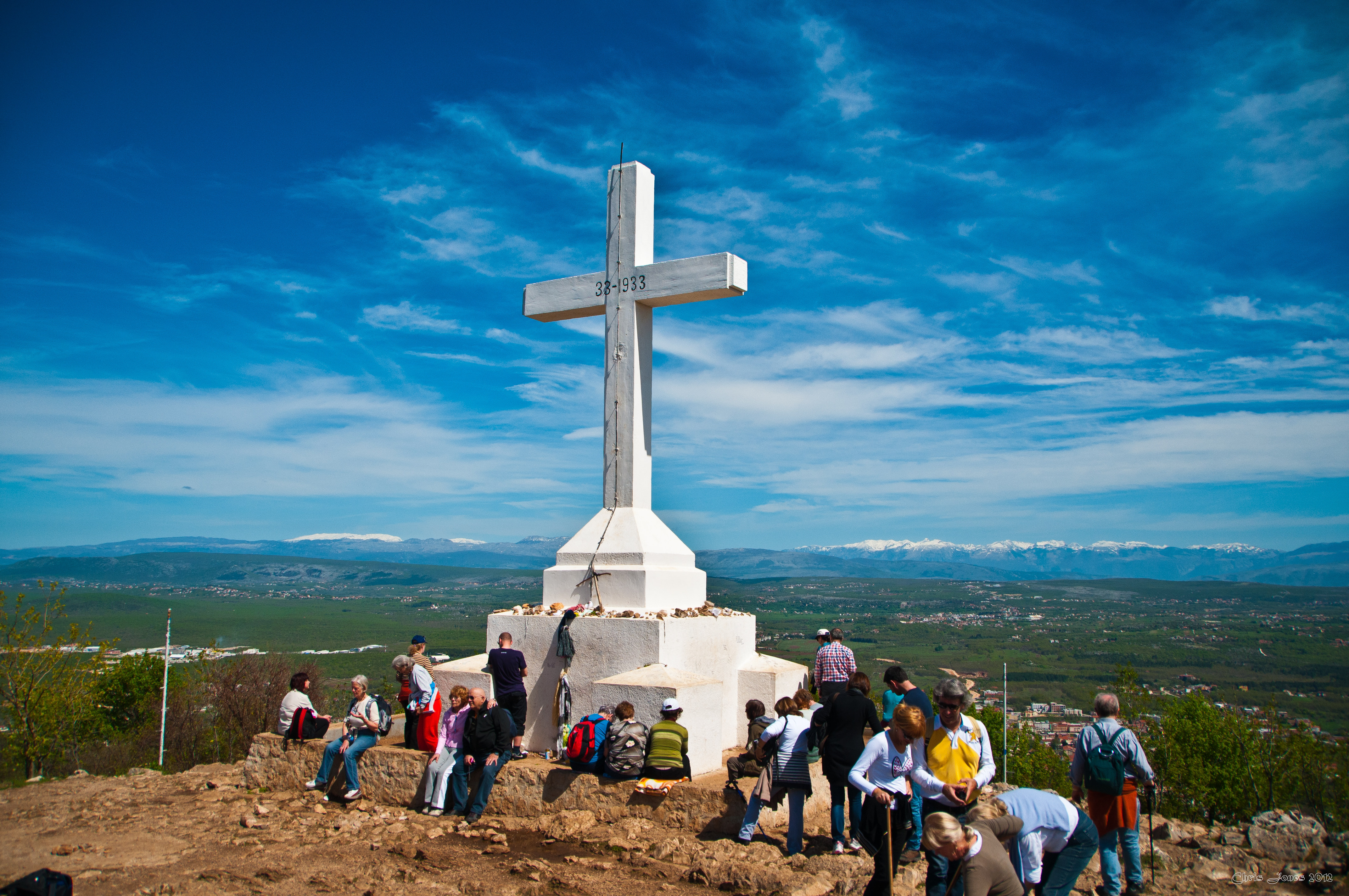
It is the hillside where the first apparitions occurred, where the rocks have been worn smooth by millions of kneeling pilgrims. It is Cross Mountain, where a concrete cross erected in 1933 — nearly fifty years before the apparitions — already held a relic of the True Cross, as though the landscape was preparing for what would come.
Pilgrims describe the thinness in remarkably consistent terms: a sense of peace that descends upon entering the village, often before they have reached the church or the hills. Some call it a presence. Others describe it as an absence — of noise, of restlessness, of the low-grade anxiety that accompanies modern life. The effect does not require belief in the apparitions.
It seems to operate on a level prior to theology, in the body before the mind can form an opinion.
The parish of Medjugorje was canonically founded in 1892, a small rural Catholic community administered by Franciscan friars. St. James Church was begun in 1935 and consecrated in 1969, built to serve a farming village of a few thousand souls. The cross on Križevac was erected in 1933 to mark the 1900th anniversary of Christ's Passion, a devotional act by local parishioners carrying materials up the mountain by hand.
Nothing about the village's early history suggested it would become one of the most visited pilgrimage sites on earth.
The transformation began on June 24, 1981, and it has not stopped. What was a quiet parish became, within months, a site of mass pilgrimage — despite the active suppression of Communist Yugoslav authorities who banned access to the hillside, interrogated the children, and confiscated the parish priest's passport. The apparitions moved from the hill to private homes to the church, but they continued.
The Yugoslav Wars of the 1990s brought devastation to the region but did not stop the pilgrimages. The village was shelled; the pilgrims kept coming. In the decades since, Medjugorje has grown into a small town built almost entirely around pilgrimage infrastructure — guesthouses, restaurants, religious goods shops — while the core devotional life remains centered on the parish church, the two hills, and the daily sacramental rhythm.
The Vatican's 2024 Nulla Osta, formally authorizing devotion and pilgrimage, ratified what millions of feet had already established.
Experience and orientation
The first thing most pilgrims notice is the quiet. Not silence — Medjugorje is a busy place, especially in summer — but a quality of stillness underneath the activity, as though the village itself is listening. Many describe this settling in the body before they have reached the church or the hills: a loosening of tension in the shoulders, a slowing of thought, a sense of having arrived somewhere that was waiting for them.
Confession is where the transformation often begins. Medjugorje has been called the confessional of the world, and the phrase is not metaphor. Dozens of priests hear confessions daily in more than twenty languages, in outdoor confessionals lining the churchyard. Pilgrims who have not confessed in years — or decades — describe being drawn to the sacrament almost involuntarily, and emerging with a sense of liberation that some compare to physical weight being lifted.
Priests who serve here speak of the confessional as the true heart of Medjugorje, more than the apparitions themselves.
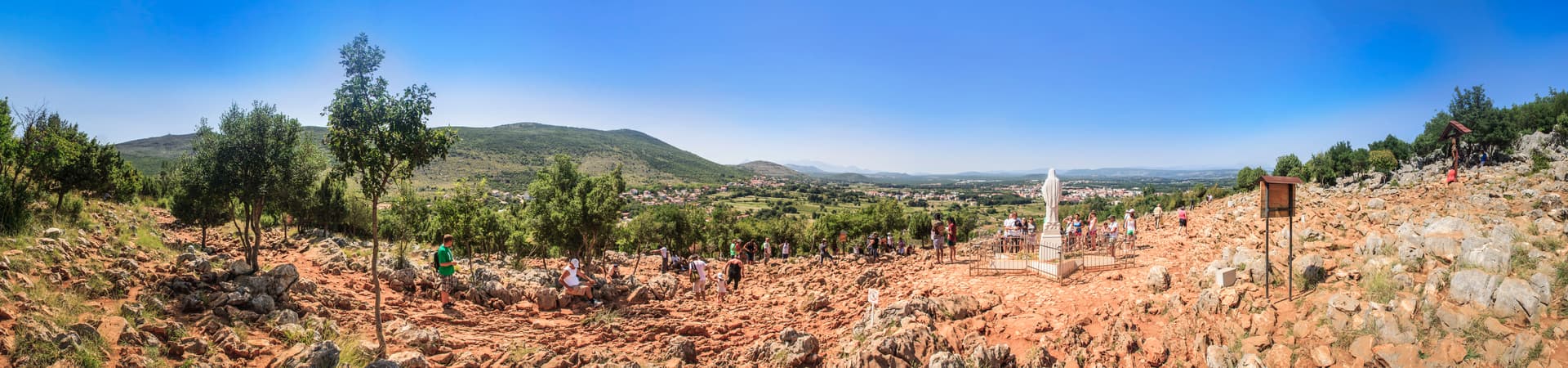
Apparition Hill is a thirty-minute climb on rough, uneven rock. Bronze relief stations mark key moments of the apparition story. Pilgrims often remove their shoes, walking barefoot on the sharp stone as an act of penance. At the top, where a statue of Mary marks the site of the first apparitions, the atmosphere is dense with whispered prayer. People weep here with a frequency that suggests something more than sentiment.
Cross Mountain is the harder climb — ninety minutes of steep, rocky terrain with fourteen stations of the cross. Many pilgrims undertake it as a penitential exercise, praying the rosary as they ascend. The summit, with its 1933 concrete cross visible from the entire valley, holds a quality of exposure — to wind, to sky, to whatever one has carried up the mountain. Coming down, people often describe feeling lighter, as though something has been left behind at the top.
Then there are the phenomena that resist categorization. Pilgrims across decades report the sun appearing to spin, pulsate, or emit colors during prayer times — a phenomenon witnessed by crowds and dismissed by skeptics as optical illusion. Rosary chains reportedly change from silver to gold. Documented healings from terminal illness, chronic pain, addiction, and depression fill the parish archives. Whether these constitute miracles, coincidences, or something else depends on the framework one brings.
What is undeniable is that they keep happening.
Medjugorje rewards those who come with open hands rather than fixed expectations. The pilgrims who report the deepest experiences tend to be those who commit to the full rhythm of the place: the evening prayer program, the hill climbs, the daily confession, the fasting. Three days is a minimum for this rhythm to take hold; five to seven days is what most organized pilgrimages allow, and the extra days matter.
Consider arriving with something honest — a grief, a question, a longing for change. Medjugorje does not require theological sophistication. It requires only a willingness to be present to what arises. The village has a way of meeting people exactly where they are, which is perhaps why it draws atheists and mystics in roughly equal measure, and changes both.
Context and lineage
On the evening of June 24, 1981 — the Feast of St. John the Baptist — two teenage girls, Ivanka Ivanković and Mirjana Dragičević, were walking near the hill called Podbrdo when they saw the shimmering silhouette of a woman bathed in light. Ivanka exclaimed, 'It is the Gospa!' — Our Lady. They fled.
The following day, June 25, four more young people joined them: Vicka Ivanković, Ivan Dragičević, Marija Pavlović, and ten-year-old Jakov Čolo. All six saw the figure together. She spoke to them, identifying herself as the Blessed Virgin Mary, and said: 'I have come to tell you that God exists, and He loves you. Let it be for you not only a word, but rather an experience.'
She identified herself as the Queen of Peace — Kraljica Mira — and began delivering messages centered on what would become known as the Five Stones: prayer with the heart, fasting on Wednesdays and Fridays, daily reading of Scripture, monthly confession, and reception of the Eucharist. The Communist Yugoslav authorities moved quickly to suppress the phenomenon. They banned access to Podbrdo, interrogated the children, and briefly detained some.
The apparitions continued — in private homes, at the Blue Cross near the base of the hill, and eventually in the parish church. The authorities could not contain what had started.
Three of the six visionaries — Vicka, Ivan, and Marija — continue to report daily apparitions to this day. The other three report annual apparitions on specific dates. Each visionary has been entrusted with secrets — ten in total — concerning future events of global significance, the content of which has not been disclosed.
The Franciscan presence in Herzegovina predates the parish of Medjugorje by centuries, rooted in the order's long history in the Balkans. The parish was founded in 1892, and its first church was completed in 1897. For nearly a century, it served a quiet agricultural community. The apparitions of 1981 transformed it utterly, drawing pilgrims first by the thousands, then by the millions.
Through the Yugoslav Wars of the 1990s — when the region suffered bombardment and ethnic violence — the parish continued its daily program without interruption. The Vatican's engagement evolved from cautious distance to active investigation: a bishops' commission in 1991, a papal commission under Cardinal Ruini in 2010, the appointment of a special envoy in 2017, authorization of official pilgrimages in 2019, and the Nulla Osta of September 2024.
Each step brought Medjugorje further into the institutional life of the Church, even as the central question — are the apparitions supernatural? — remained formally unanswered.
The Six Visionaries
visionary
Ivanka Ivanković (born 1966), Mirjana Dragičević (born 1965), Vicka Ivanković (born 1964), Ivan Dragičević (born 1965), Marija Pavlović (born 1965), and Jakov Čolo (born 1971). They were between ten and sixteen years old at the time of the first apparitions. Three continue to report daily apparitions more than four decades later.
The Franciscan Friars of Herzegovina
steward
The parish of Medjugorje has been administered by Franciscan friars since its founding. They have maintained the parish's sacramental life and prayer program through Communist suppression, war, and decades of institutional scrutiny, providing the pastoral infrastructure that makes Medjugorje's pilgrimage life possible.
Father Jozo Zovko
historical
The parish priest of Medjugorje at the time of the first apparitions. He initially doubted the visionaries but came to support them, sheltering the children when Communist authorities restricted access to the hill. He was imprisoned for eighteen months by the Yugoslav government for his role.
Archbishop Henryk Hoser
historical
Appointed by Pope Francis in 2017 as Special Papal Envoy to Medjugorje. His pastoral work helped normalize the site's relationship with Rome and laid groundwork for the 2019 authorization of official pilgrimages. He died in 2021.
Stjepan Podhorsky
historical
The architect who designed St. James Church, begun in 1935. The twin-towered church was built to serve a rural parish of modest size. That it became the center of a global pilgrimage was not in the architect's plans — yet the building has proved equal to its unexpected vocation.
Traditions and practice
The evening prayer program is the beating heart of Medjugorje's devotional life. It begins at five in the evening with the Joyful and Sorrowful Mysteries of the Rosary, prayed in the open air around St. James Church as hundreds or thousands of pilgrims find their places. Holy Mass follows at six, celebrated in Croatian with simultaneous translation through radio receivers available at the Information Office.
After Mass, the congregation kneels for the Creed and seven Our Fathers, Hail Marys, and Glory Bes. Religious objects are blessed. Prayers for the sick are offered. The Glorious Mysteries of the Rosary close the evening. The entire program lasts roughly three hours, and it has been held every day of the year since the early 1980s.
Eucharistic Adoration follows on Tuesdays and Thursdays, and again on Saturday evenings. Friday evenings bring the Veneration of the Cross. Each day, morning Mass is offered in Croatian at half past seven and in international languages — including English — at ten. The sacramental calendar is dense, deliberate, and unvarying.
The Five Stones — prayer with the heart, fasting on bread and water on Wednesdays and Fridays, daily Scripture reading, monthly Confession, and daily reception of the Eucharist — form the core of what the messages of Medjugorje ask of those who come. These are not new practices; they are among the oldest in the Catholic tradition. What Medjugorje has done is restore their urgency for millions who had let them lapse.
The physical pilgrimages are equally central. Apparition Hill, a thirty-minute climb on rough rock, is marked by bronze relief stations telling the story of the apparitions. Many pilgrims climb barefoot. The pace is slow, the mood meditative. Cross Mountain — steeper, longer, more demanding — follows the Stations of the Cross over roughly ninety minutes. Organized groups ascend for the Stations on Friday afternoons; the Rosary is prayed on Apparition Hill on Sunday afternoons.
Both climbs are available at any time, and many pilgrims return to them repeatedly during their stay.
Confession stands apart from all other practices here. Available daily in more than twenty languages, it draws pilgrims who have been away from the sacrament for years, sometimes decades. The outdoor confessionals lining the churchyard are among the most recognizable features of Medjugorje. What happens inside them — by countless accounts — is where the deepest transformation occurs.
If you come to Medjugorje seeking something rather than merely observing, commit to the rhythm of the place for at least three full days. Attend the evening prayer program from beginning to end, even when restlessness sets in — especially when restlessness sets in. Climb both hills, and consider climbing them more than once.
Go to Confession, whether or not it has been part of your practice; the availability of the sacrament in so many languages removes the barrier of unfamiliarity.
Fasting on bread and water, as the messages request for Wednesdays and Fridays, may seem austere. In practice, pilgrims describe it as clarifying — a physical counterpart to the interior stripping that Medjugorje tends to provoke. The bread in the village bakeries is good. Water drawn from the well is sufficient.
Pray at the Blue Cross, near the base of Apparition Hill, where the visionaries gathered during the Communist-era suppression. It is quieter than the hilltop and holds a quality of intimacy — the place where the apparitions continued when all efforts were made to stop them.
Roman Catholicism
ActiveMedjugorje has become one of the most significant Marian pilgrimage sites in the Catholic world, drawing over forty million pilgrims since 1981. The Vatican's 2024 Nulla Osta formally authorized devotion and pilgrimage, citing abundant conversions, frequent returns to the sacraments, over a thousand priestly vocations, deepening of faith, and reconciliations between spouses. The site is sometimes called the confessional of the world for the extraordinary number and depth of confessions heard here. Three of the six visionaries continue to report daily apparitions, making this the longest-claimed ongoing Marian apparition event in Catholic history.
The devotional life centers on the evening prayer program: Rosary (Joyful and Sorrowful Mysteries), Holy Mass, the Creed and seven Our Fathers, Hail Marys and Glory Bes kneeling, blessing of religious objects, prayer for the sick, and the Glorious Mysteries. Eucharistic Adoration follows on Tuesdays, Thursdays, and Saturday evenings. Veneration of the Cross is held on Friday evenings. Morning Mass is celebrated daily in Croatian and in international languages. Confession is available daily in more than twenty languages. The Five Stones — prayer with the heart, fasting on Wednesdays and Fridays, daily Scripture, monthly Confession, and daily Eucharist — form the devotional core. Physical pilgrimage up Apparition Hill and Cross Mountain, often undertaken barefoot or in silence, completes the practice.
Perspectives and open questions
Medjugorje occupies a distinctive position in the contemporary spiritual landscape: widely visited, deeply transformative for millions, and yet formally unresolved by the institution at its center. The Vatican has said yes to the devotion and no comment to the apparitions. This ambiguity is not evasion — it is honesty in the face of a phenomenon that resists the categories we bring to it. Engaging with Medjugorje honestly means holding multiple perspectives without forcing premature resolution.
Scholarly perspective
There is no scholarly consensus on the supernatural authenticity of the Medjugorje apparitions. The 1991 Zadar Declaration by the Yugoslav Bishops' Conference stated: 'On the basis of the investigations so far, it cannot be affirmed that these matters concern supernatural apparitions or revelations.' The Ruini Commission, established by Pope Benedict XVI in 2010, reportedly viewed the first seven apparitions (June 24 through July 3, 1981) more favorably than the subsequent ongoing ones, about which it expressed doubts.
The Vatican's 2024 Nulla Osta deliberately avoids pronouncing on the supernatural question while acknowledging the 'abundant and widespread spiritual fruits' — conversions, vocations, sacramental renewal, reconciliations — that have emerged from the devotion practiced at Medjugorje. Scholars of Marian apparitions note that the duration (over four decades) and frequency (daily) of the claimed apparitions is without precedent in Catholic tradition, which raises questions for both supporters and skeptics.
Critics point to prophecies that have not materialized — a promised visible sign that has not appeared, a peace for Yugoslavia that did not come — as well as inconsistencies in visionary testimony and the extensive commercialization of the village. Supporters respond that the spiritual fruits speak for themselves, and that the Church's own process has acknowledged them. The debate continues, and may not be resolved in the lifetimes of the visionaries.
Living and traditional perspectives
Within the Catholic devotional tradition, Medjugorje is understood as a place where the Blessed Virgin Mary has chosen to make herself present in an ongoing way, calling humanity to conversion and peace at a time of particular spiritual need. The messages are not theological innovations; they are restatements of core Catholic teaching with a renewed urgency. Pray. Fast. Read Scripture. Go to Confession. Receive the Eucharist.
The tradition holds that Mary's presence here is a maternal intervention — a mother calling her children home.
For the millions who have experienced conversion, healing, or vocational clarity at Medjugorje, the theological debate is secondary to the lived reality. The tradition does not require the apparitions to be verified in order for the fruits to be real. What it requires is an openness to grace — and the willingness to respond.
Alternative interpretations
Some visitors and alternative spiritual practitioners describe Medjugorje as a powerful thin place or energy vortex irrespective of Catholic theological framing. Reports of unusual solar phenomena — the sun appearing to spin, pulsate, or change colors — are interpreted by some as supernatural signs, by others as optical effects or collective suggestion. The phenomenon of rosary chains reportedly changing from silver to gold receives similarly varied explanations, from the miraculous to the chemical.
Some who work within broader sacred-earth or power-site frameworks include Medjugorje alongside locations from entirely different traditions, suggesting that the land itself holds qualities that predate and exceed any single religious interpretation. These perspectives are not endorsed by the Catholic community that stewards the site, but they emerge from genuine experiences that visitors have had here and deserve to be noted without dismissal.
Open questions
Genuine mysteries remain at Medjugorje, and they are worth preserving as mysteries rather than resolving through premature certainty. The content of the ten secrets entrusted to the visionaries remains undisclosed; the visionaries state these concern future events of global significance, but nothing has been verified. The claimed permanent visible sign that will reportedly be left on Apparition Hill has not appeared.
The mechanism behind the reported solar phenomena and other unusual sensory experiences remains unexplained by either devotional or scientific frameworks.
Perhaps the deepest mystery is duration itself. Three visionaries report daily apparitions after more than forty-three years — a pattern without precedent in Catholic apparition history. Whether this represents an extraordinary divine intervention, a psychological phenomenon that has become self-sustaining, or something that resists both explanations, is a question that honest engagement requires us to hold open.
Plan your visit
Access and arrival
Medjugorje has no airport. The nearest international airports are Split, Croatia (approximately two and a half hours by road), Dubrovnik, Croatia (approximately two and a half to three hours), and Sarajevo, Bosnia and Herzegovina (approximately two and a half hours). Regular bus services and private transfers operate from all three cities. When arriving from Split or Dubrovnik, a border crossing between Croatia and Bosnia-Herzegovina is required; a valid passport is needed.
EU citizens typically do not need a visa for short stays. Within Medjugorje, everything is walkable. The climbs of Apparition Hill and Cross Mountain begin at the edge of the village. The terrain is rocky and uneven — sturdy footwear is essential. Mobile phone signal is generally available in the village and on the hills. No specific access restrictions or booking requirements apply; the shrine, hills, and church are open to all visitors.
Medjugorje has extensive pilgrim accommodation, from simple guesthouses (pansions) run by local families to larger pilgrim hotels. Many pansions offer half-board and are within walking distance of St. James Church. The village has the most overnight stays of any location in Bosnia and Herzegovina, and accommodation is rarely difficult to find outside the peak summer weeks. Organized pilgrimages typically arrange lodging in advance through specialist Catholic travel agencies.
Respectful visit
Shoulders and knees must be covered in the churchyard and on both hills. Women are advised to wear loose-fitting pants, jeans, or knee-length skirts. Layered clothing is practical, as temperatures can shift during the long evening program and on the exposed hills. Sturdy walking shoes or sneakers are not optional — the rocky terrain of both hills demands them.
Photography is not permitted during any religious service, including Mass, Adoration, and Veneration of the Cross. On Apparition Hill and Cross Mountain, photography is permitted outside of organized prayer times, but discretion is expected. Pilgrims deep in prayer should not be photographed without their knowledge or consent. Consider whether the moment calls for a camera or for your full attention.
Candles may only be lit at the designated station near the Wooden Cross on the church's west side. No candles on the hills. Religious objects may be presented for blessing during the evening program. Financial offerings support the parish, which receives no institutional funding and operates entirely on pilgrim donations.
No shorts or tank tops in the churchyard or on the sacred hills. No candles on Apparition Hill or Cross Mountain. Silence during all liturgical celebrations. Pilgrim groups should arrange parish-trained guides through the Information Office. Non-Catholics are welcome at all services but should refrain from receiving Holy Communion during Mass.
Medjugorje is an active site of Catholic worship, not a spiritual marketplace. The practices offered here are sacramental and liturgical, rooted in a specific tradition. Visitors of all backgrounds are genuinely welcome, but the site is not set up for interfaith experimentation or freestyle ceremony. Approach it on its own terms.
Non-Catholics should be aware that receiving Holy Communion during Mass is reserved for Catholics in a state of grace. All are welcome to attend Mass and to receive a blessing in place of Communion.
The parish requests that pilgrim groups use parish-trained guides, available through the Information Office. This is not a restriction but a protection — untrained guides sometimes spread inaccurate claims about the apparitions or the visionaries that can distort the experience.
Current practical details
Address
5MRH+C3R, Međugorje 88260, Bosnia and Herzegovina
Phone
Hours, fees, and access can change — verify on the official source before you travel. Practical details last checked Jun 2026.
Location
Map loads as you approach this section.
Pilgrim reflections
A portrait of encounter, not a score
Pilgrims describe what they felt, how present they could become, and whether the place would shape a journey. There are no stars and no ranking of traditions.
No reviewed reflections yet
The first pilgrims can help describe the character of being here.
Share a reflection
Available after an account-backed “Been there.” Every reflection is reviewed before publication.
Nearby sacred places
Explore other sacred places in the region. Proximity does not establish access or travel time; check each place’s guidance.
Apparition Hill, Medjugorje
Medjugorje, Herzegovina-Neretva, Bosnia and Herzegovina
0.6 km away

Church of Saint James the Greater (Apostle)
Medjugorje, Herzegovina-Neretva, Bosnia and Herzegovina
1.2 km away
Cross Hill
Medjugorje, Herzegovina-Neretva, Bosnia and Herzegovina
1.8 km away

Žitomislić Monastery
Žitomislići, Žitomislići, Mostar, Herzegovina-Neretva Canton, Bosnia and Herzegovina
9.5 km away
References
Sources consulted for this page. Source categories describe the publication, not a guarantee that every claim is verified. Traditional accounts and outside interpretations may differ.
- 01Vatican sees spiritual value of Medjugorje, doesn't judge it supernatural — USCCBofficialOfficial U.S. Catholic bishops' conference reporting on the 2024 Vatican Nulla Osta decision
- 02Medjugorje and the perspective of the Church — Vatican NewsofficialVatican's own news service reporting on the decision
- 03Weekly prayer programme - Medjugorje official parish site — Parish of MedjugorjeofficialOfficial parish website with current prayer schedule and guidelines
- 04Guide-lines for pilgrims and for priests — Parish of MedjugorjeofficialOfficial parish guidelines for visitors
- 05Our Lady of Medjugorje - Wikipedia — Wikipedia contributorsacademicWell-cited Wikipedia article with extensive references to Vatican documents and scholarly sources
- 06Medjugorje - Wikipedia — Wikipedia contributorsacademicGeneral article on the village and pilgrimage phenomenon
- 07Catholic Church response to the Medjugorje apparitions - Wikipedia — Wikipedia contributorsacademicDetailed chronology of Vatican and episcopal responses
- 08Vatican finally approves Medjugorje devotion: visit Mary but not the visionaries — America MagazineacademicJesuit publication with in-depth Vatican analysis
- 09The Vatican's Medjugorje decision, explained — America MagazineacademicDetailed explanation of the nuances of the Vatican's 2024 ruling
- 10The Story of Medjugorje: Apparitions, Miracles & the 5 Stones — Catholic JourneysspiritualCatholic pilgrimage organization with detailed overview
Share a photo
Help visitors recognize Shrine of the Queen of Peace at Medjugorje, Medjugorje. Every submission is reviewed before publication.