Church of Saint James the Greater (Apostle)
A parish church that became the confessional of the world
Understand sacred places, explore living traditions, and learn how to engage respectfully with Pilgrim Map.
Access has not been verified. Check current local guidance before planning a visit.
Medjugorje, Herzegovina-Neretva, Bosnia and Herzegovina

Visit essentials
A quick read before you go
- Duration
- Most organized pilgrimages are five to seven days, a rhythm that allows pilgrims to settle into…
- Etiquette
- Medjugorje is an active site of intense prayer and worship.
Overview
Something draws them: fifty million and counting, from every continent and language, arriving in a village once known chiefly for tobacco fields and a Franciscan parish church. Since June 24, 1981, when six young people reported seeing the Virgin Mary on a nearby rocky hillside, the Church of Saint James the Greater has centered a phenomenon that still defies easy categorization. In 2024 Rome recognized the devotion's fruits without declaring the apparitions supernatural.
Pilgrims burdened by grief, doubt, and addiction fill the modest church, kneel in its five-thousand-seat outdoor prayer area, and climb the hills above. Priests hear confessions for hours in dozens of languages, and pilgrims repeatedly describe something long sealed breaking open. Designed by Zagreb architect Stjepan Podhorsky and consecrated in 1969 after interrupted construction, this rural parish church became a destination for the world.
Devotees note that its patron, James the Greater, was named patron of pilgrims long before anyone had reason to come.
Why this place is sacred
There are thin places shaped by geology, by deep time, by the sheer weight of landscape. Medjugorje is not one of them. The terrain is unremarkable karst, the church a mid-century parish building, the village itself small and largely built to accommodate the pilgrims who transformed it.
What makes the boundary thin here is human. Fifty million acts of prayer. Decades of continuous Eucharistic Adoration. Confessions that last hours, in which people name truths they have carried silently for years. The evening prayer program, running since the early 1980s, has created a rhythm of devotion so steady it has become atmospheric. Walk into St. James Church during the Rosary and the density of collective attention is palpable, regardless of your relationship to the prayer being spoken.
Pilgrims describe this in various ways. Some speak of peace, but not the peace of relaxation; rather, an alertness, a sense of being fully present in a way that ordinary life rarely permits. Others describe an encounter with something personal, an awareness of being seen or addressed. For Catholics, this often takes specifically Marian form. For others, the language is less specific but the experience no less real.
The Vatican's 2024 assessment acknowledged what pilgrims have reported for decades: that the spiritual fruits of Medjugorje, whatever their ultimate source, are genuine and abundant. Mass conversions, vocations to religious life, liberation from addictions, restored relationships. The thinness here is measured not in atmospheric phenomena but in changed lives.
The parish of Medjugorje was established in 1892 to serve a small rural community of Herzegovinian Catholics. The first stone church, completed in 1897, was a simple structure for local worship. The present church, designed by Stjepan Podhorsky and consecrated in 1969, was intended for the same purpose at a somewhat larger scale. Nothing in its construction anticipated the role it would assume twelve years later.
The transformation began on the evening of June 24, 1981. Within weeks, thousands were arriving. Within years, the village had rebuilt itself around the pilgrimage. The outdoor altar area, constructed in 1989, expanded the church's capacity to accommodate fifteen thousand. Guesthouses, restaurants, and religious goods shops filled the village. An Adoration Chapel was built for continuous Eucharistic prayer.
The evolution has not been purely physical. The parish's spiritual program deepened and formalized over decades, becoming one of the most intensive daily prayer schedules at any Catholic pilgrimage site. The evening program of Rosary, Mass, Adoration, and the veneration of the Cross now constitutes a liturgical rhythm that shapes the experience of every pilgrim who stays more than a day.
What began as a rural parish responding to an extraordinary event has become a global center of Catholic spiritual renewal.
Experience and orientation
The evening prayer program is the spiritual center of gravity. It begins at five o'clock with the Rosary, prayed in Croatian and followed simultaneously by pilgrims in their own languages. By the time Mass begins at six, the church and the surrounding outdoor area are full. Thousands of people, drawn from dozens of countries, entering together into a collective act of worship that many describe as unlike anything they have experienced in their home parishes.
Confession is where the deepest encounters tend to occur. Medjugorje has been called the confessional of the world, and the description is not hyperbolic. Priests are available for hours each day, hearing confessions in dozens of languages. Pilgrims who have not received the sacrament in years, sometimes decades, describe experiences of unburdening so profound that they use the language of physical healing: a weight lifted, a knot released, a door opened. The tears are common and unselfconscious.
Eucharistic Adoration, available continuously from one o'clock in the afternoon in the Adoration Chapel and after evening Mass on certain days, draws those seeking quieter encounter. Pilgrims sit in silence before the Blessed Sacrament, and the quality of attention in the room is striking. Time behaves differently here, according to many accounts. An hour passes like minutes.
Beyond the church itself, the hillsides contribute their own dimension. Apparition Hill, where the first visions were reported, requires a thirty-to-forty-five-minute climb over rocky ground. Cross Mountain, with its concrete cross erected in 1933 and fourteen stations of the Way of the Cross, demands ninety minutes of steeper ascent. Both paths are walked as prayer, and pilgrims report that the physical exertion opens something that sitting in a pew cannot.
The most transformative experiences often come unexpectedly. A conversation with a stranger that answers an unspoken question. A moment during Mass when the familiar words suddenly carry weight they never held before. A clarity about a decision that had seemed impossible. Pilgrims describe these as providential. Whether or not one shares that interpretation, the consistency of such reports across thousands of visitors is worth attending to.
Medjugorje rewards duration. Those who stay one day often leave puzzled by what draws millions here. Those who stay three or more days, submitting to the rhythm of the prayer program, report a cumulative effect that the first day cannot predict.
Consider arriving without an agenda beyond presence. Attend the evening prayer program on your first night, even if the Rosary is unfamiliar. Let the collective prayer carry you rather than trying to follow every word. If you are Catholic, receive the sacrament of Confession. If you are not, sit in the church during Confession hours and observe the quality of what is happening around you.
Climb at least one of the hills. The physical effort matters. Rocky ground under your feet, the sun or wind on your face, the gradual widening of the view, these are not incidental to the experience. They are part of how the place works.
Context and lineage
The parish of Medjugorje was established in 1892, carved from the older parish of Žabljak, and placed under the care of Franciscan friars who had served Herzegovina's Catholic communities for centuries. The first church, a simple stone building completed in 1897, deteriorated after World War I, its foundations undermined by unstable ground. In the 1930s, the parish secured a design from Stjepan Podhorsky, a prominent Zagreb architect who provided his services free of charge.
Construction began in 1934 but was interrupted by World War II and the poverty of the postwar years. The church was finally completed and consecrated on January 19, 1969.
Twelve years later, on the evening of June 24, 1981, the Feast of John the Baptist, two young women, Mirjana Dragicevic and Ivanka Ivankovic, reported seeing the Virgin Mary on a rocky hillside called Podbrdo near the village. The following day, four more young people joined them: Marija Pavlovic, Jakov Colo, Vicka Ivankovic, and Ivan Dragicevic, bringing the group to six visionaries, aged ten to sixteen.
The Virgin reportedly identified herself as the Kraljica Mira, the Queen of Peace, and stated she had come to call the world back to God. The apparitions moved from the hillside to the church itself, with a small side room near the main altar becoming a regular meeting place for the visionaries and the apparition for approximately three years. Daily apparitions have been reported by some of the visionaries continuously since 1981.
News spread rapidly despite the constraints of communist Yugoslavia. Within weeks, thousands were arriving. Within years, millions. The Franciscan friars who administered the parish found themselves at the center of a global phenomenon, maintaining the sacramental life and prayer program around which the pilgrimage organized itself.
The Franciscan presence in Herzegovina stretches back centuries, predating the parish itself. When Medjugorje was established in 1892, it inherited a tradition of pastoral care forged under Ottoman rule, when Franciscan friars were often the only Catholic clergy permitted to serve the region's faithful.
The pilgrimage lineage is shorter but extraordinarily dense. In just over four decades, Medjugorje has become one of the most visited Catholic pilgrimage sites in the world, comparable in scale to Lourdes and Fatima. The Vatican's gradual movement from caution to qualified approval, culminating in the 2024 nihil obstat, mirrors a pattern seen with other major Marian apparition sites, where initial ecclesiastical reserve gave way over decades to recognition of genuine spiritual fruit.
The Queen of Peace
devotional figure
The title under which the Blessed Virgin Mary is reported to appear at Medjugorje. Her reported messages center on five practices: prayer, fasting, daily Mass, Confession, and Scripture reading. The Vatican granted nihil obstat for devotion under this title in 2024.
The Six Visionaries
central witnesses
Mirjana Dragicevic, Ivanka Ivankovic, Marija Pavlovic, Jakov Colo, Vicka Ivankovic, and Ivan Dragicevic first reported the apparitions in June 1981, aged ten to sixteen. Some report continued daily apparitions to the present day. Each has reportedly received secrets concerning future events.
Stjepan Podhorsky
architect
The renowned Zagreb architect who designed the present Church of Saint James the Greater, providing his services without charge. His design gave the parish a building that, though intended for a rural community, proved capable of serving as the focal point of a world pilgrimage.
The Franciscan Friars of Herzegovina
custodians
The Franciscan province that has administered the parish since its founding in 1892. The friars maintained the sacramental life through decades of Ottoman rule, two world wars, and communist governance. Since 1981, they have stewarded the pilgrimage phenomenon, administering the prayer program and pastoral care that form the backbone of the Medjugorje experience.
Pope Francis
ecclesiastical authority
Authorized organized pilgrimages to Medjugorje in 2019 and, through the Dicastery for the Doctrine of the Faith, granted nihil obstat for the devotion in September 2024, the most positive finding possible without a papal declaration of supernatural origin.
Traditions and practice
The core practices at Medjugorje are those of the Roman Catholic sacramental tradition, intensified and made continuous by the demands of pilgrimage. The Holy Eucharist is celebrated daily in multiple languages: Croatian at 7:30 in the morning, followed by German, English, Italian, and French through midday.
The evening program begins with the Rosary at five o'clock and continues through Mass at six, after which specific devotions follow according to the day: Eucharistic Adoration on Tuesdays, Thursdays, and Saturdays; veneration of the Cross on Fridays.
Confession occupies a central place, not merely as one sacrament among others but as the practice most closely identified with Medjugorje's spiritual character. Priests hear confessions in dozens of languages throughout the day. The volume of conversions and reconciliations experienced here has given the site its informal title as the confessional of the world.
The prayer program has expanded and formalized since 1981 while remaining rooted in traditional Catholic practice. The Adoration Chapel, offering continuous Eucharistic Adoration from one o'clock each afternoon, provides an anchor of contemplative prayer throughout the day. The Way of the Cross on Cross Mountain at four o'clock on Fridays and the Rosary on Apparition Hill at four o'clock on Sundays extend the liturgical life beyond the church walls and into the surrounding landscape.
The International Youth Festival, held annually from July 31 to August 6, has become one of Europe's largest gatherings of young Catholics, featuring catechesis, prayer, and testimony. Major Marian feasts, particularly the Annunciation, the Assumption, and the Nativity of the Blessed Virgin Mary, draw increased numbers and enhanced liturgical programs.
Pilgrim groups are encouraged to register with the Shrine Information Office, which coordinates guides and facilitates integration into the prayer schedule.
Give yourself to the evening program. Arrive at the church by a quarter to five and settle into a pew or seat in the outdoor area. The Rosary begins in Croatian, but you will hear the rhythm of prayer surrounding you in every language. Let that rhythm work. By the time Mass begins, something in the atmosphere has shifted.
If you are Catholic, receive Confession during your visit. Even if it has been recent. Even if it has been decades. The priests here are practiced at meeting people wherever they are. Allow more time than you think you need.
Climb Apparition Hill with the Rosary on Sunday afternoon. The path is rough underfoot and the bronze relief plaques along the way provide structure for prayer. Climb Cross Mountain on Friday with the Way of the Cross. The ascent is demanding, the stations marked in stone, and the concrete cross at the summit contains a relic of the True Cross.
Spend time in the Adoration Chapel. No agenda is required. Sit in the silence and notice what surfaces.
Roman Catholicism
ActiveSt. James Church is the sacramental heart of the Medjugorje pilgrimage, one of the most visited Marian sites in the world. The parish has been administered by Franciscan friars since its founding in 1892. Since 1981, over fifty million pilgrims have come seeking encounter with the Queen of Peace. The Vatican granted nihil obstat for the associated devotion in September 2024, recognizing abundant spiritual fruits while leaving the question of the apparitions' supernatural character officially open.
Daily multilingual Holy Mass, the evening prayer program of Rosary and Mass, Eucharistic Adoration, the sacrament of Reconciliation, veneration of the Cross, the Way of the Cross on Cross Mountain, the Rosary on Apparition Hill, the International Youth Festival, and celebration of major Marian feasts form the core of a spiritual program that runs continuously throughout the year.
Marian Devotion and Pilgrimage Studies
ActiveMedjugorje represents a significant case study in the ongoing tradition of Marian apparition claims within Catholicism, inviting comparison with Lourdes, Fatima, and Guadalupe. Scholars of religion, sociology, and pilgrimage studies actively research the phenomenon, its social dynamics, and its effects on pilgrims.
Academic investigation, neurological and psychological studies of the visionaries, sociological analysis of pilgrimage patterns, and comparative study with other Marian apparition sites constitute an ongoing scholarly engagement with Medjugorje.
Perspectives and open questions
Medjugorje exists at the intersection of faith, skepticism, and institutional caution. For over four decades, the Catholic Church has investigated without definitive conclusion. Millions of pilgrims have experienced transformation. Scholars have studied the visionaries with scientific instruments. The perspectives that follow each hold genuine insight, and honest engagement requires holding them together without demanding premature resolution.
Scholarly perspective
The ecclesiastical and scholarly assessment of Medjugorje has proceeded through distinct phases. A commission of the Yugoslav Bishops' Conference, meeting from 1986 to 1991, voted eleven to two against declaring the events supernatural. A later papal commission convened under Benedict XVI reportedly found the initial apparitions of June 24 through July 3, 1981, credible, while expressing significant doubt about the tens of thousands of subsequent visions reported over the following decades.
In September 2024, the Vatican's Dicastery for the Doctrine of the Faith issued a nihil obstat for the Medjugorje devotion, the most positive finding available without a papal declaration of supernatural origin. The document recognized many positive fruits, including conversions, deepening of prayer, vocations, and healings, while explicitly declining to rule on the supernatural character of the apparitions themselves.
Daniel Maria Klimek's Oxford University Press study examined scientific and neurological investigations of the visionaries, arguing that the data supports the authenticity of their experience, though critics dispute both the methodology and the conclusions. The scholarly conversation remains genuinely unresolved, with serious voices on multiple sides.
Living and traditional perspectives
Within Catholic devotional tradition, Medjugorje is understood as a place where heaven has drawn near to earth. The Queen of Peace's reported messages center on what devotees call the five stones, echoing David's preparation against Goliath: prayer, especially the Rosary; fasting, particularly on Wednesdays and Fridays; daily Mass; regular Confession; and daily reading of Scripture.
The Franciscan friars who administer the parish maintain the sacramental life and prayer program that has become inseparable from the pilgrimage experience. In their understanding, Medjugorje is a school of prayer established by the Virgin Mary for the conversion of the world. The spiritual fruits, they maintain, speak for themselves: decades of transformed lives, renewed faith, and vocations born in the confession lines and prayer gatherings of this small village.
Alternative interpretations
Some visitors approach Medjugorje through frameworks beyond Catholic devotion. Reports of the sun spinning or pulsating, of rosary chains turning gold-colored, and of other unusual phenomena draw those interested in miraculous or paranormal experience. These reports echo similar accounts from Fatima and other Marian apparition sites.
Visitors from other Christian traditions, and occasionally from outside Christianity entirely, report meaningful experiences at Medjugorje. The peace and spiritual intensity that pilgrims describe do not appear to require Catholic faith as a prerequisite, though the site's identity and practice are firmly Catholic. Some interpret this accessibility as evidence that whatever operates here transcends denominational boundaries.
Open questions
Genuine mysteries persist at Medjugorje, and they are worth preserving rather than resolving prematurely. The ultimate supernatural character of the apparitions remains officially undetermined, and the Vatican's careful language suggests this may be by design rather than by delay.
The content of the ten secrets reportedly given to the visionaries, said to concern future events, remains undisclosed. Whether the apparitions will end, and under what circumstances, is unknown. Some visionaries report daily visions continuing to the present day, an extraordinary claim that distinguishes Medjugorje from other Marian apparition sites where the visions were brief and bounded.
The explanation for widely reported phenomena, including the spinning sun, changes to rosary chains, and other unusual experiences, remains outside the scope of either scientific confirmation or ecclesiastical pronouncement. What is clear is that something happens to people here. What that something ultimately is remains, after four decades, an open question.
Plan your visit
Access and arrival
The village of Medjugorje offers hundreds of guesthouses, pensions, and hotels developed specifically for pilgrims. Many are family-run and offer half-board or full-board arrangements. Organized pilgrimage groups typically arrange accommodation through tour operators who specialize in Medjugorje. Independent pilgrims will find options at all price points within walking distance of the church. No booking platform dominates; contacting guesthouses directly or through pilgrimage coordination services is common.
Respectful visit
Shoulders and knees must be covered at all times in the church, on Apparition Hill, and on Cross Mountain. These are designated prayer areas, not tourist sites. Modest attire is expected throughout: no shorts, tank tops, or sleeveless shirts. For the hillside climbs, wear sturdy footwear with good grip. The terrain, particularly on Cross Mountain, is steep and rocky.
Photography is generally permitted outside the church and on the hills, but discretion is essential during liturgical celebrations and prayer. Flash photography during Mass and Adoration is inappropriate. Consider whether the impulse to photograph is serving your pilgrimage or displacing it.
Candles are the primary physical offering and must be placed only in the designated area. Financial offerings may be made at the church. The most valued offering, in the tradition of this place, is participation: attend Mass, pray the Rosary, receive the sacraments, climb the hills in prayer.
Unauthorized celebration of Mass outside the parish church is prohibited. Prayer gatherings require permission from the parish priest. These are not bureaucratic obstacles but measures ensuring the coherence of a pilgrimage that serves millions.
Mass may not be celebrated in boarding houses, private homes, on the hillsides, or in chapels within the parish area except with the explicit permission of the Apostolic Visitor. This restriction exists to preserve the unity and integrity of the pilgrimage's sacramental life. Prayer gatherings likewise require the permission of the parish priest.
Approach the pilgrimage with openness but also discernment. The Vatican's 2024 guidance encourages focus on encounter with Mary, the Queen of Peace, rather than seeking out the alleged visionaries. Pilgrimages should center on the sacraments and the prayer program, not on extraordinary phenomena.
Current practical details
Address
Međugorje 88267, Bosnia and Herzegovina
Phone
Hours
Hours, fees, and access can change — verify on the official source before you travel. Practical details last checked Jun 2026.
Location
Map loads as you approach this section.
Pilgrim reflections
A portrait of encounter, not a score
Pilgrims describe what they felt, how present they could become, and whether the place would shape a journey. There are no stars and no ranking of traditions.
No reviewed reflections yet
The first pilgrims can help describe the character of being here.
Share a reflection
Available after an account-backed “Been there.” Every reflection is reviewed before publication.
Nearby sacred places
Explore other sacred places in the region. Proximity does not establish access or travel time; check each place’s guidance.
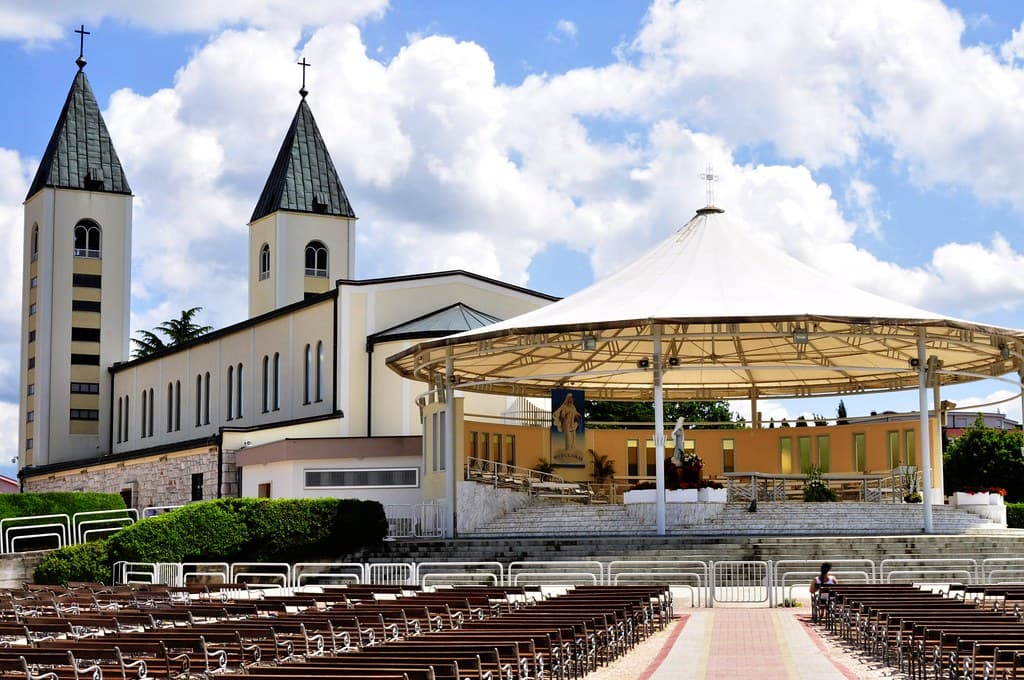
Shrine of the Queen of Peace at Medjugorje, Medjugorje
Međugorje, Herzegovina-Neretva, Bosnia and Herzegovina
1.2 km away
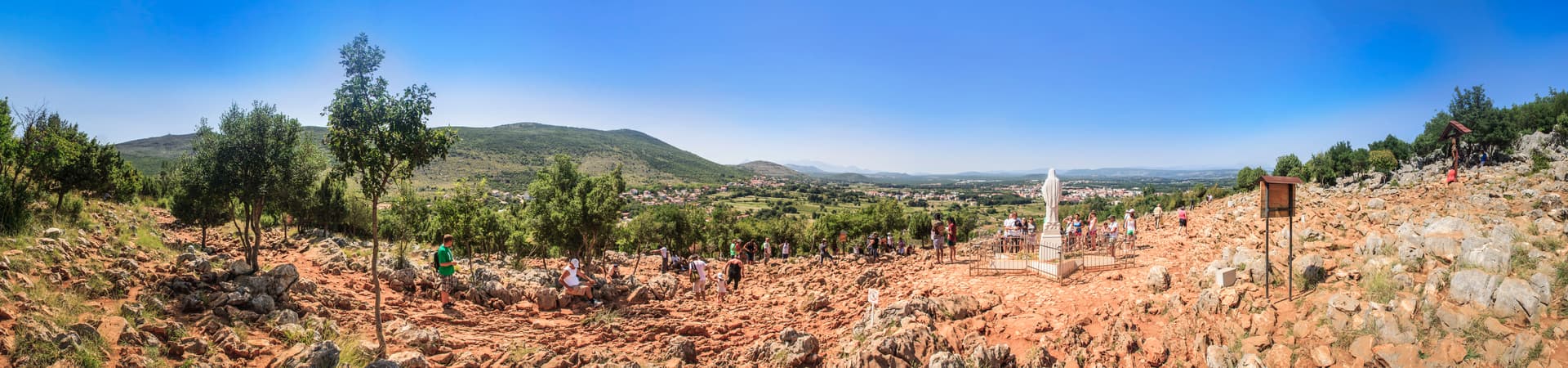
Apparition Hill, Medjugorje
Medjugorje, Herzegovina-Neretva, Bosnia and Herzegovina
1.8 km away
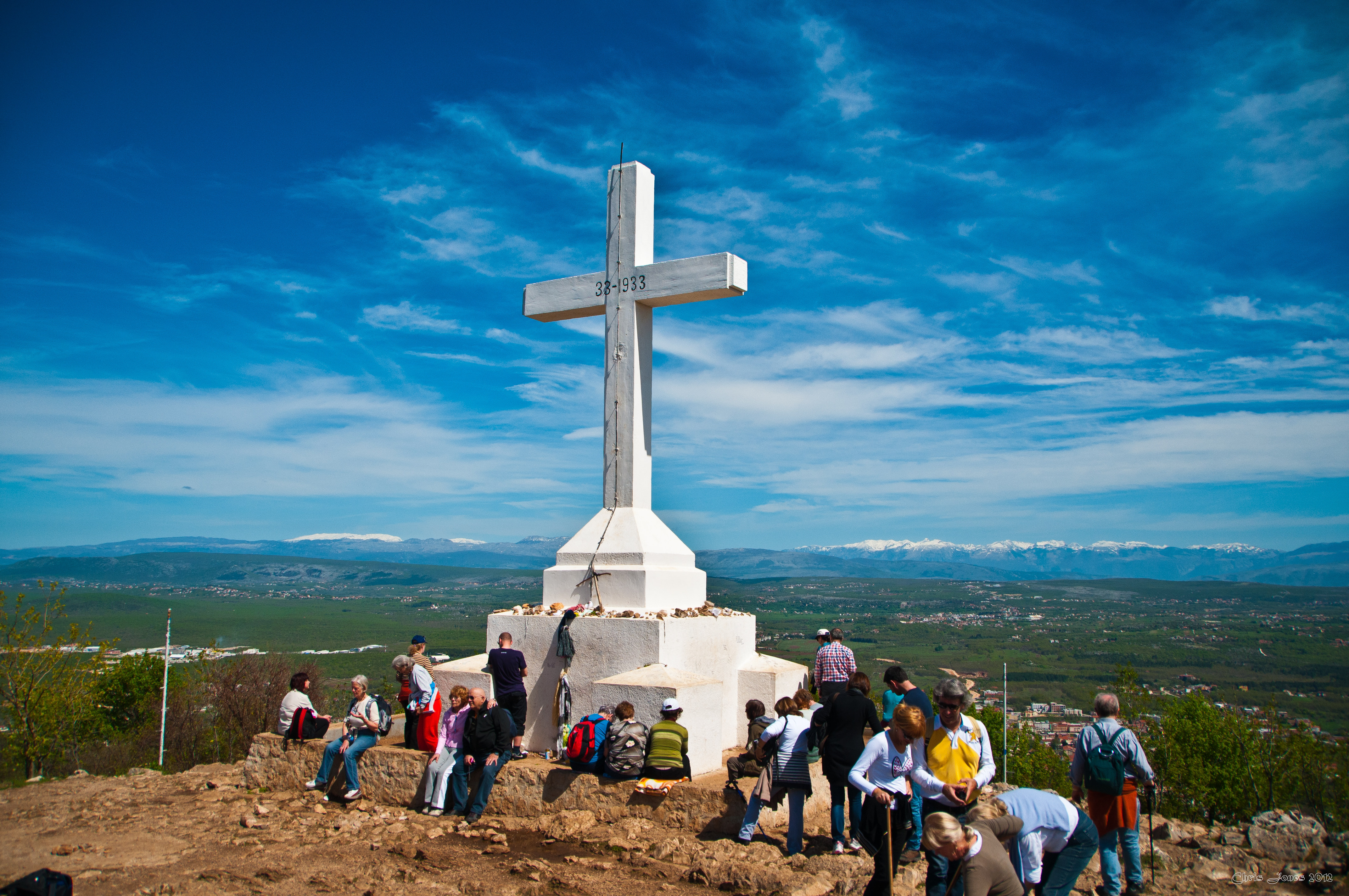
Cross Hill
Medjugorje, Herzegovina-Neretva, Bosnia and Herzegovina
3.0 km away

Žitomislić Monastery
Žitomislići, Žitomislići, Mostar, Herzegovina-Neretva Canton, Bosnia and Herzegovina
9.0 km away
Share a photo
Help visitors recognize Church of Saint James the Greater (Apostle). Every submission is reviewed before publication.