Cross Hill
Where a parish carried a cross up a mountain on their backs, and pilgrims have been climbing ever since
Understand sacred places, explore living traditions, and learn how to engage respectfully with Pilgrim Map.
Access has not been verified. Check current local guidance before planning a visit.
Medjugorje, Herzegovina-Neretva, Bosnia and Herzegovina
Read the sources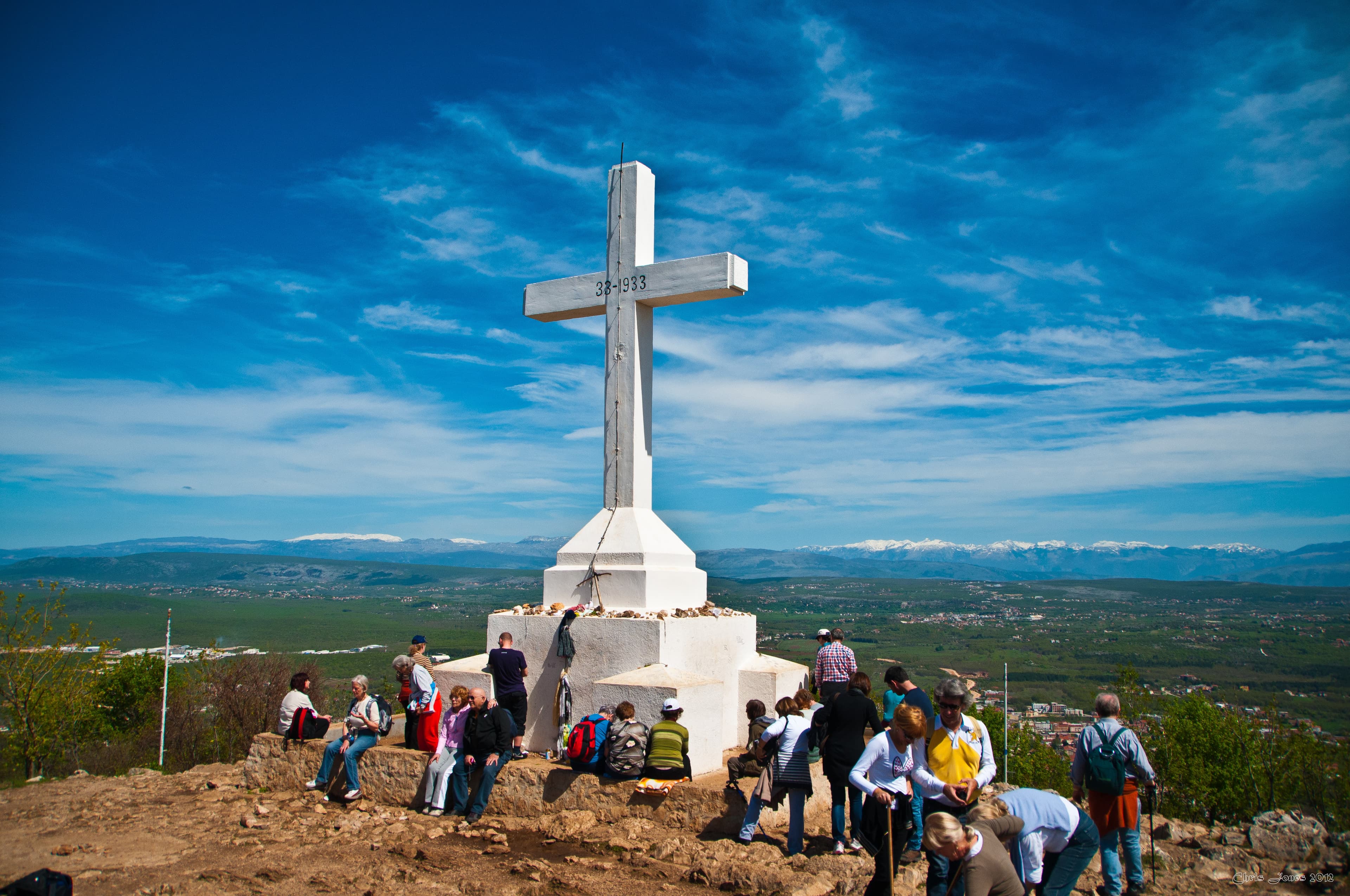
Image of Cross Hill. Image source · CC-BY-2.0
Visit essentials
A quick read before you go
- Duration
- Allow 60 to 90 minutes for the ascent, depending on pace and time at each Station.
- Access
- The trailhead begins in the village of Medjugorje, a short walk from St.
Overview
Cross Hill begins with sharp, loose, uneven rocks: the climb is a negotiation with the ground, and that is the point. In winter 1934, Medjugorje parishioners carried 16 tonnes of concrete, sand, and water up the mountain on their backs, answering Pope Pius XI's call for hilltop crosses on the 1,900th anniversary of Christ's crucifixion.
They completed the 8.56-meter cross in fifty-two days and embedded a relic of the True Cross, a gift from Rome linking the Herzegovinian hill to Calvary.
For nearly five decades it remained a local devotion above the tobacco fields. In 1981, six young villagers reported seeing the Virgin Mary, and millions now come yearly to pray the Stations along the ascent, pause at Carmelo Puzzolo's bronze reliefs, and reach the summit where Adriatic wind meets accumulated prayer. The Vatican has approved devotion here without pronouncing on the apparitions. The mountain asks no position on that question, only the climb.
Why this place is sacred
Something accumulates in places where people have suffered and prayed in the same gesture. Cross Hill holds ninety years of both.
The thinness begins with the ground. The path is not paved, not smoothed, not made easy. Sharp limestone fragments cover the ascent, and the mountain offers no shade. In summer, heat radiates from the rock. In winter, the bora wind cuts across the exposed ridge.
These are not design failures — they are the conditions the original builders faced when they carried sixteen tonnes of materials upward, and they remain the conditions under which pilgrims identify, however partially, with the Passion of Christ that the cross commemorates.
At each of the fourteen Stations, bronze reliefs by the Italian sculptor Carmelo Puzzolo depict scenes from Christ's final hours. Each station except the Garden of Gethsemane includes an image of the Virgin Mary — a choice that predates the apparitions by only three years but now resonates with particular force for those who come because of them.
The pauses at each station create a rhythm of movement and stillness, exertion and contemplation, that pilgrims describe as gradually dissolving the boundary between physical effort and prayer.
The summit cross, containing its fragment of the True Cross from the Church of the Holy Cross of Jerusalem in Rome, functions as a material link across geography and time — connecting this hilltop to the hill where Christian tradition holds that Christ died. Whether one understands this as symbolic or sacramental depends on one's theology.
Either way, the convergence of relic, elevation, and the collective intention of those who built and those who climb produces a quality of attention that many find difficult to sustain elsewhere.
Pilgrims have also reported visual phenomena: the cross appearing to spin against the sky, transforming into a column of light, or seeming to be replaced by a luminous silhouette. These accounts are numerous enough to constitute a pattern, though they remain unverified by scientific study. Skeptics point to optical illusions produced by staring at a bright fixed object against open sky.
The phenomena, whatever their origin, add another layer to the mountain's reputation as a place where ordinary perception does not fully hold.
The cross was erected in direct response to Pope Pius XI's 1933 proclamation of a Holy Year marking 1,900 years since the crucifixion of Christ. The Pope called for crosses to be built on hilltops throughout the Catholic world. Parish Priest Bernardin Smoljan organized the parishioners of Medjugorje to build theirs on the highest point visible from the village — transforming a bare karst mountain into a permanent site of devotion and a daily visible reminder of the Passion.
For its first forty-seven years, the cross served the local parish. Villagers celebrated the Feast of the Exaltation of the Holy Cross at the summit each September, a tradition that persisted even under Communist Yugoslavia's prohibition of outdoor religious gatherings — reportedly the sole exception authorities permitted in the region. The mountain's significance was local, familial, woven into the rhythms of a farming community.
The reported Marian apparitions of 1981 changed the mountain's scale but not its fundamental character. What had been a parish devotion became an international pilgrimage. The Stations of the Cross were added in 1988, giving the ascent a formal devotional structure it had previously lacked. The Vatican's 2019 authorization of official pilgrimages, and the 2024 Nulla Osta approving devotion while withholding judgment on the apparitions, situated Cross Hill within the complex institutional framework of approved Catholic piety.
Through all of this, the rocks have remained the same — sharp, demanding, indifferent to institutional status.
Experience and orientation
The ascent takes between sixty and ninety minutes, depending on pace and the time spent at each Station. Most pilgrims underestimate the terrain. The rocks are not rounded or weathered smooth — they are broken limestone, angular and loose, requiring constant attention to footing. Some pilgrims climb barefoot as a deliberate act of penance. Others find that even in sturdy shoes, the mountain imposes a quality of physical awareness that becomes inseparable from prayer.
Weeping is common. Not at any particular Station, but somewhere along the ascent — an emotional release that catches people off guard. Those who have climbed describe it not as sadness but as something closer to surrender, as though the physical effort broke through a resistance they had not known they were maintaining. The communal dimension intensifies this.
On any given day, the path holds pilgrims from a dozen countries, praying in different languages, moving at different speeds, yet sharing a single upward direction. There is a particular quality to being among strangers who are all doing something difficult for the same reason.
The summit offers an abrupt shift. After the constricted focus of the path, the view opens to the Herzegovinian countryside — the village below, the Neretva valley, the distant mountains of the Dinaric Alps. The concrete cross, weathered but solid, stands without ornament. Pilgrims gather at its base, some kneeling, some sitting on the rocks in silence. The wind is often strong here, carrying away whatever was carried up.
Those who climb during the Friday communal Way of the Cross at 4 PM — or 2 PM in winter — describe a heightened sense of shared devotion. The procession moves slowly, pausing at each Station for communal prayer. By the time the group reaches the summit, the experience has become something more than the sum of individual climbs.
Consider what you carry to the mountain before you begin. Many pilgrims arrive with a specific intention — a grief, a question, a relationship in need of healing — and find the climb gives physical form to the inner work. You need not be Catholic, or religious at all, to find that the demands of the ascent produce something useful in you.
Wear shoes with serious grip. Bring water — there is none on the mountain. Start early in summer to avoid the worst heat. If you are able, climb in silence, letting the Stations set the rhythm rather than conversation. The path is not a trail in the recreational sense. It is steep, it is rough, and it will slow you down. That slowness is not an obstacle to the experience. It is the experience.
Context and lineage
In 1933, Pope Pius XI proclaimed a Holy Year to mark nineteen centuries since the crucifixion of Christ and called for crosses to be erected on mountains and hilltops throughout the Catholic world. In the small Herzegovinian parish of Medjugorje, Father Bernardin Smoljan took the call literally.
On January 21, 1934, construction began. The parishioners had no machinery, no road to the summit, no resources beyond their own bodies and the materials they could purchase or make. Through the remaining weeks of winter, men and women carried sacks of cement, buckets of sand, containers of water, and tools up 520 meters of bare karst rock. The cross they built stands 8.56 meters high, 3.5 meters wide, and weighs approximately 16 tonnes. It was completed in fifty-two days.
Before the concrete set, a relic of the True Cross — obtained from Pope Pius XI, originally housed in the Church of the Holy Cross of Jerusalem in Rome — was embedded within it. The inscription cast into the base reads: 'IHS JESUS CHRIST REDEEMER OF MANKIND AS A SIGN OF OUR FAITH OUR LOVE AND OUR HOPE BUILT BY PASTOR BERNADIN SMOLJAN AND THE PARISHIONERS OF MEDJUGORJE FREE ALL OF US FROM ALL EVIL O JESUS.'
The first Holy Mass at the foot of the cross was celebrated on March 16, 1934, one day after its completion.
The cross has stood on the mountain for over ninety years, witnessing the arc of twentieth-century Balkan history. Built under the Kingdom of Yugoslavia, it survived the Second World War and the Communist era that followed. Under Tito's Yugoslavia, outdoor religious gatherings were prohibited, yet the annual September 14 feast at the summit continued — a quiet persistence that the authorities apparently chose not to suppress.
The 1981 apparitions added a global dimension to what had been a local devotion. As Medjugorje grew into a pilgrimage center — with hotels, restaurants, and religious goods shops filling the village — Cross Hill remained physically unchanged: the same rocks, the same cross, the same demanding climb. The addition of Puzzolo's bronze Stations in 1988 formalized the devotional path, and the Vatican's incremental approvals in 2019 and 2024 brought institutional recognition.
But the mountain's authority does not derive from Rome. It derives from the fact that an entire parish carried it into being with their hands, and that pilgrims continue to climb it with their feet.
Bernardin Smoljan
historical
The parish priest of Medjugorje who initiated and directed the construction of the summit cross in 1934. His organizational ability and the trust he held within the parish made the fifty-two-day construction effort possible.
Pope Pius XI
historical
The pope who proclaimed the 1933 Holy Year and called for crosses to be erected on hilltops worldwide. He provided the relic of the True Cross that is embedded in the summit cross.
Carmelo Puzzolo
historical
The Italian sculptor who created the bronze relief plaques depicting the 14 Stations of the Cross, installed along the mountain path in 1988. Each station except the Garden of Gethsemane includes an image of the Virgin Mary.
Pope Francis
historical
In May 2019, formally authorized official diocesan and parish pilgrimages to Medjugorje, ending decades of institutional ambiguity about whether Catholics could organize pilgrimages to the site.
Traditions and practice
The Way of the Cross is the mountain's central practice. Pilgrims ascend along the path, stopping at each of the fourteen Stations to pray and meditate on Christ's final hours — from the Garden of Gethsemane to the entombment. The prayers are traditional Catholic devotions, though many pilgrims adapt them to their own spiritual language. The physical difficulty of moving between Stations over rough terrain integrates the body into what might otherwise remain a purely mental exercise.
The Rosary accompanies many climbers, its repetitive structure matching the rhythm of footsteps on stone. Penitential barefoot climbing, while not formally required, is practiced by pilgrims seeking a more radical identification with Christ's suffering. The veneration of the relic of the True Cross at the summit — though the relic itself is sealed within the concrete and cannot be touched — forms the devotional culmination of the ascent.
Every Friday, a communal Way of the Cross begins at 4 PM in summer and 2 PM in winter. This is the most powerful expression of the mountain's living practice — a slow procession of dozens or hundreds of pilgrims praying aloud at each Station, their voices carrying across the hillside. The communal climb transforms individual devotion into shared liturgical action.
The annual Feast of the Exaltation of the Holy Cross, celebrated on or near September 14, draws large crowds for Holy Mass at the summit — a tradition unbroken since 1934. Evening prayer groups are sometimes visible from the village below, their flashlights tracing the path like a procession of stars.
Cross Hill also functions within the broader Medjugorje pilgrimage program, which typically includes evening Rosary and Mass at St. James Parish Church, a visit to Apparition Hill, Adoration of the Blessed Sacrament, and confession. The mountain is one element of an integrated devotional landscape.
If you are not Catholic, or not certain what you believe, the mountain still has something to offer. The physical act of climbing over difficult terrain, pausing at intervals, and arriving at a summit after sustained effort produces effects that do not require doctrinal commitment.
Consider climbing in the early morning, when the path is quiet and the heat has not yet built. Pause at each Station not necessarily to pray in any formal sense, but to look at the bronze reliefs — to sit with the images of suffering, compassion, and human solidarity they depict. Let the Stations set your pace rather than your fitness.
At the summit, sit with the cross for longer than feels necessary. Notice the wind, the view, the quality of silence that exists even when others are present. If you carried a question or a weight to the mountain, this is the place to set it down.
Roman Catholicism
ActiveCross Hill is one of the three principal sacred sites within the Medjugorje pilgrimage complex. The 8.56-meter concrete cross at the summit, containing a relic of the True Cross, was erected in 1934 as an act of communal parish devotion commemorating the 1,900th anniversary of Christ's crucifixion. Since the reported Marian apparitions of 1981, the mountain has become one of Europe's most visited Catholic pilgrimage destinations, drawing millions annually. The Vatican's 2019 authorization of official pilgrimages and 2024 approval of devotion have situated Cross Hill within the institutional framework of approved Catholic piety.
The Way of the Cross is the mountain's defining practice — pilgrims ascend past fourteen bronze-relief Stations depicting Christ's Passion, praying and meditating at each. The communal Friday Way of the Cross at 4 PM (2 PM in winter) is the most powerful expression of the mountain's living devotion. The annual Feast of the Exaltation of the Holy Cross on September 14, with Holy Mass at the summit, has been celebrated without interruption since 1934. The Rosary, penitential barefoot climbing, and personal prayer and meditation during the ascent are widespread practices.
Perspectives and open questions
Cross Hill sits at an intersection of verified history, institutional theology, personal testimony, and contested phenomena. Engaging honestly with the site requires holding these together — the documented facts of its construction, the Church's carefully calibrated position, the overwhelming consistency of pilgrim reports, and the unresolved questions that keep the place alive to inquiry.
Scholarly perspective
Religious studies scholars recognize Cross Hill as significant for its dual historical layers. The 1934 construction predates the apparitions by nearly five decades, anchoring the site's sacred character in a documented act of parish devotion rather than contested supernatural claims. This distinction matters theologically: the Vatican's 2024 Nulla Osta approved the spiritual fruits of devotion at Medjugorje — conversions, deepened faith, acts of charity — while explicitly not pronouncing on the authenticity of the apparitions.
Scholars note that Cross Hill offers the Vatican an easier object of approval than Apparition Hill, precisely because its origin is historical rather than visionary.
The communal construction of the cross in 1934, during a period of poverty and political marginalization for the Croatian Catholic population under the Kingdom of Yugoslavia, also situates the site within broader studies of how sacred places emerge from collective sacrifice. The mountain was transformed not by vision or miracle but by labor — an act of meaning-making through physical devotion that scholars of material religion find significant in its own right.
Living and traditional perspectives
For the Croatian Catholic community of Herzegovina, the cross on Križevac carries a significance that predates and exceeds the apparitions. It represents the faith and resilience of their grandparents and great-grandparents, who built something permanent under conditions of poverty. The continuation of the September 14 feast under Communist prohibition was a quiet act of cultural and religious resistance — the one outdoor gathering the authorities did not suppress.
Within the framework of Catholic devotion, the mountain is understood as a place where the mystery of the Cross — Christ's suffering and redemption — becomes tangible. The relic of the True Cross connects the summit to the historical Crucifixion. The physical pain of the climb connects the pilgrim to Christ's Passion. The Stations of the Cross provide a narrative framework for this identification. For practicing Catholics, this is not metaphor but participation in a reality that transcends time.
Alternative interpretations
Some pilgrims and commentators have reported phenomena at Cross Hill that exceed conventional Catholic devotion: the concrete cross appearing to spin or rotate against the sky, transforming into a column of light, or seeming to vanish and be replaced by a luminous silhouette of the Virgin Mary. A phenomenon resembling the 'spinning sun' reported at Fatima has also been described.
These accounts are numerous — documented across decades and from pilgrims of diverse backgrounds — but they remain scientifically unverified. Skeptical explanations center on well-documented optical illusions: staring at a fixed bright object against an open sky can produce apparent motion, afterimages, and distortions. The phenomena may also involve expectations shaped by prior accounts, creating a feedback loop between reported and perceived experience. Neither the Vatican nor any scientific body has formally investigated these specific claims.
Open questions
Several questions remain genuinely open. The exact provenance and chain of custody of the True Cross relic embedded in the concrete is not thoroughly documented in publicly available sources — the tradition holds that it came from Pope Pius XI via the Church of the Holy Cross of Jerusalem in Rome, but detailed records have not been widely published.
The relationship between the mountain's pre-1981 sacred character and its post-apparition significance — whether these are continuous or represent a rupture — remains a subject of theological reflection rather than settled interpretation. Whether the reported visual phenomena are supernatural, psychological, or optical in nature has not been definitively resolved, and may resist resolution given the inherently subjective nature of the experiences.
Plan your visit
Access and arrival
The trailhead begins in the village of Medjugorje, a short walk from St. James Parish Church. Medjugorje is approximately 25 km southwest of Mostar and 150 km from Sarajevo. It is accessible by car or bus from Mostar, Dubrovnik in Croatia (approximately 150 km), or Sarajevo. No public transport reaches the summit — it is a foot path only. No entry fee is charged.
Mobile phone signal is generally available in Medjugorje village and intermittently on the mountain, though coverage may be unreliable at certain points on the ascent. In case of emergency, the nearest settlement with reliable access is Medjugorje village itself at the base of the mountain.
Medjugorje village offers abundant accommodation at all price points, from family-run pensions to larger pilgrim hotels. Most lodging is within walking distance of both the trailhead for Cross Hill and St. James Church. Many accommodations cater specifically to pilgrim groups and can arrange guides, transportation, and participation in the shrine's devotional programs. Mostar, 25 km to the northeast, provides a wider range of hotels and serves as an alternative base.
Respectful visit
Modest clothing is appropriate — shoulders and knees covered, as befits a Catholic sacred site. Beyond modesty, practicality is essential: sturdy shoes with good grip are not optional on this terrain. Sandals, heels, and smooth-soled shoes are genuinely dangerous on the loose rocks.
Photography is permitted and the panoramic views from the summit reward it. Exercise restraint around other pilgrims, particularly those in prayer or visible distress. The Stations of the Cross and the summit cross are appropriate subjects. Staging photographs that treat the site as a backdrop rather than a place of devotion is discouraged.
There is no formal offering system on the mountain. Donations to the parish of St. James Church in Medjugorje support the broader shrine and its maintenance. Some pilgrims leave small devotional objects at the base of the cross or at Stations, though this is not officially encouraged.
There are no formal access restrictions — the mountain is freely open at all hours, year-round, without fee. The restrictions are imposed by the terrain itself: it is steep, rocky, exposed to weather, and without infrastructure. Visitors should exercise personal judgment about their physical capacity. The descent is often more difficult than the ascent, as the loose rocks shift underfoot on the downward slope.
The terrain is genuinely hazardous. The rocks are sharp and unstable, and there are no handrails or barriers. In wet conditions the path becomes dangerously slippery. Climbing in darkness requires a reliable flashlight and extreme caution. The mountain is not recommended for those with severe mobility impairments. Heat exhaustion is a real risk in summer — there is no shade and no water source on the mountain. Bring at least one liter of water per person.
Current practical details
Address
5MG9+66W, Zvirovići, Bosnia and Herzegovina
Hours, fees, and access can change — verify on the official source before you travel. Practical details last checked Jun 2026.
Location
Map loads as you approach this section.
Pilgrim reflections
A portrait of encounter, not a score
Pilgrims describe what they felt, how present they could become, and whether the place would shape a journey. There are no stars and no ranking of traditions.
No reviewed reflections yet
The first pilgrims can help describe the character of being here.
Share a reflection
Available after an account-backed “Been there.” Every reflection is reviewed before publication.
Nearby sacred places
Explore other sacred places in the region. Proximity does not establish access or travel time; check each place’s guidance.
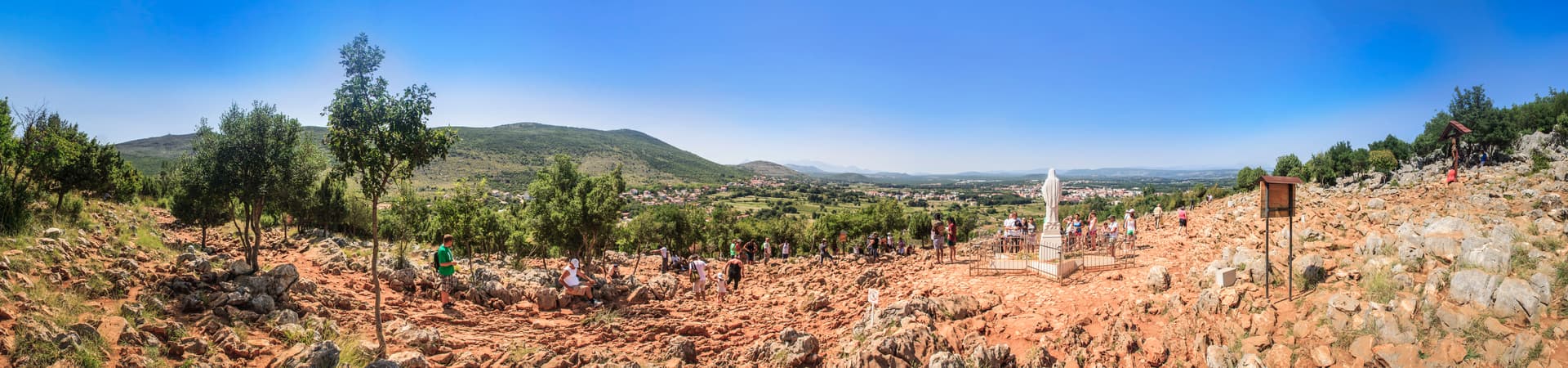
Apparition Hill, Medjugorje
Medjugorje, Herzegovina-Neretva, Bosnia and Herzegovina
1.2 km away
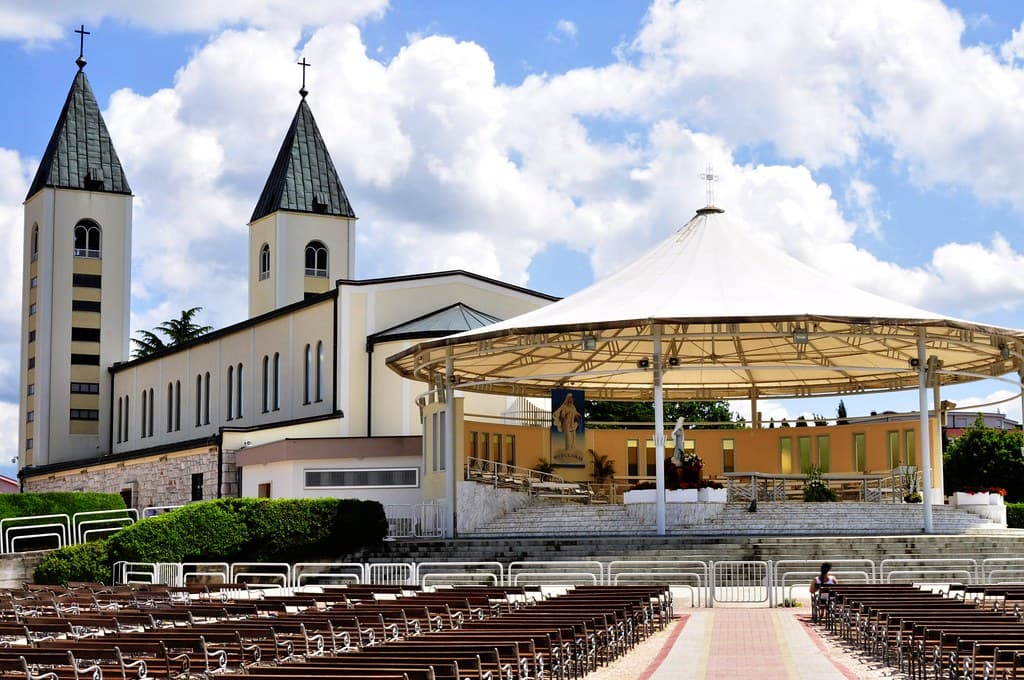
Shrine of the Queen of Peace at Medjugorje, Medjugorje
Međugorje, Herzegovina-Neretva, Bosnia and Herzegovina
1.8 km away

Church of Saint James the Greater (Apostle)
Medjugorje, Herzegovina-Neretva, Bosnia and Herzegovina
3.0 km away

Žitomislić Monastery
Žitomislići, Žitomislići, Mostar, Herzegovina-Neretva Canton, Bosnia and Herzegovina
10.7 km away
References
Sources consulted for this page. Source categories describe the publication, not a guarantee that every claim is verified. Traditional accounts and outside interpretations may differ.
- 01Vatican finally approves Medjugorje devotion — America Magazine — America Magazinenews2024 Vatican approval of devotion at Medjugorje
- 02Medjugorje — Wikipedia — Wikipedia contributorsencyclopediaGeneral overview of Medjugorje including Cross Mountain history
- 03Cross Mountain: Medjugorje's Spiritual Summit — Medjugorje.com — Medjugorje.comspiritualDetailed devotional and practical information about Cross Mountain
- 04Discover the Cross on Mt. Krizevac: History, Significance & Pilgrimage Impact — Medjugorje.com — Medjugorje.comspiritualHistorical timeline of the cross construction
- 05Križevac (Cross Mountain) — Medjugorje Guide — Medjugorje GuidespiritualPilgrim guide with practical and historical information
- 06Križevac – Cross Mountain — Medjugorje Centre of Canada — Medjugorje Centre of CanadaspiritualDetailed construction history and parish priest information
- 07Apparition Hill (Podbrdo) and Cross Mountain (Križevac) — Medjugorje WebSite — Medjugorje.wsspiritualOfficial Medjugorje shrine guide covering both hills
- 08Solemnity of the Exaltation of the Holy Cross – Krizevac Mountain — Medjugorje WebSite — Medjugorje.wsofficialAnnual feast celebration history
- 09Križevac — Turistička zajednica Čitluk (Tourist Board of Čitluk) — Tourist Board of ČitlukguideOfficial local tourism authority information
- 10The Medjugorje Witness — Spinning Cross — The Medjugorje WitnessspiritualFirst-hand pilgrim accounts of reported phenomena
Share a photo
Help visitors recognize Cross Hill. Every submission is reviewed before publication.