Ses Païsses
A Bronze Age walled village beneath Mallorca's holm oaks
Understand sacred places, explore living traditions, and learn how to engage respectfully with Pilgrim Map.
Access has not been verified. Check current local guidance before planning a visit.
Artà, Balearic Islands, Spain
Read the sources
Visit essentials
A quick read before you go
- Duration
- Not precisely documented in sourced material; given the site's compact scale (approximately…
- Access
- The site sits on the southeastern outskirts of Artà in northeastern Mallorca.
Overview
On the wooded outskirts of Artà, a low stone tower rises from a clearing of holm oaks, ringed by the collapsed and standing remains of a village wall built from boulders too large to lift by hand. Ses Païsses grew outward from that central talaiot over several centuries, from a Bronze Age tower into a fortified Iron Age settlement of more than a hectare, before its people faded from the record in the wake of Roman conquest.
What remains today is one of the best-preserved Talayotic villages in Mallorca: a place where domestic life, defense, and — it is inferred rather than proven — communal ritual once overlapped, and where a 20th-century poet later found material for a very different kind of story.
Why this place is sacred
There is no origin myth attached to Ses Païsses, no deity or venerated figure at its center, and no continuous tradition connecting the Talayotic people who built it to anyone living today. What draws attention instead is the site's material honesty: a construction sequence you can still read in the stone, if you know where to look.
The settlement began with a single cylindrical tower — the talaiot itself, the structure that gives the whole Talayotic culture its name — sometime in the Bronze Age. Rooms and chambers accumulated around it over generations. Centuries later, long after the original tower was already old, the community built the massive outer wall that now defines the site's edge, using boulders reportedly weighing around eight tonnes at the base, fitted without mortar.
That layering — tower first, walled town later — is the closest thing the site offers to a story: not a myth of founding, but a visible record of a community that kept building on top of what its ancestors had already made.
A fortified settlement combining dwelling space, defensive walling, and what researchers infer — without firm confirmation — to have been communal or ritual gathering space around the central talaiot and its hypostyle chamber.
The central talaiot was built first, with domestic and possibly ritual structures accumulating around it; the massive outer cyclopean wall was added centuries later, and the settlement was gradually abandoned following the Roman arrival on Mallorca in 123 BC, with a small remnant population persisting until the Romans founded what became present-day Artà.
Experience and orientation
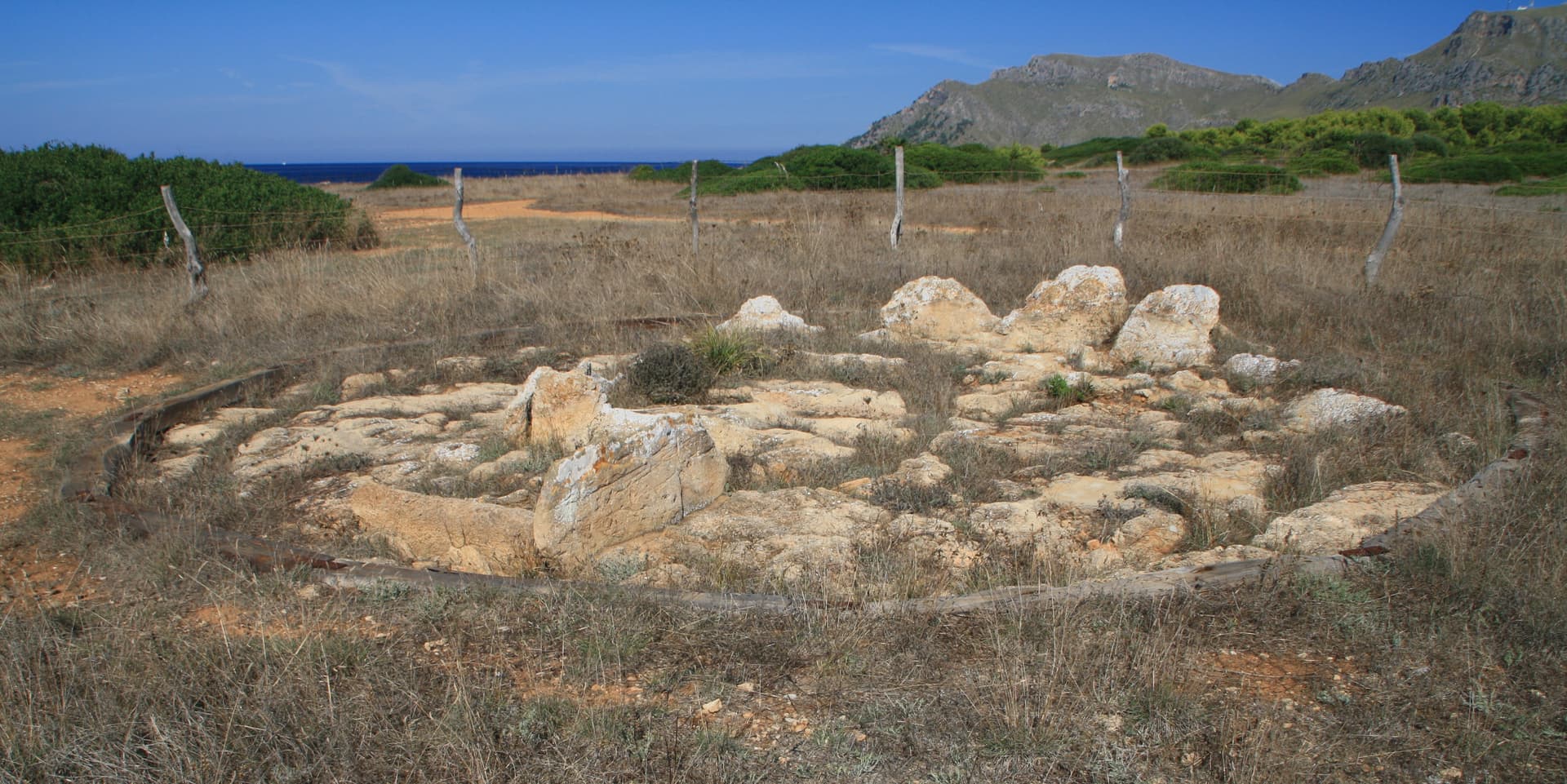
The site sits in a stand of holm oaks that shades the ruins for most of the day, and visitor accounts describe it as unhurried and rarely crowded. The approach is on foot, along the perimeter of the outer wall, whose scale becomes apparent gradually — a line of boulders that starts to look less like scattered rock and more like deliberate construction.
The southeast gateway is the clearest single feature to look for: two upright boulders with a third laid across them as a lintel, opening into a stone passage with steps to either side. Inside, paths lead around — rather than into — the central talaiot, which is fenced off to protect its remaining structure.
Visitors can view the hypostyle chamber and the horseshoe-shaped room from the walkways, and a monolith near the entrance marks the site's more recent literary association, discussed below.
Enter from the marked path near the site entrance on Camí de sa Corbaia; the outer wall and southeast gate are the natural first landmarks, with the central talaiot and hypostyle chamber further inside the perimeter.
Context and lineage
The site's central talaiot dates to the Talayotic culture's early period; sources give slightly different approximate dates for its origin (variously cited as around 1000 BCE, 900-800 BC, or c. 850 BC), a discrepancy likely owing to different dating methods or site phases rather than genuine disagreement about the culture itself. The outer cyclopean perimeter wall, which now defines the visible edge of the settlement, was added considerably later, around 650-540 BC.
The village was abandoned in stages following the Roman conquest of Mallorca in 123 BC, though a small population is said to have lingered until the Romans established a new settlement nearby that became present-day Artà.
No continuous cultural or religious lineage connects the Talayotic builders of Ses Païsses to any living community; the site's present-day custodianship rests with regional heritage authorities rather than a descendant tradition.
Giovanni Lilliu
Italian archaeologist who led the site's first major excavations between 1959 and 1963, uncovering the talaiot and surrounding structures and investigating possible parallels with Sardinia's nuragic culture.
Miquel Costa i Llobera
Mallorcan poet who drew on Ses Païsses as a setting for his 1900 poem 'La deixa del geni grec,' later adapted into the 1947 opera 'Nuredduna'; a monolith to him stands near the site entrance.
Traditions and practice
Excavated hearths, ceramics, and traces of later burial and ironwork point to domestic life and probably communal gathering around the talaiot and hypostyle chamber, but the specific rituals or beliefs of the Talayotic community are not recorded and remain inferred rather than known.
None; the site today functions solely as a protected archaeological monument, part of a broader network of Talayotic sites promoted as an archaeological route by the Consell de Mallorca.
Walk the perimeter wall slowly enough to notice the shift in construction — the older, weathered stones of the tower against the more uniform cyclopean blocks of the later wall. Pause at the southeast gateway and look at the scale of the lintel stone relative to the people who set it there without machinery. Let the holm-oak canopy and relative quiet of the site do the work that a guided narrative might otherwise do.
Talayotic Culture
HistoricalSes Païsses was a fortified village of the Talayotic culture, the Bronze and Iron Age civilization whose megalithic stone towers gave the culture its name; the site is one of the best-preserved examples of how these communities organized dwelling, defense, and possibly ritual space around a central tower.
Excavated hearths, ceramics, and later burial and ironwork point to domestic and probably communal use of the site, though specific ritual or ceremonial practices are inferred rather than documented.
Heritage stewardship and archaeological tourism
ActiveSince its 1946 designation as a Historical and Artistic Monument, Ses Païsses has been maintained as a protected site and incorporated into a Consell de Mallorca-promoted archaeological route, making it an active site of heritage tourism and public interpretation rather than religious practice.
Ongoing site conservation, regulated visitor access with posted hours and an admission fee, and inclusion in regional archaeological trail promotion.
Perspectives and open questions
Ses Païsses is read differently depending on the lens: as a data point in prehistoric Mediterranean archaeology, as a still-functioning civic landmark for Artà, and — thanks to one 20th-century poet — as a literary setting layered over the archaeological one.
Scholarly perspective
Archaeologists regard Ses Païsses as one of the largest and best-preserved Talayotic settlements on Mallorca, its construction sequence — central tower first, defensive wall centuries later — offering a relatively clear window into how these communities grew. Giovanni Lilliu's mid-20th-century excavations pursued a comparative thesis linking Talayotic construction to Sardinia's nuragic towers; this remains one interpretive line among archaeologists rather than settled consensus.
Living and traditional perspectives
No living community maintains a continuous tradition tied to the Talayotic culture; the site's present-day 'tradition' is institutional rather than devotional — heritage protection status since 1946 and ongoing management as part of Mallorca's archaeological tourism route.
Open questions
The specific function of interior spaces like the hypostyle chamber and horseshoe-shaped room — domestic, communal, or ritual — is inferred from their form rather than confirmed by any surviving record, and the underlying beliefs of the people who built and used Ses Països remain, by the nature of a pre-literate culture, largely unrecoverable.
Plan your visit
Access and arrival
The site sits on the southeastern outskirts of Artà in northeastern Mallorca. Addresses given across sources vary slightly — Camí de sa Corbaia, s/n, 07570 Artà (per the official Balearic Islands tourism board) and Lloc Poligon 13, 113, 07570 Artà (per a visitor guide) — so confirm the exact entrance location before travel. Admission is reported at €2. No confirmed tourist-office contact number or email was found in sourced material.
No mobile phone signal information was available at time of writing; check the Illes Balears Tourism Board's official listing for current access and connectivity details before relying on a phone at the site.
Respectful visit
No specific dress code was found in sourced material; sturdy, closed footwear is advisable given the uneven ancient stonework and woodland ground underfoot.
No restrictions on photography were identified in sourced material.
Not applicable; no active tradition of offerings exists at the site.
Visitors should not climb on, enter, or otherwise disturb the fenced-off central talaiot structure.
The central talaiot structure is fenced off from visitor access to protect the remaining masonry; do not attempt to climb on or enter it.
Location
Map loads as you approach this section.
Pilgrim reflections
A portrait of encounter, not a score
Pilgrims describe what they felt, how present they could become, and whether the place would shape a journey. There are no stars and no ranking of traditions.
No reviewed reflections yet
The first pilgrims can help describe the character of being here.
Share a reflection
Available after an account-backed “Been there.” Every reflection is reviewed before publication.
Nearby sacred places
Explore other sacred places in the region. Proximity does not establish access or travel time; check each place’s guidance.



References
Sources consulted for this page. Source categories describe the publication, not a guarantee that every claim is verified. Traditional accounts and outside interpretations may differ.
- 01Ses Païsses — Wikipedia — Wikipedia contributorsacademicCoordinates (39°41'14"N 3°21'13"E), settlement chronology, layout dimensions, cyclopean gateway description, excavation history.
- 02Archaeological Site Poblat talaiòtic de ses Païsses — Agència de Turisme de les Illes Balears (Balearic Islands official tourism board)officialOfficial regional tourism board listing; address, contact info, archaeological route context, Costa i Llobera monolith detail.
- 03Ses Païsses - Amazing Talayotic settlement in Artà — AccesMallorcaSource contextSite size (13,500 sqm, 374m perimeter), 1946 monument declaration, mention of Costa i Llobera literary connection, contact details.
- 04"Ses Païsses" | Majorcan archaeological site — RESERVATUM.comSource contextGeneral overview corroborating settlement timeline and site description; used for cross-checking only.
- 05Talayotic village Ses Païsses, Artá — mallorca-touristguide.co.ukSource contextCorroborates cyclopean gate description and general visitor context.
- 06Ses Paisses, Arta — seemallorca.comSource contextPractical visitor information including opening hours, admission fee (€2), and phone contact.
- 07Poblado talaiótico de Ses Paisses - Reviews — Tripadvisor contributorsSource contextVisitor reviews used only to corroborate general visitor experience; not used for factual claims.
Share a photo
Help visitors recognize Ses Païsses. Every submission is reviewed before publication.