Claper des Gegant
A walled Bronze Age village beneath a giant's-name tower
Understand sacred places, explore living traditions, and learn how to engage respectfully with Pilgrim Map.
Access has not been verified. Check current local guidance before planning a visit.
Capdepera, Balearic Islands, Spain
Read the sources
Visit essentials
A quick read before you go
- Access
- On foot via the signposted municipal hiking route from Font de Sa Cala, or via a roughly…
- Etiquette
- Access here depends on respecting posted hours rather than any code of dress or devotion.
Overview
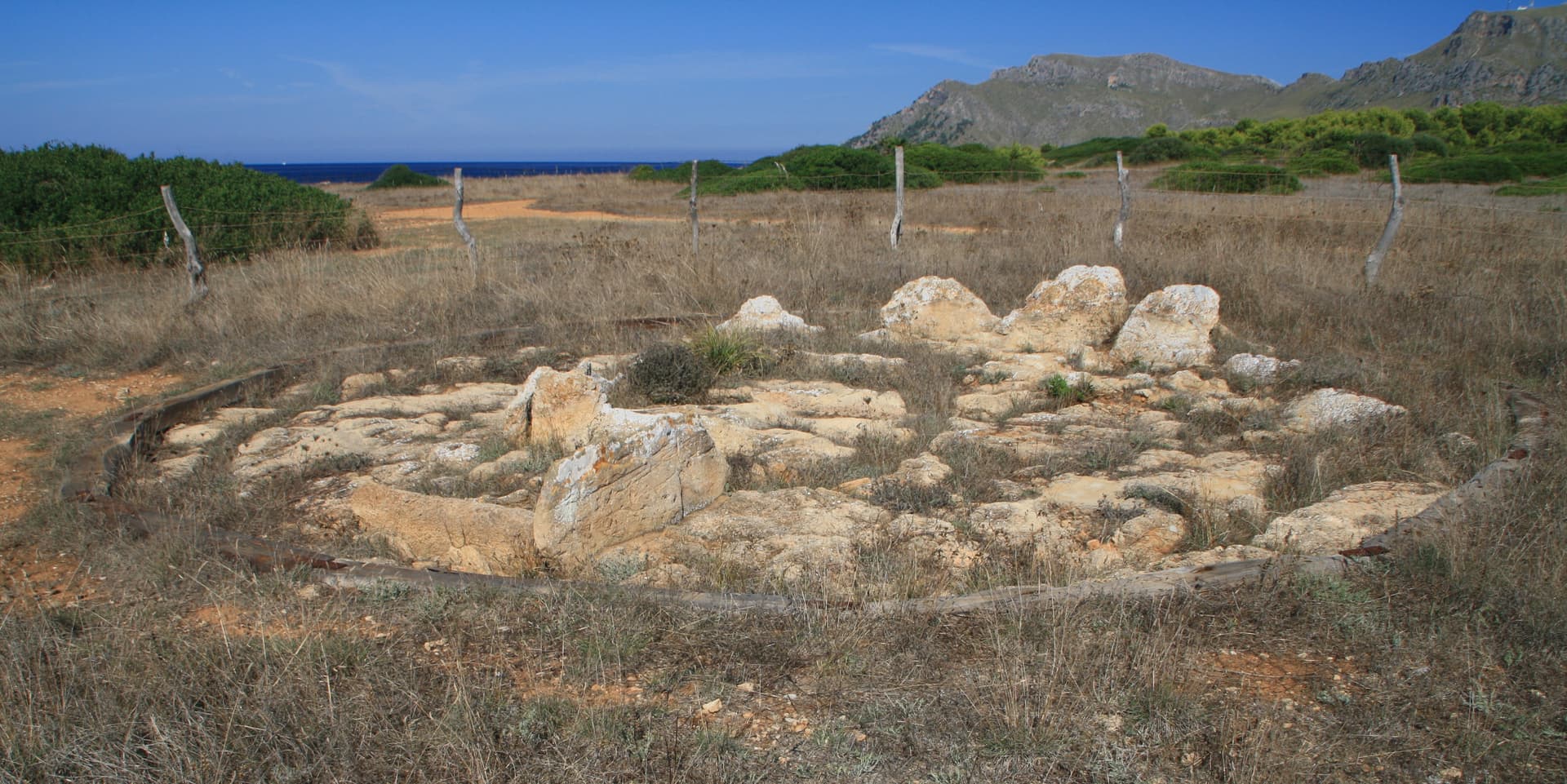
Claper des Gegant occupies Puig de sa Tortuga above Canyamel in Capdepera on Mallorca's northeast coast, overlooking sea and interior. A roughly 295-meter wall with at least three arched portals encloses a settlement built around 3,000 years ago in the Talayotic Bronze Age. Its monumental circular talayot is 9.8 meters across with 2.6-meter-thick walls, among the island's more imposing towers; circular, rectangular, and oval rooms and three rainwater cisterns surround it.
Archduke Lluís Salvador recorded the site in nineteenth-century surveys, Émile Cartailhac in 1892, José Mascaró Pasarius in early-1960s plans, and Lourdes Mazaira Cabana-Verdes through the 1996–1998 restoration that stabilized and opened it. Ceramic fragments attest later Phoenician and Roman reuse.
Why this place is sacred
Claper des Gegant carries its Catalan name — 'the giant's heap of stones' — from the same folk instinct found at megalithic sites across Europe, where builders unknown to later generations were assumed to be giants, since no one else could explain stone slabs of that size. Beyond that naming instinct, no origin legend, deity, or ritual narrative survives for this specific settlement.
What does survive is the architecture itself: a defensive wall of some 295 meters enclosing roughly 4,800 square meters, with at least three arched portals, protecting a central circular talayot 9.8 meters across, along with circular, rectangular, and oval dwelling rooms and three underground cisterns for storing rainwater.
Ceramic fragments recovered on site attest to Phoenician- and Roman-era reuse long after the Talayotic builders themselves, suggesting the walled hilltop kept being useful to whoever arrived next, even once its founding community was gone.
A fortified Talayotic village combining domestic dwellings, a monumental central tower, and communal water storage, sited defensively on the Puig de sa Tortuga hilltop with sightlines to both coast and interior.
Occupied and built up in multiple phases during the Talayotic Bronze Age (construction variously dated to roughly 3,000 years ago / around 1000 BC), with evidence of later Phoenician and Roman reoccupation via ceramic finds; documented by 19th-century antiquarians, mapped in the 1960s, and restored in 1996-1998 for stability and public access.
Experience and orientation
Approach on foot, either along the signposted municipal hiking route from Font de Sa Cala or via the roughly 500-meter dirt path from the small car park near the site. The land climbs gently to the hilltop of Puig de sa Tortuga; the wall's line becomes visible before any single structure does, and the central talayot rises above the lower dwelling rooms as the ground levels out.
Context and lineage
No named founder or dedicatee is recorded — as expected for a prehistoric community — but the site's documentation and preservation have specific names attached across two centuries.
Talayotic-culture inhabitants of prehistoric Mallorca (unnamed)
original builders and residents of the settlement during the Bronze Age
Archiduke Lluís Salvador of Austria
documented the site among Balearic antiquities during his surveys (1869-1891)
Émile Cartailhac
French prehistorian who recorded the site in his 1892 survey of Balearic monuments
José Mascaró Pasarius
produced detailed site plans of the settlement in the early 1960s
Lourdes Mazaira Cabana-Verdes
archaeologist who directed the 1996-1998 restoration campaign (vegetation clearance, structural stabilization, visitor-path creation)
Traditions and practice
Heritage tourism and municipal hiking-route walking are the only current forms of engagement; FOGESMA carries out vegetation-clearance maintenance on the ruins twice yearly, in spring and autumn.
Walk the wall's perimeter before entering the central chamber, so the settlement's scale registers before its detail does. At the main talayot, note the thickness of the outer wall — 2.6 meters — against the comparatively modest 9.8-meter diameter it encloses, and look for the entrance to the underground corridor on the chamber's southeast side. Pause at the cisterns and consider that storing rainwater, not defense or ceremony, may have been the most constant daily concern of whoever lived here.
Talayotic Culture
HistoricalThe settlement is cited by regional sources as one of the more significant and better-preserved Talayotic sites in Capdepera, its central talayot noted as among the more monumental tower structures on the island.
No ritual or ceremonial practice is documented for this site specifically; its defensive hilltop siting and communal water cisterns point to domestic and defensive functions rather than an attested ceremonial one.
Heritage conservation and archaeological stewardship
ActiveOngoing maintenance (FOGESMA's twice-yearly vegetation clearance) and the 1996-1998 restoration campaign represent a continuing, active tradition of care for the site, distinct from the extinct Talayotic culture that built it.
Structural stabilization, vegetation control, and visitor-path maintenance carried out by local heritage bodies.
Perspectives and open questions
What this settlement was for is read almost entirely from its stones, since no textual or oral tradition from its Talayotic builders survives.
Scholarly perspective
Archaeological and heritage-tourism sources agree this is a Bronze Age Talayotic fortified village — a walled settlement of roughly 4,800 square meters with a central monumental talayot, mixed dwelling forms, and cisterns — restored in 1996-1998 and maintained since as one of Capdepera's better-preserved Talayotic sites.
Open questions
Whether the central talayot tower served primarily as a lookout, a storage structure, a communal gathering space, or some combination of these remains an open question across Talayotic archaeology generally, and no site-specific resolution exists for Claper des Gegant.
Plan your visit
Access and arrival
On foot via the signposted municipal hiking route from Font de Sa Cala, or via a roughly 500-meter dirt path from a small car park just off the road near Canyamel golf course. The settlement is on private property with scheduled visiting hours; contact the Castell de Capdepera (+34 971 556 479) to confirm current access before visiting.
No mobile-signal information was available at time of writing; check with the Capdepera tourism office (visitcapdepera.com) for current details, and note that the nearest settlement with reliable signal and services is Canyamel.
Respectful visit
No specific dress code; sturdy footwear is advisable for the woodland or dirt-track approach.
No restriction on photography is documented.
None; this is not a site of ongoing devotional practice.
The site sits on private property with set, scheduled visiting hours rather than open access. Visit information is coordinated through the Castell de Capdepera (tel. +34 971 556 479, per the municipal tourism site); confirm current hours before traveling rather than assuming walk-up access.
The structures are dry-stone and unmortared; treat wall tops and chamber edges as fragile rather than climbable, and keep to the marked path through the settlement.
Location
Map loads as you approach this section.
Pilgrim reflections
A portrait of encounter, not a score
Pilgrims describe what they felt, how present they could become, and whether the place would shape a journey. There are no stars and no ranking of traditions.
No reviewed reflections yet
The first pilgrims can help describe the character of being here.
Share a reflection
Available after an account-backed “Been there.” Every reflection is reviewed before publication.
Nearby sacred places
Explore other sacred places in the region. Proximity does not establish access or travel time; check each place’s guidance.


References
Sources consulted for this page. Source categories describe the publication, not a guarantee that every claim is verified. Traditional accounts and outside interpretations may differ.
- 01Talayot 'Es Claper des Gegants' — visit capdepera — Ajuntament de Capdepera / Visit Capdepera (municipal tourism office)officialMunicipal tourism page confirming location in Canyamel, construction ~3,000 years ago, structural description, and referral to Castell de Capdepera for visiting-hours information.
- 02R.20 - Es Claper des Gegants – s'Heretat — visit capdepera (hiking route) — Ajuntament de Capdepera / Visit CapdeperaofficialListed as a signposted municipal hiking route reaching the site; page content could not be fully retrieved (403) but confirms the route's official existence via search index.
- 03Poblat prehistòric "es Claper des Gegant" — mallorca.es — Consell Insular de Mallorca / mallorca.es tourism portalofficialOfficial Mallorca tourism-board listing; confirms 'built ~3,000 years ago,' easy access from Canyamel, and structural description (talayots, wall with portals, exterior structures).
- 04Talayot de s'Heretat — Wikipedia (Spanish) — Wikipedia contributorsacademicMost detailed single source: dimensions of main talayot, wall perimeter, enclosed area, cisterns, restoration (1996-1998, led by Lourdes Mazaira Cabana-Verdes), 19th-century documentation by Archiduke Lluís Salvador and Émile Cartailhac, 1960s site plans by José Mascaró Pasarius, Phoenician/Roman-era ceramic finds, FOGESMA maintenance.
- 05El Claper des Gegant (el Talayot de s'Heretat) — Outdooractive POI — OutdooractiveSource contextSource of coordinates: 39.678056, 3.430278 (39°40'41.0"N 3°25'49.0"E); elevation 61 m; confirms private-property/set-visiting-times access and general structural description.
- 06Talayots and tradition: discover the Talayotic legacy of Capdepera — Hotel Son JaumellSource contextLocal hotel/tourism blog describing the site as housing 'one of the most monumental talayots on the island,' with a defensible hilltop position offering views of coast and interior; part of a wider Talayotic settlement network in Capdepera.
- 07Claper des Gegant — Wikidata — Wikidata contributorsacademicStructured-data entry cross-confirming site identity/naming; referenced via search index.
- 08Es Claper des Gegants — Tripadvisor — TripadvisorSource contextVisitor-review aggregator; used only to corroborate general visitor experience (walk through woodland, small car park, described as an off-the-beaten-path archaeological stop), not for factual/dating claims.
Share a photo
Help visitors recognize Claper des Gegant. Every submission is reviewed before publication.