Kokino
A Bronze Age sky observatory and holy mountain where the cosmos was made legible in stone
Understand sacred places, explore living traditions, and learn how to engage respectfully with Pilgrim Map.
Access has not been verified. Check current local guidance before planning a visit.
Staro Nagoričane, North Macedonia
Read the sources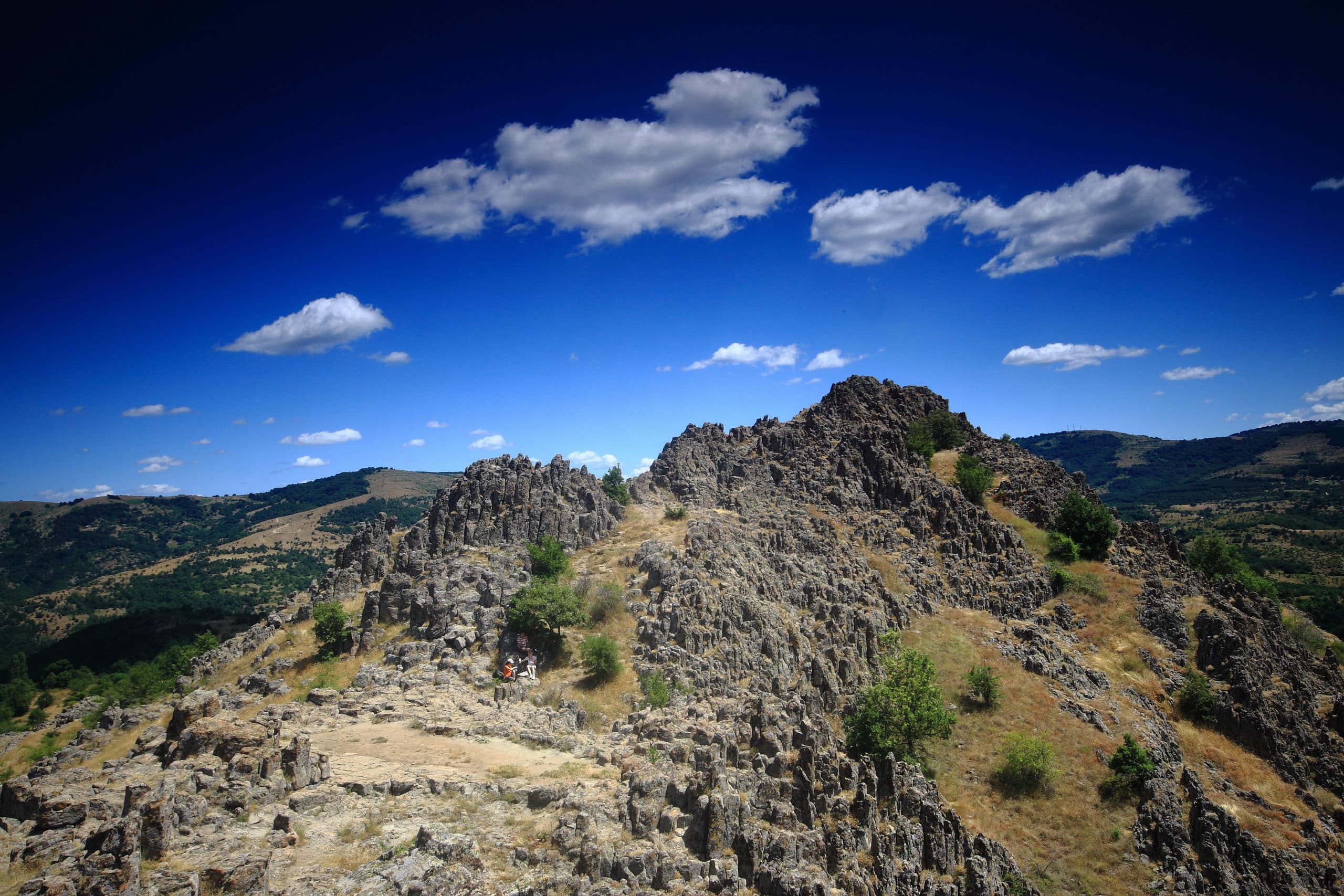
Image of Kokino. Image source
Visit essentials
A quick read before you go
- Duration
- 1–2 hours on site.
- Access
- Kokino lies 19 km northeast of Kumanovo in Staro Nagoričane municipality, approximately 6 km…
Overview
For at least seven Bronze Age centuries, roughly 1600 to 1100 BCE, communities gathered on this volcanic summit in what is now North Macedonia to watch sunrise at the solstices and equinoxes against markers carved into andesite. They came as worshippers as well as astronomers: the mountain was believed to embody the Great Goddess Mother, its fissures openings of her womb. Ceramics, ash, and animal bones placed there joined cosmological observation to divine creative power and the body.
Archaeologist Jovica Stankovski rediscovered Kokino's potential in 2001. A year later, archaeoastronomer Gjore Cenev confirmed that its eastern-horizon markers align precisely with sunrise at the summer and winter solstices and both equinoxes. NASA later included it on a short list of the world's oldest astronomical observatories. Still little known beyond the Balkans, Kokino is reached only by private vehicle and a 20-minute uphill walk, with no café or interpretive center—an ancient place encountered on its own terms.
Why this place is sacred
What made Kokino sacred was not a single event but a sustained relationship — between a community and a mountain, maintained across many generations, organized around the recurring drama of the sun's movement along the eastern horizon. The Bronze Age people who gathered here understood the solstices and equinoxes not as astronomical abstractions but as living events requiring human participation.
Their carved stone thrones were not merely viewing platforms; they were positions of ritual responsibility, places where designated observers stationed themselves to witness and, through witnessing, to sustain the cosmic order.
The mountain's volcanic character amplifies its elemental charge. Andesite — the primal igneous rock of Kokino's summit — has a quality unlike sedimentary stone: denser, darker, formed in heat and pressure, retaining warmth from the sun long after dusk.
When the summer solstice sun rises exactly over the eastern horizon markers, it does so in a landscape that looks as it did three millennia ago: open sky, bare rock, the long view across what was once the territory of the Paeonians and their predecessors.
Researchers have identified a second layer of sacred meaning: the cult of the Magna Mater, the Great Goddess Mother. The mountain summit was read as her body; the natural fissures in the rock were her generative openings. The approximately one hundred crevice pits excavated at the site held votive offerings — vessels, bones, ash — placed deep in the rock as a form of direct communion with creative power.
This dual register — cosmic observation above, chthonic offering below — gave the site its completeness as a sacred landscape.
Bronze Age astronomic-ritual site: seasonal observation of solar and lunar movements aligned with agricultural and communal cycles, combined with votive offering ceremonies invoking the Great Goddess Mother and Sun God for fertility and communal prosperity.
The site functioned as a sacred mountain from approximately 1800 BCE through roughly 700 BCE — a continuous ritual use spanning more than a millennium. After the Bronze Age communities ceased their practice, the site lay unrecognized until 2001. It now functions as an archaeological heritage site and is on UNESCO's Tentative List, sustaining a new form of reverence through scientific and heritage study.
Experience and orientation
The approach to Kokino is part of the experience. There is no public transport. You drive nineteen kilometers northeast of Kumanovo along roads that thin and flatten until the landscape opens into the upland plateau of Staro Nagoričane municipality. The parking area is modest; from there, a twenty-minute walk on an uphill path leads to the summit at 1,013 meters.
The ascent earns you the view: the Kumanovo valley spreading out to the south and west, the Serbian border visible to the north, the sky immense in every direction.
The summit itself is a natural stage. The andesite rock formation, roughly ninety meters by fifty, is deeply fissured and marked by human hands at every significant point.
The carved stone thrones — low, worn platforms cut into the rock — are oriented toward the eastern horizon with a precision that becomes vertiginous when you understand it: Bronze Age communities, working without instruments as we understand them, identified the exact sunrise positions of the solstices and equinoxes and encoded them in stone. Sitting in one of those thrones and waiting for the sun to clear the eastern ridge is to occupy a 3,800-year-old ritual role.
At any time of year, the site offers the particular quality of a genuinely old place that has not been smoothed for consumption. There are no crowds. The silence is real. Wind and rock and sky provide the only context. Moving slowly across the two platforms, pausing at the votive crevice pits (many are visible as dark slots in the andesite), touching the rock's rough warmth — these are the available forms of engagement, and they are sufficient.
At solstice or equinox, the experience sharpens: the sun rises precisely where the ancient observers expected it, where they sat waiting for it, where they recorded it in stone. The alignment, after thirty-eight centuries, still works.
Come at or before sunrise if visiting on or near a solstice or equinox. Bring warm clothing even in summer — the summit is exposed and the pre-dawn temperature drops sharply. The uphill path from parking requires sturdy footwear. Water and food must be brought; there are no facilities at the site.
Context and lineage
Kokino was discovered in 2001 by Jovica Stankovski, an archaeologist conducting regional surveys. Stankovski recognized the natural andesite formations as having been deliberately modified — platforms cut, thrones carved, markers positioned. In 2002, archaeoastronomer Gjore Cenev analyzed the stone markers and confirmed that they align with the sunrise positions at the summer solstice, winter solstice, and the spring and autumn equinoxes as seen from the stone thrones.
This was not coincidence: the alignment is precise, requiring extended observation and deliberate engineering.
The Bronze Age communities who built and used Kokino remain unnamed. Whether they were the ancestors of the later Paeonians, proto-Macedonian peoples, or an earlier undocumented culture is uncertain. What the archaeology reveals is that they maintained the site across more than a millennium — from approximately 1800 to 700 BCE — with consistent ritual practice. The approximately one hundred votive pits in the rock crevices contain ceramic vessels, animal bones, and ash, representing offerings made over many generations.
The site's sacred life was not a single founding act but an ongoing commitment.
The Bronze Age cult at Kokino, combining solar/lunar observation with Magna Mater veneration, belongs to a widespread pattern of European prehistoric sacred mountain practice. No surviving tradition draws direct continuity from the Bronze Age community; the site was reactivated as a heritage landscape rather than a living cult. North Macedonia today treats Kokino as a point of national and civilizational pride, particularly given its NASA ranking.
Traditions and practice
The ritual year at Kokino was organized around the solar calendar. On the mornings of the summer solstice, winter solstice, and both equinoxes, observers took their positions in the carved stone thrones and watched the sun rise precisely over the designated horizon markers. This was not passive watching: the act of witnessing was understood as sustaining the cosmic order and its earthly analogue, the agricultural cycle.
Alongside the upper platform's astronomical work, a parallel practice filled the rock crevices with offerings — ceramics, bones, ash — addressed to the Great Goddess Mother whose body was understood to be the mountain itself. The two practices, celestial observation and chthonic offering, together constituted a complete religious engagement with the cosmos.
No active religious practice is maintained at Kokino. The site is used for archaeological research, heritage tourism, and informal solstice and equinox gatherings by visitors who wish to experience the astronomical alignments firsthand. The UNESCO Tentative List nomination has focused ongoing conservation and documentation efforts.
The most direct engagement with Kokino's original purpose is to arrive before sunrise on or near a solstice or equinox and take one of the stone thrones. Sit still. Face east. Wait for the light to come to where the ancient observers knew it would come. The alignment will be visible to the naked eye — no instruments needed, as none were used to create it.
Outside of astronomical dates, the site rewards unhurried movement. Walk the upper platform slowly, pausing at the stone markers to understand their orientation. Locate the votive crevice pits — dark slots in the andesite where offerings were placed. Notice the quality of the rock: its density, its warmth, the way it holds the morning sun. The panoramic view from the summit extends to the Serbian border; the sense of elevated exposure is immediate and continuous.
For visitors interested in the Magna Mater dimension, the rock's fissures deserve particular attention. These natural formations, not carved by human hands, were read as alive — as the generative openings of a sacred body. Sitting near them in silence and noticing what they evoke requires no scholarly framework.
Bronze Age Archaeoastronomical Cult
HistoricalFor approximately seven centuries, Bronze Age communities maintained Kokino as an active site of solar and lunar observation, using carved stone thrones as fixed viewing platforms and stone markers to track sunrise positions at the solstices and equinoxes. The ritual dimension was inseparable from the astronomical: observation was an act of cosmic participation, ensuring the continuation of agricultural cycles and communal wellbeing.
Seasonal sunrise observation from carved stone thrones aligned with solstice and equinox sunrise positions; votive offerings in approximately one hundred rock crevice pits including ceramic vessels, animal bones, and ash; burnt offerings and libations.
Cult of the Great Goddess Mother (Magna Mater)
HistoricalResearchers identify a parallel layer of sacred meaning at Kokino: the mountain itself was read as the body of the Great Goddess Mother, and the natural fissures in the andesite rock were understood as the openings of her womb. Offerings placed within enacted direct communion with divine creative power — a chthonic counterpart to the celestial observation practiced above.
Deposition of ceramic objects, animal bones, and ash in rock crevices as votive gifts; the act of placing objects within the rock's fissures was itself the ritual, a form of sacred return.
Archaeological and Heritage Research
ActiveSince its discovery in 2001, Kokino has been the subject of ongoing archaeoastronomical and archaeological research. Its inclusion on the UNESCO Tentative List in 2009 reflects international recognition of its significance. The site's ranking by NASA as the fourth-oldest astronomical observatory in the world has positioned it as an important node in global archaeoastronomical scholarship.
Continued excavation and documentation; archaeoastronomical analysis of remaining undocumented alignments; conservation of the carved stone markers; UNESCO nomination process; heritage tourism development.
Perspectives and open questions
Kokino sits at the intersection of archaeoastronomy, Bronze Age religion, and contemporary heritage — and each of these angles illuminates different aspects of what the site was and what it remains.
Scholarly perspective
The scientific consensus is unambiguous: Kokino is a genuine Bronze Age archaeoastronomical site whose alignments have been independently verified. NASA's inclusion of the site in its list of the four oldest astronomical observatories in the world — alongside Abu Simbel, Stonehenge, and Angkor Wat — reflects the precision and significance of its solar alignments.
Jovica Stankovski's excavations have documented extensive votive activity spanning more than a millennium, while Gjore Cenev's analysis of the stone markers establishes their astronomical function beyond reasonable doubt. The scholarly debate is not about whether the alignments are intentional, but about the social organization that maintained them: who held the ritual roles, how knowledge was transmitted across generations, and what the precise relationship was between the upper astronomical platform and the votive crevices below.
Living and traditional perspectives
No living oral tradition descends directly from the Bronze Age community of Kokino. Macedonian cultural memory treats the site as an ancestral achievement and a demonstration of ancient sophisticated knowledge — a source of national pride, particularly given its relatively recent discovery and its international ranking.
The Magna Mater interpretation — reading the mountain as the body of the Great Goddess — resonates with local Balkan folk traditions that have long associated certain hills and rock formations with feminine divine power, though these connections are not historically documented.
Alternative interpretations
For practitioners of contemporary earth-based spirituality, Kokino is a resonant site: a mountain that was understood as a living divine body, where human beings maintained a sustained relationship with solar cycles. The Magna Mater framework — the earth as generative mother, the rock crevices as her womb — connects directly to contemporary goddess spirituality and to the broader European megalithic tradition.
Some visitors approach the stone thrones as seats not merely of ancient observation but of present-tense contemplative practice, using the solstice alignment as an invitation to experience cosmic scale personally.
Open questions
The identity and cultural affiliation of Kokino's Bronze Age builders remains unresolved. Whether the site served a single local community or functioned as a regional gathering place for multiple groups has not been determined. The precise transmission of astronomical and ritual knowledge across seven centuries of active use — equivalent to more than twenty-five generations — represents one of the most remarkable and unexplained aspects of the site.
What we see in the stone is the evidence of a continuity of practice; how that continuity was maintained remains unknown.
Plan your visit
Access and arrival
Kokino lies 19 km northeast of Kumanovo in Staro Nagoričane municipality, approximately 6 km from the Serbian border. No public transport serves the site. Options: private vehicle (navigate to 'Kokino Observatory, Kokino village'); hired car from Kumanovo (approximately €40 for a 3-hour round trip). Entry is free. No facilities at the site — bring water and food. Mobile phone signal is unreliable at the summit; ensure route navigation is downloaded before arrival.
Kumanovo (19 km) is the nearest city with hotels and guesthouses. Basic accommodation may be available in nearby villages. Skopje (50 km) offers a full range of options for those combining Kokino with the capital.
Respectful visit
No religious dress requirements. Appropriate footwear for rocky terrain is essential. Warm layers recommended regardless of season due to the exposed summit elevation.
Photography is freely permitted across the site.
No contemporary offering practice. Do not place objects of any kind in the rock crevices — these are active archaeological contexts.
Do not climb or sit on the carved stone markers. Do not disturb the stone thrones beyond sitting in the positions clearly designed for observation. Stay on marked paths to avoid disturbing unexcavated archaeological deposits.
Do not climb on or disturb the carved stone thrones or markers. Do not place objects in the votive crevice pits — these are protected archaeological deposits. Stay on marked paths. The summit is exposed and weather can change rapidly; carry warm layers regardless of season.
Location
Map loads as you approach this section.
Pilgrim reflections
A portrait of encounter, not a score
Pilgrims describe what they felt, how present they could become, and whether the place would shape a journey. There are no stars and no ranking of traditions.
No reviewed reflections yet
The first pilgrims can help describe the character of being here.
Share a reflection
Available after an account-backed “Been there.” Every reflection is reviewed before publication.
Nearby sacred places
Explore other sacred places in the region. Proximity does not establish access or travel time; check each place’s guidance.

Prohor Pčinjski Monastery
Klenike, Klenike / Bujanovac, Pčinja District, Serbia
8.8 km away

Church of Saint George, Staro Nagoričane
Staro Nagoričane, Staro Nagoričane, Staro Nagoričane Municipality, North Macedonia
12.6 km away

Cocev Kamen
Šopsko Rudare, Šopsko Rudare, Kratovo Municipality, Northeastern North Macedonia, North Macedonia
20.1 km away

Church of Saint Nicholas, Psača
Psača, Psača, Rankovce Municipality, North Macedonia
24.4 km away
References
Sources consulted for this page. Source categories describe the publication, not a guarantee that every claim is verified. Traditional accounts and outside interpretations may differ.
- 01Kokino - Wikipedia — Wikipedia contributorsencyclopediaMain reference article with archaeological details and history
- 02Archaeo-astronomical Site Kokino - UNESCO World Heritage Centre — UNESCOofficialOfficial UNESCO tentative list entry since 2009
- 03Kokino, Megalithic Ancient Observatory — Jovica Stankovski et al.academicAcademic paper by the discoverer of the site
- 04KOKINO: GIVING GIFTS TO GOD - Evidences of Votive Offerings — Academic researcheracademicScholarly analysis of votive offerings and ritual context
- 05Kokino Observatory in Staro Nagorichane — Atlas ObscuraguideGood visitor-oriented description
- 06The Exceptional Kokino Observatory – Ancient Megalithic Site, Holy Mountain — Ancient OriginsSource contextCovers ritual and mythological aspects including Magna Mater cult
- 07The Mystery of Kokino — World Heritage Site orgSource contextOverview of significance and mysteries
- 08Visiting the Kokino Observatory: Ancient Archaeoastronomy in Macedonia — Sailingstone TravelguidePractical visitor guide with access details
Share a photo
Help visitors recognize Kokino. Every submission is reviewed before publication.