Santuário do Caraça
Where a hermit's mountain prayer became a place wild wolves approach the altar at nightfall
Understand sacred places, explore living traditions, and learn how to engage respectfully with Pilgrim Map.
Access has not been verified. Check current local guidance before planning a visit.
Catas Altas, Minas Gerais, Brazil
Read the sources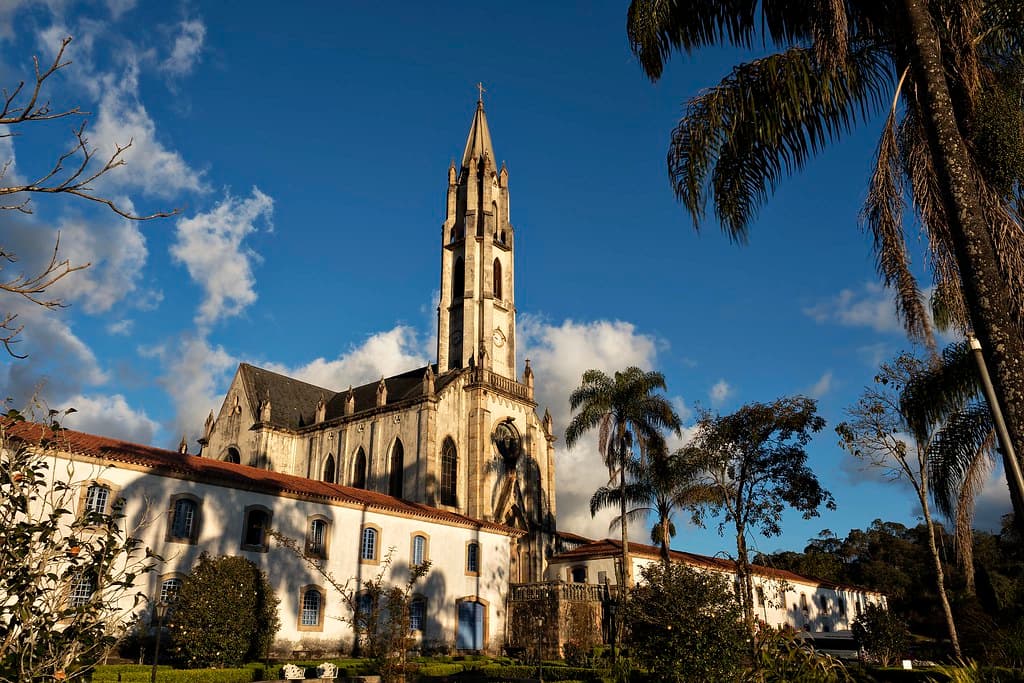
Image of Santuário do Caraça. Image source
Visit essentials
A quick read before you go
- Duration
- A single overnight stay allows for the essential experiences: the church, a short trail, and the…
- Access
- The sanctuary lies between the municipalities of Catas Altas and Santa Bárbara, approximately…
Overview
After dark at Caraça, mountain cold settles over the seminary buildings, where two future presidents of Brazil once studied, and wild maned wolves come from the treeline.
Since 1982, they have approached the neo-Gothic church steps each evening for food left by the Vincentian priests who have tended Caraça since 1820. Guests sit on the stone steps beneath a sculpture of Our Lady Mother of Men and watch. No barriers separate them; the wolves are not tame, but wild creatures choosing proximity.
This convergence arises from over two and a half centuries of prayer, education, and deliberate care for what the Vincentians call creation. Brother Lourenço de Nossa Senhora—a hermit monk whose true identity remains debated—chose the remote mountain in the 1770s amid Serra do Espinhaço peaks over 2,000 metres, pristine waterfalls through Atlantic Forest and Cerrado, and a silence that deepens rather than empties.
His modest baroque chapel was replaced in the 1880s by Father Clavelin's neo-Gothic cathedral, Brazil's first, built without slave labour and fitted with stained glass donated by Emperor Dom Pedro II. Mestre Ataíde's Last Supper hangs above the altar, its faces bearing the mestizo features that made his work revolutionary. Beyond it, 11,000 hectares of protected wilderness hold seventy mammal species, including jaguars and tapirs.
Caraça does not ask visitors to choose between sacred and natural; it demonstrates the distinction may be false.
Why this place is sacred
The name Caraça means 'big face.' Viewed from certain angles, the Serra do Caraça resembles a giant lying down, features traced in ridgeline. This anthropomorphic quality has shaped the human relationship with the landscape for centuries — the mountain as being, not backdrop.
The geological foundations here are ancient. Recognised by Brazil's geological commission as a site of speleological significance, the Itabirite Quadrilateral formations span elevations from 1,250 metres at the valley floor to 2,072 metres at Pico do Sol, the highest point of the Serra do Espinhaço. The sanctuary sits at a transition zone between two of South America's most biodiverse ecosystems — the Atlantic Forest and the Cerrado savanna — both part of UNESCO-recognised biosphere reserves.
The water that flows from these mountains serves as an ecological reference for the entire Upper Rio Doce basin.
Onto this ancient substrate, Brother Lourenço laid the first chapel in 1774. For 250 years since, the rhythms of Catholic worship have continued without interruption: daily mass, the chanting of hours, the formation of priests. The seminary that operated here from 1821 to 1968 trained generations of clergy, bishops, and national leaders, saturating the buildings with the accumulated weight of study, prayer, and devotion.
Then there are the wolves. Maned wolves are solitary, crepuscular animals — they move at dusk and dawn, avoiding humans by instinct. Yet at Caraça, they cross an invisible threshold each night, approaching the church terrace where people sit in stillness. Conservation biologists have studied this behaviour without fully explaining it. The food is the obvious draw, but other feeding stations exist in the wild.
Something about this particular place, this particular covenant between monks and wolves, produces a crossing-over that visitors recognise as thin — a moment when the boundary between the human world and something older grows permeable.
Brother Lourenço established the site around 1770 as a hospice for pilgrims and a hermitage dedicated to Nossa Senhora Mãe dos Homens — Our Lady Mother of Men, a Portuguese Marian devotion. The founding vision was contemplative and charitable: a place of withdrawal, prayer, and service to travellers in the remote mountains of Minas Gerais.
When the Lazarist (Vincentian) congregation assumed direction in 1820, they expanded this vision to include education, founding the Caraça College in 1821 — an institution that would shape Brazilian intellectual and religious life for nearly 150 years.
The trajectory of Caraça follows a pattern of destruction and renewal that the Catholic tradition might call providential. In 1968, a devastating fire destroyed the nineteenth-century college annex, ending educational activities that had defined the site for almost a century and a half. What might have been the end of Caraça became instead a transformation.
The Vincentian fathers shifted from education to conservation and spiritual hospitality, establishing the site as a Private Natural Heritage Reserve in 1994 — one of the largest in Minas Gerais.
The maned wolf feeding, begun in 1982 as a practical response to wolves raiding trash cans, evolved into a nightly ritual that now draws visitors from across the world. In 2024, the sanctuary celebrated its 250th anniversary, its identity fully woven from three strands that once seemed separate: faith, education, and ecological stewardship. The question of what Caraça is — monastery, school, nature reserve, pilgrimage site — has resolved itself.
It is all of these, and the boundaries between them have grown as thin as the veil visitors describe.
Experience and orientation
The approach matters in a way that is physical before it is spiritual. The road to Caraça climbs through nine kilometres of mountain terrain after leaving the main highway, the landscape shifting from agricultural lowlands to dense forest. By the time you arrive at 1,300 metres, you have been separated from the ordinary world by altitude, vegetation, and the simple fact of distance. Mobile phone signal is unreliable. The separation is not symbolic.
The seminary complex announces itself gradually — stone buildings emerging from forest, then the neo-Gothic tower rising 48 metres against the mountain. Inside the church, the shift is immediate. Mestre Ataíde's Last Supper commands the eye — the colonial master painted these panels in 1828, near the end of his life, rendering the apostles with the mixed-race features that made his work both revolutionary and deeply Brazilian.
The French stained glass, donated by Emperor Dom Pedro II, filters mountain light into colour. The body of Saint Pius the Martyr rests in a side chapel. The architecture, the art, and the silence combine into something that visitors describe not as museum experience but as encounter.
Outside, trails thread into the reserve. Waterfalls cascade through ecosystems that hold seventy mammal species and plant communities of exceptional richness. The hiking is physically demanding in places, and guides are required for longer routes — a restriction that preserves both safety and the quality of wilderness. The cold surprises those expecting tropical Brazil; annual average temperatures hover around 15 degrees Celsius, and winter frosts are common. The cold sharpens attention.
But the experience visitors carry home is almost always the night. After dinner in the simple refectory, guests gather on the church steps around 7:30 PM. Lights are dimmed. A tray of specially prepared food — bananas and chicken, formulated with input from veterinarians and conservation biologists — is placed on the terrace. Then waiting. The quality of this waiting is particular: communal silence under stars, the cold pressing in, anticipation held in the body.
When the wolf appears — tall, rust-coloured, moving on legs that seem too long, approaching the tray with wary precision — the silence deepens. No one speaks. The wolf feeds beneath the statue of the Virgin Mary, visible in the dim light, and something in the arrangement of elements — sacred architecture, wild animal, human stillness, mountain dark — produces an effect that visitors struggle to articulate but rarely forget.
Caraça reveals itself to those who stay. Day visitors see the church, walk a short trail, and leave by 5 PM — missing the wolf feeding and the contemplative evening and morning atmosphere that define the place. If you can, stay two nights. The first evening introduces the rhythm. The second allows you to stop performing the experience and simply inhabit it.
Arrive with warm clothing regardless of season. The altitude creates conditions far removed from the tropical coast. Bring a question, or simply bring your attention. The wolves do not appear on command — sighting is likely but not guaranteed, and the waiting itself is part of the practice. Sit on the steps and let the cold, the dark, the silence, and the possibility of encounter work on you at their own pace.
Context and lineage
The founding of Caraça is wrapped in a mystery that 250 years of scholarship have not fully resolved. Around 1770, a man known as Brother Lourenço de Nossa Senhora purchased land in the remote Serra do Caraça and began building a hospice for pilgrims and a chapel dedicated to Our Lady Mother of Men. He had entered the Third Order of Saint Francis in Tejuco — present-day Diamantina — in 1763, but his life before that moment remains opaque.
Historical research suggests he may have been Carlos Mendonça Távora, a member of the Portuguese noble family destroyed in the Távora affair of 1759. The Marquis of Pombal, Portugal's powerful prime minister, accused the Távora family of conspiring to assassinate King José I; eleven members were publicly executed in one of the most notorious political purges in Portuguese history.
If Brother Lourenço was indeed a surviving Távora, his retreat to the Brazilian mountains takes on the character of exile become vocation — a man fleeing political destruction who found, in that displacement, a spiritual purpose that would outlast the empire that persecuted him.
The hypothesis remains unproven. What is certain is that Brother Lourenço built something that endured. In 1774, he received official provision for a chapel, the date now taken as the sanctuary's founding. According to the vicar of Catas Altas, who attended Brother Lourenço on his deathbed, the Virgin Mary appeared to the dying founder and told him he could die in peace, for God would not abandon his work.
On the very day of his death, the Lazarist priests who would continue that work had already embarked on a ship from Lisbon, bound for Brazil. Whether coincidence or providence, the timing has anchored the sanctuary's spiritual identity ever since.
The succession at Caraça follows a clear arc from solitary hermitage to institutional powerhouse to ecological sanctuary. Brother Lourenço's contemplative foundation was expanded by the Congregation of the Mission (Vincentians), who arrived in 1820 and established the Caraça College the following year. For nearly 150 years, the college was among Brazil's most prestigious Catholic educational institutions, training two future presidents of the republic — Afonso Pena and Artur Bernardes — along with generations of clergy and scholars.
The 1968 fire that destroyed the college annex ended this chapter decisively. Rather than rebuild an educational institution in a rapidly secularising Brazil, the Vincentian fathers reimagined Caraça as a place where spiritual hospitality and environmental stewardship could converge. The 1994 RPPN designation formalised the ecological dimension, and the maned wolf feeding — begun pragmatically, sustained intentionally — gave the sanctuary a new public identity.
The Vincentians continue to administer the site, celebrating daily mass and welcoming over 70,000 visitors annually, with more than 17,000 choosing to stay overnight.
Brother Lourenço de Nossa Senhora
founder
The hermit monk who established the sanctuary around 1770. Possibly the Portuguese nobleman Carlos Mendonça Távora, who may have fled to Brazil after the Távora affair. His true identity remains one of the sanctuary's enduring mysteries.
Father Júlio José Clavelin
historical
French Lazarist priest who designed and oversaw construction of Brazil's first neo-Gothic church (1876-1883), built without slave labour and using only regional materials — a remarkable achievement for the era.
Mestre Ataíde (Manoel da Costa Ataíde)
historical
One of Brazil's most important colonial painters. His Last Supper (1828), Pietà, and Sacred Heart panels in the Caraça church are among his final masterworks, rendered with the mestizo features that distinguished his vision.
Father Tobias
historical
The priest who, in 1982, began leaving food for maned wolves raiding the church trash cans — initiating the nightly feeding tradition that has become central to the sanctuary's contemporary identity.
Emperor Dom Pedro II
patron
Brazil's last emperor, who visited the sanctuary and donated the central French stained glass window that remains a highlight of the church interior.
Traditions and practice
The Vincentian priests celebrate daily mass in the neo-Gothic church, continuing a liturgical tradition unbroken since the 1770s. The church holds Mestre Ataíde's Last Supper and side altar paintings, French stained glass, and the body of Saint Pius the Martyr — the accumulated sacred objects of 250 years of devotion.
The Via Sacra, a Way of the Cross pilgrimage walk on the sanctuary grounds, invites visitors to move through the Stations of the Cross in the open mountain air, the natural setting giving the traditional meditation an embodied quality that enclosed churches cannot replicate.
Marian devotion remains central to the sanctuary's spiritual life. The dedication to Nossa Senhora Mãe dos Homens — Our Lady Mother of Men — connects the site to its Portuguese origins and to the founding narrative of Brother Lourenço's deathbed apparition. The tradition holds that the Virgin promised to protect the work of Caraça, and the sanctuary's survival through fire, political upheaval, and cultural transformation is understood within this frame.
The nightly maned wolf feeding, begun in 1982, has become a practice in its own right — neither liturgical nor secular, but something that dissolves the boundary between the two. Around 7:30 PM, overnight guests gather on the church steps. A meal formulated with guidance from veterinarians and conservation biologists is placed on the terrace.
The waiting that follows carries a contemplative quality: communal silence, attention sharpened by cold and darkness, the possibility of encounter with a creature that chose, and continues to choose, proximity to this place.
The sanctuary also offers guided nature hikes along marked trails of varying difficulty, encounters with an exceptional diversity of wildlife and plant communities, and access to a historic library and museum collections that document the educational era. Spiritual retreats can be arranged, and the simple rhythm of the guesthouse — early meals, evening wolf watching, mountain silence — creates conditions for reflection that more formal retreat centres sometimes fail to achieve.
Attend morning mass even if Catholicism is not your tradition. The church interior — the Ataíde paintings, the filtered light, the acoustic quality of the neo-Gothic space — creates an experience that transcends denominational lines. Let the ritual carry you without requiring belief.
Walk the Via Sacra in the afternoon, when the mountain light is long and the trails are quietest. The Stations of the Cross invite contemplation of suffering and transformation — themes that belong to no single tradition. Move slowly. Let the forest and the mountain do as much as the devotional images.
In the evening, arrive early for the wolf feeding. Sit, and let the cold settle into your body. Resist the impulse to fill the silence with conversation. When the wolf appears, notice what happens in your chest — the quickening, the held breath, the recognition that you are in the presence of something that does not belong to you. This is the practice Caraça offers, and it requires nothing but presence.
Roman Catholic (Vincentian/Lazarist)
ActiveThe Congregation of the Mission has administered Caraça since 1820, maintaining an unbroken tradition of Catholic worship, education, and service. The sanctuary was founded within a Franciscan contemplative framework by Brother Lourenço and reimagined as an educational institution by the Vincentians. After the 1968 fire ended the seminary era, the congregation adapted its mission to conservation and spiritual hospitality while maintaining daily liturgical practice. The church holds masterworks of Brazilian colonial sacred art, including Mestre Ataíde's Last Supper and stained glass donated by Emperor Dom Pedro II.
Daily Catholic mass is celebrated by Vincentian priests. The Via Sacra pilgrimage walk on the grounds follows the Stations of the Cross through the mountain landscape. Marian devotion to Nossa Senhora Mãe dos Homens remains central to the sanctuary's spiritual identity. The nightly maned wolf feeding, while not a liturgical act, has become an integral expression of the Vincentian commitment to creation care. Contemplative retreats, spiritual reflection, and visits to the historic library and museum are available to all visitors.
Conservation Stewardship
ActiveThe RPPN Santuário do Caraça, established in 1994 via IBAMA Decree No. 32, protects over 11,000 hectares of wilderness at the transition between the Atlantic Forest and Cerrado biomes. The reserve holds seventy documented mammal species, serves as an ecological reference area for the Upper Rio Doce watershed, and falls within two UNESCO-recognised biosphere reserves. The maned wolf feeding programme, developed with input from veterinarians and conservation biologists, represents a model of human-wildlife coexistence embedded within a spiritual context.
Ongoing biodiversity monitoring, ecological research, and habitat preservation are conducted in partnership with academic institutions. The maned wolf feeding is managed according to nutritional guidelines established by zootechnicians and veterinarians. Guided interpretation programmes educate visitors about the reserve's ecosystems and species. Trail management balances access with habitat protection.
Perspectives and open questions
Caraça invites interpretation from multiple directions — historical, ecological, theological, and experiential — and honest engagement requires holding these together. The sanctuary's power lies precisely in its refusal to be only one thing: it is simultaneously a monument to Catholic education, a conservation triumph, a living place of worship, and the setting for an encounter between humans and wild animals that no single framework fully explains.
Scholarly perspective
Historians recognise Santuário do Caraça as one of the most important religious and educational institutions in the history of Minas Gerais and, by extension, Brazil. The Caraça College, operating from 1821 to 1968, trained generations of clergy, scholars, and political leaders, including two presidents of the republic. Father Clavelin's neo-Gothic church is documented as the first of its kind in Brazil, and its construction without slave labour is noted as historically exceptional for the late nineteenth century.
Ecologists recognise the RPPN as a critical conservation area at the transition between the Atlantic Forest and Cerrado biomes. Peer-reviewed research has documented seventy mammal species within the reserve, and studies published in SciELO identify the Caraça watershed as an ecological reference for water quality in the Upper Rio Doce basin. The site's recognition by both the Serra do Espinhaço and Atlantic Forest UNESCO Biosphere Reserves underscores its ecological significance.
The question of Brother Lourenço's identity continues to occupy historians. The hypothesis that he was Carlos Mendonça Távora, a survivor of Portugal's most notorious political purge, is supported by circumstantial evidence but not definitively proven. The mystery serves the sanctuary's narrative — a place founded by a man who was himself a kind of thin place, existing between identities, between worlds.
Living and traditional perspectives
Catholic tradition holds that the Virgin Mary appeared to Brother Lourenço on his deathbed, assuring him that God would not abandon the work of Caraça. The account comes from the vicar of Catas Altas, who attended the founder in his final moments. That the Lazarist priests who would continue his mission had already departed Lisbon on the day of his death is understood within the tradition as providential confirmation of this promise.
The Vincentian charism — founded by Saint Vincent de Paul in seventeenth-century France — emphasises service to the poor, education, and the formation of clergy. At Caraça, this charism has expressed itself through 200 years of institutional continuity: first through education, then through conservation and hospitality. The nightly wolf feeding, while not liturgical, resonates with the Franciscan tradition of care for creation — Brother Lourenço's own Franciscan formation coming full circle through the Vincentian priests who inherited his work.
Alternative interpretations
Some visitors and spiritual seekers interpret the convergence of mountain landscape, geological antiquity, centuries of prayer, and the nightly approach of wild wolves as evidence of a concentrated spiritual energy at Caraça. The image of the maned wolf feeding beneath the statue of the Virgin Mary is sometimes read as a living emblem of the peaceable kingdom — the prophetic vision of harmony between the human, the divine, and the wild.
This interpretation exceeds what either science or official theology would claim. Yet it responds to something real in the experience of the place. The consistency of visitor reports — a sense of peace that is more than relaxation, a quality of presence that sharpens rather than dulls — suggests that whatever is happening at Caraça resists reduction to any single explanatory frame.
Open questions
Genuine mysteries persist. The identity of Brother Lourenço — nobleman in exile or humble friar — remains unresolved, and may remain so. The nature of the Marian apparition reported at his deathbed, and the timing of the Lazarist departure from Lisbon, inhabit the space between documented history and faith narrative without settling into either.
Perhaps most intriguing is the behaviour of the wolves themselves. Maned wolves are solitary, naturally wary of humans, and rarely seen in the wild. That they have consistently approached the monastery grounds since the early 1980s — beyond the obvious food incentive — raises questions that conservation biology has not fully answered. Some observers note an unusual comfort level with human presence that seems to exceed what feeding alone would produce.
Whether this reflects habituation, the particular qualities of the sanctuary environment, or something that resists categorisation, the question remains genuinely open.
Plan your visit
Access and arrival
The sanctuary lies between the municipalities of Catas Altas and Santa Bárbara, approximately 120 kilometres from Belo Horizonte (about two hours by car) and 60 kilometres from Ouro Preto. The final nine kilometres follow a mountain road. No public buses reach the sanctuary — a private car, taxi, or arranged transfer is required. The main church and central buildings are accessible, but trails vary in difficulty and are not wheelchair accessible.
Groups of fifteen or more must book via centraldereservas@santuariodocaraca.com.br at least one week in advance. Mobile phone signal is unreliable at the sanctuary — check with your carrier but plan for limited or no connectivity. For emergencies, the sanctuary administration can assist; the nearest towns with reliable signal and medical facilities are Catas Altas and Santa Bárbara.
The sanctuary operates a guesthouse in the historic seminary building, offering simple rooms appropriate to the monastic setting. Meals are served in the refectory. Booking in advance is essential, particularly for weekends and holiday periods. Current pricing and availability should be confirmed through the sanctuary's official website (santuariodocaraca.com.br) or reservations email. The simplicity of the accommodation is part of the experience — this is not a hotel but a place that asks you to match its rhythms.
Respectful visit
Appropriate clothing for the environment is required. Shirts and proper clothing must be worn in the church and historic centre — no swimwear or shirtless visiting. Beyond protocol, warm clothing is essential. The annual average temperature is around 15 degrees Celsius, with frosts common from May through August. Evening temperatures can drop sharply, and guests sitting on the church steps for the wolf feeding will need layers, a warm jacket, and possibly gloves.
Come prepared for mountain conditions, not tropical ones.
Photography is generally permitted on the grounds and during the maned wolf feeding. Inside the church, be discreet and respectful — services take priority over photographs. During the wolf feeding, flash photography is prohibited, as it disturbs the animals and can deter their approach. Consider spending time without a camera first, particularly inside the church, where the play of light through stained glass and the presence of Ataíde's paintings reward unhurried attention.
Votive candles can be lit in the church, and donations support the sanctuary's ongoing maintenance and conservation work. The most meaningful offering visitors can make is adherence to the site's ethos of care — for the built heritage, for the natural environment, and for the contemplative atmosphere that both depend upon.
Entrance is permitted from 8:00 AM to 3:00 PM only. Day visitors must depart by 5:00 PM, with fines applied for departure after 5:30 PM. Groups of fifteen or more must book in advance via the sanctuary's reservations office. Guides are required for long hikes — those over six kilometres and those reaching the peaks — and must be arranged in advance. Bicycles are permitted only on paved roads. No pets. No disturbing wildlife or removing natural materials.
The maned wolf feeding is not guaranteed. The wolves are wild animals with their own rhythms, and some nights they do not appear. Approach the experience with openness rather than expectation. Flash photography during the wolf feeding is not permitted and will disturb the animals. Longer hikes require a registered guide and advance booking — this is both a safety requirement and a conservation measure.
Day visitors cannot stay for the wolf feeding; an overnight booking is essential for this experience.
Current practical details
Address
WG26+VJ Santuário do Caraça - Estr. do Caraça, km 9 - Catas Altas, MG, 35969-000, Brazil
Phone
Hours
Hours, fees, and access can change — verify on the official source before you travel. Practical details last checked Jun 2026.
Location
Map loads as you approach this section.
Pilgrim reflections
A portrait of encounter, not a score
Pilgrims describe what they felt, how present they could become, and whether the place would shape a journey. There are no stars and no ranking of traditions.
No reviewed reflections yet
The first pilgrims can help describe the character of being here.
Share a reflection
Available after an account-backed “Been there.” Every reflection is reviewed before publication.
Nearby sacred places
Explore other sacred places in the region. Proximity does not establish access or travel time; check each place’s guidance.
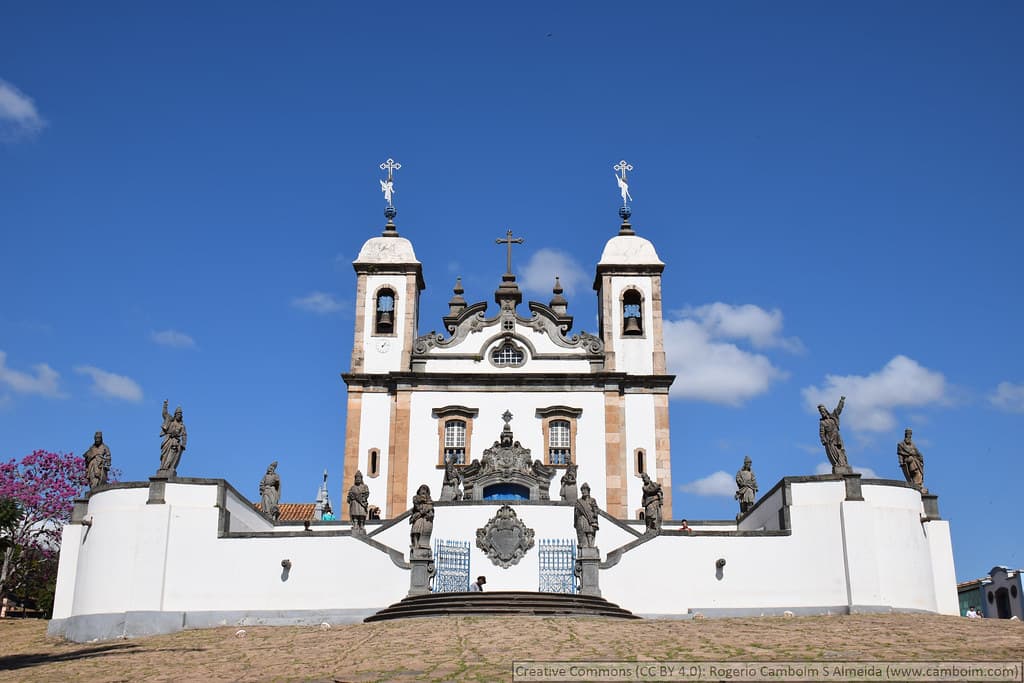
Sanctuary of Bom Jesus do Congonhas
Congonhas, Minas Gerais, Brazil
59.9 km away
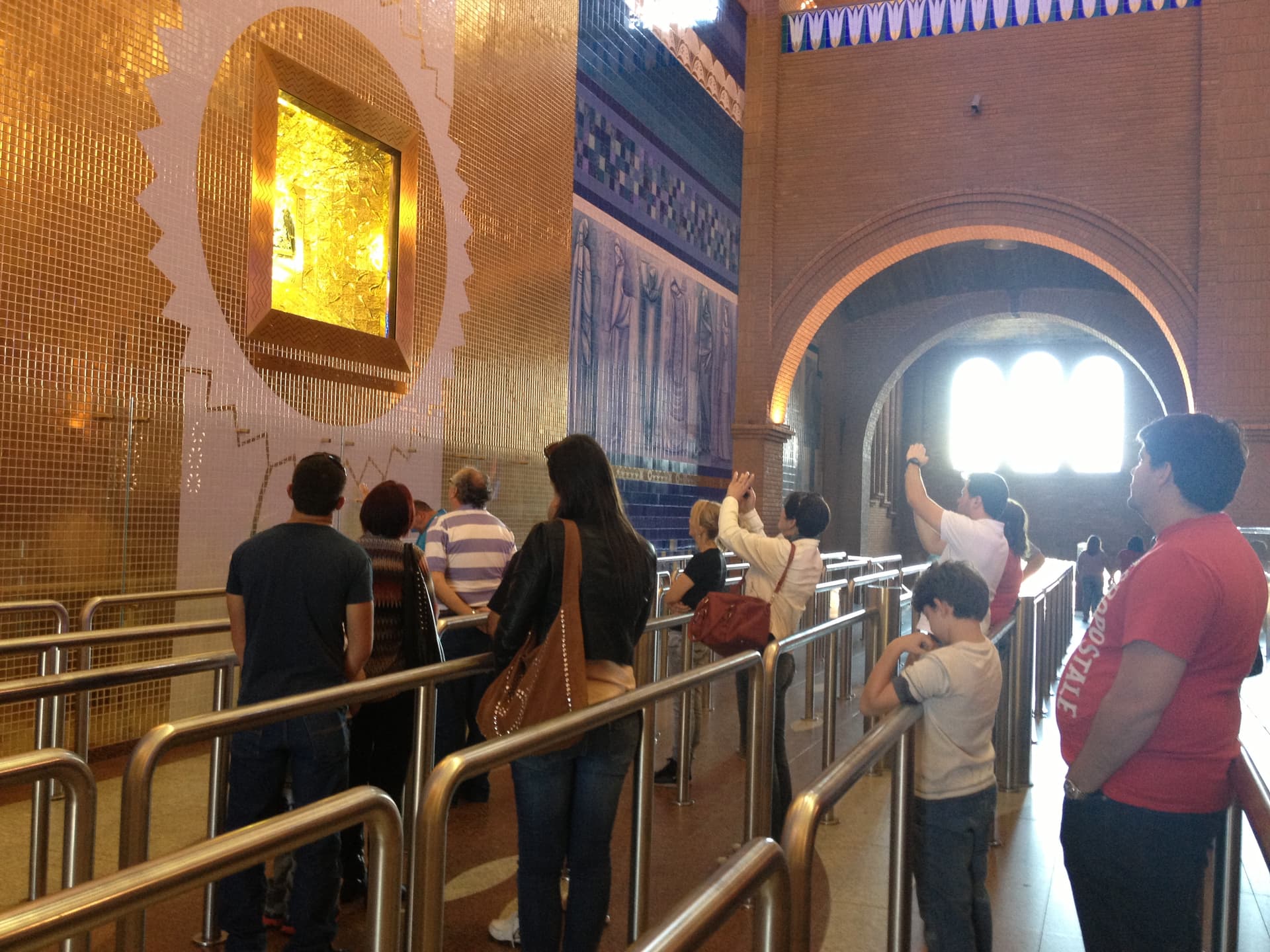
Nossa Senhora Aparecida
Aparecida, São Paulo, Brazil
355.4 km away

Aparecida, Basilica of the National Shrine of Our Lady of Aparecida
Aparecida, São Paulo, Brazil
355.4 km away

Nossa Senhora do Bom Parto Church, Tatuape
São Paulo, Brazil
498.4 km away
References
Sources consulted for this page. Source categories describe the publication, not a guarantee that every claim is verified. Traditional accounts and outside interpretations may differ.
- 01Nossa História - Santuário do Caraça — Santuário do CaraçaofficialOfficial sanctuary website with detailed institutional history
- 02Normas de Visitação - Santuário do Caraça — Santuário do CaraçaofficialOfficial visitor rules and guidelines
- 03Aparição de Nossa Senhora no Caraça — Santuário do CaraçaofficialOfficial account of Marian apparition legend at Caraça
- 04Bens Tombados: Complexo Arquitetônico e Paisagístico da Serra do Caraça — IEPHA - Instituto Estadual do Patrimônio Histórico e Artístico de Minas GeraisofficialOfficial state heritage listing for the Caraça complex
- 05ICMBio - SIMRPPN | RPPN Santuário Caraça — ICMBio (Chico Mendes Institute for Biodiversity Conservation)officialOfficial federal conservation unit registry
- 06Mammals of Reserva Particular do Patrimônio Natural Santuário do Caraça, state of Minas Gerais, Brazil — Check List (BioTaxa)academicPeer-reviewed biodiversity inventory of the reserve
- 07The Caraça Sanctuary as an ecological reference area for water quality in the Upper Rio Doce basin — SciELO BrazilacademicPeer-reviewed study on ecological importance of the sanctuary's waterways
- 08Vincentians in Brazil: A mission that changed history — Congregatio MissionisofficialOfficial Vincentian congregation account of their Brazilian mission
- 09Sanctuary and College of Caraça - HPIP — Heritage of Portuguese Influence PortalofficialPortuguese heritage database with architectural and historical details
- 10Santuário do Caraça celebra 250 anos de história, missão e cultura na Arquidiocese de Mariana — Arquidiocese de MarianaofficialOfficial archdiocese celebration of 250th anniversary in 2024
- 11Our Lady Mother of Men Church - Wikipedia — Wikipedia contributorsencyclopediaOverview of the church history, architecture, and artistic features
- 12Maned Wolves of Santuário do Caraça in Catas Altas — Atlas ObscuraguideWell-researched account of the maned wolf feeding tradition
- 13The sanctuary of Caraça, a story of men and wolves — Tiradentes-géographieacademicGeographic and historical analysis of the sanctuary
- 14Santuário do Caraça | Estrada Real — Instituto Estrada RealguideOfficial Estrada Real tourism route information
- 15Maned Wolves and Catholic Monks of Santuario do Caraca — The Wildlife DiariesguideDetailed firsthand account of visiting the sanctuary and wolf feeding
- 16An in-depth guide to Santuario do Caraca (AKA the maned wolf monastery) — Mammal WatchingguideDetailed practical visitor guide with wildlife focus
- 17Caraça Sanctuary Complex in Minas Gerais — Bahia.wsguideOverview of sanctuary history and attractions
- 18Parque Natural do Caraça — SummitPostguideClimbing and hiking information for the natural park
- 19Santuario Do Caraca Mountain Retreat — Brazil Adventure ToursguideTour operator with practical visitor information
Share a photo
Help visitors recognize Santuário do Caraça. Every submission is reviewed before publication.