Aparecida, Basilica of the National Shrine of Our Lady of Aparecida
Where a dark clay Virgin pulled from a river became the spiritual heart of a nation
Understand sacred places, explore living traditions, and learn how to engage respectfully with Pilgrim Map.
Access has not been verified. Check current local guidance before planning a visit.
Aparecida, São Paulo, Brazil
Read the sources
Visit essentials
A quick read before you go
- Duration
- Three to five hours allows a comprehensive visit including the New Basilica, the Old Basilica,…
- Access
- From São Paulo, buses depart from the Tietê Bus Terminal via the Pássaro Marron line…
Overview
In 1717, three fishermen pulled a broken, headless, thirty-six-centimetre dark terracotta statue from the Paraíba do Sul River. After body and head were reunited, their empty nets suddenly overflowed—an event they found unmistakable—and word spread. Three centuries later, devotion begun in Filipe Pedroso's humble home became a spiritual axis of the world's largest Catholic nation.
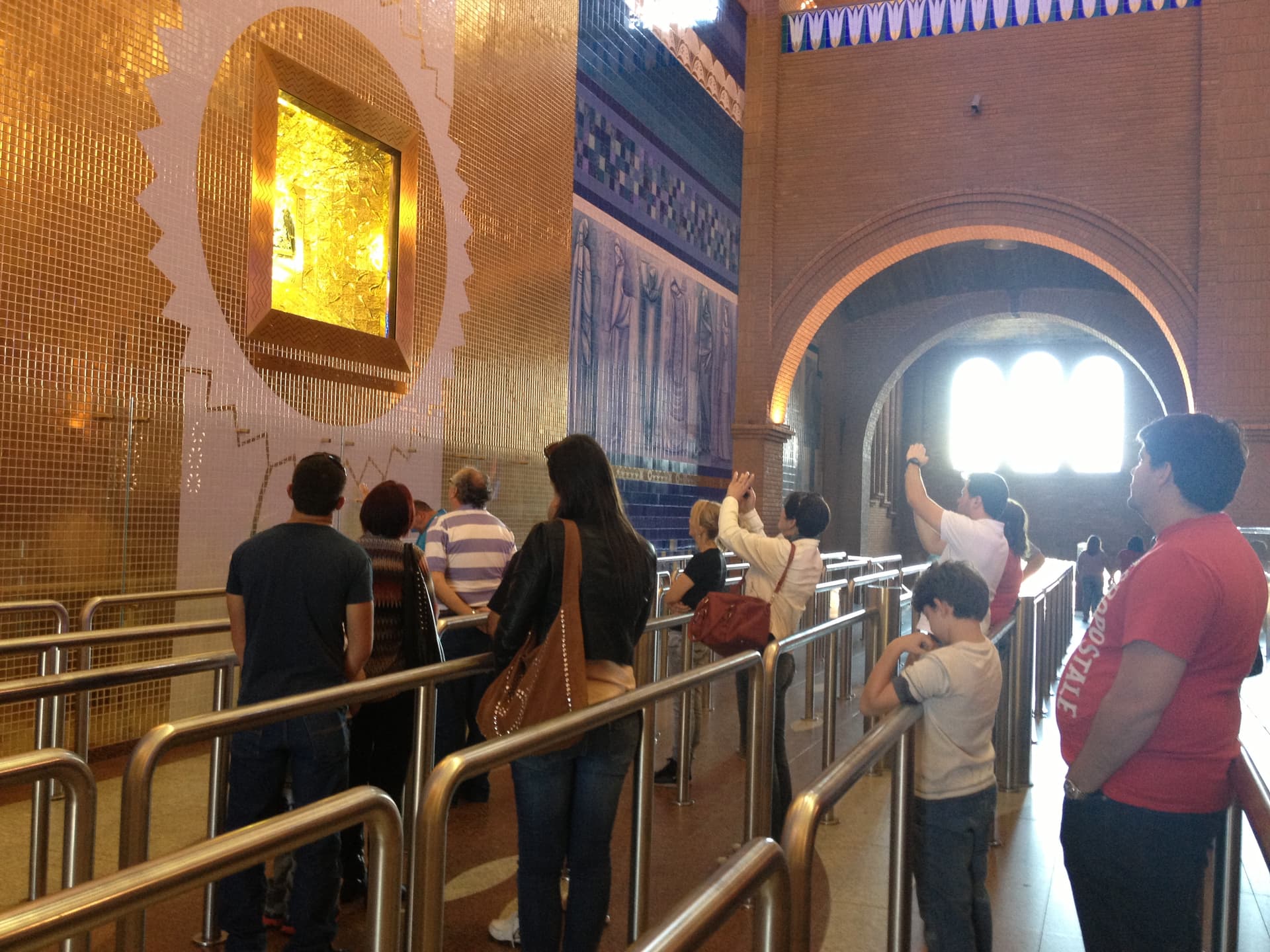
The statue's Greek-cross basilica is the world's second-largest Catholic church and holds forty-five thousand people; on October 12, Brazil's national holiday in her honour, more than a hundred and fifty thousand pilgrims gather in the Paraíba Valley. Behind glass in the central niche, the faithful call the small dark figure Nossa Senhora Aparecida, Our Lady Who Appeared. She appeared to people with nothing: fishermen after an empty day, enslaved people seeking liberation, and the poor seeking consolation.
In a nation scarred by racial hierarchy, her dark skin signifies divine solidarity rather than absence.
Sites inside
Why this place is sacred
The statue is tiny. Visitors who come expecting something imposing often describe surprise at encountering a figure smaller than their forearm, darkened by river mud or candle smoke or the original clay itself—scholars still debate the cause. It sits behind protective glass in a niche above the central altar, and the distance between the pilgrim below and the figure above is deliberate, a space that must be crossed by faith rather than proximity.
Yet the space between is not empty. Over three hundred years, millions of people have directed their deepest needs toward this point—healing, fertility, reconciliation, release from addiction, safe passage through childbirth, survival of illness. The Sala das Promessas in the basilica basement makes this tangible: thousands of ex-votos line the walls, each one a material trace of crisis and gratitude. Prosthetic limbs. Photographs of the sick who recovered. Wedding dresses from unions restored.
The cumulative effect is overwhelming, not as spectacle but as evidence of the weight of human petition concentrated in a single place.
The thinness at Aparecida is not the thinness of solitude or silence. It is the thinness that emerges when millions of people bring their suffering to the same threshold and find something waiting there. The collective devotion generates its own atmosphere—a pressure of accumulated hope that many visitors describe as almost physical, a warmth or heaviness in the chest that arrives unbidden.
For Afro-Brazilians, the thinness carries additional dimensions. The dark-skinned Virgin holds space for a history of enslavement, resistance, and endurance that the nation has not yet fully reckoned with. The miracle of Zacarias, the enslaved man whose chains broke during prayer before the statue, resonates not as distant legend but as living promise.
The devotion began as the simplest form of popular piety: a clay statue, probably discarded or lost, pulled from a river by working fishermen who interpreted the subsequent abundance of fish as divine intervention. The first shelter was a domestic altar in a fisherman's home, where neighbors gathered to pray the Rosary. The first chapel, built in 1745, formalized what the people already knew—that something had taken root here that exceeded ordinary explanation.
From a riverside fishing miracle to the spiritual center of a continent, Aparecida's evolution mirrors the growth of Brazilian Catholicism itself. The small chapel of 1745 gave way to the Old Basilica, begun in 1834 and completed in 1888, which itself proved insufficient for the growing tide of pilgrims.
The New Basilica, designed by Benedito Calixto Neto in Romanesque Revival style, was begun in 1955 and consecrated in 1980 by Pope John Paul II while still under construction—a symbol, perhaps, of a devotion that perpetually outgrows its containers.
The declaration of Our Lady of Aparecida as patroness of Brazil in 1930 bound the devotion to national identity. The establishment of October 12 as a national holiday in 1980 ensured that the connection between faith and civic life would be renewed annually. Three papal visits—John Paul II in 1980, Benedict XVI in 2007, and Francis in 2017 for the three-hundredth anniversary—have confirmed the shrine's standing as one of global Catholicism's most significant pilgrimage destinations.
Why pilgrims come
Personal petitions and thanksgiving
Devotees attribute favors to Our Lady of Aparecida’s intercession. The Room of Promises makes this relationship visible through objects and testimonies offered in gratitude.
How devotees visit
Pilgrims come to ask and give thanks, bringing photographs, letters and other ex-votos to the sanctuary. These record devotees’ interpretations of events rather than proof that everyone will receive the same favor.
These are religious traditions and devotional practices, not promises of an outcome. Follow the community’s current guidance.
Healing traditions
Traditional healing account
Aparecida's religious publications tell of a girl blind from birth who traveled with her mother from Jaboticabal in 1874. As they approached Aparecida, the girl is said to have seen the church in the distance. The story became one of the sanctuary's best-known accounts of Mary's help, alongside the finding of the image by fishermen and other narratives of rescue.
Ways to participate
Offer your intention before the image and, if you wish, visit the space where pilgrims leave testimony and thanks. Join a public prayer or spend time quietly in the basilica. The mother's long journey belongs to the story; it does not create a rule that a harder pilgrimage earns greater healing.
These accounts describe religious traditions and reported experiences. They do not promise a cure or replace medical care.
Experience and orientation
The approach to the basilica reveals its scale gradually. From a distance, the dome and the single tower of the Brasília Tower dominate the Paraíba Valley skyline. Closer, the Greek-cross plan becomes legible, its arms reaching outward as if gathering the faithful. But scale alone does not account for what people describe inside.
The interior holds a quality that visitors struggle to name. The word most often used is paz—peace—but pilgrims typically clarify that it is not passive calm. It is consolation, the specific peace that arrives after bringing suffering to someone who can hold it. Near the central niche where the statue rests, this quality concentrates. People weep here without embarrassment, surrounded by others doing the same.
The collective permission to be vulnerable—to kneel, to sob, to whisper petitions—creates an atmosphere in which emotional armor dissolves.
The Passarela da Fé intensifies this. Watching pilgrims traverse the 392-meter covered walkway on their knees—some elderly, some carrying children, some with visible injuries—confronts the visitor with a devotion that costs something. The walkway's S-curve echoes the bend of the river where the statue was found, and the slow progress of those on their knees traces that original retrieval with their bodies.
The Sala das Promessas in the basement operates differently. Here, the atmosphere shifts from collective prayer to individual testimony. Each ex-voto represents a private crisis resolved or endured: the photograph of a child who survived surgery, the crutch left behind by someone who walked out unaided, the letter folded around a gratitude too personal for display.
The cumulative effect is not sadness but something closer to witness—the recognition that ordinary life contains depths of need and grace that usually remain invisible.
On October 12, the experience transforms entirely. Over a hundred and fifty thousand people compress into and around the basilica, and the devotion becomes visceral—chanting, singing, weeping, the smell of flowers and candle wax, the press of bodies united in veneration. Those who have attended describe it as one of the most intense collective spiritual experiences available anywhere on earth.
Aparecida rewards both the planned pilgrimage and the spontaneous visit, but different approaches yield different encounters. Those seeking contemplative depth should come on a weekday morning, when the basilica's interior opens into spaciousness and silence settles between masses. Sit near the central niche and simply observe the pilgrims who approach—their faces often reveal what words cannot.
Those seeking the full power of Brazilian popular devotion should plan for October 12, understanding that the experience will be communal rather than private, overwhelming rather than subtle. Arrive the day before. Allow yourself to be carried by the crowd rather than resisting it.
Regardless of when you come, spend time in the Sala das Promessas. It is easy to skip in favor of the basilica's more dramatic spaces, but the basement room holds the devotion's raw material—the evidence of what people actually bring here and what they leave behind.
Context and lineage
In 1717, the governor of São Paulo was passing through the region near Guaratinguetá, and the local community needed fish for a banquet in his honor. Three fishermen—Domingos Garcia, Filipe Pedroso, and João Alves—went to the Paraíba do Sul River and cast their nets repeatedly without success. Hours passed. The river, normally generous, yielded nothing.
Then João Alves pulled up something unexpected: the body of a small clay statue, headless, darkened by submersion. On the next cast, the head appeared. The fishermen cleaned and reassembled the figure, recognizing it as a representation of the Immaculate Conception. They prayed, cast their nets once more, and the catch was so abundant they feared their boat would sink under its weight.
Filipe Pedroso took the statue home. Neighbors began gathering to pray the Rosary before it, and word of the miraculous catch spread through the villages along the river. Over the following years, further miracles were reported—candles that extinguished themselves and spontaneously relit during prayer, healings, answered petitions.
The devotion grew with the organic force of popular faith, rooted not in institutional decree but in the lived experience of ordinary people who found something present in the dark figure that answered their need.
The lineage of Aparecida runs not through monastic succession or priestly ordination but through popular devotion—the faith of fishermen, enslaved people, rural laborers, and urban poor who carried the devotion forward across three centuries. The Redemptorist Fathers have served as custodians of the shrine since 1894, providing institutional continuity, but the devotion's vitality has always come from below.
The canonical coronation of the statue in 1904, the declaration of patronage in 1930, the construction of the New Basilica, the national holiday—each institutional milestone ratified what the people had already established through their feet, their knees, their tears, and their ex-votos. The Aparecida Document of 2007, produced during the CELAM conference held at the shrine, extended this popular theology into official Church teaching, insisting that the Church must begin from the faith of the poor.
João Alves, Domingos Garcia, and Filipe Pedroso
historical
The three fishermen who discovered the statue in the Paraíba do Sul River in 1717. Pedroso became the statue's first custodian, housing it in his home where the initial devotion took root among neighbors and villagers.
Zacarias
historical
An enslaved man whose chains reportedly broke while he knelt in prayer before the statue around 1850. His miracle became a foundational narrative for Afro-Brazilian devotion to Aparecida and a symbol of divine solidarity with the enslaved.
Benedito Calixto Neto
historical
The architect who designed the New Basilica in Romanesque Revival style. Construction began in 1955, and the building was consecrated by Pope John Paul II in 1980 while still incomplete, finally reaching completion in 1984.
Pope John Paul II
historical
Consecrated the New Basilica on July 4, 1980, elevating it to the status of minor basilica. His visit affirmed Aparecida's standing as a pilgrimage site of global significance.
Cardinal Jorge Bergoglio (Pope Francis)
historical
Played a prominent role in the Fifth General Conference of CELAM held at Aparecida in 2007, which produced the influential Aparecida Document shaping Latin American Catholicism's preferential option for the poor. Returned as Pope for the three-hundredth anniversary in 2017.
Traditions and practice
The central devotional act at Aparecida is veneration of the original statue—approaching the central niche, often after waiting in a slow-moving line, and offering one's petition or gratitude to Nossa Senhora. This is not a passive viewing but an active encounter: pilgrims speak to her, weep before her, hold up photographs of the sick or absent, and press their hands to their hearts.
The romaria—organized pilgrimage—remains the foundational practice. Groups from parishes, neighborhoods, and communities across Brazil travel to Aparecida, sometimes on foot over hundreds of kilometers, sometimes on horseback, fulfilling promessas made in moments of crisis. The arrival at the basilica is the culmination of a physical offering that began with the first step.
The Passarela da Fé carries particular devotional weight. The 392-meter walkway connecting the Old and New Basilicas, shaped in an S-curve echoing the river's bend, is traversed by many pilgrims on their knees. This practice of penitential walking—offering bodily suffering as prayer—connects contemporary pilgrims to centuries of Catholic devotion and to the physical labor of the fishermen who first retrieved the statue.
The leaving of ex-votos in the Sala das Promessas continues a tradition as old as the devotion itself. Pilgrims bring material evidence of answered prayers—prosthetic limbs no longer needed, photographs, letters, wedding dresses, diplomas—creating a constantly growing archive of private miracle made public.
Holy Mass is celebrated hourly throughout the day, providing continuous access to the Eucharist for the stream of arriving pilgrims. Confession services are available. Religious objects may be blessed by priests at the shrine. The Rosary is prayed communally at scheduled times.
Contemporary pilgrims also tie colored ribbons in the chapel, each ribbon representing a specific prayer intention. Candles are lit and flowers offered in designated areas. The cable car to Morro do Cruzeiro, the Hill of the Cross, offers both panoramic views of the Paraíba Valley and a contemplative space for prayer at the hilltop cross.
The feast of October 12 expands all practices to their fullest expression. Processions carry the statue through crowds numbering over a hundred and fifty thousand. The atmosphere combines solemn liturgy with popular celebration—singing, chanting, and the deep collective emotion of a nation honoring its patroness on what is also Children's Day in Brazil.
If you come as a seeker rather than a declared pilgrim, the shrine still offers entry points. Attend one of the hourly masses, even if Catholic liturgy is unfamiliar—the collective devotion is its own kind of instruction. Sit near the central niche between services and simply observe the pilgrims who approach. Notice their faces. Notice your own response to their vulnerability.
Visit the Sala das Promessas with unhurried attention. Each object on those walls was placed by someone at the intersection of desperation and gratitude. Allow the room to work on you rather than moving through it as a curiosity.
If the practice of offering feels natural to you, light a candle or tie a ribbon. The gesture does not require Catholic belief—only sincerity. If it does not feel natural, simply being present with those for whom it does is its own form of participation.
Roman Catholicism
ActiveThe Basilica of the National Shrine of Our Lady of Aparecida is the largest Marian shrine in the world and the spiritual center of Brazilian Catholicism. It houses the miraculous dark clay statue discovered in the Paraíba do Sul River in 1717, declared the patroness of Brazil in 1930, and venerated by an estimated eight to twelve million pilgrims annually. The devotion is inseparable from Brazilian national identity, and the shrine has been consecrated and visited by three popes.
Hourly Holy Mass, veneration of the original statue, pilgrimages (romarias) from across Brazil often on foot or horseback, penitential walking on the Passarela da Fé, leaving ex-votos in the Sala das Promessas, tying colored ribbons representing prayer intentions, Rosary and devotional prayers, lighting candles and offering flowers, processions during the October 12 feast and other celebrations.
Afro-Brazilian Syncretic Devotion
ActiveOur Lady of Aparecida holds profound significance in Afro-Brazilian culture as a Black Madonna who affirms the dignity and identity of people of African descent. The miracle of the enslaved man Zacarias, whose chains broke during prayer before the statue, established Aparecida as a symbol of liberation. In Afro-Brazilian religious traditions, the dark Virgin has been syncretized with the orixá Oxum, goddess of love, beauty, and fresh water—a connection rooted in the colonial era when enslaved Africans found coded expressions of ancestral spirituality within Catholic devotional forms.
Congada dance processions blending African and Catholic traditions, maracatu performances during pilgrimage celebrations, syncretic devotion linking Our Lady of Aparecida with the orixá Oxum, annual pilgrimages by Afro-Brazilian community groups, and coronation reenactments of the King of Congo during congada celebrations.
Perspectives and open questions
Aparecida sits at the intersection of Catholic theology, Brazilian national identity, Afro-Brazilian cultural memory, and the sociological study of popular religion. Each lens reveals something the others miss. The devotion is large enough—and old enough—to sustain all of them without requiring resolution into a single narrative.
Scholarly perspective
Historians and sociologists recognize the devotion to Our Lady of Aparecida as one of the most significant religious and cultural phenomena in Brazilian history. The dark-skinned Virgin became a unifying symbol in a colonial society fractured by racial hierarchy, offering a figure in whom European, African, and indigenous Brazilians could each find recognition. Scholars note that the institutional Church largely followed popular devotion rather than leading it—the people venerated Aparecida for two centuries before Rome declared her patroness of Brazil.
The Fifth General Conference of the Latin American Bishops (CELAM), held at the shrine in 2007, produced the Aparecida Document, which became one of the most influential texts in contemporary Latin American Catholicism. Cardinal Bergoglio—later Pope Francis—was its primary author.
The document's insistence on a preferential option for the poor and its call for a missionary Church drew directly from the theology embedded in the devotion itself: a God who appears to fishermen, whose image emerges from a river, whose miracle breaks the chains of the enslaved.
Living and traditional perspectives
Within Catholic teaching, Our Lady of Aparecida is understood as a manifestation of the Blessed Virgin Mary's maternal solicitude for the Brazilian people. The discovery of the statue is interpreted as a providential act—Mary choosing to make herself present to humble fishermen, just as she appeared to shepherds at Fatima and a peasant girl at Lourdes. The miracles that followed confirm her intercessory power.
The dark coloration of the statue, regardless of its physical cause, is embraced by the Church as a sign of Mary's identification with all peoples, particularly the marginalized. As Father José Arnaldo Juliano dos Santos has stated: 'Her face is the face of the Brazilian people. She is the great unifier of Brazil.'
The canonization process of the devotion—from popular veneration to papal coronation to national patronage—reflects the Catholic understanding that genuine encounters with the divine are recognized by the community of faith before they are confirmed by institutional authority.
Alternative interpretations
In Afro-Brazilian religious traditions, particularly Candomblé and Umbanda, Our Lady of Aparecida has been syncretized with Oxum (Oshun), the orixá of love, beauty, fertility, and fresh water. This syncretism arose during slavery, when Africans prohibited from practicing their ancestral religions encoded their devotion within Catholic forms. The dark-skinned Virgin, found in a river—the domain of Oxum—offered a figure capacious enough to hold both traditions simultaneously.
The Catholic Church officially rejects this syncretism, yet it persists as a living practice. Congada dancers and maracatu troupes make annual pilgrimages to the shrine, performing processions that blend African and Catholic elements, including reenactments of the coronation of the King of Congo. These performances reassert African cultural memory within the official space of the basilica, maintaining a dialogue between traditions that institutional boundaries cannot fully contain.
Whether one understands this as theological confusion or as the natural creativity of a people finding the sacred where they can, the dual devotion reflects something genuine about how Aparecida functions: as a point of convergence where different streams of longing meet.
Open questions
Genuine mysteries remain at Aparecida. The cause of the statue's dark coloration is still debated—river mud, centuries of candle smoke, or properties of the original clay are all proposed, and none definitively established. How the statue came to be in the Paraíba do Sul River in the first place is unknown; it was likely a devotional figure discarded, lost, or deposited by floodwaters, but its origin workshop and original owner have never been identified.
The early miracles—the spontaneous extinguishing and relighting of candles, the breaking of Zacarias's chains—exist in oral and devotional tradition rather than documented historical record. Whether one reads these accounts as literal miracle, pious embellishment, or something between the two depends on commitments that precede the evidence.
Some sources give October 12, 1717 as the precise date of the statue's discovery; others simply state 1717 without specifying a month. The coincidence—or not—with what later became the national feast day remains an open question. Construction dates for the New Basilica also vary: it was consecrated in 1980 while still incomplete, with final construction reaching completion in 1984.
Plan your visit
Access and arrival
From São Paulo, buses depart from the Tietê Bus Terminal via the Pássaro Marron line approximately every four hours, with a travel time of around two hours and twenty minutes. By car, the drive via the Rodovia Presidente Dutra takes approximately one hour and forty-five minutes (170 km). From Rio de Janeiro, the drive or bus ride takes approximately four hours (280 km) via the same highway.
The complex offers covered parking for 2,000 buses and 3,000 private cars with mechanical assistance and insurance. Full accessibility is provided throughout the complex for visitors with disabilities. Mobile phone signal is reliable throughout the basilica complex and the city of Aparecida.
Aparecida offers a range of accommodations from simple pilgrim hostels to mid-range hotels, most within walking distance of the basilica complex. During the October feast and major holidays, accommodation should be booked well in advance. The shrine's Pilgrim Support Centre can assist with orientation and logistics. For those traveling from São Paulo or Rio de Janeiro, day trips are feasible but an overnight stay allows a more immersive experience.
Respectful visit
Modest dress appropriate for a Catholic church is expected—shoulders and knees should be covered. While enforcement varies, dressing respectfully acknowledges the sacred nature of the space and the devotion of those around you. Comfortable shoes are advisable given the size of the complex.
Photography is permitted throughout most of the basilica complex. Flash photography may be restricted in certain areas, particularly near the statue and during Mass. Use discretion—prioritize the experience of those in prayer over your documentation of it. The observation deck of the Brasília Tower offers excellent views for landscape photography.
Candles, flowers, and monetary offerings are traditional and readily available for purchase near the basilica. Pilgrims fulfilling promessas leave ex-votos in the Sala das Promessas—photographs, letters, personal objects representing answered prayers. Tying colored ribbons in the chapel is a widely practiced and welcoming form of offering open to all visitors.
No eating or drinking inside the basilica. Respectful silence during Mass and in designated prayer areas. Appropriate church attire at all times within the basilica. During the October 12 feast, advance planning is essential due to crowds exceeding 150,000 people—the shrine recommends arriving the day before and arranging accommodation in advance.
During the October 12 celebrations, crowds are extremely large and the atmosphere intensely emotional. Those uncomfortable with dense crowds or strong religious expression should plan their visit for another time. During Mass and in prayer areas, maintain respectful silence even if you are visiting as a tourist rather than a pilgrim. The Sala das Promessas contains deeply personal objects—photograph with sensitivity and refrain from touching the ex-votos.
Current practical details
Address
Av. Dr. Júlio Prestes, s/n - Ponte Alta, Aparecida - SP, 12575-068, Brazil
Phone
Hours
Hours, fees, and access can change — verify on the official source before you travel. Practical details last checked Jun 2026.
Location
Map loads as you approach this section.
Pilgrim reflections
A portrait of encounter, not a score
Pilgrims describe what they felt, how present they could become, and whether the place would shape a journey. There are no stars and no ranking of traditions.
No reviewed reflections yet
The first pilgrims can help describe the character of being here.
Share a reflection
Available after an account-backed “Been there.” Every reflection is reviewed before publication.
Dates and observances
Upcoming festivals, feast days, and pilgrimages connected to this place. Add any to your calendar, or browse the full observance calendar.
- Add to calendar
Feast of Our Lady of Aparecida
Mon, Oct 12, 2026Feast day
The feast of the Patroness of Brazil, a national public holiday, drawing massive crowds to the world's largest Marian shrine with Masses, processions, and devotions.
- Add to calendar
Feast of Our Lady of Aparecida
Tue, Oct 12, 2027Feast day
The feast of the Patroness of Brazil, a national public holiday, drawing massive crowds to the world's largest Marian shrine with Masses, processions, and devotions.
Nearby sacred places
Explore other sacred places in the region. Proximity does not establish access or travel time; check each place’s guidance.

References
Sources consulted for this page. Source categories describe the publication, not a guarantee that every claim is verified. Traditional accounts and outside interpretations may differ.
- 01The Shrine of Our Lady of Aparecida — Santuário Nacional de Aparecida (A12)officialOfficial shrine website with visitor information and history
- 02Our Lady of Aparecida - Information on the Saint of the Day — Vatican NewsofficialOfficial Vatican coverage of the feast day and devotion
- 03Basilica of the National Shrine of Our Lady of Aparecida (Aparecida, 1984) — StructuraeacademicEngineering and architectural details with precise construction dates
- 04Basilica of Our Lady of Aparecida - Wikipedia — Wikipedia contributorsacademicComprehensive article on basilica history, architecture, dimensions, and construction timeline
- 05Our Lady of Aparecida - Wikipedia — Wikipedia contributorsacademicDetailed information on the discovery, miracles, feast day, and devotion
- 06Aparecida, Brazil: The Basilica of Our Lady of Aparecida — The Catholic Travel GuideguidePractical visitor information and travel guide
- 07The Black Virgin of Brazil: Pilgrimage, Slavery, and National Myth — PilgrimapsacademicAnalysis of Afro-Brazilian significance, syncretism, and the Black Madonna tradition
- 08The Miraculous Statue of Aparecida Discovered in Brazil in 1717 — HozanaspiritualAccount of the discovery and early miracles
- 09Our Lady of Aparecida - World Religion and Spirituality Project — WRSPacademicAcademic perspective on the devotion and its sociological significance
- 10Pilgrimage to the Sanctuary of Aparecida: An unforgettable spiritual experience — SodalitiumspiritualPilgrim testimony and spiritual experience
- 11Aparecida home of the second biggest cathedral in the world — The Travelling SurveyorguideDetailed visitor account with practical information about the complex
- 12OUR LADY OF APARECIDA'S DAY - October 12 — National TodayspiritualInformation on the national holiday and celebrations
- 13Who is Our Lady of Aparecida? — AleteiaspiritualOverview of significance and identity of the devotion
- 14Basilica of the Shrine of Our Lady of Aparecida, São Paulo, Brazil — Catholic Shrine BasilicaspiritualOverview of the basilica facilities and complex
- 15Brazil's Black Sister Queens: Oxum and Our Lady of Aparecida — PatheosacademicAnalysis of syncretism between Our Lady of Aparecida and the orixá Oxum
- 16New Oratory at the Basilica: Our Lady of Aparecida — National Shrine of the Immaculate ConceptionspiritualUS National Shrine's coverage of the devotion
- 17The girl born blind — TV AparecidaofficialSupports the attributed account or visitor practice in the healing section; not evidence of clinical efficacy.
- 18Aparecida sanctuary history and miracles — official press kitofficialSupports the attributed account or visitor practice in the healing section; not evidence of clinical efficacy.
Share a photo
Help visitors recognize Aparecida, Basilica of the National Shrine of Our Lady of Aparecida. Every submission is reviewed before publication.