Sanctuary of Our Lady of the Assumption in Chacas
Where an Italian priest's vision transformed a pre-Inca huaca into a living sanctuary of artisan devotion
Understand sacred places, explore living traditions, and learn how to engage respectfully with Pilgrim Map.
Access has not been verified. Check current local guidance before planning a visit.
Chacas, Ancash, Peru
Read the sources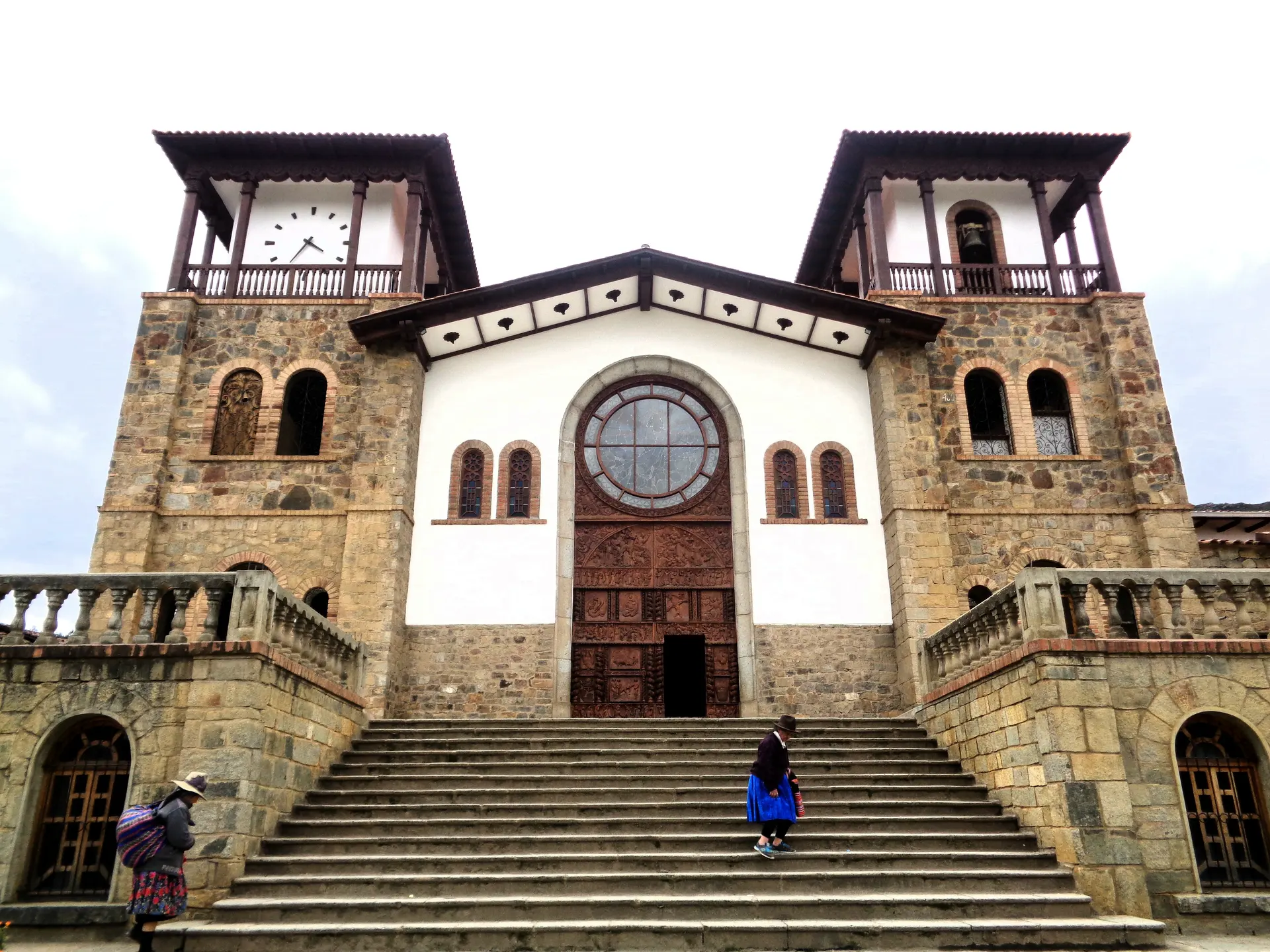
Image of Sanctuary of Our Lady of the Assumption in Chacas. Image source · CC-BY-SA-4.0
Visit essentials
A quick read before you go
- Duration
- Half day for the sanctuary; full day to include Don Bosco cooperative and town exploration.
- Etiquette
- Approach Mama Ashu with the reverence due to an active Catholic sanctuary and a site sacred to…
Overview
Chacas is recognized by the United Nations as one of the Best Tourism Villages in the world.
The original adobe church rose in 1587. Enlargements came in the 1750s, bringing the baroque altarpiece covered in gold leaf that still commands the interior. Another tower was added between 1955 and 1968. Then the earthquakes of the 1970s brought devastation that might have ended lesser sanctuaries.
Instead, Father Ugo de Censi arrived with a vision. The Italian Salesian priest, working with Operation Mato Grosso, spent thirty years transforming Chacas through his Don Bosco wood-carving cooperative. The present renaissance-style church, with its dramatic carved wooden door, was completed in the 1980s under his inspiration. The baroque altarpiece from the colonial era was carefully restored.
The sanctuary received designation as Historical Heritage of Peru in 1941 and was consecrated as a Sanctuary in 2005, when the Virgin of the Assumption was elevated as patron saint of the entire Diocese of Huari. Father Ugo de Censi, who died in 2018, now rests within the walls of the church he helped rebuild, alongside Francisco Araoz de La Madrid, a hero of Peruvian and Argentine independence buried here in 1837.
Mama Ashu—the affectionate diminutive the people of Chacas use for their Virgin—represents something rare: a living dialogue between ancient Andean sacredness, colonial Catholic devotion, and contemporary artistic dedication.
Why this place is sacred
The thinness at Mama Ashu is not singular but layered, like the strata of Andean geology itself. Beneath the church lie the memories of a pre-Inca huaca, where the huanca Piedra de Chacas drew worshipers for reasons now half-remembered. The Augustinians recognized power in this place—why else build here in 1572, at such elevation, in such remoteness?
The colonial baroque altarpiece from the 1750s carries its own accumulated devotion, the gilded surfaces touched by centuries of supplication. When earthquakes threatened to end the sanctuary's story, the reconstruction led by Father Ugo de Censi created new sacred depth. The Don Bosco cooperative didn't merely restore—they transformed loss into offering, teaching local artisans to carve their faith into cedar from Nicaragua.
The stained glass windows depicting New Testament scenes and the Virgin Mary Help of Christians filter light in patterns that shift throughout the day. The four patron saints—the Virgin of the Assumption, Saint Martin I, Saint Joseph, and the Child Jesus—each bring their own intercessions to this high-altitude chapel.
Pilgrims who climb to Chacas at 3,359 meters undergo the Andean gift of altitude: breath shortened, heartbeat quickened, the body reminded of its own fragility. In this state of physical awareness, the sanctuary's accumulated sacred weight becomes more perceptible. The thin place reveals itself not through dramatic vision but through the quiet accumulation of devotion across time.
The site served as a pre-Inca huaca dedicated to the huanca Piedra de Chacas. Augustinian missionaries built the first church here in 1572-1587, deliberately layering Catholic worship over indigenous sacred space.
From pre-Inca shrine to 1587 adobe church, through 1750s baroque expansion, to post-earthquake reconstruction in the 1980s under Father Ugo de Censi. Declared Historical Heritage in 1941, consecrated as Sanctuary in 2005.
Experience and orientation
Arrive in Chacas and notice first the altitude—3,359 meters asks something of the body. Let the shortness of breath become part of your preparation. The town itself, internationally recognized for its tourism quality, offers cobblestoned quietude and mountain vistas.
Approach the sanctuary through its carved wooden doors, a masterwork of the Don Bosco cooperative that announces immediately the integration of art and faith that defines this place. Inside, the baroque altarpiece from the 1750s commands attention with its gold leaf surfaces, housing images of the Virgin of the Assumption in her glory.
Move through the space slowly. The stained glass windows filter Andean light through scenes of Mary and the New Testament. The Holy Sepulchre and the Holy Cross of Chacas occupy their places of veneration. Colonial imagery fills the nave: the Crucified Christ, the Lord of the Passion, the Virgin of Sorrows, Saint John.
Find the tombs within—Francisco Araoz de La Madrid, independence hero buried 1837, and Father Ugo de Censi, the Italian priest who rebuilt the sanctuary, laid to rest in 2018. Their presence grounds the space in human stories of sacrifice and dedication.
Visit the Don Bosco wood-carving cooperative to understand how the sanctuary's reconstruction became a gift to the community. Young artisans continue learning the craft that brought cedar from Nicaragua to this mountain sanctuary, transforming disaster into beauty.
The sanctuary occupies the center of Chacas town in the Ancash region, at 3,359 meters elevation. The Don Bosco cooperative and hospital established by Father Ugo de Censi are nearby attractions that complete the pilgrimage experience.
Context and lineage
Before the Spanish arrived, this high ground in Ancash served as a pirushtus—a native shrine where the huanca Piedra de Chacas was venerated. This idol, one of the most important ceremonial centers in the territory, remained in place until the mid-twentieth century, testimony to the persistence of indigenous sacred memory even within a Catholic frame.
In 1572, Augustinian evangelists began building their church directly over this huaca—the standard colonial practice of sacred replacement. The adobe church was completed by 1587. The decades of the 1750s brought the baroque altarpiece that remains the sanctuary's glory, covered in gold leaf. Between 1955 and 1968, another tower was added.
Then came the catastrophic earthquakes of the 1970s. The church suffered severe damage. Into this devastation came Father Ugo de Censi, an Italian Salesian priest whose vision extended beyond mere reconstruction. Working with Operation Mato Grosso and establishing the Don Bosco wood-carving cooperative, he created a movement that rebuilt the sanctuary while teaching young people the craft traditions that would sustain the community.
The renaissance-style church visible today was completed in the 1980s. The sanctuary received Historical Heritage designation in 1941 and was formally consecrated as a Sanctuary in 2005, with the Virgin of the Assumption elevated to patron of the Diocese of Huari.
Originally a pre-Inca ceremonial site, built over by Augustinian missionaries in 1572-1587. Now under diocesan care as a sanctuary within the Diocese of Huari, with the Don Bosco cooperative maintaining artisan traditions.
Father Ugo de Censi
Architect of rebirth
Francisco Araoz de La Madrid
Independence hero
Traditions and practice
Veneration of the Virgin of the Assumption, colonial art devotion including the baroque altarpiece, prayers to the four patron saints (Virgin of the Assumption, Saint Martin I, Saint Joseph, Child Jesus).
The August 15 festival for Mama Ashu draws pilgrims from across the region. The Don Bosco wood-carving cooperative continues to create religious art. Mass is celebrated regularly, and the sanctuary receives pilgrims year-round.
Attend Mass at the sanctuary to experience the liturgy within the baroque and renaissance-style interior. Visit the Don Bosco cooperative to see how sacred art continues to be made. Spend time with the colonial imagery, letting the accumulated devotion of centuries speak.
Roman Catholicism / Marian Devotion
ActiveThe sanctuary serves as the center of devotion to the Virgin of the Assumption (Mama Ashu), patron of the Diocese of Huari since 2005. The baroque altarpiece and colonial imagery support centuries of Marian practice.
Daily Mass, August 15 festival, veneration of colonial art, pilgrimage traditions.
Andean Pre-Inca Sacred Tradition
HistoricalThe site was originally a pirushtus, a native shrine where the huanca Piedra de Chacas was venerated until the mid-twentieth century.
Original practices unknown; the idol's presence into modern times suggests continuity of some form of recognition.
Perspectives and open questions
Mama Ashu can be understood through multiple lenses: as an example of religious syncretism, as a testament to community resilience, as a showcase of artisan revival, or as a living sanctuary where devotion continues to accumulate.
Scholarly perspective
The site demonstrates the colonial practice of sacred replacement—building churches over indigenous shrines. The survival of the huanca Piedra de Chacas until mid-twentieth century shows the incomplete nature of religious substitution.
Living and traditional perspectives
Within Catholic tradition, Mama Ashu represents Marian devotion at its most tender, with the affectionate naming of the Virgin reflecting the intimate relationship between people and their patroness.
Alternative interpretations
The layering of pre-Inca, colonial, and modern sacred geography invites reflection on how sacred places accumulate meaning across cultures and time.
Open questions
The full spiritual practices associated with the huanca Piedra de Chacas before the Spanish arrival remain largely undocumented.
Plan your visit
Access and arrival
Chacas offers basic accommodations. The town's recognition as a Best Tourism Village means increasing visitor infrastructure.
Respectful visit
Modest dress appropriate for a Catholic sanctuary. Shoulders and knees covered. Comfortable shoes for exploring Chacas.
Photography may be permitted in some areas but check current guidelines. Never photograph during Mass or private devotion.
Candles and donations support the sanctuary's work. The Don Bosco cooperative sells artisan crafts that support the community.
Respect areas reserved for prayer and clergy. The burial sites of Father Ugo de Censi and Francisco Araoz de La Madrid deserve particular reverence.
Altitude at 3,359 meters requires acclimatization. Arrive slowly and allow time to adjust before climbing to the sanctuary.
Current practical details
Address
RJPM+QJR, Jirón Buenos Aires, Chacas 02315, Peru
Hours
Hours, fees, and access can change — verify on the official source before you travel. Practical details last checked Jun 2026.
Location
Map loads as you approach this section.
Pilgrim reflections
A portrait of encounter, not a score
Pilgrims describe what they felt, how present they could become, and whether the place would shape a journey. There are no stars and no ranking of traditions.
No reviewed reflections yet
The first pilgrims can help describe the character of being here.
Share a reflection
Available after an account-backed “Been there.” Every reflection is reviewed before publication.
Nearby sacred places
Explore other sacred places in the region. Proximity does not establish access or travel time; check each place’s guidance.

References
Sources consulted for this page. Source categories describe the publication, not a guarantee that every claim is verified. Traditional accounts and outside interpretations may differ.
- 01Santuario de Mama Ashu Essential Tips and InformationSource context
- 02Santuario de Mama Ashu - Lonely PlanetSource context
- 03Santuario de Nuestra Señora de la Asunción de ChacasSource context
- 04Chacas - Best Tourism Villages UNWTOSource context
- 05Chacas - WikipediaSource context
- 06Chacas: The Peruvian town that is among the best for tourism in the worldSource context
Share a photo
Help visitors recognize Sanctuary of Our Lady of the Assumption in Chacas. Every submission is reviewed before publication.