Sanctuary of Our Lady of Sorrows, Badajoz, Spain
Where a skeptic became a stigmatist and the Vatican found a light in rural Spain
Understand sacred places, explore living traditions, and learn how to engage respectfully with Pilgrim Map.
Access has not been verified. Check current local guidance before planning a visit.
La Codosera, Badajoz, Spain
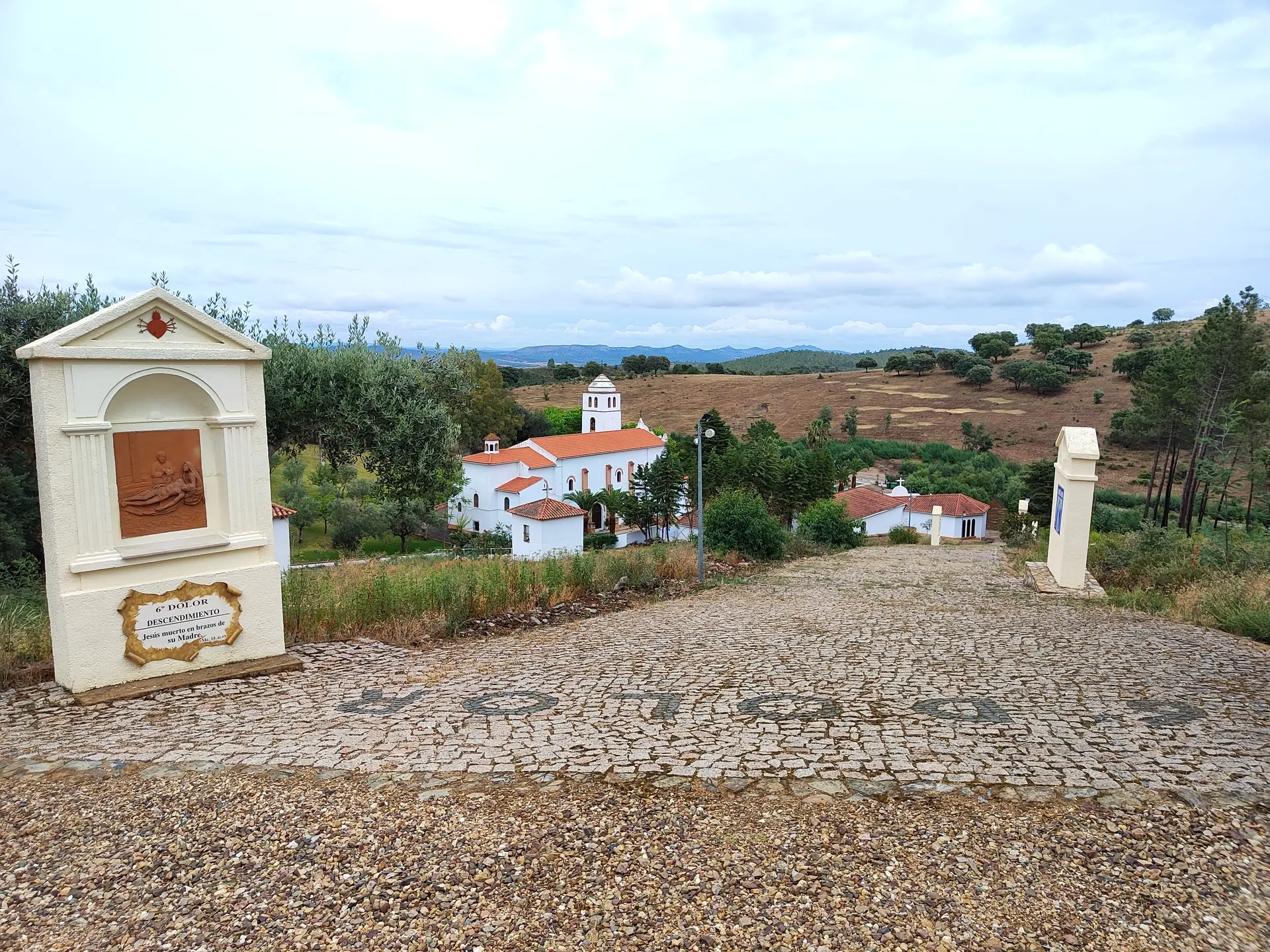
Image of Sanctuary of Our Lady of Sorrows, Badajoz, Spain. Image source · CC-BY-SA-4.0
Visit essentials
A quick read before you go
- Duration
- One to two hours for the sanctuary, Apparitions Chapel, and museum.
- Access
- La Codosera is approximately 60 km northwest of Badajoz, 500 meters from the Portuguese border.
Overview
The events at Chandavila unfold with a narrative directness that resists both easy belief and easy dismissal. On May 27, 1945, ten-year-old Marcelina Barroso Exposito saw a dark shape in a chestnut tree near the settlement of El Marco, in the municipality of La Codosera. On her return journey, the shape resolved into the Virgin of Sorrows, elevated above the tree, wearing a black mantle full of stars, looking toward the town.
When the Virgin asked, 'Do you want to come with me?' Marcelina replied in fear.
Three days later, seventeen-year-old Afra Brigido Blanco arrived at the site not as a devotee but as a skeptic, intending to mock the reported apparitions. During the Corpus Christi celebration, she fell into ecstasy. She later testified: 'I have seen the Most Holy Virgin of Sorrows. The brilliance she brought I believed would asphyxiate me.'
On July 22, 1945, while praying in the church, Afra had a vision of the crucified Christ and experienced intense pain. She fell to the floor in the position of the crucified. The stigmata, the five wounds of Christ, appeared on her hands, feet, and side, with the wounds on hands and feet perforating through the flesh. The stigmata bled especially on Fridays and on dates associated with the Passion.
Afra carried the stigmata until at least 1953. She then lived quietly in Madrid, working in a hospital until her death on August 23, 2008. Her ashes rest in the sanctuary. The University of Antwerp's academic Stigmatics Database includes her case.
For nearly eighty years, the sanctuary was sustained by local devotion alone. Then, on August 22, 2024, the Vatican's Dicastery for the Doctrine of the Faith issued a nihil obstat, recognizing 'many signs of an action of the Holy Spirit' at Chandavila, including conversions, healings, and other spiritual fruits. The document was titled 'A Light in Spain.' On September 15, 2024, the Archbishop of Merida-Badajoz designated the church a Diocesan Sanctuary. In 2025, approximately 32,000 pilgrims visited.
Why this place is sacred
The thinness of Chandavila is inseparable from the figure of Afra Brigido. Her journey from mockery to stigmata compresses the entire arc of encounter with the sacred into a single biography. She came to laugh. She left bearing the wounds of Christ in her flesh. Whatever one's framework for understanding these events, the narrative demands engagement.
The stigmatic phenomenon itself is a form of radical thinning. The boundary between the spiritual and the physical dissolves when wounds appear on a body without external cause. The University of Antwerp, which maintains an academic database of documented stigmatics, includes Afra's case, placing it within a scholarly framework that neither endorses nor dismisses but documents.
The timing deepens the thinning. The apparitions began in May 1945, as World War II was ending and the world was confronting the scale of human suffering inflicted in the previous six years. The Virgin appeared as the Dolorosa, the Sorrowful Mother, carrying grief rather than joy. The message of forgiveness and love for the Cross addressed a world that had abundant reason for sorrow and uncertain capacity for forgiveness.
The geography adds another dimension. La Codosera sits near the Portuguese border in one of Spain's poorest and most marginalized regions. The apparitions occurred not in a major city or established pilgrimage center but at the periphery, in a chestnut grove near a small settlement. This follows the consistent Marian pattern of choosing the poor, the young, and the overlooked as messengers.
The chestnut tree itself connects to ancient traditions of sacred trees across cultures. The Virgin chose to appear not in a church but in nature, in a living tree, rooting the sacred in the organic rather than the institutional.
Afra's subsequent life of quiet service in a Madrid hospital, decades of anonymity after the dramatic events of 1945, adds a dimension that many other apparition narratives lack. The visionary did not become a public figure. She worked with the sick. She died without fanfare. Her ashes returned to the place where her life changed.
The sanctuary was built to honor the apparitions that began in May 1945 and to serve as a center of devotion to Our Lady of Sorrows in the Extremaduran countryside.
From a small chapel built at the chestnut tree in 1947, the sanctuary grew to include a larger church, an outdoor Apparitions Chapel, a museum, and a hermitage. For nearly eight decades, it was sustained by local and regional devotion without official Church recognition. The 2024 Vatican nihil obstat transformed its status, bringing international attention and significantly increased pilgrimage.
Experience and orientation
The drive to La Codosera from Badajoz follows the EX-110 through the dehesa landscape of Extremadura: rolling terrain of cork oaks and grassland that has been a pastoral landscape for millennia. The Portuguese border is 500 meters from the sanctuary.
The sanctuary complex is modest by the standards of European apparition sites. There is no grand basilica, no monumental approach. The buildings serve their purpose without architectural pretension. This simplicity is part of the experience: nothing mediates between the visitor and the events.
Enter the main church. The image of Our Lady of Sorrows, dressed in a black mantle, anchors the devotional space. The atmosphere is quiet, maintained by the small community that serves the sanctuary. Light candles and sit with the story.
Visit the Apparitions Chapel, located at the site of the original chestnut tree. On Saturday evenings, Mass is celebrated here outdoors, weather permitting. The open-air setting connects the liturgy to the landscape where the events occurred.
The museum documents the apparition history through photographs, testimonies, and artifacts. The account of Afra's transformation from skeptic to stigmatist is presented with directness. The documentation of the stigmata, including the University of Antwerp's academic record, provides a framework that neither sensationalizes nor dismisses.
Afra's ashes rest in the sanctuary, a quiet presence that brings the narrative full circle. She returned here after decades of anonymity in Madrid, to the place where everything changed.
The surrounding landscape deserves attention. The dehesa of Extremadura, with its scattered oaks and vast skies, has its own contemplative quality. The proximity to the Portuguese border adds a geographic liminality that echoes the spiritual liminality of the apparition narrative.
The sanctuary complex includes the main church, the Apparitions Chapel, and the museum. All are within easy walking distance. La Codosera town provides basic services. The sanctuary has parking available.
Context and lineage
On May 27, 1945, Marcelina Barroso Exposito saw a dark shape in a chestnut tree. On her return, the shape resolved into the Virgin of Sorrows in a star-covered black mantle. The apparitions continued throughout the summer. On May 30, Afra Brigido, who had come to mock the reports, fell into ecstasy and testified to seeing the Virgin.
The Virgin asked Marcelina to walk toward her on her knees through dry chestnut husks, thorns, and stones, promising that nothing would happen to her. According to the account, a carpet of reeds and grass appeared over the treacherous terrain as the girl walked across it.
On July 22, Afra had a vision of the crucified Christ and received the stigmata. The wounds bled especially on Fridays. The blood was reported to emanate a soft perfume.
The devotion belongs to the tradition of 20th-century European Marian apparitions, which includes Fatima (1917), Beauraing (1932), and Banneux (1933). The Chandavila apparitions share common features: young visionaries, a rural setting, a message of sorrow and repentance, and a long period of popular devotion before official recognition.
Marcelina Barroso Exposito
First visionary, age 10 at the time of the apparitions
Afra Brigido Blanco
Second visionary and stigmatist, age 17 at the time; later worked in a Madrid hospital
Jose Maria Alcaraz y Alenda
Bishop of Badajoz who authorized construction of the sanctuary
Traditions and practice
Pilgrimage to the apparition site, the Way of the Cross devotion, and prayer for the intentions of the visionaries are traditional practices. The September 15 feast, the liturgical memorial of Our Lady of Sorrows, serves as the sanctuary's principal celebration.
Regular Mass schedule: Thursdays 19:00, Saturdays 19:00 (Apparitions Chapel, weather permitting), Sundays 12:30. Confessions: Thursdays 18:00-19:00, Saturdays 18:15-19:00, Sundays 11:30-12:30. Year-round pilgrimage with approximately 32,000 visitors in 2025. Museum visits documenting the apparition history.
Arrive early enough to walk the grounds before entering the church. Visit the Apparitions Chapel to stand where the events occurred. If visiting on a Saturday, attend the outdoor Mass. Allow the simplicity of the setting to work without expecting the infrastructure of larger apparition sites. Read the account of Afra's journey from skepticism to stigmata and let the narrative's directness speak for itself.
Roman Catholic Marian Devotion (Our Lady of Sorrows)
ActiveThe devotion centers on the Sorrowful Mother, emphasizing Mary's solidarity with human suffering. The 2024 Vatican nihil obstat recognized the sanctuary's spiritual richness and the visible signs of the Holy Spirit's action among pilgrims.
Regular Mass and confession; pilgrimage to the apparition site; September 15 feast celebrations; Rosary and devotional prayer; veneration of the image of Our Lady of Sorrows.
Stigmatic Mysticism (Afra Brigido Blanco)
HistoricalAfra's stigmata, documented from 1945 and persisting until at least 1953, represent one of the most well-documented cases in 20th-century Catholic mysticism. Her ashes rest in the sanctuary.
Afra's life of prayer, suffering, and quiet charity is presented as a model of sacrificial devotion. Her remains serve as a point of pilgrimage and reflection.
Perspectives and open questions
Chandavila invites interpretation through Catholic Mariology, the phenomenology of stigmata, the sociology of apparitions, and the politics of Vatican recognition. The 2024 nihil obstat placed the sanctuary at the intersection of popular devotion and institutional discernment.
Scholarly perspective
The Vatican's 2024 nihil obstat represents the official theological assessment: recognition of spiritual fruits without declaring the apparitions supernaturally authentic. The University of Antwerp's Stigmatics Database documents Afra's case within a scholarly framework. The historical context, apparitions in May 1945 in a community marked by poverty and the aftermath of the Spanish Civil War, is studied within the broader sociology of Marian apparitions.
Living and traditional perspectives
Within Catholic devotional tradition, the apparitions are received as genuine divine communication. The Virgin's appearance to two humble girls follows the established Marian pattern. Afra's stigmata are understood as physical participation in Christ's Passion. The message of forgiveness addresses the wounds of post-Civil War Spain.
Alternative interpretations
The apparition's connection to the chestnut tree echoes pre-Christian traditions of sacred trees. The border location places the sanctuary in a liminal geographic zone. The timing at the exact end of World War II invites reflection on the relationship between collective suffering and mystical experience.
Open questions
The full content of the secret message communicated to Afra has never been publicly revealed. The mechanism of stigmatic phenomena remains scientifically unexplained. Afra's quiet decades in Madrid are largely undocumented.
Plan your visit
Access and arrival
La Codosera is approximately 60 km northwest of Badajoz, 500 meters from the Portuguese border. By car via EX-110 from Badajoz. Limited public transport. Opening hours: daily 8:00-14:00 and 16:00-20:00. Contact: santuariochandavila.org.
Limited accommodation in La Codosera. Badajoz, 60 km southeast, provides a full range of options.
Respectful visit
Modest attire inside the sanctuary. Comfortable clothing and footwear for the rural setting. Sun protection in summer.
Generally permitted in the sanctuary grounds and museum. Respectful behavior during services.
Candles and monetary donations are standard offerings.
Quiet behavior throughout, especially during Mass and prayer.
Summer in Extremadura brings extreme heat exceeding 40 degrees. Plan visits for morning or evening. The sanctuary is remote; a car is recommended. Limited services in La Codosera.
Current practical details
Address
Carretera El Marco, s/n, 06518 La Codosera, Badajoz, Spain
Phone
Hours
Hours, fees, and access can change — verify on the official source before you travel. Practical details last checked Jun 2026.
Location
Map loads as you approach this section.
Pilgrim reflections
A portrait of encounter, not a score
Pilgrims describe what they felt, how present they could become, and whether the place would shape a journey. There are no stars and no ranking of traditions.
No reviewed reflections yet
The first pilgrims can help describe the character of being here.
Share a reflection
Available after an account-backed “Been there.” Every reflection is reviewed before publication.
Nearby sacred places
Explore other sacred places in the region. Proximity does not establish access or travel time; check each place’s guidance.


Share a photo
Help visitors recognize Sanctuary of Our Lady of Sorrows, Badajoz, Spain. Every submission is reviewed before publication.