Dolmen of Guadalperal
A Neolithic tomb that drowns and resurfaces, marking drought with five-thousand-year-old granite
Understand sacred places, explore living traditions, and learn how to engage respectfully with Pilgrim Map.
Access has not been verified. Check current local guidance before planning a visit.
El Gordo, Cáceres, Spain
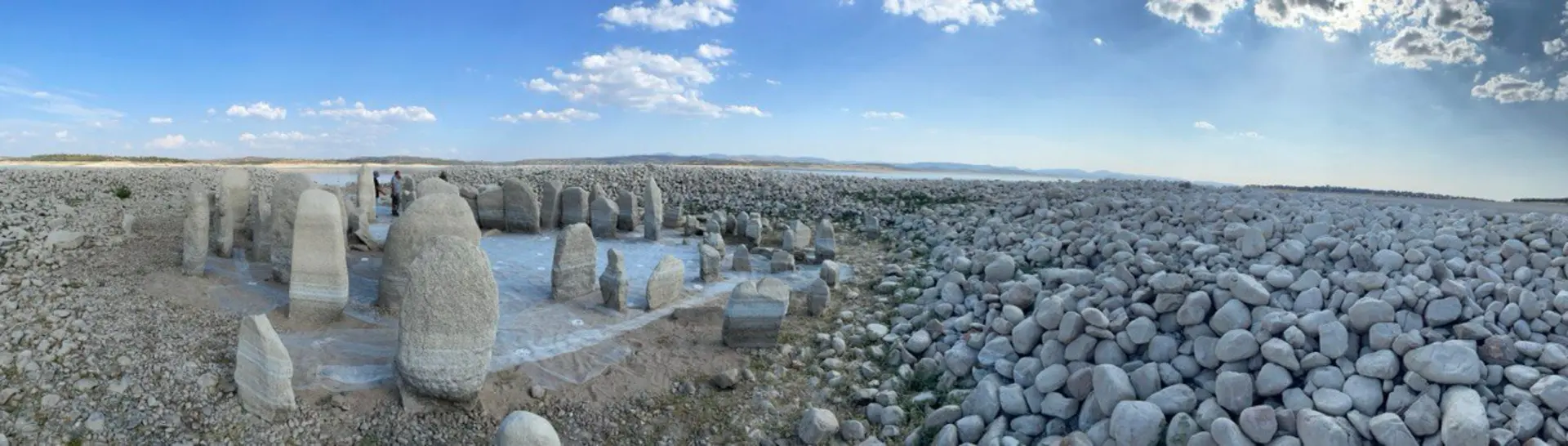
Image of Dolmen of Guadalperal. Image source · CC-BY-3.0
Visit essentials
A quick read before you go
- Duration
- The dolmen itself can be viewed in thirty to sixty minutes.
- Access
- The dolmen is within the Valdecanas Reservoir, near the towns of Peraleda de la Mata and El…
Overview
The Dolmen of Guadalperal exists in two registers at once. In one, it is a Late Neolithic or Chalcolithic corridor tomb: an ovoid chamber roughly five meters in diameter, accessible through a twenty-one-meter passage, built from granite orthostats quarried and erected by communities whose names we will never know. In the other, it is a ghost that appears and vanishes according to the reservoir's mood, a monument whose visibility is determined not by opening hours but by rainfall.
The German archaeologist Hugo Obermaier reached the site between 1925 and 1927. He found ceramics, flint knives, axes, jewelry, and a copper punch. He set some of the fallen orthostats back upright on concrete bases and arranged the tumulus pebbles in a surrounding ring. His research was not published until 1960, three years before the Valdecanas dam drowned the site.
For decades, the dolmen was invisible. Local people remembered it. Archaeologists knew it existed. But the water covered everything.
In the summer of 2019, a drought reduced the reservoir to twenty-seven percent capacity. The stones broke the surface. NASA captured the emergence in satellite imagery. Smithsonian Magazine and dozens of international outlets covered the story. The press called it the Spanish Stonehenge, a comparison that is architecturally imprecise but emotionally accurate: this was a monument on a scale that demanded attention.
At the entrance to the chamber stands a menhir whose carved surface has been reinterpreted by recent researchers as possibly the oldest realistic map in the world, depicting the Tagus River and its tributaries in serpentine lines scored into granite. If the interpretation holds, the builders were not merely burying their dead; they were recording their landscape in stone, creating a permanent document of the world as they understood it.
The dolmen was declared a Site of Cultural Interest by the Spanish Ministry of Culture in 2022. The local community group Raices de Peraleda campaigns for the monument's relocation to dry ground. Institutional archaeologists argue that moving the stones would sever the monument from the landscape that gave it meaning. The debate remains unresolved. The water, indifferent to human arguments, continues to rise and fall.
Why this place is sacred
The thinning at Guadalperal does not happen through permanence. It happens through the cycle of drowning and resurfacing, a rhythm that gives the monument a quality no other megalithic site possesses: the quality of impermanence.
Most ancient monuments endure by standing still. Guadalperal endures by vanishing. The reservoir swallows it for years at a time, and the stones sit in the dark water, accumulating algae and erosion. Then the drought comes, the water drops, and the orthostats break the surface again, standing in the mudflats like bones emerging from soil.
This cycle creates a form of encounter that is radically contingent. You cannot plan a visit to Guadalperal the way you plan a visit to Stonehenge or Carnac. The water decides when the stones are seen. The monument chooses its own moments of visibility. This contingency strips away the tourist infrastructure, the interpretive panels, the gift shops. When you reach the dolmen, you find only the stones, the mud, and the silence.
The Franco-era submersion adds a political dimension to the thinning. The dam that drowned the dolmen also displaced living communities. The people of Peraleda de la Mata lost homes and land to the same reservoir that swallowed the monument. When the stones resurface, they carry the memory of that displacement. The ancient builders and the modern displaced share a common narrative: both built something that the state destroyed.
The menhir at the entrance poses its own form of thinning. If its carved lines truly represent the Tagus and its tributaries, then the builders were creating a map, a document of their relationship to the land. The map survived five thousand years only to be submerged beneath the river it depicted. The landscape erased its own portrait.
And then there is the climate dimension. The dolmen emerges only during drought, only when the land is suffering. Its visibility is a symptom of crisis. To see the monument is to witness the landscape under stress. Beauty and catastrophe arrive together, indistinguishable.
The dolmen served as a corridor tomb and ceremonial center for the prehistoric communities of the Tagus River valley. Its position near one of the few fordable points on the river suggests it functioned as a gathering place where different communities converged for funerary rites, trade, and ceremony.
From a Neolithic-Chalcolithic funerary monument, the site saw continued use into the Roman era, evidenced by coins and grinding stones. It was scientifically excavated by Hugo Obermaier in 1925-1927 but remained unpublished until 1960. Submerged by the Valdecanas Reservoir in 1963, it re-emerged during droughts in 2019 and 2022, becoming an international symbol of submerged heritage and climate change. Declared a Site of Cultural Interest in 2022.
Experience and orientation
Before anything else, check the water level. The Dolmen of Guadalperal is only accessible when the Valdecanas Reservoir drops below approximately thirty percent capacity. This happens during severe drought, typically in late summer. In normal years with adequate rainfall, the monument is submerged and invisible. There is no guaranteed visiting period.
Assuming the stones are above water, the approach defines the experience. Two options exist. The first is a boat tour from the shores near Peraleda de la Mata or El Gordo, operated by local providers for approximately fifteen euros. The ride across the diminished reservoir, passing over submerged landscapes, carries its own strange power. The second is walking: roughly two hours on foot across exposed reservoir bed, through mud and uneven terrain, on what is technically private property.
Neither approach is easy. Both enforce a kind of pilgrimage.
The dolmen itself appears as a cluster of granite orthostats standing in the mudflats. The ovoid chamber, roughly five meters across, is defined by the upright stones. The twenty-one-meter access corridor stretches behind. Some stones stand where Obermaier placed them on concrete bases in the 1920s. Others lean at the angles that decades of submersion have imposed.
Look for the carved menhir at the chamber entrance. The serpentine lines scored into the granite have been interpreted as a map of the Tagus and its tributaries. Whether or not the interpretation holds, the carving is real, and the act of recording landscape in stone is self-evident.
The dolmen has no facilities. No shade. No water. No interpretive panels. No restrooms. The surrounding landscape is the exposed bed of the reservoir: cracked earth, scattered debris, the remnants of a drowned world. In summer, when drought is most likely, Extremaduran temperatures can exceed forty degrees Celsius.
The nearby towns of Peraleda de la Mata and El Gordo provide basic services. Navalmoral de la Mata, approximately twenty kilometers away, offers a fuller range of amenities.
The dolmen is located within the Valdecanas Reservoir, in Caceres province, Extremadura. Access from the reservoir shore is by boat (approximately fifteen euros from local operators) or on foot through difficult terrain. The nearest towns are Peraleda de la Mata and El Gordo. Navalmoral de la Mata is approximately twenty kilometers away.
Context and lineage
The dolmen was constructed by the prehistoric communities of the Tagus River valley, positioned at one of the few fordable points on the river. The builders quarried and erected approximately 150 granite orthostats to create an ovoid chamber with a twenty-one-meter access corridor. At the chamber entrance, they placed a menhir carved with serpentine lines that recent researchers have interpreted as possibly the oldest realistic map in the world, depicting the Tagus and its tributaries.
The site served as a funerary monument and likely as a ceremonial and trading center where communities from different territories converged at the river crossing.
The dolmen belongs to the Iberian megalithic tradition, which produced thousands of corridor tombs, dolmens, and menhirs across the peninsula from the fifth millennium BCE onward. In Extremadura, the Dolmen de Lacara near Merida provides a comparable monument. The broader tradition connects to the Atlantic European megalithic complex extending from Portugal through Brittany to Scandinavia.
Hugo Obermaier
German archaeologist who conducted the first scientific excavation of the dolmen between 1925 and 1927, repositioning fallen orthostats and documenting artifacts
Raices de Peraleda
Local community heritage organization advocating for the permanent relocation of the dolmen to dry ground
Traditions and practice
The dolmen served as a corridor tomb where the dead were interred with grave goods including ceramics, flint knives, axes, jewelry, and a copper punch. The river crossing location suggests gatherings for trade and ceremony. Evidence of Roman-era use, including coins and grinding stones, indicates the site retained significance across millennia.
When visible, the dolmen draws visitors who arrive by boat tour (approximately fifteen euros) or on foot through exposed reservoir bed. The community group Raices de Peraleda advocates for permanent relocation. Academic teams have conducted digital conservation through terrestrial laser scanning and photogrammetry, creating detailed records of a monument that spends most of its time underwater. The site received extensive international media coverage during its 2019 emergence, featured by NASA, Smithsonian, and dozens of other outlets.
Check reservoir levels before planning a visit. If the dolmen is accessible, arrive early to avoid the worst heat. Whether approaching by boat or on foot, allow the journey itself to shape the experience. At the dolmen, find the carved menhir and spend time with its serpentine lines. Consider the layers: the builders who quarried these stones, the archaeologist who set them upright again, the dam that drowned them, the drought that reveals them.
If the water is too high and the stones are invisible, that absence is also part of the story.
Neolithic-Chalcolithic Funerary and Ceremonial Tradition
HistoricalThe Dolmen of Guadalperal was a corridor tomb and ceremonial center built between the fifth and third millennia BCE at a strategic ford on the Tagus River. The approximately 150 granite orthostats formed an ovoid chamber with a twenty-one-meter access corridor. The carved menhir at the entrance, possibly depicting the Tagus and its tributaries, suggests the builders encoded their understanding of the landscape in permanent stone.
Funerary burial within the corridor tomb with grave goods including ceramics, flint knives, axes, jewelry, and a copper punch. The river crossing location suggests the site also served as a gathering place for trade and ceremony, linking communities from different territories. Evidence of Roman-era use, including coins and grinding stones, indicates the site retained significance across millennia.
Modern Heritage Activism and Environmental Witness
ActiveSince the 2019 drought exposure, the dolmen has become a powerful symbol of cultural heritage lost to development and of climate change making the invisible visible. NASA satellite imagery, Smithsonian coverage, and international media attention transformed a local monument into a global conversation about what we choose to drown and what the earth refuses to forget.
Community advocacy by Raices de Peraleda for permanent relocation. Digital conservation through terrestrial laser scanning and photogrammetry. Academic research on submerged heritage. Boat tours and guided visits when the dolmen is visible. International media documentation.
Perspectives and open questions
Guadalperal invites interpretation through prehistoric archaeology, heritage conservation, environmental science, and the politics of memory. Its periodic submersion and emergence make it unlike any other megalithic monument in Europe.
Scholarly perspective
Archaeologists classify the dolmen as a Late Neolithic or Chalcolithic corridor tomb dating to the fourth-third millennium BCE, with possible earlier use phases. Obermaier's 1925-1927 excavation, though foundational, involved interventions that complicate interpretation. Peer-reviewed research in Internet Archaeology and npj Heritage Science has documented the monument digitally and assessed decades of submersion damage. The menhir carving, reinterpreted as a possible map of the Tagus River, has generated debate about prehistoric cartographic knowledge.
The 2022 designation as a Site of Cultural Interest reflects institutional recognition of the monument's significance.
Living and traditional perspectives
No indigenous oral traditions survive regarding the dolmen. The prehistoric builders' specific cultural identity and beliefs are unknown. However, the community of Peraleda de la Mata has developed a strong cultural connection to the monument. The group Raices de Peraleda advocates for the dolmen's permanent relocation, framing it as a matter of cultural justice: the dam that drowned the monument also displaced their families.
Alternative interpretations
The dolmen's periodic emergence from water has attracted interest from earth-mystery and sacred landscape enthusiasts who read its submersion and revelation as metaphor for hidden and recovered knowledge. The nickname 'Spanish Stonehenge,' while architecturally imprecise, speaks to a universal human impulse to recognize certain megalithic sites as places of cosmic significance.
Open questions
Why was this specific river crossing chosen for such a massive monument? What social organization could mobilize the labor to quarry, transport, and erect 150 granite orthostats? Is the menhir carving truly a map of the Tagus? What happened to the artifacts Obermaier sent to Germany? The monument's decades of submersion have caused unknowable damage to evidence that might have answered these questions.
Plan your visit
Access and arrival
The dolmen is within the Valdecanas Reservoir, near the towns of Peraleda de la Mata and El Gordo in Caceres province, Extremadura. Approximately 170 km southwest of Madrid. Nearest significant town: Navalmoral de la Mata, approximately 20 km. Access by car to the reservoir shore, then by foot across exposed reservoir bed (difficult, approximately two hours) or by boat tour from local operators (approximately fifteen euros). No public transport to the site. No facilities at the dolmen.
No accommodation near the dolmen itself. Peraleda de la Mata and El Gordo offer limited options. Navalmoral de la Mata (approximately 20 km) provides a wider range. Badajoz and Madrid offer full services at greater distances.
Respectful visit
Sturdy waterproof footwear is essential for crossing the muddy reservoir bed. Sun protection including hat, sunscreen, and long sleeves recommended in summer. Bring more water than you think you need.
Photography is permitted and encouraged. The site has become internationally known through photographs and satellite imagery. Drone photography may be subject to local aviation restrictions.
Do not leave any objects at the site. The dolmen is a protected archaeological monument.
Do not touch, climb on, or lean against the stones. Do not remove any material. The monument is a Site of Cultural Interest protected by the Spanish Ministry of Culture. When submerged, the site is inaccessible.
The dolmen is only accessible during severe drought. Summer heat in Extremadura can exceed forty degrees Celsius. There are no facilities at the site: no shade, water, or restrooms. The walk across exposed reservoir bed is approximately two hours through difficult terrain. Sturdy waterproof footwear is essential. Bring ample water and sun protection.
Current practical details
Address
Embalse de Valdecañas, 10392, Cáceres, Spain
Phone
Hours
Hours, fees, and access can change — verify on the official source before you travel. Practical details last checked Jun 2026.
Location
Map loads as you approach this section.
Pilgrim reflections
A portrait of encounter, not a score
Pilgrims describe what they felt, how present they could become, and whether the place would shape a journey. There are no stars and no ranking of traditions.
No reviewed reflections yet
The first pilgrims can help describe the character of being here.
Share a reflection
Available after an account-backed “Been there.” Every reflection is reviewed before publication.
Nearby sacred places
Explore other sacred places in the region. Proximity does not establish access or travel time; check each place’s guidance.


Share a photo
Help visitors recognize Dolmen of Guadalperal. Every submission is reviewed before publication.