Sanctuary of Our Lady of Salette
A high alpine sanctuary where the weeping Virgin called her people to reconciliation
La Salette-Fallavaux, Isère, France
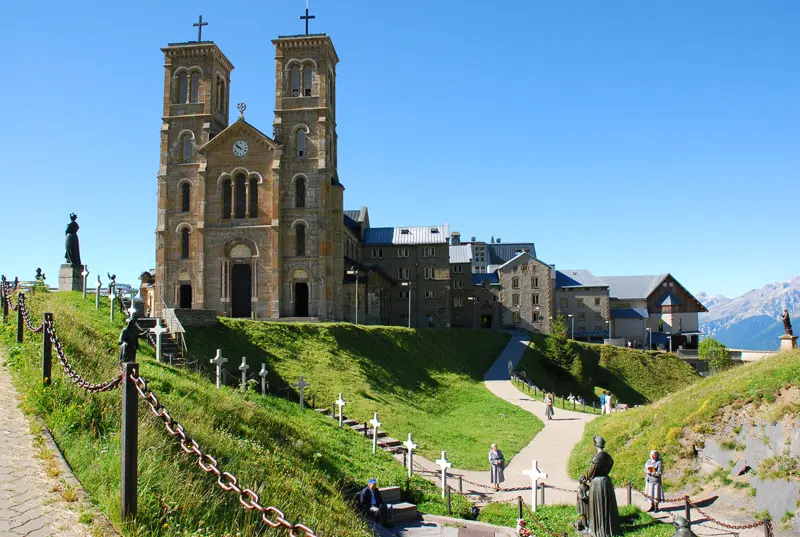
Image of Sanctuary of Our Lady of Salette. Image source · CC-BY-SA-3.0
Visit essentials
Before you go
- Access
- From Grenoble: 80 km via RN 85 (Route Napoleon) through Vizille and La Mure to Corps, then RD…
- Address
- Le Sanctuaire, 38970 La Salette-Fallavaux, France
- Duration
- Minimum half day for basic visit.
- Etiquette
- Standard Catholic pilgrimage etiquette applies.
Overview
On a September afternoon in 1846, two children tending cattle in the high pastures above La Salette-Fallavaux saw a globe of fire descend. Within the light sat a woman, face buried in her hands, weeping. She rose to speak of sorrow at her people's abandonment of faith and hope that they might return, gave a message for 'all her people,' and disappeared into light.
The alpine meadow became one of France's most significant pilgrimage sites. After five years of investigation, the Church approved the apparition. A basilica rose where the Vision had stood, and the Missionaries of La Salette were founded to welcome pilgrims and carry the message worldwide. The sanctuary now receives hundreds of thousands each year, drawn by the distinctive image of Mary in tears—a mother grieving for her children and pleading for their return.
At nearly 2,000 meters elevation, La Salette requires effort to reach. The road winds through alpine valleys, the air thins, and the world below recedes; the mountain itself becomes preparation for encounter.
Why this place is sacred
Some places become thin through gradual accumulation of prayer over centuries. La Salette became thin in a single afternoon, when heaven touched earth in a globe of fire. The shepherd children's testimony, tested by five years of Church investigation, created the foundation. What followed—the pilgrims, the prayers, the confessions, the tears—deepened the thinness year by year.
The apparition's content shapes the quality of sacred space. La Salette is not a place of triumph or miracle cure but of reconciliation. The Virgin appeared weeping, burdened by her people's indifference. The message was one of return—to faith, to Sabbath observance, to respect for the holy name. Pilgrims come here to be reconciled, to confess, to begin again. The Sacrament of Reconciliation is central to La Salette spirituality, and confessors are always available.
The mountain setting reinforces this theology of ascent and transformation. The climb to La Salette mirrors the spiritual journey—effortful, requiring endurance, rewarded with vista and clarity. The thin air at 1,800 meters creates a physical reminder that pilgrims have left ordinary elevation behind.
The site had no particular sacred significance before the 1846 apparition. It was simply high pasture where shepherds brought cattle to graze. The apparition itself created the sacred space.
From alpine meadow to approved apparition site (1851) to minor basilica (1879), La Salette has grown in infrastructure while maintaining its essential character. The Missionaries and Sisters of La Salette have spread the message globally, but the mountain sanctuary remains the heart. The 300,000 annual pilgrims continue patterns established by the first faithful who climbed these slopes after the children's testimony spread.
Experience and orientation
The journey to La Salette begins with departure from the lowlands. From Grenoble, the Route Napoleon winds south through increasingly dramatic landscape. At Corps, the road turns toward the sanctuary, climbing through switchbacks as the valley falls away. The air cools and thins. By arrival, pilgrims have already been transformed by the approach.
The sanctuary complex spreads across the alpine meadow: the basilica with its distinctive towers, the statues marking the apparition site, the outdoor Stations of the Cross winding up the hillside. A spring marks the precise location where the Virgin appeared—pilgrims drink its water and fill bottles to carry home. The statues of Maximin and Melanie with the weeping Virgin recreate the encounter, allowing pilgrims to stand where the children stood.
The rhythm of pilgrimage here follows the mountain day. Morning brings Mass in the basilica, the light filtering through high windows. Afternoon invites the outdoor Stations of the Cross, a walking meditation that uses the natural landscape—ascending, pausing, praying, ascending again. Evening brings candlelight processions and the opportunity for Reconciliation. The mountain night falls cold and clear, thick with stars at this elevation.
Confession holds particular importance at La Salette. The Virgin's message called for conversion, for return to faith. Confessors are always available, and many pilgrims report that their experience of Reconciliation here carries unusual depth. The mountain setting, the weeping Virgin's plea, the effort of the journey—all prepare the soul for honest encounter with grace.
La Salette asks pilgrims to match physical effort with spiritual openness. The climb teaches that encounter requires preparation. The message of reconciliation invites honest examination of what needs healing.
Context and lineage
On September 19, 1846, Maximin Giraud (11) and Mélanie Calvat (14) were tending cattle in the mountain pastures when they saw a brilliant light descend. Within it sat a woman, weeping, her face in her hands. She rose and spoke to them in French and then in local dialect, ensuring they understood. She spoke of her Son's burden, of her people's sins—blasphemy and Sabbath-breaking—and of coming hardship if they did not convert. She gave each child a personal secret.
Then she rose into the air, became light, and vanished. The children ran to tell their employers, and the message began to spread.
La Salette gave birth to two religious congregations: the Missionaries of Notre-Dame de La Salette (priests dedicated to pilgrimage ministry and spreading the message) and the Sisters of Notre-Dame de La Salette. Both continue to serve the sanctuary and carry the La Salette charism worldwide. The Association of Pilgrims of Notre-Dame de La Salette (est. 1962) manages practical operations.
Maximin Giraud
Shepherd child, visionary (age 11 at apparition). Remained firm in his testimony throughout his life despite various pressures.
Mélanie Calvat
Shepherd child, visionary (age 14 at apparition). Later life marked by additional mystical claims, some controversial.
Bishop Philibert de Bruillard
Bishop of Grenoble who conducted the five-year investigation and approved the apparition in 1851. Founded the Missionaries of La Salette.
Pope Leo XIII
Granted canonical coronation to the image in 1879, elevating the site to minor basilica status.
Traditions and practice
The apparition message called for traditional Catholic observance: Sunday Mass attendance, refraining from blasphemy, keeping the Sabbath holy. These remain the theological core of La Salette spirituality.
Daily Mass in the basilica. Rosary devotions. Outdoor Stations of the Cross—a walking meditation that ascends the hillside through fourteen stations to the summit. Eucharistic Adoration with confessors available. Candlelight processions on major feast days. Pilgrimage groups receive guided reflection on the apparition message and the theme of reconciliation. The spring water from the apparition site is collected by pilgrims.
Allow the mountain climb to quiet your mind before arrival. Attend Mass if possible. Walk the outdoor Stations of the Cross—let the physical effort of ascent mirror inner work. Consider the Sacrament of Reconciliation; it holds particular significance here. Drink from the spring and sit with the statues of the apparition. Let the weeping Virgin's message address whatever grief or alienation you carry.
Roman Catholicism
ActiveLa Salette is one of France's most important approved Marian apparition sites, recognized by the Church since 1851. The apparition gave birth to two religious congregations and established patterns for Marian pilgrimage that influenced later sites. The message emphasizes reconciliation with God, conversion, Sabbath observance, and the tender grief of a mother for her children.
Daily Mass, Rosary, outdoor Stations of the Cross, Eucharistic Adoration, Confession/Reconciliation, candlelight processions. Major gatherings on August 15 and September 19. Pilgrimage retreats focused on the La Salette message of reconciliation. Water from the apparition spring collected by pilgrims.
Perspectives and open questions
La Salette holds significance as an approved Marian apparition, a theology of reconciliation, and a continuing controversy about prophetic secrets. Each perspective reveals different facets of this mountain sanctuary.
Scholarly perspective
The Church approved the 1846 apparition after thorough five-year investigation. The core message—Mary weeping for her people, calling for conversion—is accepted. Scholarly debate focuses on the secrets given to each child, particularly the difference between Mélanie's 1851 version (sent to Pope Pius IX, discovered in Vatican archives in 1999) and her expanded 1879 publication. Prudent scholars distinguish between the authenticated apparition and later additions.
Living and traditional perspectives
Catholic tradition honors La Salette as a mother's plea for her wayward children. The image of Mary weeping—rare in Marian iconography—creates a particular spirituality of tenderness and sorrow. The emphasis on reconciliation, Sabbath observance, and conversion aligns with traditional Catholic piety. The religious congregations born from La Salette carry this spirituality worldwide.
Alternative interpretations
Traditionalist Catholic groups and apocalyptic interpreters focus heavily on the secrets of La Salette, particularly the controversial 1879 version of Mélanie's secret, which contains more explicitly apocalyptic content. Some interpret these texts as prophecy of current Church crisis. The official Church position considers the 1879 text distinct from the authenticated 1851 original.
Open questions
The full content and interpretation of the secrets remains debated. The 1851 texts, though discovered in the Vatican archives, have generated scholarly analysis but not definitive interpretation. The relationship between the modest 1846 message and later apocalyptic interpretations continues to be discussed. What the children actually experienced remains a matter of faith, beyond historical verification.
Plan your visit
Access and arrival
From Grenoble: 80 km via RN 85 (Route Napoleon) through Vizille and La Mure to Corps, then RD 212c to sanctuary. From Lyon: approximately 2.5 hours driving. Train service to St. Georges de Commie, then 1-hour taxi. The sanctuary sits at 1,800 meters elevation. Parking available on site. The sanctuary hotel offers accommodation with meals.
The sanctuary operates its own hotel offering various room options, with breakfast, lunch, and dinner available. Simple accommodations designed for pilgrims. Corps village (valley below) offers additional lodging options.
Respectful visit
Modest dress covering shoulders and knees in the basilica. Warm layers recommended for outdoor activities at alpine elevation.
Permitted outdoors and generally in the basilica outside of services. No photography during Mass or other liturgies. Flash photography discouraged.
Candles available for lighting near the apparition site. Donations support the sanctuary's ongoing ministry.
Mobile phones silenced in the basilica. Respectful silence during services and in designated prayer areas.
Mountain weather can change quickly; bring layers. The altitude (1,800m) may affect those unaccustomed. Winter access may be difficult or impossible due to snow. Allow adequate time; rushing through La Salette defeats its purpose.
Current practical details
Address
Le Sanctuaire, 38970 La Salette-Fallavaux, France
Phone
Hours
Hours, fees, and access can change — verify on the official source before you travel. Practical details last checked Jun 2026.
Location
Map loads as you approach this section.
Pilgrim reflections
A portrait of encounter, not a score
Pilgrims describe what they felt, how present they could become, and whether the place would shape a journey. There are no stars and no ranking of traditions.
No reviewed reflections yet
The first pilgrims can help describe the character of being here.
Share a reflection
Available after an account-backed “Been there.” Every reflection is reviewed before publication.
Nearby sacred places
Explore other sacred places in the region. Proximity does not establish access or travel time; check each place’s guidance.

Sanctuary of Notre-Dame du Laus
Saint-Étienne-le-Laus, Saint-Étienne-le-Laus, Hautes-Alpes / Provence-Alpes-Côte d'Azur, France
40.0 km away

Abbey Church of Saint-Antoine-l'Abbaye
Saint-Antoine-l'Abbaye, Saint-Antoine-l'Abbaye, Isère / Auvergne-Rhône-Alpes, France
69.3 km away

Sanctuary of Notre-Dame de Myans
Myans, Myans, Savoie / Auvergne-Rhône-Alpes, France
73.1 km away

Mont Ventoux
Vaucluse, France
93.8 km away
References
Sources consulted for this page. Source categories describe the publication, not a guarantee that every claim is verified. Traditional accounts and outside interpretations may differ.
- 01History - Sanctuaire Notre-Dame de La Salette — La Salette SanctuaryofficialOfficial sanctuary website
- 02Notre-Dame-de-la-Salette visitor guide — France This WaySource contextPractical visitor information
- 03Come to the sanctuary — La Salette SanctuarySource contextOfficial visitor information
- 04La Salette | EWTN — EWTNSource contextCatholic media network reference
- 05Our Lady of La Salette - Wikipedia — Wikipedia contributorsencyclopediaGeneral reference with citations
- 06Sanctuary of Our Lady of La Salette, France — Catholic Shrine BasilicaSource contextCatholic pilgrimage reference
Photo gallery
3 curated photos
Share a photo
Help visitors recognize Sanctuary of Our Lady of Salette. Every submission is reviewed before publication.