Sanctuary of Aphrodite
Part ofArchaeological Site of Palaepaphos
The ancient world's holiest shrine to love, where a stone stood for a goddess under an open sky
Understand sacred places, explore living traditions, and learn how to engage respectfully with Pilgrim Map.
Access has not been verified. Check current local guidance before planning a visit.
Kouklia, Paphos, Cyprus
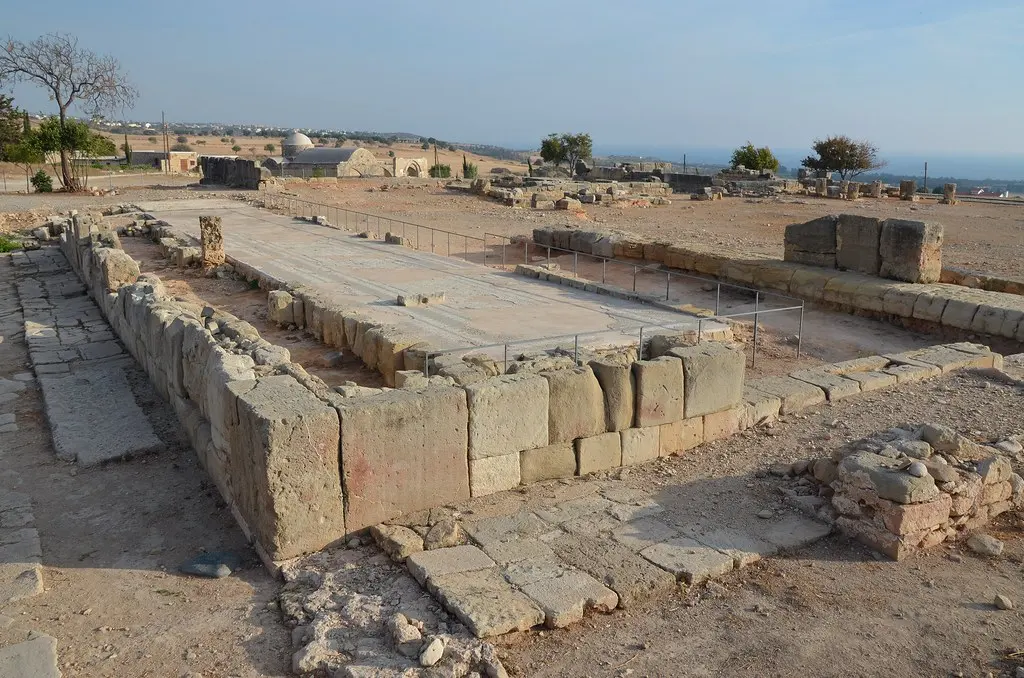
Image of Sanctuary of Aphrodite. Image source
Visit essentials
A quick read before you go
- Duration
- One to two hours for the sanctuary ruins and museum.
- Etiquette
- Standard archaeological site etiquette applies.
Overview
What made the Sanctuary of Aphrodite at Palaepaphos unlike any other sanctuary in the ancient Greek world was what it lacked. There was no great temple enclosing the deity. There was no carved statue giving the goddess a face, a body, a human shape. There was a conical stone, dark and smooth, possibly fallen from the sky, standing on an open-air altar. This stone was Aphrodite.
Or rather, this stone was where Aphrodite was present, a distinction that the ancient worshippers may or may not have made.
The Roman historian Tacitus visited in the 1st century CE and recorded his astonishment. The form of the goddess, he wrote, does not resemble the human form. The altar was open to the sky, and the priests claimed that rain never fell upon it. He described bloodless rites centered on the anointing of the stone with oil.
This aniconic worship, venerating divine presence through an abstract form, was archaic by the standards of classical Greece, where every deity had a face. At Palaepaphos, something older persisted, a way of encountering the divine that predated the anthropomorphic imagination.
Scholars trace the sanctuary's origins to the 12th century BCE, when Mycenaean settlers established the Aphrodite cult, but the form of worship suggests continuity with an even older Cypriot tradition, possibly connected to Near Eastern goddess cults of the Late Bronze Age.
For over sixteen hundred years, from the Mycenaean period through the Roman era, pilgrims came from across the Mediterranean to this open altar on the coast of Cyprus. The annual Aphrodisia festival brought processions from the city of Nea Paphos, eleven kilometers away. When the Emperor Theodosius I banned pagan worship in the late 4th century CE, the sanctuary fell silent.
What remains at Kouklia are the foundations, the museum, and a conical stone that asks you to imagine what it would mean to call a piece of rock by the name of love.
Why this place is sacred
The sanctuary forces a question that the more spectacular ruins of Greece do not: what makes a place sacred when the sacred object is a stone? The conical baetyl at the center of the Aphrodite cult was not decorated, not carved, not shaped to resemble anything. If it was a meteorite, as some scholars suggest, then it was literally an object from beyond the Earth, a piece of sky embedded in the ground.
If it was shaped by human hands, those hands chose to create an abstract form rather than a likeness. Either way, the worship directed at this stone for sixteen centuries suggests that the Paphians understood something about divine presence that the more representational Greek religion had moved away from: that the sacred does not require a face.
The open-air altar amplifies this simplicity. The sanctuary was never enclosed. The worshipper stood under the sky, exposed to the elements, anointing a stone with oil. Tacitus reports that the priests claimed rain never fell on the altar, a statement that, whether literally true or not, encodes the understanding that this place operated by rules different from the ordinary world.
The bloodless offerings deepen the distinctiveness. Where other Greek sanctuaries slaughtered animals, Palaepaphos offered doves, flowers, and incense. This was a cult of fragrance and gentleness, aligned with the goddess it honored. Aphrodite was not a warrior deity. She was the goddess of love, beauty, and desire, forces that operate through attraction rather than force. The offerings mirrored the deity.
Today, standing among the ruins, the open sky is still there. The altar is gone, the stone is in the museum, and the doves no longer arrive. But the question the sanctuary posed remains: what form does love take when you strip away all representation? A stone, anointed with oil, under an open sky. For sixteen centuries, that was enough.
The sanctuary was established as the center of Aphrodite worship on Cyprus, likely building on an older Cypriot fertility cult. Its unique aniconic worship, centered on the conical baetyl, distinguished it from every other Greek sanctuary. The mythological connection to Aphrodite's birth from the sea near the coast of Paphos grounded the cult in the specific geography of this shore.
The sanctuary evolved through multiple cultural layers. A possible Late Bronze Age Cypriot fertility cult was absorbed and hellenized by Mycenaean settlers around the 12th century BCE. Phoenician influence in the 8th-6th centuries BCE may have reinforced the aniconic and Near Eastern elements of the worship. The Ptolemaic and Roman periods brought expansion and greater monumentalization. Tacitus's 1st-century CE account provides the most detailed ancient description. The late 4th-century CE edicts of Theodosius I ended the cult.
In the 13th century, the Lusignan Crusaders built a manor house on the site using ancient stones; this building now serves as the Kouklia Archaeological Museum. Modern archaeological excavations have continued since the 1880s, with the University of Zurich leading ongoing work.
Experience and orientation
Arriving at Kouklia, a quiet village on the Paphos-Limassol motorway, the visitor finds none of the scale that the sanctuary's ancient reputation might suggest. The ruins are modest: foundation walls, column bases, partial reconstructions that hint at the complex's layout without overwhelming with grandeur. This modesty is instructive. The sanctuary's power was never architectural.
Begin in the Kouklia Archaeological Museum, housed in the 13th-century Lusignan manor house adjacent to the ruins. The museum is small, which means it can be appreciated in full rather than sampled. The conical stone, the object that was Aphrodite for sixteen centuries, is displayed here. It is worth standing before this stone for longer than feels natural.
What you are looking at is one of the most venerated objects in the ancient world, a form to which pilgrims from across the Mediterranean directed their prayers, their offerings, their desire for love and beauty and fertility. The stone makes no concessions. It does not resemble a woman, a goddess, or anything human. It is a stone, and it was enough.
The museum also displays votive offerings, pottery, jewelry, and architectural fragments that provide context for the worship. Terracotta figurines show what the worshippers looked like. Inscriptions record their names and prayers.
Outside, the ruins spread across a site that is open to the sky, as the sanctuary always was. Walk through the foundation outlines and try to inhabit the space as a worshipper would have: approaching the altar with doves in hand, oil for anointing, incense to burn. The open quality of the ruins, their lack of enclosure, preserves something of the original worship's character, even if it preserves it accidentally rather than by design.
From the site, the coast is visible. Petra tou Romiou, the rock where Aphrodite was born from the sea, lies approximately twelve kilometers to the east. The visual connection between the sanctuary and the mythological birthplace links the ruins to the landscape in a way that maps, directions, and distances cannot fully communicate. The goddess was born at the shore and worshipped inland. The journey from coast to sanctuary was the ancient pilgrim's path.
Kouklia is approximately 16 km east of Paphos city, accessible by car via the motorway in about 20 minutes. Limited public transport; a car is recommended. Start at the museum to see the conical stone and artifacts, then explore the ruins. Allow one to two hours. Combine with a visit to Petra tou Romiou for the full mythological experience.
Context and lineage
Greek mythology locates Aphrodite's birth near the coast of Paphos. According to Hesiod's Theogony, the goddess was born from sea foam created when Kronos severed the genitals of Ouranos and cast them into the sea. She came ashore on the beach of Paphos, and the sanctuary was established to honor her at the place nearest to her emergence.
The sanctuary's legendary founders include Kinyras, the mythical first king of Paphos, who established both the city and the Aphrodite cult, uniting political and religious authority in a single dynasty. His descendants, the Kinyrades, served as hereditary priest-kings for centuries. A second tradition attributes the foundation to Agapenor, king of Tegea, who was shipwrecked on Cyprus after the Trojan War.
The sanctuary's lineage spans multiple cultural layers: a possible pre-Greek Cypriot fertility cult, Mycenaean Greek religion, Phoenician influence (connecting Aphrodite to Astarte and Ishtar), Ptolemaic and Roman expansion, and finally Christian suppression. Each layer absorbed rather than replaced the previous one, creating a palimpsest of sacred meaning. The aniconic worship of the conical stone may represent the oldest surviving layer, a form of Near Eastern baetyl veneration that persisted through sixteen centuries of cultural change.
Kinyras
Legendary founder of Paphos and the Aphrodite cult, first of the Kinyrades dynasty of priest-kings who maintained the sanctuary for centuries.
Tacitus
Roman historian who visited the sanctuary in the 1st century CE and left the most detailed ancient description of the aniconic worship, the open-air altar, and the conical stone.
The Kinyrades
Hereditary dynasty of priest-kings who served as both political rulers and high priests of Aphrodite at Palaepaphos, maintaining the cult for centuries.
University of Zurich Archaeological Expedition
Leading ongoing excavations at the sanctuary since 2006, continuing to reveal new aspects of the site's history and worship practices.
Traditions and practice
The anointing of the conical baetyl with oil was the central ritual act, a gesture of intimate contact between human devotion and divine presence. Offerings were bloodless: doves, sacred to Aphrodite, along with flowers and incense. The annual Aphrodisia festival drew pilgrims from across the Greek world for a procession from Nea Paphos to the sanctuary, a walk of approximately eleven kilometers that reenacted Aphrodite's journey from the sea to her sanctuary. Oracular consultations were available.
Ritual purification preceded approach to the altar. The sanctuary's hereditary priests, the Kinyrades, presided over all ceremonies.
The sanctuary is managed by the Cyprus Department of Antiquities as an archaeological site. The Kouklia Archaeological Museum displays the conical stone and ritual artifacts. Ongoing excavations by the University of Zurich continue to deepen understanding of the site. Cultural tourism and educational programs provide access. Some visitors with personal connections to goddess spirituality approach the site with devotional intentions, though this is private practice rather than organized activity.
Begin at the museum with the conical stone. Allow yourself to consider what it means to look at an object that embodied the goddess of love for sixteen centuries. Note its simplicity. Then walk through the ruins, paying attention to the open quality of the site. The sanctuary was never enclosed by a roof; the worshipper stood under the sky. This openness is still present.
Find the altar area and imagine the scene Tacitus described: the stone, the oil, the doves, the incense, the open sky. Notice the view toward the coast. Aphrodite was born at the sea and worshipped here. If time allows, drive to Petra tou Romiou and complete the ancient pilgrim's route in reverse, from sanctuary to shore.
Ancient Greek Worship of Aphrodite
HistoricalThe Sanctuary of Aphrodite at Palaepaphos was the most important center of Aphrodite worship in the ancient world, maintaining continuous practice for approximately 1,600 years. Its aniconic worship of a conical stone, its open-air altar, and its bloodless offerings distinguished it from every other Greek sanctuary.
Anointing of the conical baetyl with oil. Offerings of doves, flowers, and incense. Annual Aphrodisia festival with procession from Nea Paphos. Oracular consultations. Open-air worship under the sky. Ritual purification before approaching the altar.
Pre-Greek Cypriot Fertility Cult
HistoricalBefore the Mycenaean establishment of the Aphrodite cult around the 12th century BCE, the site likely served an indigenous Cypriot fertility goddess cult dating to the Late Bronze Age. The baetyl worship and Near Eastern elements of the cult suggest continuity with Levantine traditions connecting Aphrodite to Astarte and Ishtar.
Sacred stone worship as representation of divine feminine power. Fertility offerings and rituals reconstructed from material evidence. Connection to Near Eastern goddess traditions.
Archaeological Research and Conservation
ActiveSince the first systematic excavations in 1887-1888, the sanctuary has been the subject of sustained archaeological research. The University of Zurich has led ongoing excavations since 2006. The site's inclusion in the Paphos UNESCO World Heritage Site (1980) ensures institutional protection and international attention.
Excavation and documentation by international archaeological teams. Museum curation and interpretation. Conservation of structural remains. UNESCO heritage management protocols.
Perspectives and open questions
The Sanctuary of Aphrodite invites reflection on the nature of divine presence, the power of simplicity, and the relationship between a goddess and her geography. Each interpretive lens reveals a different aspect of what sixteen centuries of devotion to a stone can mean.
Scholarly perspective
Archaeologists confirm the sanctuary dates to at least the 12th century BCE, with possible earlier Bronze Age cult activity. The aniconic worship is well attested by ancient literary sources and confirmed by archaeological evidence. The conical stone is understood as a baetyl, common in Near Eastern religion but unusual in Greek worship. The Mycenaean origins and subsequent Phoenician and Greek religious synthesis are documented through material culture. Ongoing excavations continue to reveal new structures and refine the site's chronology.
Living and traditional perspectives
The ancient literary tradition, from Homer to Tacitus, treats the Paphian sanctuary with a combination of reverence and fascination. Tacitus's account is the most detailed: he notes the aniconic form, the open-air altar, the claim that rain never falls on it, and the bloodless offerings. The sanctuary's hereditary priesthood, the Kinyrades, was renowned across the ancient world.
The close connection between the sanctuary and the mythological birthplace of Aphrodite at the nearby coast created a sacred geography that made Paphos synonymous with the goddess herself.
Alternative interpretations
Modern goddess spirituality movements have adopted the Sanctuary of Aphrodite as a pilgrimage destination, interpreting the site through the lens of divine feminine energy. The conical stone has attracted speculation about its meteoritic origin, connecting earthly worship to cosmic objects. Some esoteric traditions connect the sanctuary to a network of feminine sacred sites across the Mediterranean. These interpretations draw on the site's genuine ancient significance but extend it through frameworks not present in the historical record.
Open questions
Whether the conical stone is a meteorite or a deliberately shaped sacred stone remains unresolved. The exact nature of the transition from pre-Greek to Greek worship at the site is unclear. Whether sacred prostitution was practiced at the sanctuary, as some ancient sources claim, is hotly debated by modern scholars. The claim that rain never fell on the open-air altar remains unexplained. The full extent of the sanctuary complex, including potentially unexcavated structures, is unknown.
Plan your visit
Access and arrival
Paphos city (16 km) offers a full range of accommodations. Kouklia village has limited options. The site is a short drive from any Paphos hotel. Mobile phone signal is reliable. The museum has basic visitor facilities. No food service at the site; Kouklia village has a few local restaurants.
Respectful visit
No specific dress code. Comfortable walking shoes recommended. Sun protection in summer.
Photography is permitted at the ruins. Museum photography policies may vary; check at the entrance.
Do not leave offerings or objects at the archaeological site.
Do not climb on or touch ancient structures | Do not remove any objects from the site | Stay on designated paths | Do not enter fenced excavation areas | UNESCO World Heritage property protected under both Cypriot and international law
Do not climb on or touch ancient structures. Do not remove any objects from the site. Stay on designated paths. The site is a UNESCO World Heritage property protected by law.
Current practical details
Address
PH4G+V2W, F612, Kukla Baf 8500, Cyprus
Hours
Hours, fees, and access can change — verify on the official source before you travel. Practical details last checked Jun 2026.
Location
Map loads as you approach this section.
Pilgrim reflections
A portrait of encounter, not a score
Pilgrims describe what they felt, how present they could become, and whether the place would shape a journey. There are no stars and no ranking of traditions.
No reviewed reflections yet
The first pilgrims can help describe the character of being here.
Share a reflection
Available after an account-backed “Been there.” Every reflection is reviewed before publication.
Nearby sacred places
Explore other sacred places in the region. Proximity does not establish access or travel time; check each place’s guidance.

Archaeological Site of Palaepaphos
Kouklia, Paphos, Cyprus
0.2 km away

Agios Neophytos Monastery
Tala, Tala, Paphos District, Cyprus
19.4 km away

Chrysorrogiatissa Monastery
Panagia, Panagia, Paphos District, Cyprus
22.8 km away

Sanctuary of Apollo Hylates
Episkopi, Episkopi, Limassol District, Cyprus
26.8 km away
Share a photo
Help visitors recognize Sanctuary of Aphrodite. Every submission is reviewed before publication.