Archaeological Site of Palaepaphos
The city that existed because a goddess was born nearby, where kings served as priests of love
Understand sacred places, explore living traditions, and learn how to engage respectfully with Pilgrim Map.
Access has not been verified. Check current local guidance before planning a visit.
Kouklia, Paphos, Cyprus

Visit essentials
A quick read before you go
- Duration
- One to two hours for the ruins and museum.
- Etiquette
- Standard archaeological site etiquette applies.
Overview
At Palaepaphos, Aphrodite’s sanctuary preceded the city, drawing worshippers, pilgrims, and wealth into western Cyprus’s most important urban centre. Its Kinyrades rulers were priest-kings whose political authority came from custodianship of the cult. Altars spread through the city rather than one precinct; terracotta figurines and votives drove economic activity, while the sanctuary’s prestige supported trade with Egypt, the Levant, and the Aegean.
Tradition held that Aphrodite was born from the sea at Petra tou Romiou, twelve kilometres down the coast, and came ashore there before being worshipped inland; annual Aphrodisia pilgrims linked that shore to her sanctuary. Political prominence shifted to Nea Paphos under the Ptolemies in the 4th century BCE, but worship continued until Emperor Theodosius I banned pagan practice in the late 4th century CE.
The ruins now lie partly beneath Kouklia and surrounding farmland; discovery of a royal palace in 2016 confirmed what ancient sources had long claimed about the city’s concentrated human and divine power.
Places within this site
Why this place is sacred
What distinguishes Palaepaphos from other ancient sacred sites is the totality of its integration. In most Greek cities, the sacred existed in designated spaces: a temenos, a temple, a sanctuary precinct. In Palaepaphos, the entire city was, in some sense, a sanctuary. Ritual altars have been found throughout the urban area. The production of votive offerings was a civic industry. The priest-kings governed as intermediaries between the goddess and the people.
This distributed sacredness creates a different kind of encounter for the modern visitor. There is no single focal point that concentrates all the site's significance. Instead, walking through Kouklia means walking across a landscape where sacred practice once saturated every aspect of human life, from commerce to governance to the arrangement of domestic space. The ruins hint at this totality without fully revealing it, since much of the ancient city remains unexcavated beneath the village and its fields.
The mythological dimension adds a geographical thinness. Palaepaphos sits within a sacred landscape defined by Aphrodite's story: her birth at the sea, her emergence onto the shore, her worship inland. The ancient pilgrimage route from the coast to the sanctuary, traversed annually during the Aphrodisia festival, traced a line that connected the place of the goddess's origin to the place of her veneration.
Walking from Petra tou Romiou to Kouklia today, though the ancient road is gone, still passes through a landscape that was organized, both mythologically and architecturally, around a single divine narrative.
The 2016 discovery of a royal palace adds a political dimension to the site's layered significance. The Kinyrades were not merely priests who happened to rule. They were rulers whose authority was inseparable from their priestly function. The palace was not a secular building adjacent to a sacred one; it was the residence of a sacred king. At Palaepaphos, power and devotion shared the same address.
Palaepaphos was established as both a settlement and a cult center, the two functions emerging together rather than sequentially. The Mycenaean Greek settlers who arrived around 1200 BCE brought or encountered the Aphrodite cult and built a city around it. The city's purpose was never purely commercial or defensive; it existed to serve and benefit from the sanctuary's international prestige.
The city passed through distinct phases: Late Bronze Age Cypriot settlement, Mycenaean foundation (c. 1200 BCE), Iron Age expansion with Phoenician influence, and Classical-Hellenistic prosperity. The shift of the political capital to Nea Paphos in the 4th century BCE under the Ptolemies reduced Palaepaphos's political significance but not its religious importance; the sanctuary continued to function for another seven centuries.
The Lusignan Crusaders built a manor house on the site in the 13th century, reusing ancient stones, a building that now serves as the Kouklia Archaeological Museum. Modern archaeology, ongoing since the 1880s, continues to reveal the extent and character of the ancient city.
Experience and orientation
The experience of Palaepaphos is one of layered presence. The modern village of Kouklia sits on top of the ancient city, its streets and fields covering structures that archaeologists have only partially revealed. Walking through the village, aware that royal palaces and ritual altars lie beneath the ground you are crossing, creates a particular kind of encounter: with a sacred city that is mostly invisible but entirely present.
The museum is the essential starting point. Housed in the 13th-century Lusignan manor, itself built from ancient stones, the museum displays artifacts that bring the ancient city to life. The conical baetyl stone that represented Aphrodite is here, along with terracotta figurines, pottery, jewelry, and inscriptions. Each object is a fragment of a world where the worship of love organized an entire civilization.
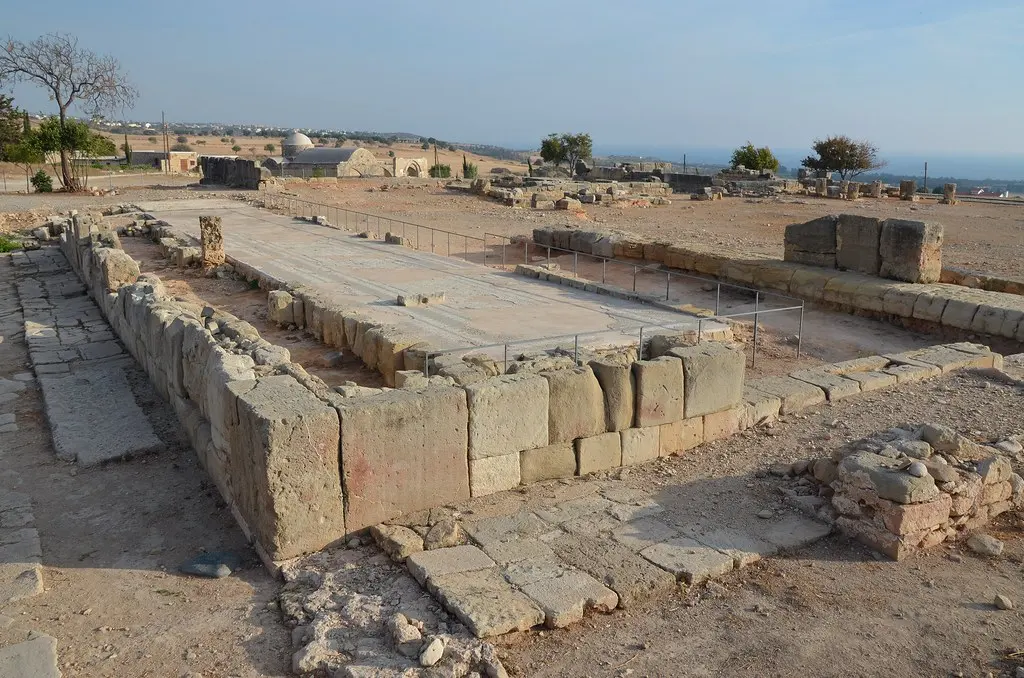
The ruins of the sanctuary area, adjacent to the museum, offer the most visible encounter with the ancient city. Foundation walls and partial reconstructions outline the sanctuary complex. The open quality of the ruins, exposed to sky and wind, accidentally preserves something of the original worship, which was itself open-air.
Interpretive panels provide historical context, but the experience is most powerful when the visitor simply stands among the stones and considers scale: this modest collection of remains was once the most important Aphrodite sanctuary in the Mediterranean world.
For visitors who wish to understand the full sacred geography, the drive to Petra tou Romiou completes the picture. Standing at the rock where Aphrodite was born, then driving inland to the sanctuary where she was worshipped, reenacts in compressed form the annual pilgrimage that connected coast and sanctuary. The landscape between the two points, coastal cliffs giving way to rolling agricultural country, is the landscape through which the ancient processions moved.
Start at the Kouklia Archaeological Museum. Allow one to two hours for the museum and ruins. A car is recommended for the 16 km drive from Paphos. Combining the visit with Petra tou Romiou (12 km east) creates a half-day experience that follows the ancient mythological geography from coast to sanctuary.
Context and lineage
Three origin stories converge at Palaepaphos. The first is cosmological: Aphrodite was born from the sea near Paphos, and the city was built to honor her at the place closest to her emergence. The second is dynastic: King Kinyras founded both the city and the cult, establishing the Kinyrades dynasty that would serve as priest-kings for centuries.
The third is Homeric: Agapenor, king of Tegea, was shipwrecked on Cyprus after the Trojan War and founded the city, connecting Palaepaphos to the epic tradition.
Beneath these mythological layers lies the archaeological evidence of a Late Bronze Age settlement that predates the Greek stories. The city's origins may reach back to the 14th century BCE, with the Mycenaean establishment around 1200 BCE representing not a founding but a cultural transformation of an existing settlement.
Palaepaphos's lineage is multiply layered: Late Bronze Age Cypriot, Mycenaean Greek, Phoenician, Ptolemaic, and Roman. Each culture contributed to the city's sacred character without erasing what came before. The result is a palimpsest of sacred civilization, a site where the worship of love and beauty persisted across cultural transformations that would have been unimaginable to any single generation of its inhabitants.
Kinyras
Legendary founder of Paphos and the Kinyrades dynasty. First priest-king, uniting political and religious authority in a single person and institution.
The Kinyrades Dynasty
Hereditary priest-kings who governed Palaepaphos and maintained the Aphrodite cult for centuries. Their dual authority as political rulers and high priests made Palaepaphos a theocratic city.
Tacitus
Roman historian whose 1st-century CE account provides the most detailed ancient description of the sanctuary and its unique worship practices.
University of Zurich Archaeological Expedition
Leading ongoing excavations since 2006, including the identification of a royal palace in 2016 that confirmed the city's political significance.
Traditions and practice
Sacred practice at Palaepaphos was not confined to the sanctuary. Ritual altars distributed throughout the city suggest that offerings, sacrifices, and libations were part of the fabric of daily life. The annual Aphrodisia festival, with its procession from Nea Paphos, was the great public ceremony, but the Kinyrades priest-kings performed daily rituals at the sanctuary. The production of terracotta figurines and other votive objects was a significant civic activity, connecting the economy directly to devotional practice.
Trade embassies from Egypt, the Levant, and the Aegean came in part because of the sanctuary's prestige, making international commerce an extension of religious significance.
The site is managed by the Cyprus Department of Antiquities as part of the Paphos UNESCO World Heritage property. The Kouklia Archaeological Museum provides interpretive context. Ongoing excavations by the University of Zurich and other institutions continue to reveal new aspects of the ancient city. Cultural tourism brings visitors from around the world. The village of Kouklia itself continues to exist on the ancient foundations, a living settlement on sacred ground.
Walk through the ruins with awareness of what lies beneath your feet: a city organized around devotion. The visible remains are only a fraction of what exists. Notice the open quality of the site, the sky above the ruins, the agricultural land surrounding them. Consider that the farmers' fields may cover royal palaces and ritual spaces. In the museum, spend time with the votive figurines.
These small, often humble objects were the offerings of ordinary people to the goddess of love. They carry the devotional intentions of individuals, named and unnamed, across three thousand years. If you visit Petra tou Romiou, allow the drive inland to serve as a compressed pilgrimage: from the place of birth to the place of worship, across a landscape that the ancients understood as Aphrodite's own.
Aphrodite Cult and Sacral Kingship
HistoricalPalaepaphos was unique in the ancient Greek world for combining religious and political authority in the Kinyrades dynasty of priest-kings. The city grew around the Aphrodite sanctuary, making it a theocratic civilization organized around the worship of love and beauty. Ritual altars throughout the city testify to the pervasiveness of sacred practice in daily life.
Sacral kingship uniting political rule and priestly function. Sacrifices and libations at altars throughout the city. Annual Aphrodisia festival with procession from Nea Paphos. Production of votive terracotta figurines. International trade facilitated by the sanctuary's prestige.
Aphrodite's Sacred Geography
HistoricalThe mythological landscape of Aphrodite's birth at the sea and worship inland created a sacred geography that connected the coast to the sanctuary. The annual Aphrodisia festival's procession from Nea Paphos to Palaepaphos traversed this landscape, reenacting the goddess's journey and binding the geography to the divine narrative.
Pilgrimage from the coast to the inland sanctuary. Annual Aphrodisia procession. Ritual connections between Petra tou Romiou (the birthplace) and the sanctuary (the place of worship). Libations at coastal sites associated with the birth myth.
Archaeological Research and Conservation
ActiveOngoing excavations since the 1880s have progressively revealed the extent of Palaepaphos. The 2016 discovery of a royal palace marked a significant advance. The site's inclusion in the Paphos UNESCO World Heritage Site (1980) ensures international protection. The University of Zurich leads current excavation work.
Systematic excavation and documentation. Museum curation at the Kouklia Archaeological Museum. Conservation of structural remains. UNESCO heritage management. Publication of findings in peer-reviewed literature.
Perspectives and open questions
Palaepaphos invites reflection on what it means for an entire civilization to be organized around the worship of love. The fusion of sacred and political authority, the distribution of ritual throughout urban life, and the mythological geography connecting sea and sanctuary all offer perspectives unavailable at more conventional archaeological sites.
Scholarly perspective
Archaeologists confirm Palaepaphos as a major Late Bronze Age and Iron Age city that served as the political and religious capital of the Paphos kingdom. The 2016 identification of a royal palace strengthened understanding of the city's political dimension. The relationship between the local Cypriot Bronze Age cult and the later Greek Aphrodite cult is understood as a process of cultural assimilation. Ongoing excavations continue to refine the chronology and character of the site.
Much of the ancient city remains unexcavated, suggesting that significant discoveries are still possible.
Living and traditional perspectives
The ancient literary tradition treats Palaepaphos as inseparable from Aphrodite. Homer calls the goddess Kypris, the Cypriot, and refers to her fragrant altar at Paphos. Tacitus describes the sanctuary's unique worship. The city's mythological geography, connecting the goddess's birth at the sea to her worship inland, created a narrative that made every visit to Paphos a participation in Aphrodite's story.
Alternative interpretations
Modern goddess spirituality movements identify Palaepaphos as a key site in a network of feminine sacred places. The sacral kingship of the Kinyrades has been interpreted through the lens of sacred marriage traditions. The site's connection to Aphrodite's birth from the sea has been adopted by various neo-pagan and New Age frameworks. These interpretations extend the site's ancient significance through contemporary spiritual concerns.
Open questions
The full extent of the ancient city, much of which lies beneath Kouklia village and agricultural land, remains unknown. The 2016 royal palace discovery suggests significant structures await excavation. How the pre-Greek Cypriot cult transitioned into the Greek Aphrodite cult in detail is still being studied. The complete network of ritual altars throughout the city and their specific functions have not been fully mapped.
Plan your visit
Access and arrival
Paphos city (16 km) offers full accommodations. Kouklia village has limited options. The site is a short drive from Paphos hotels. Mobile phone signal is reliable. Basic visitor facilities at the museum. No food service at the site; Kouklia village has a few local restaurants.
Respectful visit
No specific dress code. Comfortable walking shoes and sun protection recommended.
Photography is permitted at the ruins. Museum photography policies may vary; check at entrance.
Do not leave offerings or objects at the archaeological site.
Do not climb on ancient structures | Do not remove any objects from the site | Stay on designated paths | Do not enter fenced excavation areas | Respect the village of Kouklia as a living community | UNESCO World Heritage property protected by law
Do not climb on or touch ancient structures. Do not remove any objects. Stay on designated paths. Do not enter fenced excavation areas. The site is a UNESCO World Heritage property.
Current practical details
Address
Γρίβα Διγενή 1, Kouklia 8500, Cyprus
Phone
Hours
Hours, fees, and access can change — verify on the official source before you travel. Practical details last checked Jun 2026.
Location
Map loads as you approach this section.
Pilgrim reflections
A portrait of encounter, not a score
Pilgrims describe what they felt, how present they could become, and whether the place would shape a journey. There are no stars and no ranking of traditions.
No reviewed reflections yet
The first pilgrims can help describe the character of being here.
Share a reflection
Available after an account-backed “Been there.” Every reflection is reviewed before publication.
Nearby sacred places
Explore other sacred places in the region. Proximity does not establish access or travel time; check each place’s guidance.


Share a photo
Help visitors recognize Archaeological Site of Palaepaphos. Every submission is reviewed before publication.